England · Ruin
Basing House
Basing House was a large Tudor palace and fortified house in Old Basing, Hampshire, built from 1531 for William Paulet and greatly expanded in the 16th century. It comprised two linked houses (an Old House within earthwork defences and a much larger New House outside them) and was destroyed by fire after a Parliamentary assault in 1645; only lower-ground brickwork, cellars, foundations and earthworks survive today.
First raised
1531
Its prime
1603
Today
Ruin
As it stood in 1603
What Basing House looked like in its prime.
A vast, two-part red-brick Tudor complex: an Old House set inside a broad earthen ringwork with a brick curtain retaining wall and arched basement openings, and a larger New House outside the defences connected by a bridge and gateway. Extensive low-lying ranges of brick with many windows, steep tiled gabled roofs and clusters of tall chimneys rose above the grassy ramparts beside the River Loddon, set within parkland and formal service yards.
Its story
The story of Basing House.
A New Palace for the Lord Treasurer, 1531
Basing House was built from 1531 as a new palace for William Paulet, 1st Marquess of Winchester, treasurer in turn to Edward VI, Mary I and Elizabeth I. The Great Barn nearby was finished in 1534, just before a visit from Henry VIII and Anne Boleyn. In its final form the place was two linked houses. The Old House replaced the keep of an older ringwork castle and so stood inside a defensive ring of earthworks and walls; the slightly later New House stood outside them, its annexe alone running to some 360 rooms, built largely to lodge the crowds who travelled with a visiting monarch. A bridge and gateway carried the link between the two across and through the defences, a connection that would prove fatal in the last fight for the house.
Royal Guests, 1552-1603
Edward VI arrived on 7 September 1552 and rode on to Donnington Castle after three days. Elizabeth I came in August 1560 and liked the house and its entertainment so well that she said she would have married Lord Treasurer Paulet had he been a younger man; she returned in August 1569. In September 1601 she entertained the French ambassador, the Duke de Biron, at the Marquess of Winchester's expense, hunted in the park with visiting French noblemen, killed 20 deer and knighted 11 men. James I visited in August 1603, and Anne of Denmark stayed that September, when there was dancing and the elderly Earl of Nottingham was betrothed to the much younger Margaret Stewart.
Boarded Windows in the 1630s
The 4th Marquess's entertainments almost bankrupted the family and maintenance fell behind. After a century, a brick complex on this scale, and a somewhat experimental one, had trouble with dry and wet rot, broken windows, leaking roofs and keeping its various wings heated. On taking the title in February 1629 the 5th Marquess downsized: the family moved out to its other houses and the windows were boarded over through the first half of the 1630s, until returns from his estates across England allowed restoration to begin.
Three Sieges and the Storming of 14 October 1645
John Paulet, the 5th Marquess, stood with Charles I when war broke out in 1642, and parliamentary forces invested Basing House on three occasions; the Royalists broke the first two. The last siege began in August 1645, when Colonel John Dalbier took up position around the walls with 800 troops. The garrison held out as the attacking force was reinforced again and again, until Oliver Cromwell arrived with a heavy siege-train.
By 14 October 1645 the New House had been taken and the defences of the Old House breached, and the final storming went in across the link between the two. From the first firing of the guns the assault was over in forty-five minutes; the fires it started burned for as much as nine hours. Many valuable goods were carried off, and the fire killed several priests who had taken refuge in the cellar.
Carried Off Brick by Brick
Cromwell returned to London, and Parliament decreed that anyone might take what they wished from the estate, a message aimed at other Royalist supporters. Local villagers were encouraged to remove the bricks of Basing House, and the materials went into homes across the surrounding area. Using the local populace to pull a building down happened from time to time; inviting them to keep what they carried away was unusual, and the archaeological evidence is that the salvage was sorted into types for systematic reclaim rather than left a free-for-all.
John Paulet's estates were confiscated and he was sent to the Tower of London on a charge of high treason that was later dropped; Charles II returned the site to him. His son Charles Paulet, 1st Duke of Bolton, grew wealthy again through his support for William of Orange during the Glorious Revolution, and spent that wealth demolishing what was left of Basing House and building at nearby Hackwood the seat that served the Marquesses of Winchester, later also Dukes of Bolton, until 1794.
Step inside
10 places to explore in 1603.
The record describes 10 distinct spots at Basing House, including 4 interiors: wine cellar and vaulted storage, service wing with bread ovens, side rooms with salt alcoves and vaulted roofs and more. Create your own photoreal reconstruction and explore every one, more scenes means more rooms, more angles, and more of the place to stand in.
Build Your Own Castle
Recreate Basing House with AI to explore it.
The artist rebuilds it as it stood in 1603, a photoreal reconstruction that belongs to you alone. Pay with coins, no subscription needed.
Recreate this castle →Defend this castle →Whose castle
Clans who held Basing House.
The families that held Basing House for a decade or more across its history, follow a name to its clan.
Paulet
Built from 1531 for William Paulet; seat of the Paulet Marquesses of Winchester until its destruction in 1645.
From the archive
Basing House on paper: the measured plan and period views.
The survey plan and photographs below are the ground truth this page's reconstructions are checked against, drawn and photographed while the castle was still a working garrison. Every image is public-domain or openly licensed, with its source named.
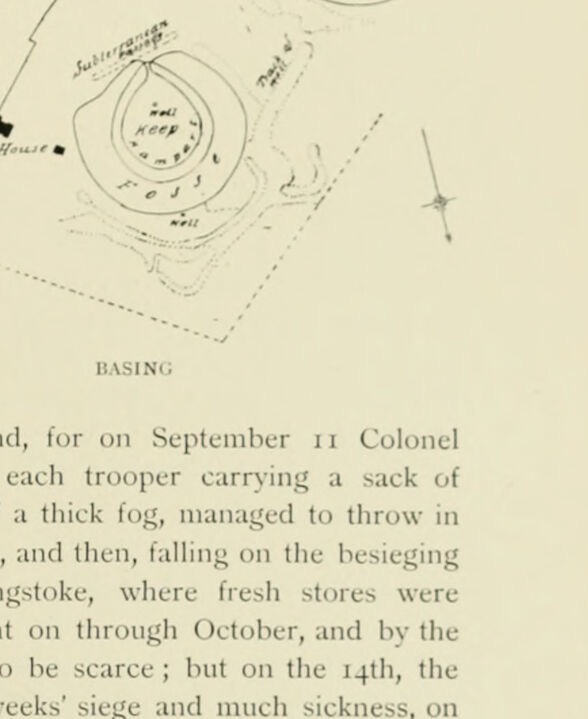
BASING
1897 · J. D. Mackenzie, The Castles of England, vol. 1 (1897)
Public domain
Nearby