
Ireland · Restored
Knappogue Castle
Caisleán na Cnapóige
Knappogue Castle is a 15th-century Irish tower house founded in 1467, later expanded in the mid-19th century with a west wing, clock tower and gateway. It was restored in the 20th century and today functions as a cultural venue offering guided tours, weddings and medieval banquets.
Its prime
1860
Today
Restored
As it stood in 1860
What Knappogue Castle looked like in its prime.
A tall rectangular 15th-century tower house of pale local limestone attached to a mid-19th-century west wing; the later work includes a square clock tower and an arched entrance gateway. The structure rises several storeys with comparatively small window openings in the medieval tower and larger windows in the Victorian addition. Rooflines combine the medieval tower top with pitched roofs on the wing. The castle stands within a planted demesne with a walled formal garden.
Its story
The story of Knappogue Castle.
Seán Mac Conmara's Tower House, 1467–1571
The tower house was built in 1467 by Seán Mac Conmara, anglicised MacNamara, son of Síoda Mac Conmara, in the parish of Quin, County Clare, and is a good example of the late medieval type. Its Irish name, Caisleán na Cnapóige, translates as "castle of the place abounding in little hills". In 1571 it became the seat of the MacNamara sept, the Earls of West Clancullen.
Rebellion, Confiscation and Return, 1641–1661
Donnchadh Mac Conmara was a leader of the Irish Rebellion of 1641, and Knappogue remained in MacNamara hands throughout the Irish Confederate Wars of the 1640s. After the Cromwellian conquest of Ireland of 1649–53 the castle was confiscated in accord with the Adventurers' Act, and its new owner was a roundhead, Arthur Smith, who occupied it from 1659 to 1661. After the monarchy was restored in 1660, Knappogue was returned to its MacNamara owners.
The Scotts and the Barons Dunboyne, from 1800
Francis MacNamara, High Sheriff of Clare in 1789, sold the castle in 1800 to the Scott family of Cahircon, who carried out major restoration and extension work; William Scott owned it in 1837. In 1855 it was acquired by Theobold Fitzwalter Butler, 14th Baron Dunboyne, and became the family seat of the Dunboynes. They continued the Scotts' work, adding a drawing-room, the long room and a west wing that took in the clock tower and the gateway, the remodelling handled by the architects James Pain and his brother George Richard Pain.
Clare County Council and the East Clare Brigade, 1919–1921
During the War of Independence of 1919–21, Clare County Council held its meetings at Knappogue, guarded by the East Clare Flying Column. Michael Brennan, commander of the East Clare Brigade, used the castle as his headquarters over the same period.
Land Commission, Texas and Shannon Development, since 1927
In 1927 the Knappogue demesne was purchased by the Irish Land Commission and the castle became the possession of the Quinn family. In 1966 castle and lands were bought by Mark Edwin Andrews, a former Assistant Secretary of the United States Navy from Houston, Texas. With his wife Lavonne, an American architect, and in collaboration with the then Shannon Free Airport Development Company and Bord Fáilte Éireann, he carried out an extensive restoration around 1969, intended to accommodate use of the castle as restaurant and private residence.
That work returned much of the building to its former 15th-century state while retaining the later additions that chronicle its continuous occupation. The Andrews afterwards leased part of the castle to the Irish Government as a cultural and tourist facility for a nominal rent, and Shannon Development purchased it in 1996. The walled garden, which dates from 1817, has been restored to its former state. The castle offers guided tours and serves as a venue for weddings and medieval banquets.
Step inside
8 places to explore in 1860.
The record describes 8 distinct spots at Knappogue Castle, including 3 interiors: drawing-room (west wing), the long room, medieval tower interior. Create your own photoreal reconstruction and explore every one, more scenes means more rooms, more angles, and more of the place to stand in.
Build Your Own Castle
Recreate Knappogue Castle with AI to explore it.
The artist rebuilds it as it stood in 1860, a photoreal reconstruction that belongs to you alone. Pay with coins, no subscription needed.
Recreate this castle →Defend this castle →Whose castle
Clans who held Knappogue Castle.
The families that held Knappogue Castle for a decade or more across its history, follow a name to its clan.
MacNamara
Seat of the MacNamara sept, Earls of West Clancullen, from 1571; Francis MacNamara sold the castle in 1800.
The Scott family of Cahircon bought Knappogue in 1800 and carried out major restoration and extension.
Acquired in 1855 by Theobold Fitzwalter Butler, 14th Baron Dunboyne; the seat of the Dunboyne family.
The castle became the possession of the Quinn family in 1927, after the Irish Land Commission purchased the demesne.
From the archive
Knappogue Castle on paper: the measured plan and period views.
The survey plan and photographs below are the ground truth this page's reconstructions are checked against, drawn and photographed while the castle was still a working garrison. Every image is public-domain or openly licensed, with its source named.
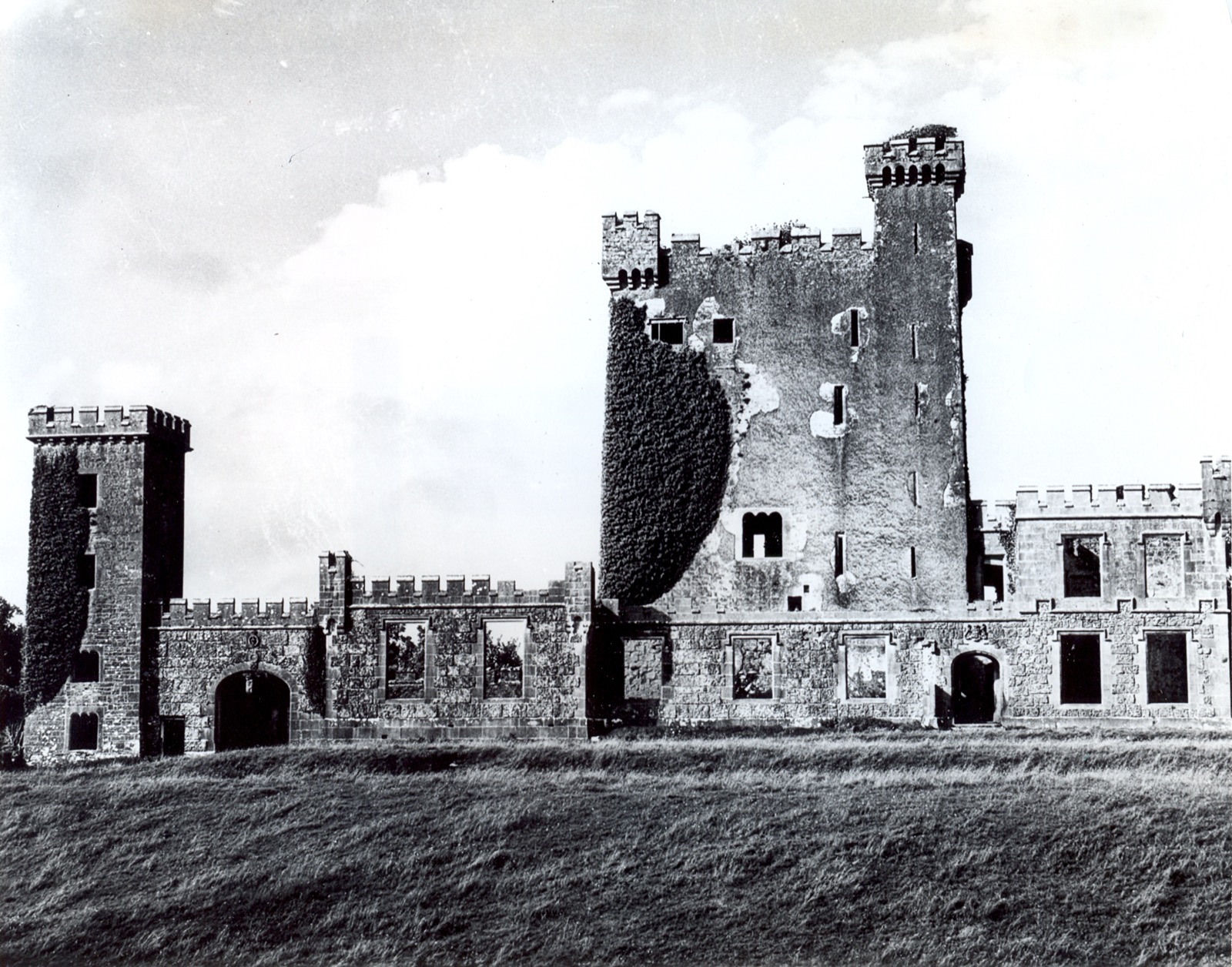
Knappogue Castle
· European Heritage Awards Archive (via Europeana)
Public domain


