Quinn
also Ó Coinn, O'Quinn
Of Conn the Hundred-Battler, three distinct lordships, one Anglicised name.
- Origin
- Ulster, Ireland
- Motto
- Quae sursum volo videre
- Famous bearer
- Anthony Quinn (1915–2001), actor, Zorba the Greek
- Register
- Irish family
Where the Quinn name comes from
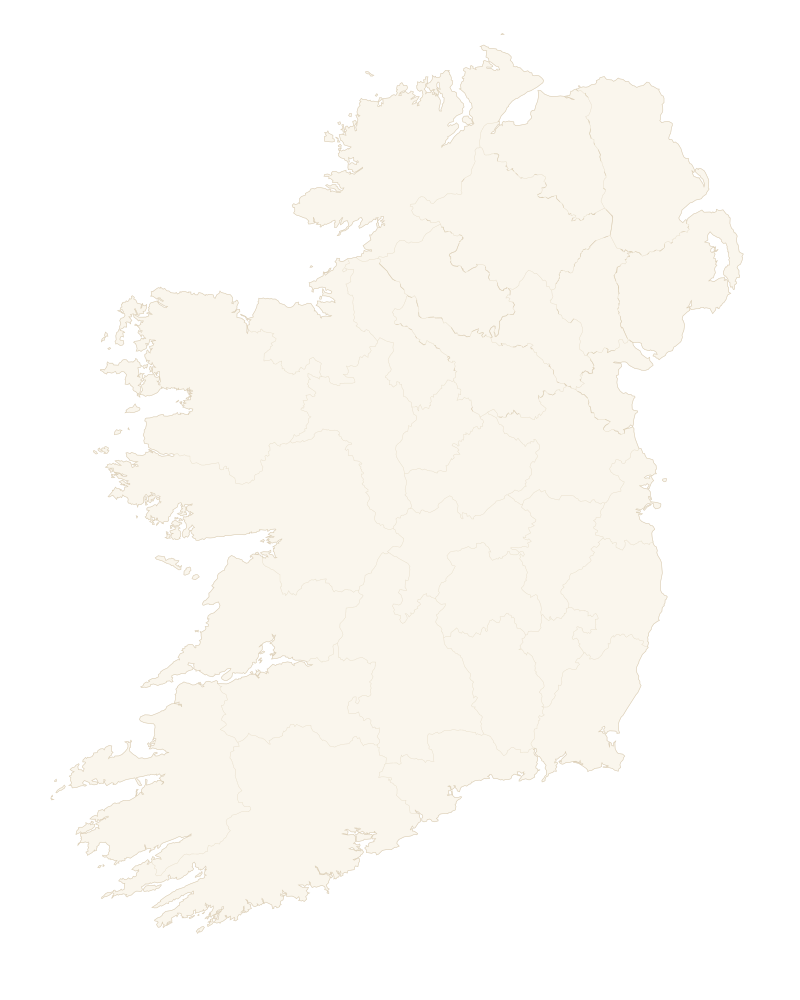
CoreHistoric reach
The seat of Quinn
Seat vacantChief
No one leads the Quinn community yet. When the movement opens, you can stand for its leadership, or help elect whoever does.
Current mission
No shared goal set yet. Once Quinn has leadership, it sets the public focus: a restoration, a gathering, a real-world project that helps its own.
The Quinn clan is being rebuilt. Join the waiting list for the movement today, and you help decide who leads it and what it does.
Help rebuild the Quinn clan →Motto
Quae sursum volo videre
“I wish to see heavenly things”
What does the Quinn name mean?
From Ó Coinn, descendant of Conn. Conn is among the great Old Irish personal names, born by Conn Cétchathach, Conn of the Hundred Battles, the legendary 2nd-century high king from whom most of the great northern Irish dynasties traced descent. Several distinct Ó Coinn kindreds gave rise to the modern Quinns: the Tyrone Quinns of the Cenél nEóghain, the Thomond Quinns of Clare (close kin of the O'Briens), and the Longford Quinns of Annaly. All Anglicised independently as Quinn by the 17th century.
The history of Quinn
Descendant of Conn, and not always the same Conn
Quinn is the English spelling of Ó Cuinn, also written Ó Coinn, and of Mac Cuinn. In Irish, Ó means descendant and Mac means son, so the name says one thing plainly: the people of Conn. Conn is among the great Old Irish personal names, carried by Conn Cétchathach, Conn of the Hundred Battles, the legendary 2nd-century high king from whom most of the northern Irish dynasties traced their descent.
Which is why there is no single Quinn family. The surname belongs to several unrelated kindreds, strongest in Ulster and found also in Clare, Longford and Mayo: the Ó Cuinn of Thomond, the Ó Cuinn of An Chraobh in County Tyrone, and others seated in Annaly, in County Antrim, at Raphoe and near Castlebar.
Clontarf, 1014, and the Clare line at Inchiquin
Ireland was among the first countries in Europe to fix hereditary surnames, and the Quinns belong to that founding generation. They came into use as the dominance of the Uí Néill collapsed: in 1002 the high kingship passed to Brian Boru, leader of the Dál gCais of Munster. The Thomond Quinns are a Dalcassian sept (Brian's own kindred, which also produced the O'Briens) and they take their name from Niall Ó Cuinn, slain at the Battle of Clontarf in 1014.
In Clare they held the lands around Lough Inchiquin near Corofin from the 12th century as the principal cadet branch of the O'Briens of Thomond, and supplied the earldom's cadet line into the early modern period. Their seat, Inchiquin Castle, is a ruin now on the lake's western shore; the senior line passed in time to the Earls of Dunraven.
Hereditary quartermasters to the kings of Tír Eoghain
The Ulster Quinns were seated at An Chraobh in County Tyrone, close to the O'Neills, kings of Tír Eoghain and chiefly family of the Cineál Eoghain of the northern Uí Néill. Their standing was no courtesy: they served as the O'Neills' hereditary quartermasters, an office handed down the family the way land was. In a Gaelic lordship that was the machinery of power: a chief was elected by his kinsmen, held the clan's property in custody rather than as possession, and ruled through kindreds who owed him named duties.
A third distinct family sat in Annaly, tied to the O'Farrell lords of Longford, and C. Thomas Cairney's tribal scheme independently lists the O'Quins among the chiefly families of the Conmaicne Rein beside the O'Farrells. By 1890 the name was numerous in Dublin and in counties Tyrone, Antrim and Roscommon, a spread no one lordship can account for.
What the old pedigrees can and cannot carry
From the 8th century Irish scholars compiled genealogies for these kindreds: Rawlinson B 502, the Book of Ballymote, the Leabhar Mór na nGenealach of Dubhaltach MacFhirbisigh. They are not a family tree for everyone named Quinn: they record the agnatic descent of chiefs, not of every member of the clan. At least one genetic study finds them fairly accurate back into the Middle Ages but unreliable before the 7th century, which puts descent from Conn of the Hundred Battles on the tradition's side of that line, not history's.
The older tribal schemes are shakier again: Cairney, following T. F. O'Rahilly, lists the O'Quins twice over, under the Conmaicne Rein and under the Dál gCais, and O'Rahilly's scheme was itself drawn from the 11th-century Lebor Gabála Érenn and rejected outright by Francis John Byrne. Nor was a clan ever only a bloodline. It took in the chief's unrelated clients, who assumed the leading lineage's name in allegiance and whose sons carried it after them, so to be a Quinn was to belong to that world as much as to descend from any one man in it.
How Ó Cuinn became Quinn
Anglicising a Gaelic surname went one of two ways: keep the prefix and respell it, so that Ó becomes O' and the name reads O'Quinn, or drop it altogether. Each Ó Cuinn kindred did this separately, and by the 17th century all had landed on the same English spelling, which is why Quinns from Clare, Tyrone and Longford share a surname without sharing an ancestor. The doubled n carries information too: Quinn is usually the Catholic spelling, Quin the Protestant.
The Irish form still bends where the English has gone rigid. A man is Ó Cuinn; his daughter is Ní Chuinn, from Iníon Uí, the descendant's daughter; a wife may take Bean Uí Chuinn. And if the family story holds that the name was changed at Ellis Island, it was not: no name was ever legally changed there, and emigrants who altered a spelling did it themselves.
The lordships end, and a castle comes back
The Gaelic world these septs belonged to was taken apart in little over a century. English common law, counties and sheriffs replaced the country and the clan chief, and surrender and regrant traded tanistry for primogeniture. When the Kingdom of Ireland was created in 1541, Dublin drew the chiefs in with new titles and, in 1552, new arms, among them Baron Inchiquin, a peerage named for the lakeside lordship the Ó Cuinn had held since the 12th century.
The early 17th century closed the book. The Tudor reconquest destroyed the ancient Gaelic aristocracy, in 1607 the senior chiefs of Ulster left for Spain and died in Rome, and the Plantation of Ulster followed onto the ground the Tyrone Quinns had served. From before the fall one exact thing survives: Tadhg Ó Cuinn, at work in October 1415, an Irish scribe writing under the name in its own language. The name came back to a castle within living memory: Knappogue in County Clare, a tower house of 1467, became the possession of the Quinn family in 1927, after the Irish Land Commission purchased the demesne.
Quinns of the wider world
Quinn is one of the twenty most common surnames in Ireland. Edel Quinn, born in 1907 to a Cork bank cashier's family, entered the Legion of Mary despite a tuberculosis diagnosis that gave her months, went out as its envoy to East and Central Africa in 1936, and founded over six hundred local praesidia before her death in 1944. John Paul II declared her Venerable.
Anthony Quinn (1915–2001) came of a County Cork Quinn line that emigrated to Mexico in the mid-19th century, won two Academy Awards in the 1950s and is remembered above all for Zorba the Greek in 1964. Aidan Quinn (born 1959) was born in Chicago to a Tyrone Quinn who emigrated in the 1950s. Pat Quinn (1948–2014) was Governor of Illinois, Felix Patrick Quinn (1874–1961) a Canadian industrialist and politician, Roderic Quinn (1867–1949) an Australian poet.
None of them descend from one another, and that is the truth worth carrying: Quinn is not one family that grew but several Irish kindreds who arrived independently at the same spelling, and then went out across the world under it.
Champions of the Quinn name
The bearers whose lives are inseparable from this surname. Each has their own page, biography, achievements, geography, connection to the family.
Historic Places, Rebuilt
Explore the streets and seats the Quinn name knew, rebuilt with AI as they stood in history.
Historic Places, Rebuilt · New
The MacDonnell stronghold on its Antrim sea-stack, whole and inhabited, Clan Donald astride the North Channel.
Historic Places, Rebuilt · New
The O'Brien Earls of Thomond's great four-towered tower-house, hung with banners and famed for its feasts.
Castles the Quinn held
Strongholds this name held for a decade or more, look one up, or rebuild it to explore.
- Knappogue Castle
The castle became the possession of the Quinn family in 1927, after the Irish Land Commission purchased the demesne.
The castles of the homeland
The great strongholds of the homeland, look one up, see what it looked like in its prime, and recreate it to explore.
 Ashford Castle, County MayoRestored · prime 1880
 Manderley CastleRestored · prime 1840
 Dublin CastleRestored · prime 1790
All castles in Ireland → · Strongest castles in Ireland → · Castles of Europe
Play As Your Clan
Hold a real castle against whatever you choose to send at it, take a ship out in her own service years, or stand at the shoulder of someone the record remembers. The chronicler sets the scene; the deeds are yours.
Notable bearers of the Quinn name
- Anthony Quinn (1915–2001), actor, Zorba the Greek
- Aidan Quinn (b. 1959), actor
- Niall Quinn (b. 1966), Irish footballer
- Pat Quinn (1948–2014), Governor of Illinois