Kennedy
also O'Kennedy, Ó Cinnéide
Of Ormond and the Dál Cais, Brian Boru's nephews.
- Origin
- Munster, Ireland
- Motto
- Avise la fin
- Famous bearer
- John F. Kennedy (1917–1963), 35th President of the United States
- Register
- Irish family
Ranked of all time
The 10 Most Powerful Irish Clans of All Time
Ranked of all time
The 10 Oldest Clans in Ireland
Where the Kennedy name comes from
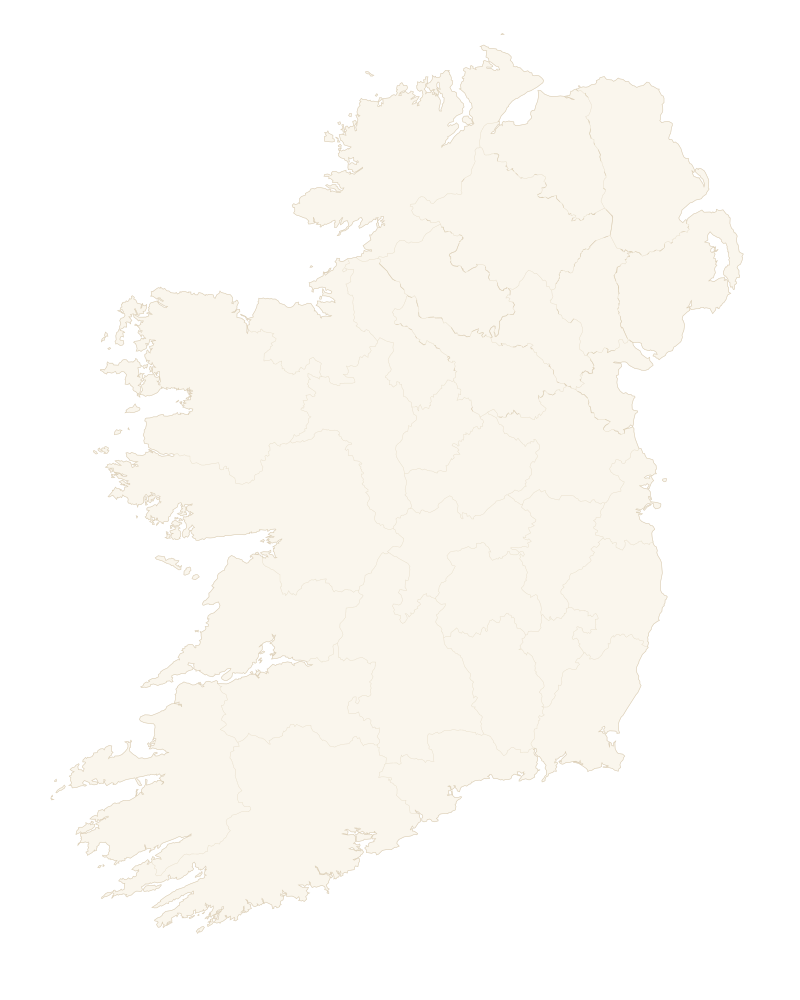
CoreHistoric reach
The seat of Kennedy
Seat vacantChief
No one leads the Kennedy community yet. When the movement opens, you can stand for its leadership, or help elect whoever does.
Current mission
No shared goal set yet. Once Kennedy has leadership, it sets the public focus: a restoration, a gathering, a real-world project that helps its own.
The Kennedy clan is being rebuilt. Join the waiting list for the movement today, and you help decide who leads it and what it does.
Help rebuild the Kennedy clan →Motto
Avise la fin
“Consider the end”
What does the Kennedy name mean?
From Ó Cinnéide, descendant of Cinnéide. The name Cinnéide is Old Irish for 'helmet-headed' (cenn, head + éide, armour). The eponymous Cinnéide was Cinnéide mac Lorcain (d. 951), king of Thomond and uncle to Brian Boru, making the Kennedys collateral kin of the O'Briens and descendants of the same Dál Cais line. The northern Scottish Kennedys (Kennedys of Cassillis in Ayrshire) are an entirely separate origin and unrelated.
The history of Kennedy
Helmet-headed: the name the Dalcassians carried
In Irish the name is Ó Cinnéide, descendant of Cinnéide, and the personal name behind it is built from cenn, a head, and éide, armour: helmet-headed. That is the reading the catalogue holds, but not the only one. A second derives the surname from Ó Ceannéidigh, from ceann, head, and éidigh, ugly or fierce, which would make the ancestor grim-headed rather than armoured; some readings push ceann further still, to chief or leader. The sources genuinely disagree and no charter settles it. What all three share is a man remembered for his head (helmeted, fierce, or commanding) and a family content to be known by him for the next thousand years.
The eponym is Cinnéide mac Lorcáin, who died in 951 and was king of Thomond. His exact relationship to Brian Boru is one of the places the sources part company. The catalogue record has him as Brian's uncle, which makes the Kennedys collateral kin of the O'Briens out of the same Dál gCais stock; the surname literature identifies Cennétig mac Lorcáin as the father of the high king Brian mac Cennétig, better known as Brian Bóruma. Both readings put the family inside the same royal kindred, within one degree of the most famous king Gaelic Ireland produced; they differ only on which branch the surname froze onto. A reader who wants certainty here should be suspicious of anyone offering it.
The date that matters is 1002, when the Uí Néill lost the high kingship of Ireland to Brian, leader of the Dál gCais or Dalcassians. It was during that century of collapsing Uí Néill dominance that hereditary surnames began to be used in Ireland at all, which made the Irish among the first people in Europe to carry them. From the Dál gCais came O'Brien and Kennedy, along with the MacNamaras, MacMahons, O'Gradys, O'Hickeys, O'Mearas and a dozen more chiefly names of Thomond. A Kennedy today is not carrying a late medieval label: the name was fixed while most of the continent still did without.
Lords of Ormond, east of the Shannon
After the Ó Briain themselves, the Ó Cinnéide were the second great family of the Dál gCais, and their country was Ormond, the land east of the Shannon in what is now north Tipperary. They held the lordship of it outright until the Norman invasion of the late twelfth century. Ormond was a kingdom in the Gaelic sense: a chief with the status of royalty, a patrilineal kindred around him, clients bound to him, and a stretch of river country that fed the arrangement.
The Normans took the name and left the family the land, for a while. The Butlers became earls of Ormond, a Norman title stamped over a Gaelic country, and across the thirteenth century they pushed the Ó Cinnéide steadily south and east out of the best of it. The Kennedys were not extinguished, they were displaced, and the name of their kingdom outlived their possession of it. Anyone reading about the Butler earls of Ormond is reading about land the Kennedys held first.
They did not vanish into tenantry. The family re-established itself in the Kilkenny and Tipperary borderland and remained a substantial gentry family there through the seventeenth century: landholders, not labourers, for four hundred years after the displacement. The site's territorial tiles trace that arc: Tipperary and Clare as the core, Limerick, Kerry and Kilkenny as historic ground, a Dalcassian family working outward from the Shannon and then downriver into Leinster.
Grey, Brown and Red: three Kennedy clans in one kingdom
By the late medieval period the Kingdom of Ormond was ruled not by one Kennedy clan but by three, and they were told apart by colour: the Ó Cinnéide Fionn were the Grey Kennedys, the Ó Cinnéide Donn the Brown, and the Ó Cinnéide Ruadh the Red. This is ordinary Irish practice, not heraldry: fionn is fair, donn brown, ruadh red, and the same adjectives separated men everywhere in Gaelic Ireland. Applied to whole branches of a ruling family, the colours did the work a surname could no longer do, because by then every one of them was a Kennedy.
The Grey Kennedys are the branch most readers will care about, because of where their line ended up. The genealogist Brian Kennedy, in JFK's Irish O'Kennedy Ancestors, traces the American family to the Ó Cinnéide Fionn and gives their progenitor as Diarmaid Ó Cinnéide Fionn, who in 1546 became owner of Knigh Castle, close to what is today Puckane in County Tipperary: the last high-water mark of the line, a castle held in the family's own name in the family's own country.
What came next was not a battle but an administrative dismantling. In 1541 the Kingdom of Ireland was created and Dublin set about drawing the Gaelic chiefs inside it, inventing titles for them and granting new coats of arms in 1552. The associated policy of surrender and regrant replaced tanistry (under which a chief was elected by his kinsmen from the eligible male cousins) with European primogeniture, and the county and the sheriff took the place of the country and the chief. The early seventeenth century finished it: the Tudor re-conquest destroyed the old Gaelic aristocracy, the senior northern chiefs left in 1607 in the Flight of the Earls, and Dublin disarmed the native lordships for the first time.
For the Grey Kennedys the reckoning came later and quietly. In 1740, having lost out to the new Anglo-Irish order, they left north Tipperary for Dunganstown, near New Ross in County Wexford. Set the addresses side by side and the fall is plain: a castle at Knigh in 1546, a small farm in Wexford in 1740. It is also the step that put the family within reach of a Famine emigrant quay, which is why the name is now better known in Massachusetts than in Ormond.
Carrick's grim-headed men: the Scottish clan
There is a second Kennedy country, and a reader tracing the surname needs to know it exists. Clan Kennedy is a Scottish Lowland clan seated in Carrick, in Ayrshire, and both the clan literature and the surname literature state flatly that the Irish Kennedy family and the Scottish Kennedys of Carrick are unrelated. Two separate peoples arrived at the same spelling. If your line comes out of Ayrshire, Galloway or Wigtownshire rather than Tipperary or Wexford, everything above belongs to somebody else's family and everything below belongs to yours.
The Scottish origin story is traditional rather than documentary. It holds that the Votadini were a tribe in Lothian, that their chief Cunedda was sent by the British leader Vortigern to plant settlements in the south-west of Scotland against Picto-Scottish sea raids, and that Cunedda is rendered in the Celtic form as Cinneidgh, meaning ugly or grim-headed, which became attached to the district of Carrick. That is a legend of origin, not a charter, and it arrives at almost the same meaning as the Irish etymology by an entirely different route, a reminder of how easily two unrelated names converge.
Charter evidence begins in the twelfth century. Early in the reign of William the Lion, Gilbert Mac Kenedi witnessed a charter to Melrose Abbey granting lands in Carrick; in the reign of Alexander II, Gillespie Kennedy is named in charters as senechal of Carrick. By the thirteenth century Kennedys are the administrative family of the district, the men who run it on the ground and whose names the abbeys need on their deeds.
The Wars of Scottish Independence made them more. Kennedys supported Robert the Bruce, and the Carrick inheritance came into the family through the marriage of Sir John Kennedy of Dunure to Mary de Carrick, who descended from Sir Gilbert de Carrick. Dunure on the Ayrshire coast, granted in 1357, is the point of origin of the Kennedys of Carrick. In 1372 Robert II rewarded John Kennedy of Dunure as chief of his name and baillie of Carrick: the two things a Scottish family needed in writing, headship of the surname and the king's authority over the district, in a single act.
Cassillis, Culzean and the Kings of Carrick
About 1457 Gilbert Kennedy, a son of Mary Stewart and grandson of Robert III, was created Lord Kennedy and served as a regent to the infant James III. His brother James Kennedy was one of the most respected churchmen Scotland produced: Bishop of Dunkeld, later Archbishop of St Andrews, briefly High Chancellor, and founder in 1450 of St Salvator's College, which makes him one of the founders of the University of St Andrews. A kinsman, Hugh Kennedy of Ardstinchar, went to France with the Great Army of Scotland during the Hundred Years' War, fought at Baugé and served with Joan of Arc at the Siege of Orléans. Joan figures on the arms of the Kennedys of Bargany because of him.
In 1509 David Kennedy, 3rd Lord Kennedy, was created Earl of Cassillis; he was killed at Flodden in 1513. The second Earl was murdered in 1527. The third Earl, Gilbert, inherited at twelve, and one of his first acts was to sign the death warrant of Patrick Hamilton, the first Scottish Protestant martyr; he died in 1558, one of four Scottish commissioners poisoned on their journey home from the marriage of Mary, Queen of Scots to the Dauphin of France. Three earls in fifty years, three violent ends. The catalogue calls them the Kings of Carrick, and the phrase is not flattery; it describes a family that held its country the way a king holds one, and paid the same price.
The castles read as a survey of the south-west. Dunure was the original seat. Loch Doon was in Kennedy hands from the fourteenth century and twice taken from them, in 1446 and 1511. Cruggleton in Wigtownshire was granted to Gilbert Kennedy by David II, and Dunskey came with the ward of Kinhilt in 1456. Dalquharran was Kennedy land from a charter record of 1474 until the estate was sold in the 1930s, four and a half centuries in one pair of hands. Maybole Castle was built about 1560 as a house of the Earls of Cassillis, whose seat was Cassillis House nearby, and Greenan came to Thomas Kennedy, Earl of Cassillis, in 1766.
Kennedy fought Kennedy as readily as anyone else. In 1601 the Earls of Cassillis, supported by Clan Fergusson, feuded with their own relations the Kennedy Lairds of Bargany, and the Laird of Bargany was killed. The Kermuck branch, hereditary constables of Aberdeen from at least 1413, were outlawed when in 1652 the father and son of the family mortally wounded John Forbes of Watertown. The Moray Kennedys began with Janet Kennedy, sister of the 3rd Lord Kennedy, who bore a son to James IV and travelled north with the possession of the earldom of Moray; that branch became a sept of Clan Cameron and produced Lieutenant General Sir Alexander Kennedy Clark, who served through the entire Peninsular War and at Waterloo in 1815 commanded the centre squadron of the Royal Dragoons, personally taking the eagle and colours of the 105th Regiment of French Infantry.
The chiefship itself was decided in a courtroom. When the 8th Earl died the succession was contested for three years between the heir general, William Douglas, afterwards Duke of Queensberry, and the heir male, Sir Thomas Kennedy of Culzean. In January 1762 the House of Lords found for Thomas. He died unmarried in 1775 and was succeeded by his brother David, who commissioned Robert Adam to build Culzean Castle and died unmarried in 1792, extinguishing the baronetcy. The earldom then passed to a cousin, Archibald Kennedy, a Royal Navy captain whose father had migrated to America in 1722 and become collector of customs in New York.
His son Archibald (1770–1846) was created Baron Ailsa in 1806 and Marquess of Ailsa in 1831, and that line holds the chiefship today: the 9th Marquess of Ailsa, also Earl of Cassillis, Lord Kennedy and Chief of the Name and Arms of Kennedy. Culzean, built by the 10th Earl, went to the National Trust in 1945. The motto the catalogue records for the name is Avise la fin: consider the end. For a family that lost three earls in fifty years and argued a succession through the House of Lords, it is well chosen.
From Ó Cinnéide to Kennedy: how the name lost its Ó
Irish surnames are patronymic in form and grammatical in behaviour, which is why one family turns up in the records under four or five spellings. Ó means descendant, historically Ua. A man is Ó Cinnéide; his daughter is Ní Chinnéide, from Iníon Uí, the descendant's daughter; a woman who marries him becomes Bean Uí Chinnéide, or simply Uí Chinnéide. The name changes shape according to who carries it, and the flat English Kennedy, identical for every member of the household, throws away what the Irish form was carrying.
Anglicisation did the rest. When Gaelic names were forced into English spelling the prefixes went first: Ó, Mac and Nic were frequently removed altogether, and where they survived Ó became O'. The same process turned Ó Fathaigh into Fahey or Fay, Ó Ceallaigh into Kelly, and Mac Gabhainn into McGowan or plain Gowan. Kennedy, O'Kennedy and Ó Cinnéide are not three families but one name photographed at three points along that road, and the catalogue carries all three as forms of the same record.
One thing is worth knowing before ordering a certificate. An Irish clan, a fine, was not purely a blood group: it included the chief and his patrilineal relatives, but also unrelated clients, and those clients and their male-line descendants took the name of the leading lineage as a show of allegiance even though they could never be elected chief. The medieval genealogies (Rawlinson B 502, the Book of Ballymote, the Book of Lecan) record the descent of chiefs, not of every man who bore the name, and genetic work suggests they are reasonably accurate back to the Middle Ages but unreliable before the seventh century. Carrying the surname is real heritage. It is not by itself proof of descent from Cinnéide.
New Ross to East Boston: the cooper's line
Patrick Kennedy was born at Dunganstown in County Wexford in 1823, on the farm his family had moved to eighty-three years earlier. In 1849, fleeing the Great Famine, he and Bridget Murphy sailed from New Ross to Boston. He settled in East Boston and worked as a cooper, making barrels, and they had five children. He died in 1858 of cholera, thirty-five years old. Bridget, born in 1824, outlived him by thirty years. That is the whole of the first American generation: nine years in the country, a trade, five children, and a grave.
Their youngest, Patrick Joseph Kennedy, P. J., was born in 1858, the year his father died, and lived until 1929. He went into business and then politics, as a Massachusetts state Representative from 1884 to 1889 and a state Senator from 1889 to 1895. His election in 1884 came thirty-five years after the family stepped off the boat and made him the first Kennedy to hold public office in America: one generation from the cooper's shop to the statehouse, which in the Boston of the 1880s was not a small thing for an Irish Catholic family.
P. J. and his wife Mary Augusta Hickey had four children. The eldest, Joseph Patrick Kennedy Sr (1888–1969), built a fortune in banking and securities trading and expanded it into filmmaking and real estate; he founded Somerset Importers and owned Chicago's Merchandise Mart. Franklin Roosevelt made him the first chairman of the Securities and Exchange Commission in 1934, then chairman of the Maritime Commission, then Ambassador to the United Kingdom from 1938 to 1940, a post he resigned over his attitude towards Nazi Germany.
In 1914 Joseph married Rose Elizabeth Fitzgerald, daughter of his own father's political rival John Francis Fitzgerald, the Boston mayor known as Honey Fitz; two rival Irish machines became one family. They had nine children between 1915 and 1932. Pope Pius XII named Rose a countess in 1951 for her exemplary motherhood and charitable works, and she lived until 1995, long enough to bury four of them: Joe Jr, killed in 1944 when the bomber he was piloting exploded in flight near the coast of England; Kathleen, who died in 1948 as the widow of the heir to the Devonshire dukedom; and John and Robert, both assassinated. The dynasty is usually written as a success story. It was also, repeatedly, a bereavement.
The Kennedys in Washington, and the road back to Dunganstown
John Fitzgerald Kennedy came home from the Navy, considered journalism, wrote a book called Why England Slept and reported for Hearst Newspapers before standing for Congress. He represented Massachusetts's 11th district in the House from 1947 to 1953, sat in the Senate from 1953 to 1960, and in 1960 narrowly defeated Richard Nixon for the presidency. His administration ran from 1961 until his assassination in Dallas in 1963, and its record includes the Peace Corps, the Alliance for Progress with Latin America, the peaceful resolution of the Cuban Missile Crisis in October 1962, the Nuclear Test Ban Treaty of 1963, the Twenty-fourth Amendment ending the poll tax, the continuation of Apollo with the declared goal of landing a man on the Moon, and the Civil Rights Act of 1964, introduced to Congress by Kennedy and signed into law by Lyndon Johnson.
The others held office alongside him and long after. Robert was Attorney General from 1961 to 1964 and Senator for New York from 1965 until his death in 1968. Edward, Ted, was Senator for Massachusetts from 1962 until he died in 2009. Eunice helped establish the National Institute of Child Health and Human Development and founded the Special Olympics; Jean Kennedy Smith was Ambassador to Ireland from 1993 to 1998. A member of the family held federal elective office in nearly every year from 1947 until 2011, when Patrick J. Kennedy left the House after sixteen years representing Rhode Island. Joseph P. Kennedy II held a Massachusetts seat from 1987 to 1999 and Joseph P. Kennedy III from 2013 to 2021, later serving as special envoy to Northern Ireland; in 2020 he became the first Kennedy ever to lose an election in Massachusetts. Caroline Kennedy was Ambassador to Japan and then Australia, and Robert F. Kennedy Jr became Secretary of Health and Human Services in 2025.
On 17 March 1961 the Chief Herald of Ireland granted arms to all the descendants of Patrick Kennedy of Dunganstown, the cooper who died in East Boston in 1858. The design is three gold closed helmets on a black field, drawn from the arms of the O'Kennedys of Ormond and the FitzGeralds of Desmond, from whom the family descends; the crest is an armoured hand holding four arrows between two olive branches, taken from the arms of the United States and standing for Kennedy and his brothers. Three helmets, for a name that means helmet-headed: after eight hundred years and an ocean, the etymology came home in a herald's patent.
So did the man. In June 1963, four months before Dallas, President Kennedy went to Dunganstown. His cousin Mary Ryan was still living in the family's original cottage. He called it the warmest welcome he had ever had anywhere in his travels. The cottage is a small museum now, and the family farm is still worked by Kennedys, the same ground the Ó Cinnéide Fionn moved onto in 1740, when Knigh Castle and the lordship of Ormond were already gone.
If you are tracing the name, start with geography rather than arms. Tipperary, Clare, Limerick, Kerry, Kilkenny and Wexford point to Ormond and the Dál gCais: Brian Boru's kindred, displaced by the Butlers, dismantled by the Tudors, scattered by the Famine. Ayrshire, Galloway, Wigtownshire, Aberdeenshire and Moray point to Carrick, to Dunure and Cassillis and Culzean, and to a clan making Scottish bishops and earls while the Ormond Kennedys were losing their country. The sources are unambiguous that the two are unrelated: the shared spelling is an accident of English orthography, not a shared ancestor. Both are worth carrying, and neither needs the other's history to be impressive.
Champions of the Kennedy name
The bearers whose lives are inseparable from this surname. Each has their own page, biography, achievements, geography, connection to the family.
Historic Places, Rebuilt
Explore the streets and seats the Kennedy name knew, rebuilt with AI as they stood in history.
Historic Places, Rebuilt · New
The O'Brien Earls of Thomond's great four-towered tower-house, hung with banners and famed for its feasts.
Historic Places, Rebuilt · New
The cathedral citadel of the Kings of Munster, whole and roofed on its rock, round tower, Cormac's Chapel and Gothic cathedral.
Castles the Kennedy held
Strongholds this name held for a decade or more, look one up, or rebuild it to explore.
- Culzean Castle
Seat of the Kennedy Earls of Cassillis, later Marquesses of Ailsa and chiefs of Clan Kennedy; built by the 10th Earl and given to the National Trust in 1945.
- Dalquharran Castle
Held by the Kennedys from Gilbert Kennedy's 1474 charter record until the family sold the estate in the 1930s.
- Dunskey Castle
Gilbert Kennedy, 1st Lord Kennedy, obtained the ward of Kinhilt with Dunskey in 1456.
- Dunure Castle
Point of origin of the Kennedys of Carrick, granted the lands in 1357.
- Greenan Castle
John Kennedy of Baltersan held Greenan by 1603; the castle came to Thomas Kennedy, Earl of Cassillis, in 1766.
- Maybole Castle
Built c. 1560 as a house of the Kennedy Earls of Cassillis, the "Kings of Carrick".
- Loch Doon Castle
In Kennedy hands from the 14th century; twice taken from them, in 1446 and 1511.
- Cruggleton Castle
Granted to Gilbert Kennedy by King David II in the 14th century.
The castles of the homeland
The great strongholds of the homeland, look one up, see what it looked like in its prime, and recreate it to explore.
 Ashford Castle, County MayoRestored · prime 1880
 Manderley CastleRestored · prime 1840
 Dublin CastleRestored · prime 1790
All castles in Ireland → · Strongest castles in Ireland → · Castles of Europe
Play As Your Clan
Hold a real castle against whatever you choose to send at it, take a ship out in her own service years, or stand at the shoulder of someone the record remembers. The chronicler sets the scene; the deeds are yours.
Notable bearers of the Kennedy name
- John F. Kennedy (1917–1963), 35th President of the United States
- Robert F. Kennedy (1925–1968), Attorney General, US Senator
- Edward 'Ted' Kennedy (1932–2009), US Senator for Massachusetts
- Jamie Kennedy (b. 1970), actor
Stories of Kennedy
Ich bin ein Berliner
1963On the morning of the twenty-sixth of June 1963, two months after a Kennedy state visit to Dunganstown in Wexford and five months before his assassination in Dallas, John Fitzgerald Kennedy, 35th President of the United States, gave a nine-minute speech from the steps of the Schöneberg Rathaus, the city hall of West Berlin, on the political and moral significance of the Berlin Wall. The wall had been built by the East German government in August 1961 to stop the haemorrhage of citizens from the Soviet sector to the Western. Kennedy spoke before a crowd of about four hundred and fifty thousand West Berliners, the largest single audience of his presidency. The speech, drafted aboard Air Force One in the morning with Theodore Sorensen, McGeorge Bundy and the West German interpreter Robert Lochner, ended in the four words Ich bin ein Berliner, which Kennedy wrote out phonetically on the speech card in his own hand and which he checked with Lochner backstage in the mayor's office moments before he went out. The speech is remembered as one of the foundational documents of the Cold War. Kennedy himself remarked to Sorensen on Air Force One on the way home that they would never have another day quite like this one.
Read the story →
JFK at New Ross
1963On the late morning of the twenty-seventh of June 1963, four days after the Ich bin ein Berliner speech in West Berlin, John Fitzgerald Kennedy, 35th President of the United States, brought Air Force One down at Dublin airport for a state visit to Ireland that the Department of State had advised against. He had not been expected to spend the time in his great-grandfather Patrick Kennedy's small parish at Dunganstown in County Wexford. He was due, by the Department of State's draft schedule, to spend an hour at Áras an Uachtaráin, an hour with the Taoiseach Seán Lemass, and to address the Dáil; the rest of the visit was to be Limerick, Galway and Cork. He cancelled half the schedule on the morning of the twenty-seventh and went instead to the small farmhouse at Dunganstown, three miles outside the town of New Ross, where his cousin Mary Kennedy Ryan was at the kitchen door. He took his tea with her in the front parlour. He addressed a crowd of about ten thousand on the quay at New Ross at noon, in a speech he had drafted on the flight from Berlin in pencil on the back of a yellow legal pad, and which is, by the assessment of the speechwriter Theodore Sorensen, the speech that meant the most to him personally of any speech he ever gave. He was assassinated in Dallas one hundred and forty-nine days later.
Read the story →