O'Brien
also Ó Briain, OBrien, Brien, Bryan
Of Thomond and the Dál Cais, the line of Brian Boru.
- Origin
- Munster, Ireland
- Motto
- Lámh Láidir an Uachtar
- Famous bearer
- Brian Bóramha (Brian Boru, c.941–1014), high king of Ireland, victor and casualty of Clontarf
- Register
- Irish family
Ranked of all time
The 10 Most Powerful Irish Clans of All Time
Ranked of all time
The 10 Oldest Clans in Ireland
The O'Brien arms and country

Coat of armsO'Brien ArmsOriginal: Sodacan / Derivative: Retroplum · CC BY-SA 3.0

- Coat of arms: Granted to an individual and inherited down that one documented line. These are the arms of particular families of the name, not of everyone who shares the surname.
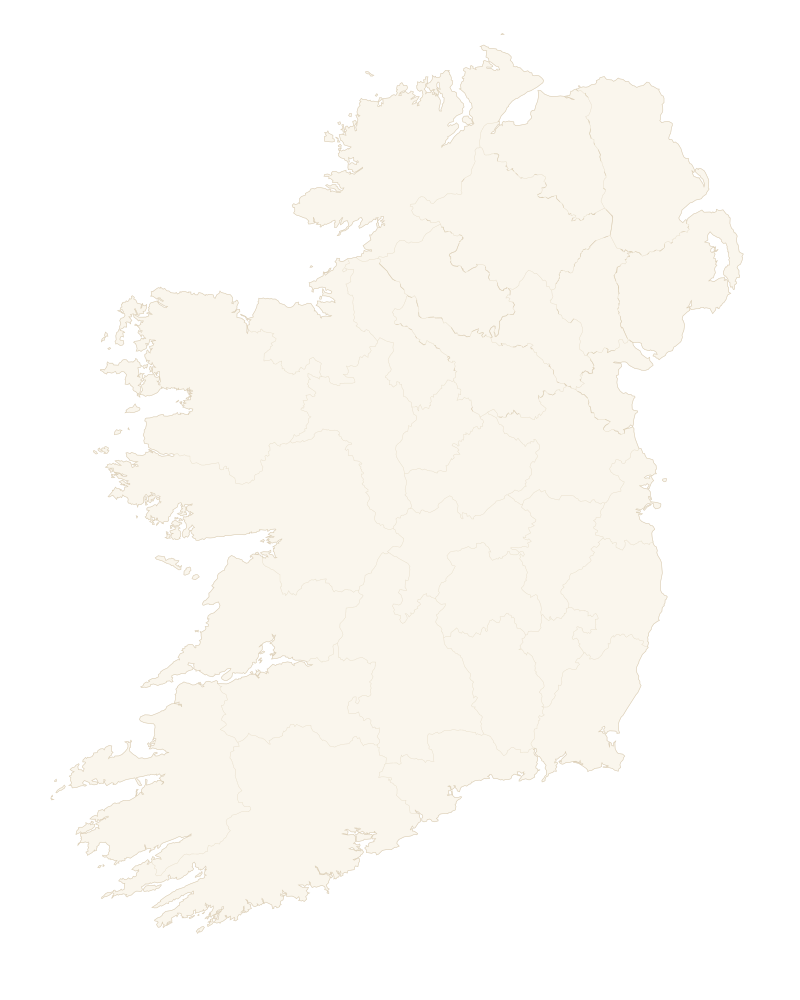
CoreHistoric reach
The seat of O'Brien
Seat vacantChief
No one leads the O'Brien community yet. When the movement opens, you can stand for its leadership, or help elect whoever does.
Current mission
No shared goal set yet. Once O'Brien has leadership, it sets the public focus: a restoration, a gathering, a real-world project that helps its own.
The O'Brien clan is being rebuilt. Join the waiting list for the movement today, and you help decide who leads it and what it does.
Help rebuild the O'Brien clan →Motto
Lámh Láidir an Uachtar
“The strong hand uppermost”
What does the O'Brien name mean?
From Ó Briain, descendant of Brian. The Brian here is Brian Bóramha, 'Brian of the cattle-tribute', high king of Ireland from 1002 to his death at the battle of Clontarf in 1014. He was the most consequential Irish king of the post-Viking period and the only Gaelic high king ever effectively to subjugate the whole island. The surname was adopted by his great-grandson Toirdhealbhach Ó Briain in the 11th century, among the very oldest hereditary surnames in Europe and demonstrably named for a single, identifiable ancestor.
The history of O'Brien
Descendant of Brian, and the man the name was fixed to
Ó Briain means descendant of Brian, and unusually for a surname the Brian is a single identifiable man. Brian Bóramha (c.941-1014) was born at Killaloe on the western shore of Lough Derg, twelfth son of Cennétig mac Lorcáin, chief of the small Dál gCais kindred of north Munster, who died in 951. He learned his soldiering in the war against the Norse of Limerick under his elder brother Mathgamain, succeeded him when Mathgamain was betrayed at Donnubán mac Cathail's house and executed in 976, took the kingship of Munster from the Eóganachta who had held it for five hundred years, was inaugurated High King of Ireland at Tara in 1002, and fell at Clontarf on Good Friday 1014.
Surnames began to be used in Ireland during that same century of declining Uí Néill dominance, which put the Irish among the first people in Europe to carry them, and the name was fixed to the family within a few generations: it was taken by his great-grandson Toirdhealbhach Ó Briain in the 11th century, and is recorded too as applied first to Brian's grandson Donnchad. Anglicisation frequently stripped the Gaelic particle out (Ó Fathaigh flattened to Fahey, Ó Ceallaigh to Kelly); Ó Briain kept its prefix as O', and threw off Brien, O'Bryan, O'Brian, Brian, O'Brine and O'Bryen, all claiming a general common ancestry. The eleventh-century harp at Trinity College Dublin that tradition attributes to Brian is the harp on the arms of the Republic of Ireland and on every Irish coin struck since 1928.
Thomond, the kingdom the name held for five centuries
The Dál gCais annexed the country now called Clare in the 8th century, taking it from the weakened Uí Fiachrach Aidhne and renaming it Thomond, north Munster. Four Ó Briains ruled in Munster and two held the High Kingship with opposition. The narrowing came in 1118, when Tairrdelbach Ua Conchobair exploited the war between the brothers Diarmait and the former high king Muircheartach, invaded Munster and split it in the Treaty of Glanmire: Thomond to the sons of Diarmait Ua Briain, Desmond to the Mac Cárthaigh. After the death of Domnall Mór Ua Briain the family retreated further beyond the Shannon into modern County Clare in the wake of the Norman invasion, and from there provided around thirty monarchs of Thomond down to 1542.
The seat was Kincora on the Shannon at Killaloe; the ritual centre was the inauguration site at Magh Adhair near Quin, and when Máel Sechnaill II of the Uí Néill wanted to warn the Dalcassians off, he cut down the sacred tree there. Succession ran by tanistry: the royal kindred elected the most suitable male candidate from close paternal relations, the roydammna, those of kingly material, rather than passing the crown to an eldest son. Under Brehon law a chief held the clan's property as custodian, not owner, and the clan was wider than the bloodline, since unrelated clients of a chief took the leading lineage's name as a show of allegiance. That is one reason a single Dalcassian surname is carried by so many.
The de Clares and the field at Dysert O'Dea
Around 1250 Henry III granted the district of Tradraighe to Robert de Muscegros, and in 1276 all of Thomond was granted to Thomas de Clare, a descendant of Strongbow, the crown taking advantage of the feuding between Clann Taidhg and Clann Briain, whom de Clare backed. In the late 13th century a Norman house disputed the throne of Thomond outright.
The de Clares failed. They were decisively beaten at the battle of Dysert O'Dea in 1318, and the Kingdom of Thomond stayed outside foreign control for a further two hundred years. They never returned to Tradraighe and the remains of their castle eventually collapsed. The stone keep that replaced it at Bunratty dates from around 1450, and at about 1500 Bunratty came into O'Brien hands: they moved the chief seat there from Ennis and built the site up into the principal stronghold of Thomond.
1543: a crown surrendered for an earldom
When the Kingdom of Ireland was created in 1541 the Dublin administration set out to bring the Gaelic chiefs inside it, inventing titles such as Baron Inchiquin, granting new coats of arms in 1552, and replacing tanistry with primogeniture through the policy of surrender and regrant. In 1543 Murchadh Carrach Ó Briain, the last Ó Briain to reign in Thomond, surrendered his Gaelic royalty to Henry VIII and took in exchange the titles Earl of Thomond and Baron Inchiquin, keeping a role in governance. At his death in 1551 the earldom passed by special remainder to his nephew Donough, and the barony of Inchiquin to his male heirs through his son Dermot.
The bargain is legible in the arms. The Chief Herald of Ireland recorded the first heraldic arms of the O'Briens as gules a dexter forearm holding a sword in pale all proper, a red field with a right arm holding an upright sword. The image came from the Eóganacht kings and their throne-name Magha Nuadhad, a reference to Nuada Airgetlám, who lost an arm in battle and was disqualified from kingship until it was replaced in silver. In 1543 Murrough was granted English arms instead, gules three lions passant guardant in pale per pale or and argent. The old arm survived as the crest, now issuing from clouds and carrying the motto Lámh Láidir an Uachtar, the strong hand uppermost.
Tower houses of the Burren and the Shannon
The Tudor century turned O'Brien lordship into O'Brien landholding, castle by castle. In 1558 Bunratty was taken by Thomas Radclyffe, Lord Lieutenant of Ireland, from Donal O'Brien of Duagh and given to Donal's nephew Connor O'Brien. In 1560 Elizabeth I granted Ballyhannon near Quin, previously held by Donnell O'Brien, to Conor O'Brien, Earl of Thomond, to hold in tail male by service of one knight's fee. Its tower of about 1490 survives fully intact, slit-windowed and crenellated, a registered National Monument; the 5th Earl's rental of 1626 shows it let to one Robert Hawksworth, with a quarter of land, for four pounds.
Doonagore above Doolin Point is one of only three cylindrical tower houses in the Burren, sandstone with limestone carving and a doorway guarded by a machicolation. Sir Donald O'Brien owned it in 1570, and it later fell to the MacClancys, hereditary brehons or lawyers to the O'Briens. Out on Inisheer the Clann Teige branch built O'Brien's Castle around 1400 on one of the highest points of the island, a rectangular donjon entered at first-floor level by an external wooden stair. The Ballinalacken O'Briens traced their descent from Turlough Don, who died in 1528, and from the Ennistymon branch founded by Sir Donald O'Brien of Dough Castle at Lahinch, who died in 1579.
Confederates, Cromwell and the slighting of Carrigogunnell
Carrigogunnell stands on an outcrop of volcanic trap rock near Clarina, over the low lands of Limerick and the Shannon. The site is first named in 1209, when Carrac Ui Conaing was granted to Donnchad Cairbreach, King of Thomond. In 1536 the Lord Deputy Leonard Grey marched on the very strong castle called Carekogunyel, which, he reported, stands on a high rock and is the key of all the county.
The 17th century pulled the house two ways at once. Murchadh O'Brien, 6th Baron Inchiquin (c.1614-1674), known ever after as Murrough of the Burnings, fought the Confederate wars first on one side and then as a Royalist, and was the most argued-over bearer of the name in his century. In 1646 Lord Barnabas O'Brien let Lord Forbes and the forces of the English Long Parliament occupy Bunratty, whose defence fell to Rear-Admiral Penn, father of William Penn of Pennsylvania, because whoever held it could blockade maritime access to Confederate-held Limerick and the Shannon. Ballinalacken was held by Daniel O'Brien of Dough in 1641-2, and in 1654 a Cromwellian officer ordered Dough and Ballinalacken preserved from the general dismantling of fortifications. Carrigogunnell was captured during the second siege of Limerick and slighted in September 1691; its last owner, Donough Brien, had prudently sold it beforehand to Michael Boyle, afterwards Archbishop of Dublin.
Dromoland, exile and the line that did not break
Leamaneh, the tower raised about 1490 with a 17th-century mansion later joined to it, is bound up with Máire Rua, daughter of Sir Torlach Rua MacMahon, Lord of Clonderlaw, and of Lady Mary O'Brien, daughter of the third Earl of Thomond. A later husband, in financial difficulty, mortgaged the Leamaneh estate he held through his wife to repay his debts. Her son Donough, Sir Donat after 1686, found tower and manor damaged, stayed on until 1684 or 1685, then moved the family seat to the much larger Dromoland. The gates of Leamaneh followed in 1906 or 1908, moved by Lord Inchiquin; the complex itself fell into ruin in the late 18th century.
The titles scattered in the Jacobite wreck. The Earldom of Thomond went extinct at the death of Henry O'Brien, 8th Earl, because the next heir descended from Daniel O'Brien, 3rd Viscount Clare, attainted in 1691, so the title was forfeit; the exile Charles O'Brien, 6th Viscount Clare, used the style Earl of Thomond regardless, as did his son, who died childless in 1774. At the death of James O'Brien, 3rd Marquess of Thomond, the barony of Inchiquin passed to a distant cousin and descendant of Murrough, Sir Lucius O'Brien, 5th Baronet, and down his descendants to Donough O'Brien, 18th Baron Inchiquin, born in 1943, the only Gaelic dynastic head whose chiefly title is recognised in unbroken male-line descent from a pre-Norman Irish king.
After the kingdom: the name in Ireland and abroad
William Smith O'Brien (1803-1864) led the Young Ireland rising of 1848 and was transported to Van Diemen's Land for it. Ignatius O'Brien, 1st Baron Shandon (1857-1930), served as Lord Chancellor of Ireland from 1913 to 1918. Conor Cruise O'Brien (1917-2008) worked in all three registers at once, as diplomat, as historian and as politician. The old houses found new uses around them: in the 1840s a bow-fronted house went up at Ballinalacken as the home of Lord O'Brien, probably built by John O'Brien MP, who died in 1855, and became a guest house in 1938, while Bunratty was restored in the 20th century and opened to the public.
The emigrant name travelled with the rest of Ireland. Jeremiah O'Brien (1744-1818) was a US Navy officer of the American Revolutionary War; Laurence O'Brien (1792-1870) a merchant and politician in Newfoundland; Hugh O'Brien (1827-1895) mayor of Boston; Ambrose O'Brien (1885-1968) founder of the National Hockey Association in Canada; Leslie O'Brien (1908-1995) Governor of the Bank of England. At home it carried the painters Dermod O'Brien (1865-1906) and Kitty Wilmer O'Brien (1910-1982), the aviation pioneer Sicele O'Brien (1887-1931), the novelist Edna O'Brien (1930-2024) and the racehorse trainer Aidan O'Brien, born in 1969. The Gaelic form never went out of use either, in the linguist Liam Ó Briain (1888-1974), the radio producer Doireann Ní Bhriain, born in 1952, and the comedian Dara Ó Briain, born in 1972.
Champions of the O'Brien name
The bearers whose lives are inseparable from this surname. Each has their own page, biography, achievements, geography, connection to the family.
Historic Places, Rebuilt
Explore the streets and seats the O'Brien name knew, rebuilt with AI as they stood in history.
Historic Places, Rebuilt · New
The O'Brien Earls of Thomond's great four-towered tower-house, hung with banners and famed for its feasts.
Historic Places, Rebuilt · New
The cathedral citadel of the Kings of Munster, whole and roofed on its rock, round tower, Cormac's Chapel and Gothic cathedral.
Castles the O'Brien held
Strongholds this name held for a decade or more, look one up, or rebuild it to explore.
- Bunratty Castle
Stronghold of the O'Brien Earls of Thomond, 15th–17th centuries.
- Doonagore Castle
Owned in 1570 by Sir Donald O'Brien of the O'Brien dynasty.
- Leamaneh Castle
Built c. 1490 by Toirdhealbhach Donn Ó Briain; the O'Brien seat until Sir Donat O'Brien moved to Dromoland in 1684/85.
- Ballyhannon Castle
The castle stood on O'Brien lands; granted to Conor O'Brien, Earl of Thomond, in 1560.
- O'Brien's Castle
Built around 1400 by the Clann Teige, a branch of the O'Briens (Uí Briain).
- Carrigogunnell
Held by the O'Briens; the last owner, Donough Brien, sold the castle to Michael Boyle, afterwards Archbishop of Dublin.
- Ballinalacken Castle
In O'Brien hands for centuries, Daniel O'Brien of Dough held it in 1641–2, and the Ennistymon O'Briens kept it until the mid-18th century, when it passed to another branch of the family.
- Dough Castle
Held by the family of Sir Donal O'Brien by 1584; part of the O'Brien tower still stands.
Castles that share the O'Brien name
The same name on the map, look one up, see what it looked like in its prime, and recreate it to explore.


All castles in Ireland → · Strongest castles in Ireland → · Castles of Europe
Play As Your Clan
Hold a real castle against whatever you choose to send at it, take a ship out in her own service years, or stand at the shoulder of someone the record remembers. The chronicler sets the scene; the deeds are yours.
Notable bearers of the O'Brien name
- Brian Bóramha (Brian Boru, c.941–1014), high king of Ireland, victor and casualty of Clontarf
- Donough O'Brien, 4th Earl of Thomond (1577–1624), earl, soldier, the family's Renaissance figure
- William Smith O'Brien (1803–1864), leader of the Young Ireland rising of 1848
- Edna O'Brien (1930–2024), novelist