Hogan
also O'Hogan, Ó hÓgáin
The young ones of Ormond, a Dalcassian name.
- Origin
- Munster, Ireland
- Famous bearer
- Paul Hogan (b. 1939), Australian actor (Crocodile Dundee)
- Register
- Irish family
Where the Hogan name comes from
CoreHistoric reach
The seat of Hogan
Seat vacantChief
No one leads the Hogan community yet. When the movement opens, you can stand for its leadership, or help elect whoever does.
Current mission
No shared goal set yet. Once Hogan has leadership, it sets the public focus: a restoration, a gathering, a real-world project that helps its own.
The Hogan clan is being rebuilt. Join the waiting list for the movement today, and you help decide who leads it and what it does.
Help rebuild the Hogan clan →What does the Hogan name mean?
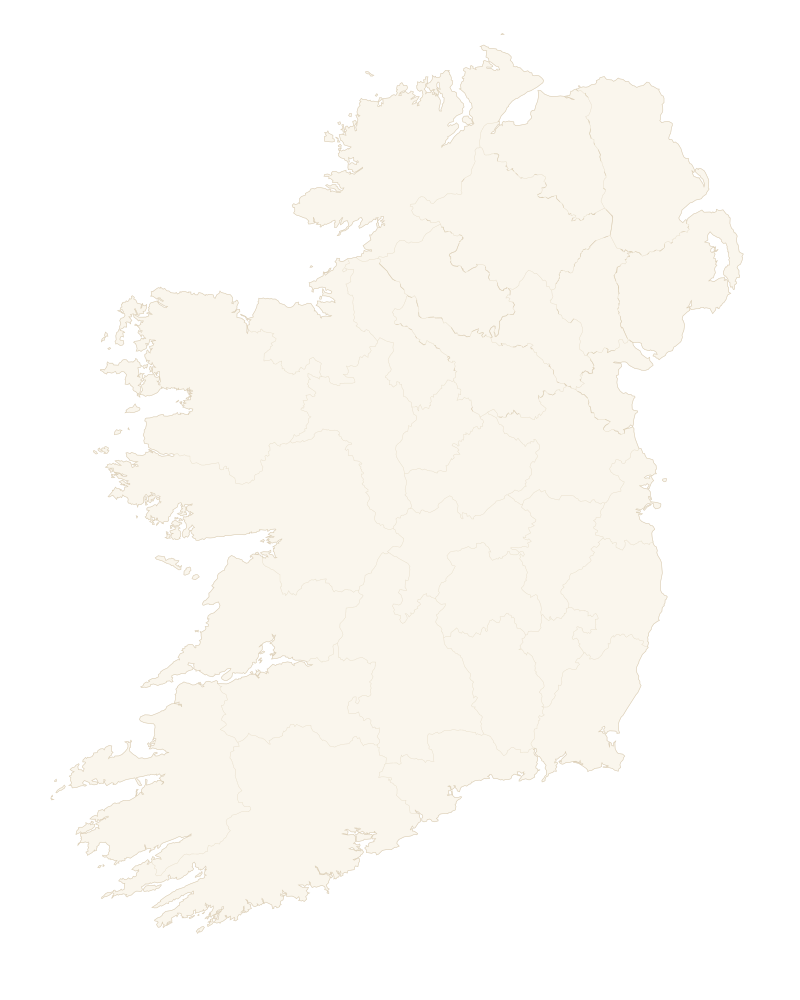
From Ó hÓgáin, 'descendant of Ógán', a diminutive of óg, 'young', so 'the young one's descendants'. The Ó hÓgáin were a Dalcassian (Dál gCais) family of the Lower Ormond country on the Tipperary–Clare border near Nenagh, kin to the wider O'Brien-led confederation of Thomond.
The history of Hogan
The young one's descendants, spelled out in Irish
In Irish the name is Ó hÓgáin, and every part of it is doing work. Ó means "descendant" and was historically Ua; Gaelic spelling attaches a lowercase h to a following vowel, which is why the name is written Ó hÓgáin rather than Ó Ógáin, on the pattern of Ó hUiginn for O'Higgins and Ó hAodha for Hughes. The ancestor's name, Ógán, is a diminutive of óg, "young", so the whole reads as the descendants of the young one, or the young warrior. Óg was no idle word in Irish naming: it sat between given name and surname to separate a son from his father, so that Seán Óg Ó Súilleabháin stands for John O'Sullivan Jr.
The Gaels were among the first peoples in Europe to take hereditary surnames, and Ireland fixed hers in the century when Uí Néill dominance was ebbing and Brian Boru of the Dál gCais took the high kingship in 1002. A second and smaller stream feeds the same modern spelling: Hogan also serves as an anglicised form of Ó hEochagáin, written elsewhere as Houghegan. The Irish grammar behind the name could tell a bearer apart by sex and marriage, Ó for a man, Ní for his daughter, Bean Uí for a woman who took her husband's name, and all of that was carried in a single word before English records flattened it.
Lower Ormond, from Nenagh west across the Shannon
The Ó hÓgáin were a Dalcassian family, part of the Dál gCais of Munster, and their country was Lower Ormond in north Tipperary near Nenagh, running west over the Shannon into Clare, with Limerick the third county the name touches. They were kin to the wider confederation of Thomond led by the O'Briens, whose chiefs were among the few in Gaelic Ireland accorded the status of royalty, ranked with MacCarthy of Desmond in Munster and O'Connor in Connacht.
An Irish clan, fine in Irish, was not simply a bloodline. It took in the chief and his patrilineal relatives, and also unrelated clients who assumed the leading lineage's name as a show of allegiance while staying ineligible for election as chief. Political power was territorial rather than genealogical. Under Brehon law a chief was appointed by his kinsmen as custodian of the clan and its property, responsible for maintaining and protecting both, and succession ran by tanistry: when a chief died the next was elected from the agnatic cousins descended from a shared grandfather or great-grandfather.
The books that wrote the lineages down, and the sheriff who ended them
From the 8th century onward, genealogical collections were compiled to trace families like this one: the genealogies in Rawlinson B 502, the Book of Ballymote, the Book of Lecan, the Leabhar Mór na nGenealach compiled by Dubhaltach MacFhirbisigh, and the Ó Cléirigh Book of Genealogies. They set down the agnatic descent of chiefs and chieftains rather than every member of a clan, and at least one genetic study has judged them fairly accurate back to the Middle Ages and unreliable before the 7th century. The Ormond country was about to be redrawn from Dublin.
In the 16th century English common law was pushed through Ireland with a centralised royal administration, and the county and the sheriff replaced the country and the clan chief. When the Kingdom of Ireland was created in 1541 the Dublin administration set about drawing the Gaelic chiefs into it, inventing titles such as Baron Inchiquin and Earl of Tyrone for them and granting new coats of arms in 1552. Surrender and regrant went further and swapped tanistry, with its elected cousins, for European primogeniture. After the Tudor reconquest and the Flight of the Earls in 1607, the authorities held the whole island and disarmed the native lordships.
The O' that fell away
Anglicisation did to the name what the sheriff did to the lordship. When Gaelic names were put into English the prefixes were routinely cut: Ó and Ua became O', or disappeared entirely, so that Ó hÓgáin surfaced in English records as O'Hogan and then plainly as Hogan, with the h and the descent it marked gone without a trace. The same shears turned Ó Fathaigh into Fahey, Ó Ceallaigh into Kelly, and Mac Uidhir into Maguire, and they stripped the O' so thoroughly from Ó Súilleabháin that a modern Sullivan carries no visible sign of it.
What the clipping produced was a name built to travel. Hogan is an Irish surname mostly of County Tipperary, and it left that ground with the emigrant ships for the United States, Canada, Australia and Britain, where the spelling held even as the Irish behind it fell out of daily use. The result is a surname that lost its grammar but kept its shape.
A Jesuit scholar, a chief of staff, and a man on the republican side
Independence carried the name into the institutions of the new Irish state. Daniel Hogan (c. 1895 to the 1940s) rose to lieutenant-general and served as Chief of Staff of the Defence Forces in Ireland. Seán Hogan (1901-1968) stood on the republican side of that same generation. Another Daniel Hogan (1899-1980) sat in politics as a Fianna Fáil man, and Brigid Hogan-O'Higgins (1932-2022), born a Hogan, was an Irish politician in her own right.
Learning and letters came from the same surname. Edmund Hogan (1831-1917) was an Irish Jesuit scholar. Desmond Hogan (born 1950) is an Irish writer and Bosco Hogan an Irish actor of the late twentieth century; Linda Hogan (born 1964) is an Irish ethicist, theologian and academic, and Ruth Hogan (born 1961) an English novelist. Noel Hogan (born 1971) works as an Irish musician, songwriter and producer, and Anni Hogan (born 1961) as a British musician and composer.
Michael Hogan, and the stand at Croke Park that carries his name
Michael Hogan (1896-1920) was a Tipperary footballer, and he was shot dead by Crown forces at Croke Park on Bloody Sunday in November 1920. The stadium's Hogan Stand commemorates him, which means the surname is spoken by every crowd that names where it is sitting, and that a footballer killed in Dublin gave his family name to a permanent part of the ground he died on.
Sport kept the name in circulation on both sides of the Irish Sea. Liam Hogan (1939-2014) was an Irish hurler, and Paddy Hogan (born 1987) is another. Gary Hogan (born 1947) is an Irish football manager and former footballer. Jimmy Hogan (1882-1974) was a British footballer, while Scott Hogan (born 1992) and a second Liam Hogan (born 1989) are English footballers of the present day.
Crocodile Dundee and the Australian bearers
The name travels furthest in Australia. Paul Hogan (born 1939), the actor and comedian who created Crocodile Dundee, is among its most recognised bearers anywhere. Hector Hogan (1931-1960) ran for Australia as an Olympic sprinter. Edmond Hogan (1883-1964) was an Australian politician.
Australian sport and press hold several more: Raymond Hogan (1932-1995) and Tom Hogan (born 1956) were cricketers, Simon Hogan (born 1988) plays Australian rules football, and Allan Hogan (born 1943) has worked as a journalist.
Nine majors, two Medals of Honor, and a Portuguese painter
Ben Hogan (1912-1997) is one of the giants of golf, the winner of nine major championships, and the American bearer the name is best known by. Before him, Henry Hogan (1840-1916) served as a sergeant in the United States Army and became one of only nineteen soldiers ever awarded the Medal of Honor twice. Baseball took the name early: Marty Hogan (1869-1923) played as an Anglo-American professional, and Happy Hogan (1877-1915) as an American player.
The rest of the American record is quieter and just as wide. Lester Hogan (1920-2008) was a physicist; Hubertina D. Hogan (1924-2017) and Virginia D. Hogan (1929-2004) were chemists; Inez Hogan (1895-1973) wrote and illustrated books; David Hogan (1949-1996) composed music and directed choirs; Joseph Lloyd Hogan (1916-2000) was a Roman Catholic bishop. Further afield, João Hogan (1914-1988) painted as a Portuguese artist, a reminder that the name did not only follow the English-speaking routes out.
Historic Places, Rebuilt
Explore the streets and seats the Hogan name knew, rebuilt with AI as they stood in history.
Historic Places, Rebuilt · New
The O'Brien Earls of Thomond's great four-towered tower-house, hung with banners and famed for its feasts.
Historic Places, Rebuilt · New
The cathedral citadel of the Kings of Munster, whole and roofed on its rock, round tower, Cormac's Chapel and Gothic cathedral.
The castles of the homeland
The great strongholds of the homeland, look one up, see what it looked like in its prime, and recreate it to explore.
 Ashford Castle, County MayoRestored · prime 1880
 Manderley CastleRestored · prime 1840
 Dublin CastleRestored · prime 1790
All castles in Ireland → · Strongest castles in Ireland → · Castles of Europe
Play As Your Clan
Hold a real castle against whatever you choose to send at it, take a ship out in her own service years, or stand at the shoulder of someone the record remembers. The chronicler sets the scene; the deeds are yours.
Notable bearers of the Hogan name
- Paul Hogan (b. 1939), Australian actor (Crocodile Dundee)
- Ben Hogan (1912–1997), American champion golfer
- Michael Hogan (1896–1920), Tipperary footballer, namesake of the Hogan Stand