Ryan
also O'Ryan, Ó Maoilriaghain, Mulryan
Of Owney and Aherlow, the densest Tipperary surname.
- Origin
- Munster, Ireland
- Motto
- Malo mori quam foedari
- Famous bearer
- Cornelius Ryan (1920–1974), historian, author of The Longest Day
- Register
- Irish family
The Ryan arms and country

Coat of armsArms of RyanEccekevin · CC BY-SA 4.0

- Coat of arms: Granted to an individual and inherited down that one documented line. These are the arms of particular families of the name, not of everyone who shares the surname.
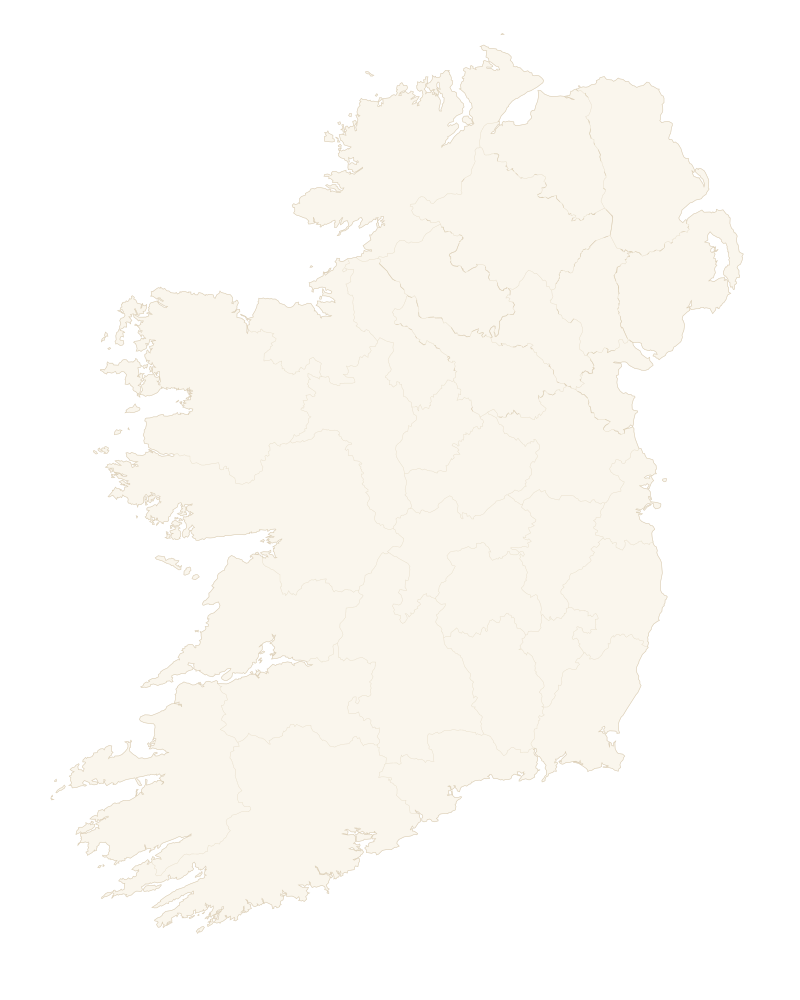
CoreHistoric reach
The seat of Ryan
Seat vacantChief
No one leads the Ryan community yet. When the movement opens, you can stand for its leadership, or help elect whoever does.
Current mission
No shared goal set yet. Once Ryan has leadership, it sets the public focus: a restoration, a gathering, a real-world project that helps its own.
The Ryan clan is being rebuilt. Join the waiting list for the movement today, and you help decide who leads it and what it does.
Help rebuild the Ryan clan →Motto
Malo mori quam foedari
“I would rather die than be disgraced”
What does the Ryan name mean?
Almost universally a contracted Anglicisation of Ó Maoilriaghain, descendant of the devotee of Riaghain. (Riaghan was a 9th-century saint of Limerick whose cult survived as a personal name into the early surname era.) The fuller form Mulryan is still used in the older Tipperary register; standard usage from the 18th century onwards is Ryan. A small minority of Ryans descend instead from Ó Riain of Carlow, same Anglicised form, different Gaelic origin.
The history of Ryan
The name whose meaning was lost before the records began
Ryan is almost universally a contracted Anglicisation of Ó Maoilriaghain, the descendant of the devotee of Riaghain. The Ó Maoil construction, the descendant of a named figure's follower, sits beside Mac Giolla, the servant's son, and is the same religious tie that produced Kilpatrick for a follower of Patrick and Kilbride for a follower of Saint Brigid of Kildare. Riaghan was a 9th-century saint of Limerick whose cult outlived him as a personal name and carried into the surname era; the fuller form Mulryan still stands in the older Tipperary register.
What Rian itself meant, nobody can say. Old Irish rían, meaning water or ocean, and rí, meaning king, have both been proposed and both discounted by scholars, leaving the popular gloss of little king or illustrious without support. John Ryan, Professor of Early and Medieval History at University College Dublin, put it flatly: the Rian in Ó Riain and Ó Maolriain has never been satisfactorily explained, and like Niall it seems old enough that its meaning was lost before records began.
From the Feara Cualann to the uplands of Owney
Irish scribes began compiling genealogical collections in the 8th century to trace the ancestry of the clans: Rawlinson B 502, the Book of Ballymote, the Book of Lecan, the Leabhar Mór na nGenealach of Dubhaltach MacFhirbisigh. In the traditional scheme that came down through them the O'Mulryans are a chiefly family of the Feara Cualann, reckoned to the Laigin who gave their name to Leinster, though Seán Duffy sets the Feara Cualann apart as one of the two groupings the early literature does not support. That eastern origin still shows in the older ground of the name in Carlow, Kilkenny and Wexford, and it explains why a Munster family carries a Leinster pedigree.
Ireland began fixing hereditary surnames during the 11th century, in the decades when the Uí Néill lost the high kingship to Brian Boru of the Dál gCais, which put the Irish among the first people in Europe to use them at all. By the 14th century the Ryans of Owney had taken the place of the older Ó Mulryans in the upland districts of Owney and Arra and in the Glen of Aherlow, and they held that district as its principal family until the confiscations of the 17th century. A separate and much smaller line, the Ó Riain of Carlow, arrived at the identical English spelling from an entirely different Gaelic name.
Why one upland district carries one name
An Irish fine was never only a blood group. It held the chief and his patrilineal relatives, but it also held unrelated clients who took the name of the leading lineage as a declaration of allegiance, while remaining ineligible, they and their agnatic descendants alike, ever to be elected chief. A chief's power was territorial rather than genealogical, and every household that lived under his protection in Owney had reason to be called by his name. That is the mechanism behind one of the densest single-county surname clusters in Ireland.
Under Brehon law the chief was appointed by his kinsmen as custodian of the clan and its property, not as its owner, and the succession ran by tanistry: on a death, the new chief was elected from the agnatic cousins descended from a shared grandfather or great-grandfather. The system spread a name across a whole upland country within a few generations, under a leadership that was elected rather than inherited.
The sheriff replaces the chief
The 16th century dismantled the arrangement that had made the Ryans of Owney what they were. English common law was carried through Ireland with a centralised royal administration, and the county and the sheriff took over from the country and the clan chief. When the Kingdom of Ireland was created in 1541 the Dublin administration set out to bring the Gaelic chiefs inside it, minting titles such as Baron Upper Ossory, Earl of Tyrone and Baron Inchiquin, granting new coats of arms in 1552, and attaching to them the policy of surrender and regrant, which replaced election by tanistry with succession by primogeniture.
The early 17th century finished the work. The Tudor reconquest broke the old Gaelic aristocracy, the senior Ulster chiefs left for Spain in 1607 and ended their lives in Rome, and Dublin held real authority over the whole island for the first time. For the Ryans the reckoning came with the Cromwellian settlement, which took nearly all of the family's land. The motto they kept, Malo mori quam foedari, I would rather die than be disgraced, belongs to that stripped generation. The surname survived where the title did not.
Mulryan in the parish book, Ryan on the passenger list
Anglicisation did the rest. Clerks writing Gaelic names in English routinely dropped the prefix, so that Ó Fathaigh became Fahey and Ó Ceallaigh and Ó Cadhla both became Kelly; where it was kept, Ó was flattened to O'. Ó Maoilriaghain travelled the same road, holding on as Mulryan in the older Tipperary registers before standard usage settled on Ryan from the 18th century onward. The Irish forms lost more than a syllable in the crossing: Ó, Ní for a daughter, and Bean Uí for a wife all arrived in English as the single undifferentiated Ryan.
In a district where nearly every family answered to the same word, the Irish habit of naming a man by his father and grandfather in the genitive did the work the surname no longer could, a man known to his neighbours by three given names rather than by the one that everybody shared. Post-Famine emigration then carried the name out of Tipperary by the shipload, and among those emigrants of that generation was the grandfather of the writer who would put it on ten million book jackets. A separate stream reached the same spelling from outside Ireland entirely, Ryan being also an Americanised form of the German surname Rein.
Cornelius Ryan, from Heytesbury Street to Omaha Beach
Cornelius John Ryan was born at Heytesbury Street in south Dublin on 5 June 1920, the son of a clerk in the Dublin city corporation. He was schooled at the Christian Brothers' Synge Street School, where he was the senior student violinist of the orchestra, and at twenty he left for London to take a reporter's job on the Daily Telegraph in 1940.
The war handed him the European beat. Attached in 1943 to the United States Eighth Air Force at the bomber bases of East Anglia, he flew fourteen combat missions as an air correspondent aboard B-17 Flying Fortresses over Germany. He moved to Reuters in 1944, was attached to the Allied Expeditionary Force for the Normandy landings, and came ashore on Omaha Beach on 6 June 1944, filing the first Allied wire-service report from the beach itself.
Six thousand interviews and the view from the foxhole
Ryan moved to the United States in 1947, became an American citizen in 1951 and joined Collier's magazine in 1952. The assignment that took over the rest of his life came in 1956. The histories of Normandy then in print were written almost entirely from the commander's office and almost never from the soldier's foxhole, and he set out to build one the other way round, by finding every surviving participant he could and taking the testimony first-hand.
The Longest Day (1959) took three years and six thousand interviews, gathered by a research team working across Europe and the United States from roughly three thousand American, British, Canadian, French, Dutch, Polish and German survivors. Published in January 1959, it sold ten million copies in eighteen languages and set the template for post-war popular history. Darryl Zanuck's 1962 film of it, with an eighteen-language ensemble cast, was the largest-budget non-musical Hollywood production of its decade.
He wrote two more books on the same method: The Last Battle (1966), on the Berlin endgame of 1945, and A Bridge Too Far (1974), on Operation Market Garden, finished against the clock and published a fortnight before he died in New York on 23 November 1974, aged fifty-four. Richard Attenborough's film of A Bridge Too Far followed in 1977, and the Overseas Press Club of America founded the Cornelius Ryan Award in his memory. A Dublin clerk's son had carried Ó Maoilriain, the commonest surname of the Irish south-east, into the founding generation of Anglo-American popular history.
Champions of the Ryan name
The bearers whose lives are inseparable from this surname. Each has their own page, biography, achievements, geography, connection to the family.
Historic Places, Rebuilt
Explore the streets and seats the Ryan name knew, rebuilt with AI as they stood in history.
The castles of the homeland
The great strongholds of the homeland, look one up, see what it looked like in its prime, and recreate it to explore.
 Ashford Castle, County MayoRestored · prime 1880
 Manderley CastleRestored · prime 1840
 Dublin CastleRestored · prime 1790
All castles in Ireland → · Strongest castles in Ireland → · Castles of Europe
Play As Your Clan
Hold a real castle against whatever you choose to send at it, take a ship out in her own service years, or stand at the shoulder of someone the record remembers. The chronicler sets the scene; the deeds are yours.
Notable bearers of the Ryan name
- Cornelius Ryan (1920–1974), historian, author of The Longest Day
- Tony Ryan (1936–2007), founder of Ryanair
- Frank Ryan (1902–1944), republican, Spanish Civil War commander
- Meg Ryan (b. 1961), actress