O'Carroll
also Carroll, Ó Cearbhaill
Ely O'Carroll, kings of north Tipperary into the Tudor age.
- Origin
- Leinster, Ireland
- Motto
- In fide et in bello fortis
- Famous bearer
- Charles Carroll of Carrollton (1737–1832), signer of the American Declaration of Independence
- Register
- Irish family
Where the O'Carroll name comes from
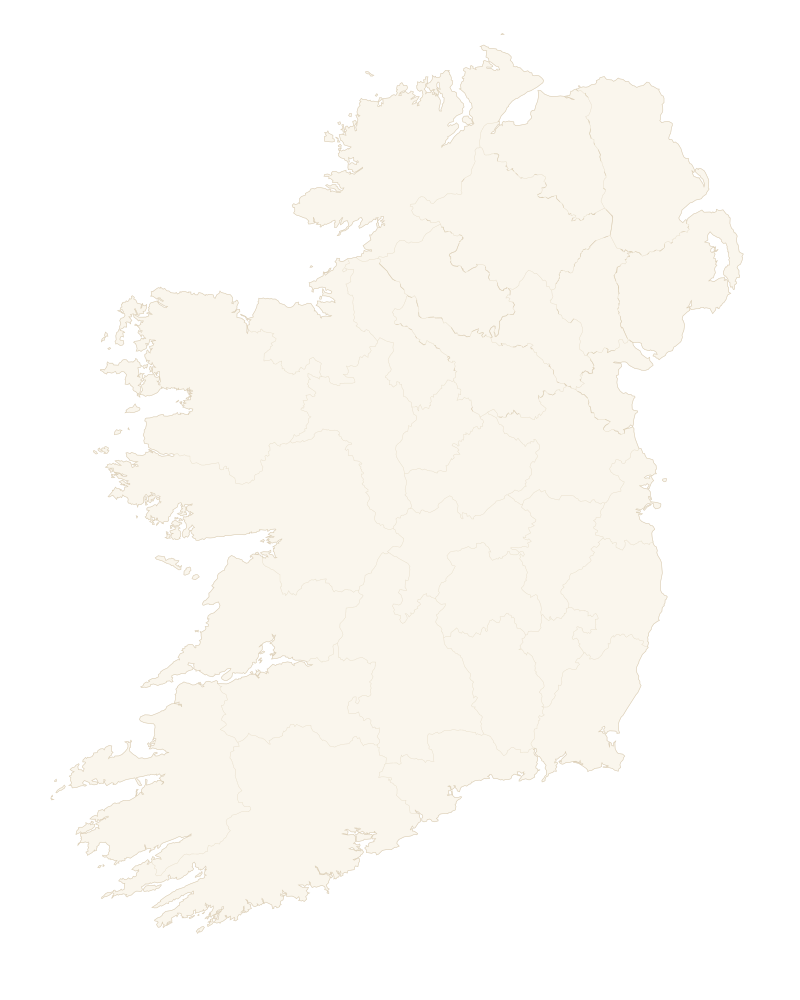
CoreHistoric reach
The seat of O'Carroll
Seat vacantChief
No one leads the O'Carroll community yet. When the movement opens, you can stand for its leadership, or help elect whoever does.
Current mission
No shared goal set yet. Once O'Carroll has leadership, it sets the public focus: a restoration, a gathering, a real-world project that helps its own.
The O'Carroll clan is being rebuilt. Join the waiting list for the movement today, and you help decide who leads it and what it does.
Help rebuild the O'Carroll clan →Motto
In fide et in bello fortis
“Strong in faith and in war”
What does the O'Carroll name mean?
From Ó Cearbhaill, descendant of Cearbhall ('hacking warrior'). Several distinct families took the surname independently in different parts of Ireland; the most powerful were the Ó Cearbhaill of Éile (Ely O'Carroll), the Munster sept who ruled a kingdom of north Tipperary and southern Offaly from the 8th century to the late 16th. Two further unrelated Carroll lines were the Ulster Ó Cearbhaill of Oriel (modern Louth and Monaghan) and a smaller Leinster line in Ossory.
The history of O'Carroll
Ó Cearbhaill: the descendants of Cearbhall
The name is Ó Cearbhaill, where Ó means descendant as Mac means son, built on the personal name Cearbhall. Its sense is disputed: usually glossed near 'lord of hacking', from Old Irish cerb and often rendered 'valorous in battle', though philologists have argued for 'crooked mouth', from cerr and bel. Ireland began using surnames early by European standards, in the century that ended with Brian Boru taking the high kingship in 1002.
More than one family reached the name independently, so Carrolls are not a single kindred. The Ó Cearbhaill of Éile in north Tipperary and southern Offaly, the Ely O'Carroll, were much the most powerful; there were also O'Carrolls of Oriel around Dundalk, of Ossory in Carlow and Kilkenny, and two septs in Kerry. The prefix is very often dropped in this name and occasionally replaced with Mac, and Carvill is another anglicisation of it.
The bounds of Ely O'Carroll
The Ordnance Survey letters for King's County in 1838, drawing on Sir William Betham, Ulster King of Arms, set the lordship out in the language of the land: the pasture of Ballycrinass, Rosscullenagh and Drumcan, running to the Lake of Leghagh, bounded west by Laghenagarken and east near Glencrokin. The mountain ground ran from Lochan na gCaorach to Poll Dubh in Roscomroe, then south-east to the Slieve Bloom Mountains.
An Irish clan, a fine, was never only blood. It held the chief and his patrilineal relatives, but also unrelated clients who took the leading lineage's name in allegiance while remaining ineligible to be elected chief. Surnames counted historically within Ely O'Carroll include Bohan, Dooley, Meagher, Kelly, Flanagan, Corcoran and Healy. Succession ran by tanistry: the next chief was elected from the agnatic cousins of a common grandfather, so the chiefship was a contest, not an inheritance.
Birr and the Leap of the O'Bannons
A castle has stood at Birr since 1170, and from the fourteenth century to the seventeenth the O'Carrolls ruled from it over the country called Ely O'Carroll. That is the plain fact behind the family: a Gaelic kindred holding a defined territory from a defined stronghold, under successive nominal Anglo-Norman overlords, for some three hundred years.
The second castle was not theirs to begin with. Leap was raised by the O'Bannons and called Léim Uí Bhánáin, the Leap of the O'Bannons, secondary chieftains subject to the ruling O'Carrolls. The Annals of the Four Masters record that Gerald FitzGerald, Earl of Kildare, tried and failed to take it in 1513. That a dependent family's fortress could turn away an Earl of Kildare says a good deal about the lordship behind it.
Mulrooney O'Carroll and the treaty of June 1538
Maolroona, or Mulrooney, O'Carroll, who died in 1532, joined with O'Brien and others against the English government and, in Betham's dry phrase, gave them much trouble. His daughter Grace, or Grania, married Ulick Burke, Lord of Clanrickard, and was mother of Rickard Sassanagh Burke, the first Earl. The rivalry for the chiefship that followed his death is remembered at Leap in the room still called the Bloody Chapel.
His son Fergonamuin, or Ferdinando, succeeded as O'Carroll and on 12 June 1538 concluded a treaty with Leonard, Lord Gray, Lord Deputy of Ireland. He consented, for himself and his successors, to pay the king twelvepence for every carucate of land in the lordship and a hundred and twenty marks on the nomination of a chief, to bring the Chief Governor twelve horsemen and twenty four footmen on general hostings with forty days' provisions at his own cost, and to victual eighty gallowglasses for three months a year.
The last kings of Éile
In 1548 Teige Caoch O'Carroll, son of Ferdinando, whom Sir James Ware called petty King of Ely, routed the English out of his country, then submitted and was created Baron of Ely, a patent Betham searched for and could not find. The machinery closing around him was new: the Kingdom of Ireland had been created in 1541, and surrender and regrant, with fresh titles and fresh coats of arms in 1552, replaced tanistry with primogeniture.
The sources disagree on who made the final surrender: the clan account names Teige Cian O'Carroll as the last of Éile to surrender and regrant to the Tudor kingdom, the family record names Maolruanaidh O'Carroll surrendering Ely formally in 1552. Either way, they were among the last Gaelic kindreds to make that bargain. William Adhar O'Carroll, younger brother of Teige, was knighted on 30 March 1567 and made Governor of Ely and Captain of his Nation by Sir Henry Sidney, and Sir George Carew knighted his son Sir Mulrooney at Dublin Castle in 1603.
Cromwell, the Parsons grant and the troop of thirty sons
Roger O'Carroll, son and heir of Sir Mulrooney, attached himself to the King's party under the Duke of Ormond and was put out of his estates by Cromwell. Birr had already gone: after the death of Sir Charles O'Carroll, Sir Lawrence Parsons was granted the castle and 1,277 acres in 1620, and it has been the seat of the Parsons Earls of Rosse ever since. Leap passed by marriage to the Darby family in 1642.
Donagh, or Denis, O'Carroll, a descendant of Donogh O'Carroll, brother of the Mulrooney who died in 1532, held Modereeny and Buolybrack in Tipperary and was ousted in the same confiscations. He married a daughter of O'Kennedy and had thirty sons, whom he formed into a troop of horse and presented to the Duke of Ormond for the service of King Charles I. At the Restoration his son John was granted lands at Killury in County Galway, and John's second son Daniel took service with the King of Spain, was made a Knight of the Order of Saint Iago, and rose to lieutenant general in the British service as Sir Daniel.
Ely O'Carroll rebuilt on the Monoccasy
Charles O'Carroll, eldest son and heir of Roger, stood in favour with Charles II and James, who could not restore his paternal estate but granted him large tracts on the Monoccasy River in Maryland. He divided them into three manors of 20,000 acres each and named them for what the family had lost: Ely O'Carroll, Doughoregan and Carrolston. He was made Attorney General of the province, and the family record dates his emigration to 1688.
His great-grandson Charles Carroll of Carrollton (1737-1832) was a wealthy Maryland landowner who signed the Declaration of Independence in 1776, the only Catholic to sign it and the last of the signers living at his death. His cousins were Daniel Carroll (1730-1796), who signed both the Articles of Confederation and the United States Constitution, and Daniel's brother John Carroll (1735-1815), first Catholic bishop and archbishop in the United States and founder of Georgetown University. No other Catholic family in America produced signers of both founding documents.
The name since, from Dhammaloka to Croke Park
The earliest bearer named in the family's own roll is Maol Ruanaidh Cam Ó Cearbhaill, a musician who died in 1329. After him the name travels far from Éile. William Carroll (1788-1844) was Governor of Tennessee. Laurence Carroll (1856-1914) became an anti-imperial Irish Buddhist monk in British Burma under the ordination name Dhammaloka. Mella Carroll, born in 1934, went to the High Court as the first woman appointed to a superior court in Ireland.
The name is loudest now at Croke Park. Rory O'Carroll, born at Crumlin in Dublin on 11 May 1989 and playing with Kilmacud Crokes from the age of five, made his senior debut for Dublin at full-back against Westmeath on 11 June 2010 and held that position as the team's marking defender for six more seasons. He won All-Ireland senior medals in 2011, 2013 and 2015, all three at full-back, and took the All-Star at full-back in 2013.
The chiefship has a modern afterlife. F. J. O'Carroll of Éile O'Carroll constituted Clan Cian by a Charter of Re-Formation in the early 1980s for the Cianachta, and Fredrick Arthur O'Carroll has since taken the mantle of Chief of the Name with a Council of Chieftains behind him; The O'Carroll is a recognised member of the Standing Council of Irish Chiefs and Chieftains. Not everyone accepts the idea of one overarching Clan Cian, but the Ely country still answers to the name.
Champions of the O'Carroll name
The bearers whose lives are inseparable from this surname. Each has their own page, biography, achievements, geography, connection to the family.
Historic Places, Rebuilt
Explore the streets and seats the O'Carroll name knew, rebuilt with AI as they stood in history.
Castles the O'Carroll held
Strongholds this name held for a decade or more, look one up, or rebuild it to explore.
- Leap Castle
Stronghold of the ruling O'Carroll clan, whose feuds bloodied the castle chapel after 1532.
- Birr Castle
The O'Carrolls ruled from Birr over "Ely O'Carroll" from the 14th to the 17th century.
The castles of the homeland
The great strongholds of the homeland, look one up, see what it looked like in its prime, and recreate it to explore.
 Ashford Castle, County MayoRestored · prime 1880
 Manderley CastleRestored · prime 1840
 Dublin CastleRestored · prime 1790
All castles in Ireland → · Strongest castles in Ireland → · Castles of Europe
Play As Your Clan
Hold a real castle against whatever you choose to send at it, take a ship out in her own service years, or stand at the shoulder of someone the record remembers. The chronicler sets the scene; the deeds are yours.
Notable bearers of the O'Carroll name
- Charles Carroll of Carrollton (1737–1832), signer of the American Declaration of Independence
- Daniel Carroll (1730–1796), signer of the US Constitution
- John Carroll (1735–1815), first Roman Catholic bishop of the United States, founder of Georgetown
- Lewis Carroll (Charles Lutwidge Dodgson, 1832–1898), mathematician, author of Alice's Adventures in Wonderland
- Carroll O'Connor (1924–2001), actor (All in the Family)