Ireland · Still standing
Birr Castle
Caisleán Bhiorra
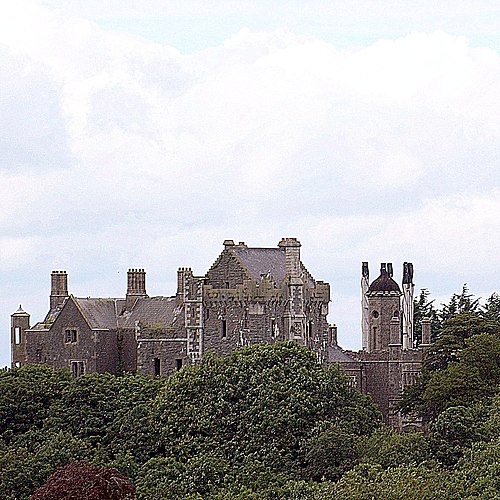
Birr Castle is a large Gothic-revival country house-style castle in Birr, County Offaly, long associated with the Parsons family, Earls of Rosse. The estate is notable for the 19th-century 'Leviathan' telescope on the demesne and for its public gardens, museum and ancillary buildings around an entrance courtyard.
Its prime
1845
Today
Still standing
As it stood in 1845
What Birr Castle looked like in its prime.
A bulky, rectangular grey-masonry castle with crenellated parapets and short, square and rounded corner towers; a recessed central arched entrance framed by projecting diagonal 'flanker' towers; a mix of mullioned rectangular windows and tall pointed-arch (lancet) windows on a projecting wing; several tall chimneys and low pitched roofs with greenish metal detail; the castle sits directly above formal lawns, shrub beds and parkland with a flag flying from the roofline.
Its story
The story of Birr Castle.
Ely O'Carroll and the Parsons Grant of 1620
A castle has stood at Birr since 1170, and from the 14th to the 17th centuries the O'Carroll family ruled from here over the territory known as "Ely O'Carroll". After the death of Sir Charles O'Carroll, Sir Lawrence Parsons was granted Birr Castle and 1,277 acres in 1620. Parsons engaged English masons to build a new castle: not on the site of the O'Carrolls' Black Tower, which has since disappeared, but at its gatehouse, with "flankers" added diagonally at either side to give the building the plan it retains today.
Fifteen Months Under Siege, 1641
After Sir Lawrence's death in 1628, and that of his elder son Richard, the castle passed to his younger son William. During the Irish Rebellion of 1641, William was besieged at Parsonstown, as Birr was then called, by Catholic forces for fifteen months. After the civil war his son Laurence, created a baronet in 1677, refurbished the castle.
The Leviathan of Parsonstown, 1845
Laurence Parsons, 2nd Earl of Rosse, heightened and "Gothicised" the castle in the early 19th century, but it was his son, the 3rd Earl, who made Birr famous. In 1845 he completed the "Great Telescope", the Leviathan of Parsonstown, a reflector with a 72-inch (183 cm) mirror that on completion was the largest telescope on Earth, able to capture more light and see further into space than any instrument before it. Birr became a focus for astronomical observation, and visitors came from all over the world, Charles Babbage and the Prince Imperial Napoléon Eugène among them. Its record size stood until the 100-inch Hooker Telescope was completed at Mount Wilson in 1917.
The 3rd Earl's sons continued the scientific tradition: Lawrence Parsons, 4th Earl of Rosse, is noted for measuring the heat of the moon. He and his mother, Mary Parsons, Countess of Rosse, were also eminent photographers, and her darkroom, on show in the demesne's science museum, is believed to be the oldest surviving example in the world.
Dismantled for a War, Rebuilt for the Stars
After the 4th Earl's death in 1908 the great telescope fell into disrepair. The mirror was taken to the Science Museum in London; around 1914 the metal supporting structure was melted down for use in the First World War, and in 1925 the wooden structures around the walls were demolished for safety. Following several intermediate attempts, the telescope was restored more completely in the late 1990s and can once again be seen moving in occasional demonstrations.
Astronomy returned in earnest after Lord Rosse agreed in 2010 to let Trinity College Dublin repurpose an old sheep yard on the demesne: the Rosse Solar-Terrestrial Observatory was formally opened on 28 June 2014, and the I-LOFAR radio-telescope station, the westernmost node in a Europe-spanning network, held its first-light ceremony on 27 July 2017. The castle remains the home of the 7th Earl of Rosse, and in 2025 Birr was added, alongside Dunsink Observatory and Armagh Observatory, to the World Heritage Tentative List as one of the Irish Historic Astronomical Observatories.
Step inside
10 places to explore in 1845.
The record describes 10 distinct spots at Birr Castle, including 1 interior: ireland's historic science centre interior (gallery and darkroom). Create your own photoreal reconstruction and explore every one, more scenes means more rooms, more angles, and more of the place to stand in.
Build Your Own Castle
Recreate Birr Castle with AI to explore it.
The artist rebuilds it as it stood in 1845, a photoreal reconstruction that belongs to you alone. Pay with coins, no subscription needed.
Recreate this castle →Defend this castle →Whose castle
Clans who held Birr Castle.
The families that held Birr Castle for a decade or more across its history, follow a name to its clan.
The O'Carrolls ruled from Birr over "Ely O'Carroll" from the 14th to the 17th century.
Parsons
Held by the Parsons family, Earls of Rosse, since Sir Lawrence Parsons was granted the castle in 1620.
From the archive
Birr Castle on paper: the measured plan and period views.
The survey plan and photographs below are the ground truth this page's reconstructions are checked against, drawn and photographed while the castle was still a working garrison. Every image is public-domain or openly licensed, with its source named.
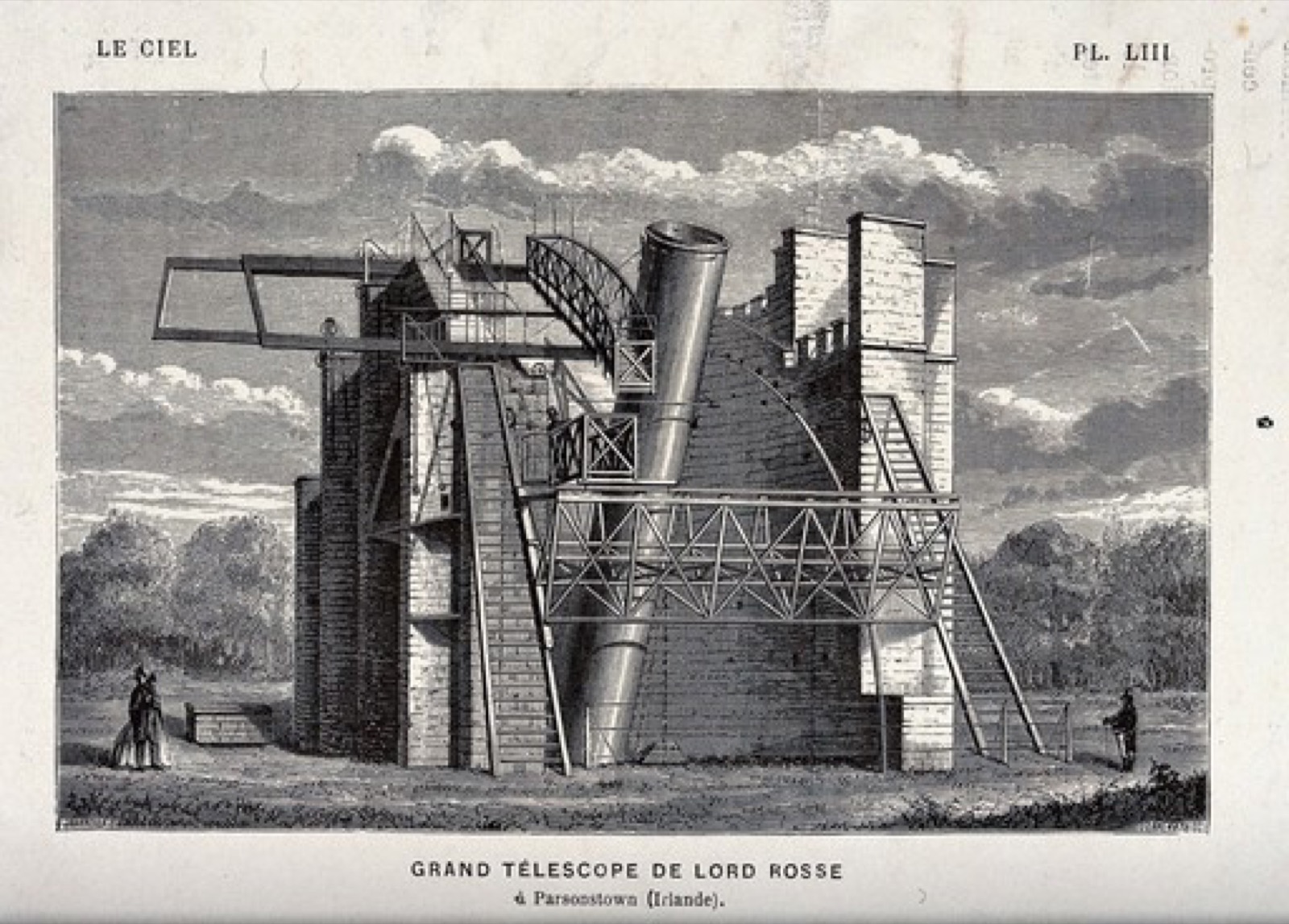
Astronomy: a large refracting telescope, at Birr Castle, Ireland. Engraving.
· Wellcome Collection (via Europeana)
CC BY
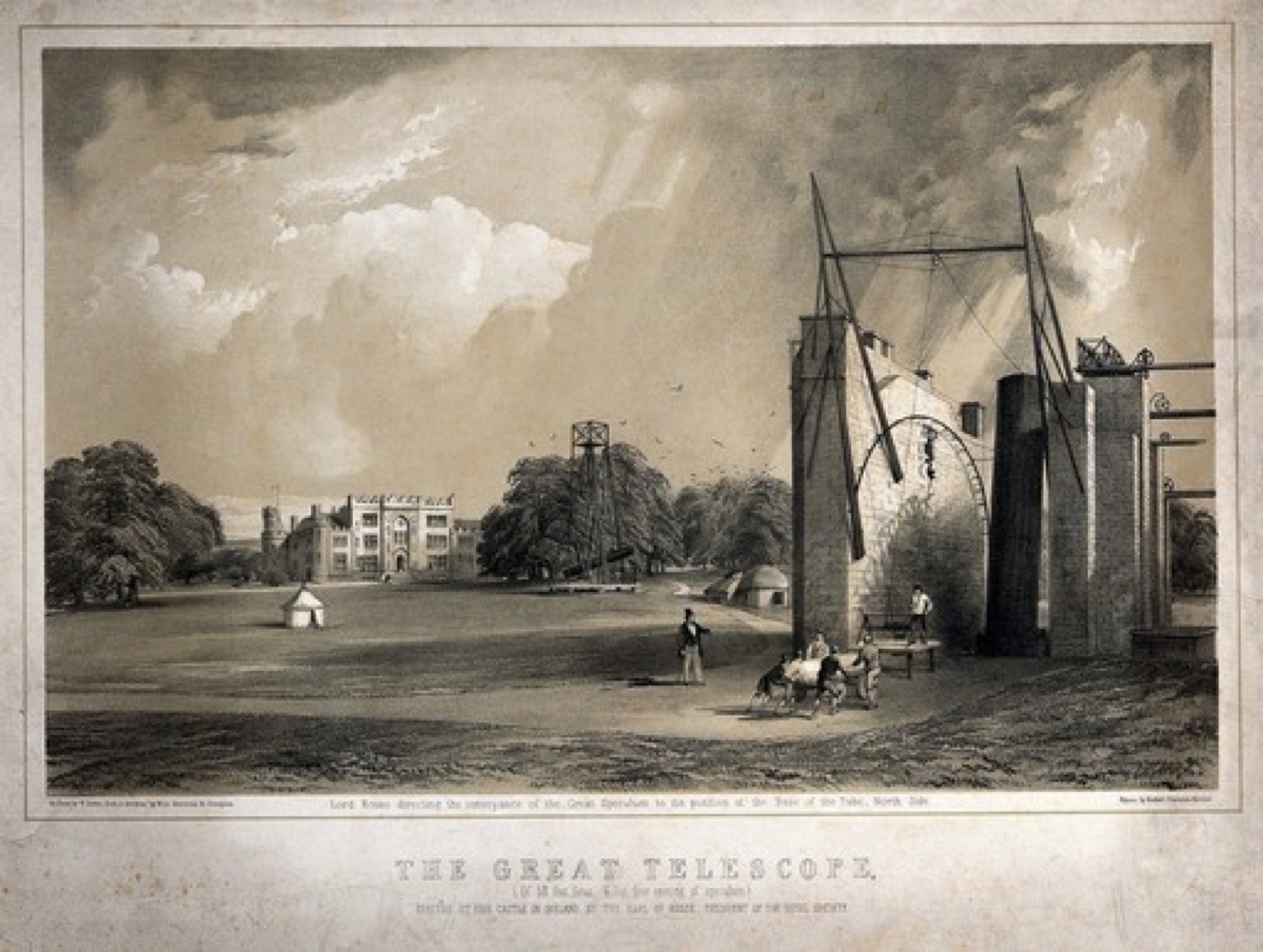
Astronomy: a large refracting telescope, at Birr Castle, Ireland. Lithograph by W. Bevan after Miss Henrietta
· Wellcome Collection (via Europeana)
CC BY