O'Neill
also Ó Néill, ONeill, Neill
The royal house of Tír Eoghain, Hugh O'Neill's earldom and the Flight of the Earls.
- Origin
- Ulster, Ireland
- Motto
- Lámh Dhearg Éireann
- Famous bearer
- Niall Glúndubh (d. 919), high king of Ireland, eponymous ancestor
- Register
- Irish family
Ranked of all time
The 10 Most Powerful Irish Clans of All Time
Ranked of all time
The 10 Oldest Clans in Ireland
The O'Neill arms and country

Coat of armsO'NeillPublic domain

- Coat of arms: Granted to an individual and inherited down that one documented line. These are the arms of particular families of the name, not of everyone who shares the surname.
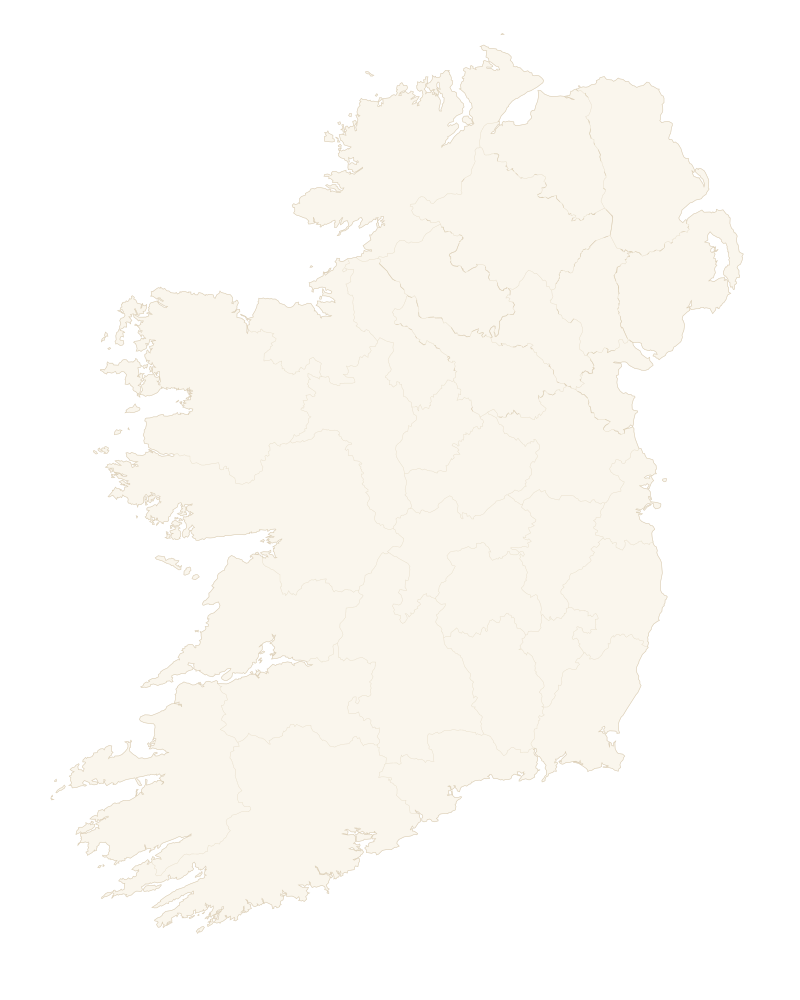
CoreHistoric reach
The seat of O'Neill
Seat vacantChief
No one leads the O'Neill community yet. When the movement opens, you can stand for its leadership, or help elect whoever does.
Current mission
No shared goal set yet. Once O'Neill has leadership, it sets the public focus: a restoration, a gathering, a real-world project that helps its own.
The O'Neill clan is being rebuilt. Join the waiting list for the movement today, and you help decide who leads it and what it does.
Help rebuild the O'Neill clan →Motto
Lámh Dhearg Éireann
“The Red Hand of Ireland”
What does the O'Neill name mean?
From Ó Néill, descendant of Niall. The Niall in question is Niall Glúndubh, 'Niall Black-knee', high king of Ireland 916–919, killed in battle at Islandbridge near Dublin fighting the Norse. His grandson Domhnall first used the surname Ó Néill, around 940, making it among the oldest hereditary surnames in Europe. The Niall Glúndubh line claims descent in turn from Niall of the Nine Hostages, the 4th-century progenitor of the Uí Néill kindred, though that claim is into the legendary horizon of Irish dynastic genealogy.
The history of O'Neill
The name is older than most of Europe's surnames
O'Neill is the anglicised form of the Irish Ua Néill, later Ó Néill, built from ua, meaning grandson or descendant, and the personal name Niall, from the Old Irish niadh, a warrior or champion. The Niall in question is not a figure of legend but a dated king: Niall Glúndubh, 'Niall Black-knee', king of Ailech and high king of Ireland from 916 to 919, killed in battle at Islandbridge near Dublin fighting the Norse. Within a generation or two his descendants had stopped being named for their own fathers and were called descendants of Niall instead, permanently. The sources differ on who did it first: one tradition names his grandson Domhnall, around 940, while the fullest account of the dynasty credits his great-grandson Flaithbertach Ua Néill. Either way the surname was in fixed hereditary use in Ulster before the Norman Conquest of England.
That matters more than it sounds. The Gaels were among the first peoples in Europe to adopt surnames at all, and Ireland did so during the century in which Uí Néill dominance was breaking down (the high kingship passed in 1002 to Brian Boru of the Dál gCais) so fixed family names spread in exactly that unsettled period. Most of Europe would not settle hereditary surnames for another three or four hundred years. A reader in Boston or Brisbane whose passport says O'Neill carries one of the oldest continuously used family names in Europe.
Behind Niall Glúndubh stands the older and far bigger claim: descent from Niall of the Nine Hostages, the fourth-century progenitor of the Uí Néill, the kindred that dominated Ulster and, at intervals, all Ireland from the fifth century onward. That claim is written into the genealogical collections Irish scholars began compiling in the eighth century: the pedigrees in Rawlinson B 502, the Book of Ballymote, the Book of Lecan, the Leabhar Mór na nGenealach of Dubhaltach Mac Fhirbhisigh, the Ó Cléirigh Book of Genealogies. No other corner of Europe has anything quite like them, and they are not uniformly reliable: at least one genetic study concluded that the Irish genealogies hold up reasonably well back into the Middle Ages and become unreliable before the seventh century. Niall Glúndubh is firm ground. Niall of the Nine Hostages is a claim the family made and believed, and an honest page says so rather than presenting it as fact.
One more honesty is owed. An Irish clan, a fine, was never simply everybody sharing a set of great-grandparents. It held the chief and his patrilineal relatives, and it also held unrelated clients, who took the name of the leading lineage as a declaration of allegiance and whose descendants carried it thereafter without ever being eligible for election as chief. The O'Neills headed the Cenél nEógain of the northern Uí Néill, alongside kindred names (O'Cahan, O'Donnelly, O'Hagan, O'Gormley, O'Hegarty, MacLoughlin) and beside the Cineál Conaill, whose chiefs were the O'Donnells of Tír Chonaill. Not every O'Neill descends from Niall. That is not a flaw in the pedigree; it is how Gaelic society worked, and it means the name was a political allegiance as much as a bloodline.
Out of a murky background: the kings of Tír Eoghain
The family disappears from the Annals of Ireland between the 1080s and the 1160s, and historians describe them as emerging from that silence out of a very murky background. What brought them back into the record was a partition imposed from outside. In 1167 Ruaidrí Ua Conchobhair, high king of Ireland, marched north and split the kingdom of Ailech in two along Slieve Gallion: the northern portion to Niall Mac Lochlainn of the McLaughlins, the southern to Áed Ua Néill. Two branches of the same royal stock were left to fight over one kingship, and they did so for seventy-four years. It ended at the battle of Caimeirge in 1241, where the O'Neills killed the MacLoughlin leadership outright. From 1232 until 1616 the O'Neills were sovereign kings of Tír Eoghain, holding the country that is now County Tyrone, County Londonderry and County Antrim.
They were fortunate in their enemies. The Norman invasion from 1169 shattered the older balance of Gaelic power across most of the island, and after 1241 the O'Neill house used that disruption to displace rival clans rather than be displaced itself. Then the Normans in Ulster were wrecked in their turn. The Bruce invasion devastated the Norman Earldom of Ulster, which had held eastern Ulster and almost the whole north coast as far as Derry, and its collapse in 1333 left a vacuum on the O'Neills' eastern flank. A branch of the family long on good terms with the Normans stepped into it and took large parts of eastern Ulster: the Clann Aodha Buidhe, named for Aodh Buidhe who died in 1298, known in English as the O'Neills of Clandeboye.
That eastern expansion is why two of the best-known O'Neill sites sit outside Tyrone altogether. The castle at Edenduffcarrick on Lough Neagh was built in 1345 by the Clandeboy O'Neills and later took the name of Shane McBrian McPhelim O'Neill, ruler of Lower Clandeboy from 1595 to 1617; it is Shane's Castle today. The medieval castle at Belfast was seized by an O'Neill branch around the end of the fourteenth century, and Aodh Ó Néill, Lord of Clandeboye, still held it in 1523.
By the late fifteenth century the English crown had stopped treating the Ulster lordship as a rebellion to be crushed and begun treating it as a foreign court. In 1493 Henry VII called Henry O'Neill, King of Tyrone, 'the Chief of the Irish Kings' and sent him a gift of livery, a courtesy with a calculation inside it, because the Tudors could not yet govern Ulster and so flattered the man who did.
Tullaghoge: how an O'Neill was made
The inauguration site at Tullyhogue Fort, outside Cookstown in Tyrone, was the political theatre of the entire Ulster lordship. This is where a man became The O'Neill: the seat of Shane O'Neill, of Hugh O'Neill, and of the chiefs who through the Tudor century ruled half a province as what was in practice a sovereign state inside a kingdom that claimed them. Ulster was not a rebellious county with a troublesome landlord in it; it was a country with its own law, its own succession and its own army, and Tullaghoge was where that country crowned itself.
Under Brehon law a chief did not own his people's land. He was appointed by his kinsmen as custodian of the clan, responsible for maintaining and protecting it and its property. Succession ran by tanistry: on a chief's death the successor was elected from the agnatic cousins descended from a common patrilineal grandfather or great-grandfather. Eoin MacNeill argued that tanistry, choosing a successor before the office fell vacant, does not appear in the records until the feudal period after the Normans, while Gearóid Mac Niocaill answered that there is no good evidence for any such distinction. The political consequence is not in doubt: a wide field of eligible cousins meant every succession was contestable, and the O'Neills bled from that for four centuries.
Into this the Tudor state introduced a rival machine. When the Kingdom of Ireland was created in 1541 the Dublin administration set out to bring the Gaelic chiefs inside it by making them peers of it, inventing titles such as Earl of Tyrone, Baron Inchiquin and Baron Upper Ossory, and granting the recipients new coats of arms in 1552. The earldom of Tyrone was granted in 1542, to Conn Bacach O'Neill. The policy was called surrender and regrant, and the sting sat in the succession clause: a title held from the crown descended by primogeniture to the eldest son, not by election among cousins.
Two offices now existed for one lordship, and they did not fit. The O'Neill made at Tullaghoge by his kinsmen and the Earl of Tyrone made in Dublin by patent could be, and repeatedly were, different men. For sixty years every English administration in Ireland could find an O'Neill claimant willing to be its instrument, and every claimant an administration willing to be his. The family's worst disasters came through that door.
Shane O'Neill and the sons of Shane
Shane O'Neill, remembered as Shane the Proud, was Prince of Tyrone and chief of all the O'Neill clans, and he was killed in 1567. Two years later an act of attainder stripped his name and his blood in law: the formal erasure of a Gaelic prince. It stood a very long time. The Oireachtas finally reversed the attainder of 1569 by act in March 2015, and with it recognised the legal standing of the historical legacy of Conn Bacach O'Neill, of Shane, and of Hugh O'Neill, Earl of Tyrone.
Shane left an estimated ten sons by various wives and mistresses, all young when he died, and because he had claimed them all as legitimate heirs in his lifetime they were scattered on his death into the households of their maternal grandfathers and aunts: O'Donnell, Maguire, O'Quinn, MacDonald and MacLean. Sixteen years later, in 1583, the brothers met at the court of their uncle the chief of Clan MacLean in the Scottish isles and agreed to act together. The MacLeans gave them an army of more than two thousand Scots. They landed in Ulster, took both the English administration and the sitting O'Neill chiefs by surprise, and carved out a large sphere of control in the east of the province in alliance with the MacDonalds of Antrim. English officials, casting about for a label, called them the Mac-Shanes, the sons of Shane.
What followed was seven years of civil war inside the surname. The brothers fought Sir Turlough O'Neill, the recognised O'Neill Mór of the day, and the rising Baron of Dungannon who would become Hugh Rua O'Neill, Earl of Tyrone. In 1590 the earl captured and hanged three of the brothers; over the rest of the decade he took and imprisoned three more, until two or three of them and their nephews were left hiding in the Glenconkeyne forest in eastern Tyrone. In 1593 the earl had the chief of the family sheltering them killed, and the survivors elected Hugh MacShane O'Neill as their leader. He held the chiefship until 1622.
That branch kept the name MacShane deliberately, as an honorific for their loyalty to Shane and to his hunted sons (a surname born out of a defeat and worn on purpose) and its chiefs stayed active in the wars and politics of Ulster, Ireland and Spain for the next two hundred years. The wider point is uncomfortable and true: the Tudor conquest of Ulster never had to defeat a united O'Neill nation, because there was not one to defeat.
Hugh O'Neill and the Nine Years' War
Hugh O'Neill, 2nd Earl of Tyrone (c.1550–1616), is the central figure of the whole family story and, arguably, of Gaelic Ireland. He was raised partly at the English court, understood the Tudor state from the inside as no previous Ulster chief had, and was granted the earldom of Tyrone by Elizabeth in 1587. For years he was the crown's man in Ulster. Then, from 1594, he led the rising known as the Nine Years' War or Tyrone's Rebellion, the largest and longest-fought Irish rebellion the Tudor monarchy ever faced, and he fought the English forces in Ireland for the best part of a decade.
It was not a raid or a protest. Hugh built and paid a standing Ulster army and used it in the field against the crown's professionals, and the campaigns at the Yellow Ford in 1598 and at the Moyry Pass were the high tactical watermark of Gaelic Ireland: the moment an Irish lordship met an English army on open ground and beat it.
The war was lost at Kinsale. A Spanish expeditionary force landed in the far south in 1601 to help; Hugh and his allies marched the length of Ireland to join it, and the combined attempt ended in disaster. The rebellion never recovered. He submitted at Mellifont in March 1603, six days after the death of Elizabeth, and therefore six days too late to know that the queen who would never have granted him terms was already gone.
He was allowed to keep his title and his lands, and stayed on in Ulster as earl for another five years, living under English supervision at Dungannon. That is the part most often skipped. Hugh O'Neill did not fall at a battle; he spent five years being administered, watched, and slowly stripped of the practical authority that had made the earldom mean anything at all.
Rathmullan, 1607, and the plantation that followed
In September 1607, after what the sources describe as repeated threats to his life, Hugh O'Neill left Ireland in secret. He sailed from Rathmullan on Lough Swilly with Rory O'Donnell, Earl of Tyrconnell, and about ninety of their nobility, making for the French coast. It has been called the Flight of the Earls ever since. None of them came back. Hugh went on to Rome, kept using his title to the end, and died there in 1616; he is buried at San Pietro in Montorio. In Irish law the earldom was declared forfeit by act of the Irish Parliament a year after he left.
The consequences were immediate and total. The lordship of Tír Eoghain was merged into the Kingdom of Ireland, and the Plantation of Ulster (the organised settlement of the confiscated north with English and Scottish colonists) began three years later. For the first time the English authorities in Dublin held real control over the whole island, brought centralised government to all of it, and disarmed the native clans and their lordships. The end of Gaelic Ireland is generally dated, with very little dispute, to that month at Rathmullan.
The family fought on anyway, in every war the seventeenth century offered. Hugh's son Shane O'Neill died in 1641 at the head of his regiment in Spain, leaving his claim to his son Hugo Eugenio; other exiled descendants kept the title and commanded the Ulster Irish Regiment in the Spanish army for the rest of the century. At home the Irish Rebellion of 1641 and the Irish Confederate Wars brought out Owen Roe O'Neill (c.1585–1649), the Confederate general who won at Benburb in 1646 and whose death in 1649 removed the one Irish commander with a serious military answer to Oliver Cromwell. Cromwell's victory was complete by 1653.
For those O'Neills who did not fight, loyalty bought nothing. The Fews, in County Armagh, had been carved out around 1432 to 1436 by Aodh, a younger son of Eoghan Mór of Tyrone, largely on land unlawfully taken from the archbishop of Armagh. In the rebellion of 1642 Sir Henry O'Neill of the Fews sided with the English crown while his sons and brothers took a prominent part in the rising. His lands were confiscated regardless and divided among Cromwellian settlers, the chief beneficiary being Thomas Ball with grants of more than 6,000 acres; Sir Henry was banished to Connacht, to land in County Mayo, and his son Captain Shane O'Neill went with him. The pattern repeated in the next war: when the Williamite conflict began in 1689 the heir to the Mayo estate was a minor being educated in France, the family took no part, the estates were seized anyway, and the property went by default and was sold in 1702 and 1703.
The Wild Geese: O'Neills in the armies of Europe
Dispossession under the Penal Laws pushed the surname into continental service, and for a century and a half O'Neills were professional soldiers for France and Spain against the power that had taken their land. Felix O'Neill, senior male of the line of Brian Ballach O'Neill, lost his whole estate to Penal Law confiscation, emigrated to France and served as a cavalry officer in the Irish Brigade, fighting the British, the Austrians and the Dutch through the War of the Spanish Succession until he was killed at Malplaquet on 11 September 1709. Henry O'Neill (1676–1745) was the child sent to France while the Mayo lands were seized. He never recovered them (his continental relatives were afraid to send him home to press the claim) and rose instead to lieutenant-colonel in the Regiment of Clare, dying at Fontenoy in May 1745 aged sixty-nine. He was the last undisputed claimant to the lordship of the Fews, and a caution belongs here: some O'Neill families claim descent from him, but contemporary documentation shows he died without leaving any descendants.
After Henry's death, contemporaries identified Felix O'Neill (c.1720–1792) of Creggan in County Armagh, descended from Aodh Buidhe O'Neill, as the man to whom the lordship of the Fews in right and justice belonged; the Abbé James MacGeoghegan of the Irish College in Paris, writing his History of Ireland between 1758 and 1762, called him the present representative and chief of the house. Felix went into the Spanish army, became a lieutenant general and served at times as Captain General of Aragon and of Galicia, and is best remembered for a Jacobite rescue: he got Charles Edward Stuart away after Culloden. Through his youngest son Juan (1768–1809), who married into a Mallorcan family, the line continued in Mallorca through the nineteenth century and in Argentina through the twentieth.
A second Spanish line went further still. Arthur O'Neill, born in Dublin in 1736, joined the Spanish army in 1752 and served over twenty years in the colonial administration as Don Arturo O'Neill de Tyrone, becoming Governor of Yucatán in October 1792 and later Governor of West Florida; back in Spain in 1803 he joined the Supreme Council of War and two years later was created 1st Marqués del Norte. His brothers settled on St Croix and were licensed by the Spanish crown in 1783 to plant sugar in Puerto Rico; their sons took up the grant in 1804, Arturo O'Neill y O'Keefe moved his family there in March 1810, and his descendants live in Puerto Rico, Spain and the United States to this day.
Then Portugal, and the strangest afterlife of the Ulster kingship. In 1896 Jorge O'Neill of Lisbon submitted his genealogy to the Somerset Herald in London. In 1900 Sir Henry Farnham Burke, Somerset Herald, stated that the only pedigree then on record in either office of arms showing a lineal male descent from the House of O'Neill was the one registered in Jorge's favour, and recognised him as Representative of the House and of the earldom created in 1542 for his kinsman Conn Baccagh O'Neill. Pope Leo XIII, the King of Spain and the King of Portugal recognised him as Prince of Clanaboy, and on the strength of that grant the Chief Herald of Ireland recognised the family as Princes of Clanaboy in 1945. Jorge's grandson Hugo holds the title today and has not pressed the senior claim to the whole House of O'Neill, out of respect for his O'Neill chief cousins.
Not every claim survives inspection, and an honest page says which. A rival Spanish line headed by Don Carlos O'Neill, 12th Marquis de la Granja, has been called the Prince of the Fews and claims direct descent from Henry O'Neill, the same Henry the contemporary evidence says died childless; its traceable descent begins instead with a 'Red' Henry O'Neill and his wife Hanna O'Kelly of Keenagh, County Roscommon, whose children moved to Spain in the 1750s and 1760s.
Shane's Castle, the Red Hand and the name today
At home the surname had to survive the Penal Laws, and part of it survived by disappearing. In the early eighteenth century many McShane families, needing to hold property, translated their Gaelic name, son of John, into its English equivalent and became Johnson. The best-known result is Sir William Johnson, 1st Baronet of New York, made a baronet in 1753 for his victory over the French at Niagara in the French and Indian War, whose family had carried the McShane name a generation or two earlier. By the twentieth many Irish branches had turned back, and the clan today counts McShane, Johnson, Johnston and Shane as parts of one family, active in Ulster, America and Australia.
The other survival route was conformity, and Shane's Castle is where that is written into the peerage. Shane MacBrien O'Neill gave the castle at Edenduffcarrick its modern name in 1722. After the Plantation some O'Neill families joined the Church of Ireland and married into the incoming nobility: Mary O'Neill, daughter of Henry O'Neill, lord of Shane's Castle, married Arthur Chichester, and it is through that marriage that the present barons trace back to the royal house. The barony of O'Neill of Shane's Castle was created in 1868 for the Reverend William O'Neill, a musical composer born William Chichester, who had succeeded to his cousin's estates in 1855 and taken the surname O'Neill by royal licence in order to inherit them, despite not descending from an O'Neill in the male line. It is a fair emblem of what happened to Gaelic Ulster: the name kept, the land kept, the male line quietly replaced.
The Red Hand is the family's other legacy to the whole of Ireland. The arms of the O'Neills of Ulster were white, with a red left hand cut off below the wrist, palm down and the fingers spread; under British rule the device shifted to the form seen today, a right hand palm up with the fingers together. Because the house was so prominent, the red hand escaped the family altogether and became a badge of Ulster, of Tyrone and of Ireland, and was worked into the arms of so many allied families that heralds came to treat it as a cliché. Since the 1920s it has been used most visibly by the Protestant population of Northern Ireland, a symbol taken from a Gaelic Catholic dynasty and flown by the descendants of the planters who replaced them, which is about as concise a summary of Ulster history as any single object manages.
The legend attached to it (a race across the sea for the lordship of Ireland, a man named O'Neill falling behind, cutting off his own hand and throwing it ashore to touch land first and win the island) survives in several versions that all share that shape. It is a magnificent story, and it is late: the legends seem to have been written down in the seventeenth century, centuries after O'Neill families were already using the red hand. The badge came first and the explanation was supplied afterwards. A warning follows for anyone buying a crest, because the sources disagree: one holds to the strict feudal rule, that arms descend through a direct line and families named O'Neill without descent from an armigerous O'Neill have no claim to them at all; the other holds that Irish practice never worked that way, and that the right belongs to the extended sept.
As for how far the name reaches: geneticists have found that 21 per cent of men from north-western Ireland, 8 per cent of men across Ireland as a whole, a substantial share of men in western and central Scotland and around 2 per cent of men in New York carry a particular Y-chromosome haplotype, and estimated that two to three million men carry it. Moore and colleagues concluded that these men descend from a single early-medieval progenitor and proposed that he could be Niall. Proposed, not proved, but a remarkable thing to be able to say about a surname. The modern name has kept the habit of prominence: Eugene O'Neill (1888–1953), the American playwright who won the Nobel Prize in Literature in 1936, and Martin O'Neill of Kilrea in County Derry, who won a European Cup as a player and three Scottish league titles as a manager. Eleven centuries after Niall Glúndubh fell at Islandbridge, the name he left behind is still doing work.
Champions of the O'Neill name
The bearers whose lives are inseparable from this surname. Each has their own page, biography, achievements, geography, connection to the family.
Historic Places, Rebuilt
Explore the streets and seats the O'Neill name knew, rebuilt with AI as they stood in history.
Castles the O'Neill held
Strongholds this name held for a decade or more, look one up, or rebuild it to explore.
- Belfast Castle
A branch of the O'Neill (Uí Néill) dynasty seized the medieval castle around the end of the 14th century; Aodh Ó Néill, Lord of Clandeboye, still held it in 1523.
- Shane's Castle ruins
Built in 1345 by the Clandeboy O'Neill dynasty and named for Shane McBrian McPhelim O'Neill, ruler of Lower Clandeboy 1595–1617; the O'Neills, latterly Barons O'Neill, have held the estate into the modern era.
The castles of the homeland
The great strongholds of the homeland, look one up, see what it looked like in its prime, and recreate it to explore.
 Ashford Castle, County MayoRestored · prime 1880
 Manderley CastleRestored · prime 1840
 Dublin CastleRestored · prime 1790
All castles in Ireland → · Strongest castles in Ireland → · Castles of Europe
Play As Your Clan
Hold a real castle against whatever you choose to send at it, take a ship out in her own service years, or stand at the shoulder of someone the record remembers. The chronicler sets the scene; the deeds are yours.
Notable bearers of the O'Neill name
- Niall Glúndubh (d. 919), high king of Ireland, eponymous ancestor
- Hugh O'Neill, 2nd Earl of Tyrone (c.1550–1616), leader of the Nine Years' War
- Owen Roe O'Neill (c.1585–1649), general, Confederate Irish, victor of Benburb 1646
- Eugene O'Neill (1888–1953), American playwright, Nobel laureate 1936