Scotland · Ruin
Barr Castle
Barr Castle is a late medieval Scottish tower house standing on a low ridge south of the village of Lochwinnoch, Renfrewshire. The rectangular stone tower survives as a ruin today but was once a multi-storey residence with ancillary courtyard buildings and defensive battlements.
Its prime
1699
Today
Ruin
As it stood in 1699
What Barr Castle looked like in its prime.
A simple rectangular stone tower roughly 7.8m by 10.7m on plan, rising to corbelling for four angle turrets about 12m high; walls of roughly-coursed, square-faced masonry with dressed corner quoins. The south side retains a chimney stack and part of the gable; the west face has a pedimented entrance carved with initials. Window openings puncture all sides. The tower stands on a low grassy ridge with scattered mature trees and low-lying water nearby, and formerly had a courtyard of subsidiary buildings attached to the south.
Its story
The story of Barr Castle.
Barr Castle was built by the Glen family, a late-medieval tower house on a low ridge south of the village of Lochwinnoch in Renfrewshire, a plain rectangle of roughly-coursed masonry standing some twelve metres to the corbelling of its four vanished angle turrets. Unusually for a Scottish castle, its first-floor hall had a flat, low ceiling instead of the usual loftily arched form.
On the death of Alexander Glen in April 1629 the castle passed to the Hamiltons of Ferguslie; the pediment above the main entrance is inscribed with the initials of Margaret Hamilton and John Wallace. The tower was converted into a larger residence, probably in the late 17th century, and the Hamiltons retained it until the late 18th century, when they sold and abandoned it for a new mansion, John Hamilton, Alexander's grandson, selling the estate to the MacDowall family.
As of 2011 Barr Castle is owned by Fergus MacDowall of Garthland, Chief of the Clan MacDowall, and because of his status the ruin is regarded as the clan seat, though the MacDowall family have little historical connection with the castle beyond ownership, since the 18th century, of the land on which it was built.
Step inside
10 places to explore in 1699.
The record describes 10 distinct spots at Barr Castle, including 4 interiors: ground-floor kitchen and fireplace, ground-floor passage and circular stair, first-floor hall and more. Create your own photoreal reconstruction and explore every one, more scenes means more rooms, more angles, and more of the place to stand in.
Build Your Own Castle
Recreate Barr Castle with AI to explore it.
The artist rebuilds it as it stood in 1699, a photoreal reconstruction that belongs to you alone. Pay with coins, no subscription needed.
Recreate this castle →Defend this castle →Whose castle
Clans who held Barr Castle.
The families that held Barr Castle for a decade or more across its history, follow a name to its clan.
Glen
Built by the Glen family, who held it until the death of Alexander Glen in 1629.
Held by the Hamiltons of Ferguslie from 1629 until sold in the late 18th century.
MacDowall
The MacDowalls of Garthland have owned the land since the 18th century; the ruin is regarded as the seat of Clan MacDowall.
From the archive
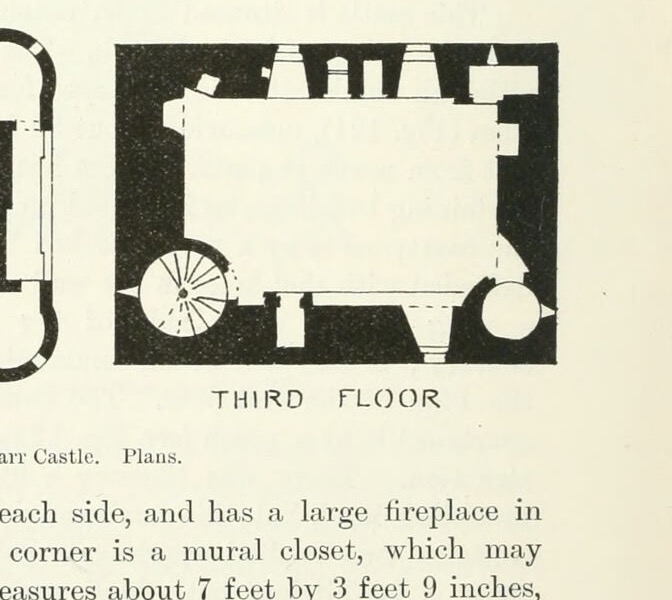
Barr Castle on paper: the measured plan and period views.
The survey plan and photographs below are the ground truth this page's reconstructions are checked against, drawn and photographed while the castle was still a working garrison. Every image is public-domain or openly licensed, with its source named.
KITCHEN / ENTRANCE / COURTYARD (plan block at left)
1889 · MacGibbon & Ross, vol. 3 (1889)
Public domain
FIRST FLOOR
1889 · MacGibbon & Ross, vol. 3 (1889)
Public domain
SECOND FLOOR
1889 · MacGibbon & Ross, vol. 3 (1889)
Public domain
Nearby