Scotland · Ruin
Craigie Castle
Craigie Castle is a medieval ruined fortification in South Ayrshire, Scotland, with fabric surviving mainly from the 15th century and earlier hall-house work dating to the 12th–13th centuries. The small castle stands on a knoll surrounded originally by ditches and marshy lochans and is a scheduled monument. Surviving fabric includes crumbling gables, portions of curtain wall, an arched entrance pend, and the shell of a high rib‑vaulted great hall.
Its prime
1450
Today
Ruin
As it stood in 1450
What Craigie Castle looked like in its prime.
By c.1450 the castle presented as a compact rectangular hall-house built of coarse grey masonry with coursed lower walls and rough rubble infill, its roofline defined by two prominent gables and a crenellated parapet. A south‑west arched entrance pend with a circular flanking bastion led over a drawbridge across ditches and lochans. The hall block rose over an unvaulted basement and contained a three‑bay rib‑vaulted great hall; the complex was set on a low knoll amid meadow and marsh.
Its story
The story of Craigie Castle.
Walter Hose's Fief and the Lindsay Inheritance, 1177–1371
The lands of Craigie were held in the 12th century by Walter fitz Alan, Steward of Scotland, with Walter Hose holding his fief from the Steward, and in 1177 Walter Hose of Cragyn gave the church of Cragyn to the monks of Paisley. The castle, Caisteil Chreagaidh in Gaelic, was originally built for the Lyndesay or Lindsay clan, and is recognised as one of the earliest buildings in the county. A second reading of the fabric makes the main building a hall house of the 12th or 13th century, incorporating an even earlier structure that may have been raised by the predecessors of Walter Hose, who held sway before Anglo-Norman control.
The Hose succession ran through John, probably Walter's son, to John's son Thomas, who left no heir, so that Thomas's sisters Christiana and Matilda inherited between them. Christiana's son by William Lyndesey of Crawfurd was Walter de Lyndesay, knight, and the Lindsay male line ran on until John de Lyndesey, whose daughter was the last heir. About 1371 she married John Wallace of Riccarton, who in the reign of David II had a charter of the lands of Moorlecere in Forfarshire and was styled 'Wallayis of Richardtoun'. From that date Craigie was the chief residence of the family.
The Ditches, the Drawbridge and the Vaulted Hall
The castle stands on a knoll rising out of a plateau between what appear to have been two marshes or lochans, and the ditches were originally cut between them, enclosing an area of about four acres. One ditch cuts the ridge 117 metres north-east of the castle to form an outer bailey. The castle would have been effectively isolated from the mainland, the water raising a significant barrier to any potential besieger at a period when the use of gunpowder was unknown. The entrance lay on the south-west side and was reached by a drawbridge whose abutment still survives; the entrance pend, or arched passage, was defended by a circular watch-tower or bastion, and within the closing wall a courtyard was surrounded by buildings, with a doorway from it into the great hall that has long been blocked up.
Writing in 1863, Paterson praised the high degree of military science employed in the construction, noting that besiegers would be exposed to raking crossfire even after crossing the ditches and would be outflanked on nearly all sides. Smith, in 1895, recorded a deep trench cut 145 paces to the north-east of the castle, running north-west to south-east for 162 paces to connect the two lochans, with a second trench near the south wall and the remains of a third on the west side. A 'Kragy' castle appears on Timothy Pont's map of about 1600, drawn on high ground with a prominent entrance way, wooded policies and a surrounding pale.
The present Gothic castellated ruins date mainly from the 15th century, with some 12th or 13th century work. The earlier hall carried a wide crenellated parapet rising flush with the main wall-face; during the 15th century those crenellations were built over and a new hall was fashioned on the walls of its predecessor. That hall was rib-vaulted in three bays over an unvaulted basement and is counted one of the finest vaulted halls in Scotland, its only rivals of the same period being Tulliallan, Bothwell and Auchendoun. It has been said that in its time Craigie was the most impressive building of its kind in Ayrshire.
Sark, Flodden and the Bailies of Kyle Stewart
John Wallace was Lieutenant-General to James II and fought at the Battle of Sark on 23 October 1448, killing the English general Magnus with his own hands. He was injured on the battlefield and died of his wounds at Craigie Castle about three months later. In the second half of the 15th century the family had Blind Harry write his poem The Wallace, which recorded the story of Sir William Wallace some 150 years after his death. An Adam Wallace was Comptroller of the Household of James III in 1468, and in 1489 John Wallace obtained a lease to mine coal near Kingcase in Prestwick.
John Wallace was killed at the Battle of Flodden in 1513. His brother Adam inherited and became oversman of Prestwick as well as Bailie of Kyle Stewart, and in 1515 he was made alderman of Ayr, controlling the Royal Burgh for a decade. The Wallaces of Craigie held the bailieship of Kyle Stewart heritably and as such were the chief local representatives of the Crown. In 1527 Gilbert Kennedy, 2nd Earl of Cassillis, was ambushed and murdered on the sand dunes at Prestwick, and Adam Wallace was implicated in the feud, an essentially Campbell-inspired one, because his wife, Dame Isabelle, was said to have planned the assassination, and the controversy cost the family prestige and influence.
In 1559 Sir John Wallace rode with the Earl of Glencairn, the Lords Boyd and Ochiltree, the Sheriff of Ayr, the Laird of Cessnock and others, taking a body of 2,500 men to Perth in support of the reformers. In the 1560s the family acquired Fail Monastery, though it was afterwards granted to Walter Whytford and passed out of their hands.
Newton, Philiphaugh and the Debts of Sir Hugh Wallace
The Wallaces had built Newton-on-Ayr Castle, previously known as Sanquhar, about the 15th century, but James V granted it to Sir William Hamilton, Provost of Ayr, in 1539. John Wallace of Craigie, with forty others, forcefully regained it in 1559 and was compelled to hand it back to the Hamiltons; it was returned to John Wallace of Burnbank, and in 1587 was occupied by James Stewart, Earl of Arran, by then called James Stewart of Sanquhar, with his brother Harry Stewart and his wife Elizabeth Stewart, Lady Lovat. In 1598 the Wallaces confirmed their ownership and moved in shortly after. The family's removal from Craigie is dated to 1588 by one account and to the years after 1598 by another; the old castle was then left to fall into ruin.
Sir Hugh Wallace stood with the Royalist cause of Charles I and Charles II, and his estate was sequestered, returning to him only when Charles II came to the throne. He had raised a regiment of foot at his own expense, which resulted in great debts, the sale of lands and, in 1626, the disposal of the heritable Kyle bailieship to the Crown for £10,000 Scots. Charles I knighted him, and in 1669 Charles II conferred a baronetcy upon him. All his sons predeceased him, and a grandnephew, Thomas, inherited; most liberal in his ideas, he fought with Montrose at the Battle of Philiphaugh and died about 1650.
The Lairds of Craigie are said to have cared little for the religious discipline of the presbyterians. Sir Hugh allowed his tenants or servants to work on Sundays and travelled openly upon the Sabbath, and the ministers of the neighbouring parishes wrote to his own minister, Mr Inglish, about such open and scandalous breaches. The laird ignored their advice, and in church he threw his sword at the minister, the blade sticking in the wood at the back of the pulpit; the minister recovered and told him that God would reduce his great stone house to a pile of stones that no one would be able to repair, and that the son of whom he had great hopes would die a fool. Before long the castle was in need of repair, and when the stonemasons started work a great part of it fell down and had almost buried them all. The story may have a grain of truth in that Sir Hugh was an ardent supporter of the episcopalian sentiments of Charles I and II and no friend of the Presbyterians.
Killiecrankie, the Campbells of Craigie and the Scheduled Ruin
Sir William Wallace commanded a cavalry under James VII, James II of England, and went into exile in France with him. He was at the Battle of Killiecrankie and died about 1700; his brother succeeded to estates much impoverished by Sir William's adherence to the Jacobite cause. Paterson recorded that the tower was undergoing some repairs at the end of the 17th century when a part of the roof fell in, after which the castle was completely abandoned.
In the 1730s Craigie House was built in Ayr as a replacement residence for Sir Thomas Wallace of Newton-on-Ayr Castle, the fifth baronet. In 1770 Sir Thomas Wallace died and the baronetcy was inherited by his grandson Thomas Dunlop, whose father was John Dunlop of that Ilk and whose mother was Frances Anne Wallace of Dunlop, Sir Thomas's daughter and sole heir. Thomas adopted the name Wallace, sold off the estate of Craigie in 1783, moved to England and died within three years. His son was Major-General Sir John Alexander Wallace, who fought in India, Egypt, Spain and France and died in 1857.
It was the belief of Mrs Frances Dunlop of Dunlop, a lineal descendant of William Wallace, that he was born at his grandfather's home of Craigie Castle and moved away only after a number of years had passed, the burgeoning family leaving too little space there; the claim is a family belief rather than a documented fact. An armorial plaque taken from the ruins, set in the wall of the steading at Craigie Mains, bears the impaled arms of the Lindsays and the Wallaces. In 1783 William Campbell, who had made his fortune in India, purchased the principal portion of the Craigie estate; his brother Richard Campbell of Craigie inherited in 1823, and the property remained in the Campbell family for a number of generations, until Ayr Town Council bought Craigie House and estate from them in 1940. The ruin on its knoll has been protected as a scheduled monument since 29 January 1955, and Clan Lindsay is the operator of the site.
Step inside
8 places to explore in 1450.
The record describes 8 distinct spots at Craigie Castle, including 4 interiors: entrance pend and circular watch bastion, inner courtyard and entrance to the great hall, three‑bay rib‑vaulted great hall and more. Create your own photoreal reconstruction and explore every one, more scenes means more rooms, more angles, and more of the place to stand in.
Build Your Own Castle
Recreate Craigie Castle with AI to explore it.
The artist rebuilds it as it stood in 1450, a photoreal reconstruction that belongs to you alone. Pay with coins, no subscription needed.
Recreate this castle →Defend this castle →Whose castle
Clans who held Craigie Castle.
The families that held Craigie Castle for a decade or more across its history, follow a name to its clan.
Lindsay
Originally built for the Lindsay (Lyndesay) clan; the last heir, a daughter, carried it to the Wallaces about 1371.
Passed by marriage to John Wallace of Riccarton about 1371.
From the archive
Craigie Castle on paper: the measured plan and period views.
The survey plan and photographs below are the ground truth this page's reconstructions are checked against, drawn and photographed while the castle was still a working garrison. Every image is public-domain or openly licensed, with its source named.
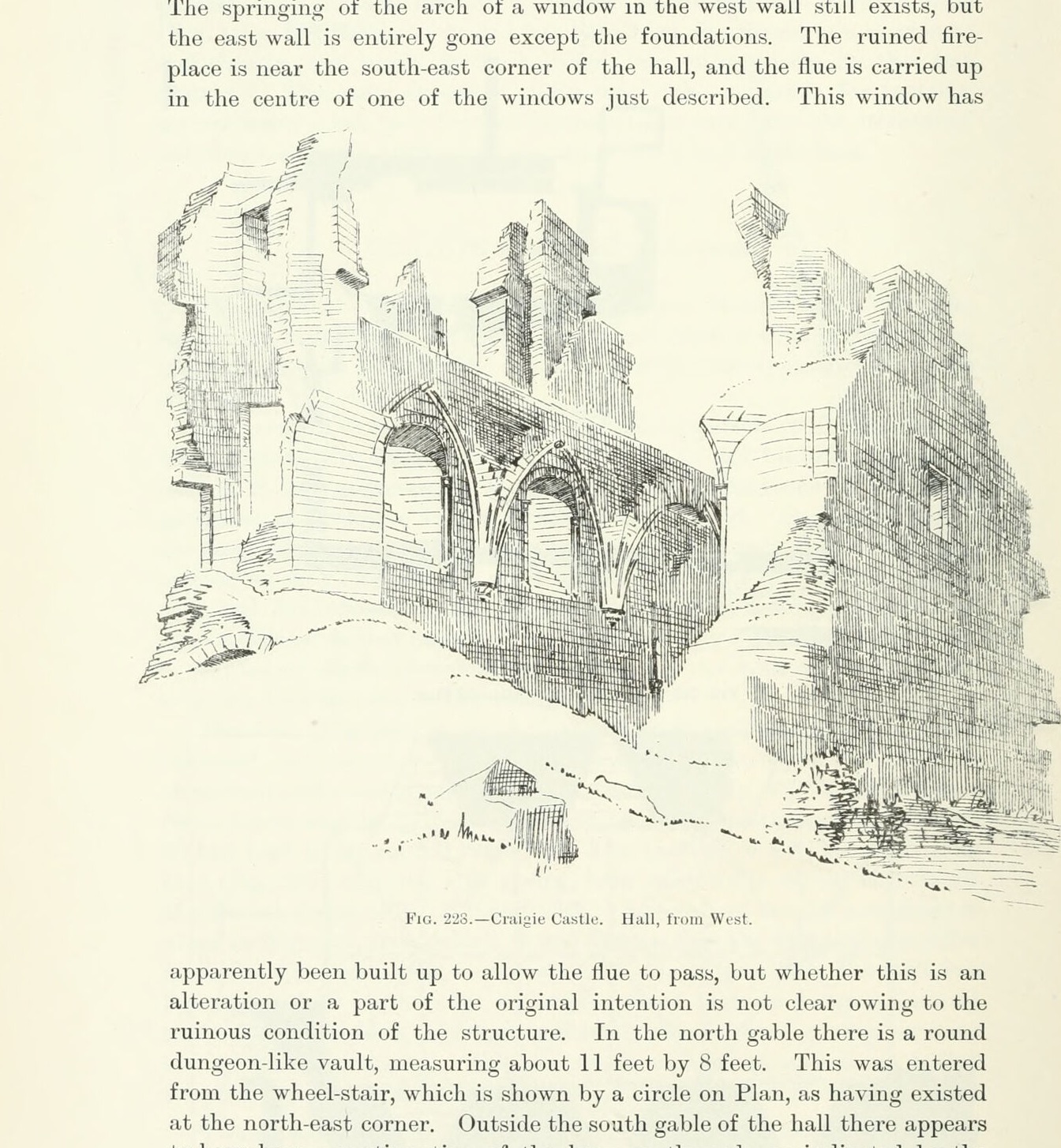
Fig. 223. Craigie Castle. Hall, from West.
1889 · MacGibbon & Ross, vol. 3 (1889)
Public domain
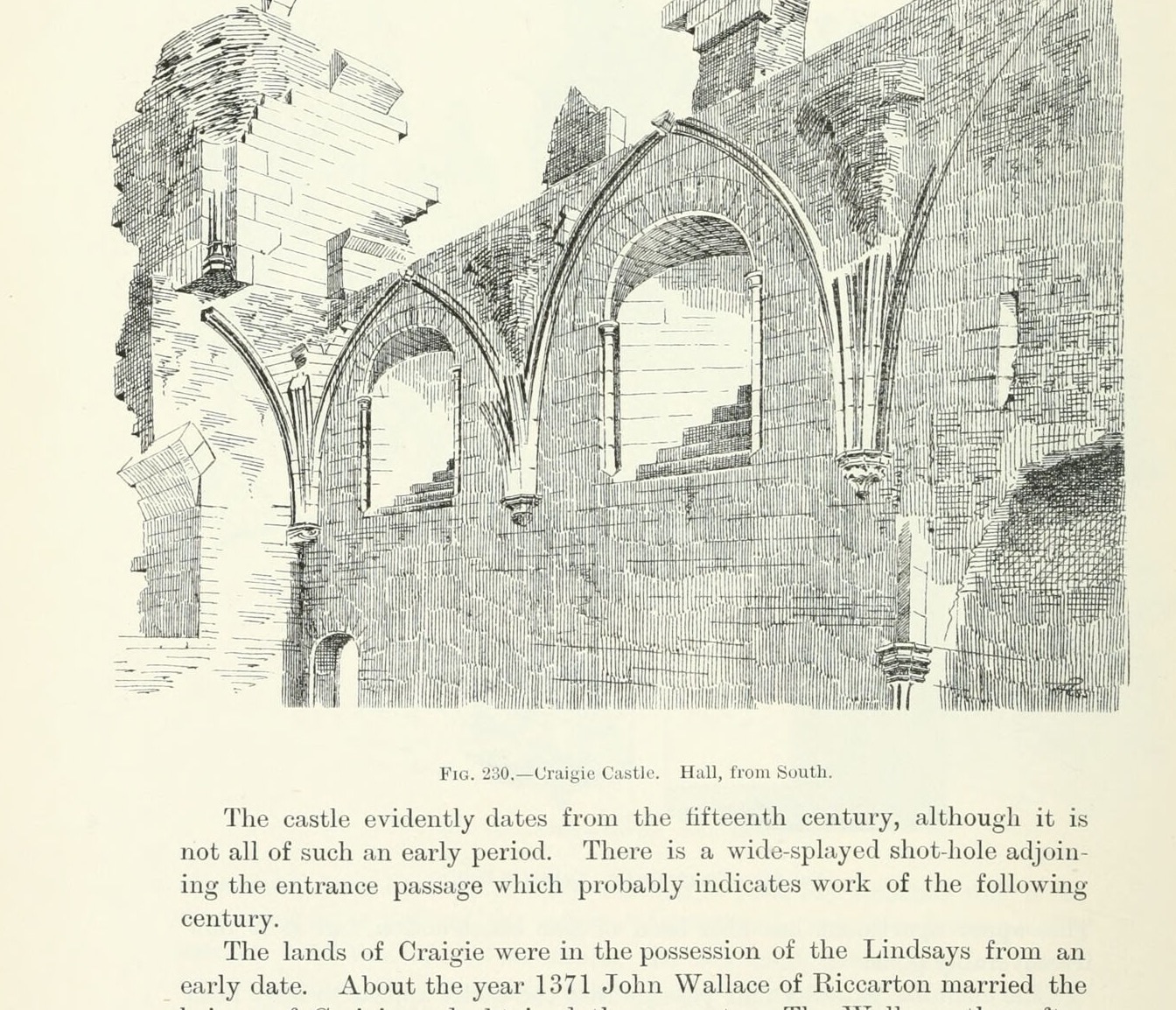
Fig. 230. Craigie Castle. Hall, from South.
1889 · MacGibbon & Ross, vol. 3 (1889)
Public domain
Nearby