Clan Fletcher
Arrow-makers to the great clans, patriots in their own right.
- Origin
- Argyll & the West Coast, Scotland
- Motto
- Dieu pour nous
- Famous bearer
- Andrew Fletcher of Saltoun (1653–1716), patriot and political theorist
- Register
- Scottish clan
The Fletcher arms, tartan and country

TartanFletcher tartanMicheletb · CC BY-SA 4.0 
Coat of armsFletcher of Fletcher armsBorne by the Fletcher line, one branch of the name rather than all of it.Czar Brodie · CC BY-SA 3.0 
Coat of armsCoat of arms of Fletcher baronets of Clea HallBorne by the Clea Hall line, one branch of the name rather than all of it.CC BY 4.0


- Tartan: The checked cloth the family is known by.
- Coat of arms: Granted to an individual and inherited down that one documented line. These are the arms of particular families of the name, not of everyone who shares the surname.
What is the Fletcher clan tartan?
One Fletcher sett is recorded, and it is the swatch above. A sett is the block of coloured bands the cloth is built from, repeated in both directions; the whole plaid is that one square enlarged.
Almost no clan tartan is medieval. Highland dress was proscribed from 1746 until 1782, and when it returned it returned as ceremony rather than everyday cloth, so the surname-to-sett map was fixed after the break, by the Bannockburn weavers’ pattern books, the royal visit to Edinburgh in 1822, and the Vestiarium Scoticum of 1842. The Fletchers wore tartan long before any of that. What the registers fixed was which one. Nobody polices any of it. Wearing the Fletcher sett declares allegiance to the name, not descent from any particular line of it.
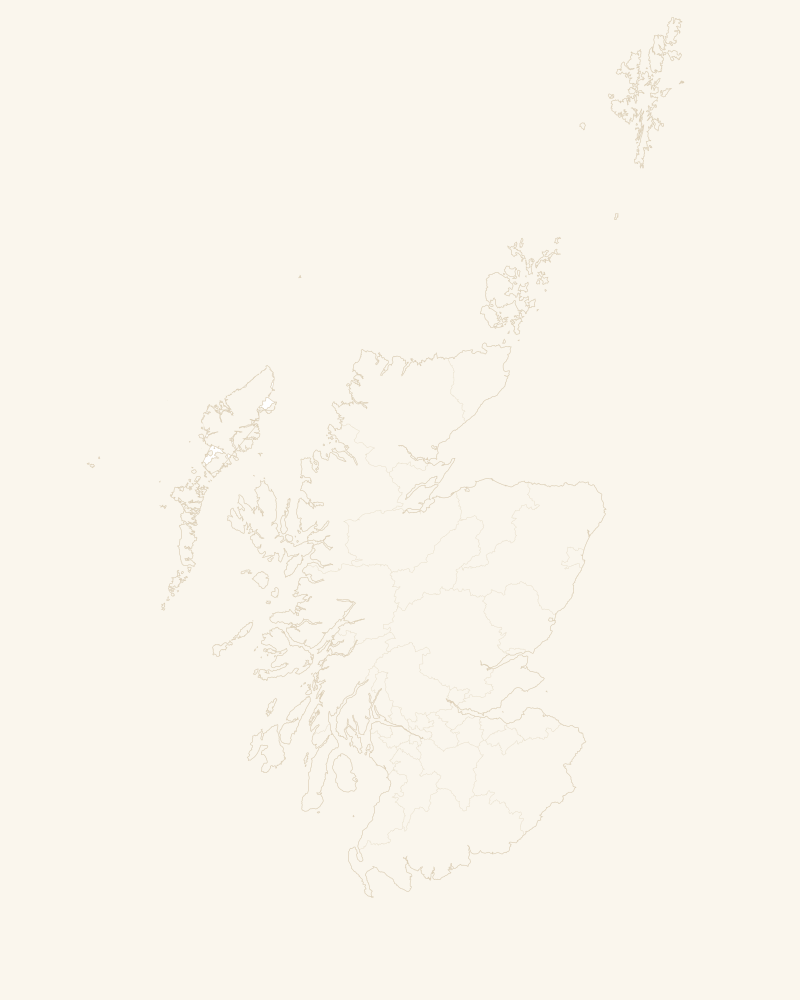
The seat of Clan Fletcher
Seat vacantChief
No one leads the Clan Fletcher community yet. When the movement opens, you can stand for its leadership, or help elect whoever does.
Current mission
No shared goal set yet. Once Clan Fletcher has leadership, it sets the public focus: a restoration, a gathering, a real-world project that helps its own.
The Fletcher clan is being rebuilt. Join the waiting list for the movement today, and you help decide who leads it and what it does.
Help rebuild the Fletcher clan →Motto
Dieu pour nous
“God for us”
What does the Fletcher name mean?
From the French 'flèche', arrow. The Fletchers were arrow-makers, and clans across Scotland included a Fletcher sept.
The history of Clan Fletcher
Three feathers, a shaft, and a war
The name is the work. Fletching is the fin-shaped stabiliser fixed to the back of an arrow, and a fletcher is the man who attaches it. The word travelled into English from the French flèche, arrow, which has its own roots in the Old Frankish fliukka, and it arrived attached to a specific set of hands. Traditionally the fletching was three matched half-feathers spaced equally around the shaft near the nock, though four were also used. In English archery the cock feather, taken from a male bird, went on the outside of the shaft, and the two hen feathers stabilised it from behind. They were fixed with glue and silk thread. The whole purpose of that fiddly, patient work was to stop the shaft tumbling in flight, because an arrow that tumbles is a stick thrown at a man in armour, and an arrow that spins is a weapon.
What a fletcher handled is known in detail because a shipload of his work survives. When the Mary Rose, a ship of Henry VIII's navy, capsized at Portsmouth in 1545, she took down more than 3,500 arrows with her. Analysis shows shafts mainly of poplar, with others of ash, beech and hazel, ranging from 24 to 33 inches long and averaging 30 inches. The commonest heads in military use were the short bodkin point and a small barbed arrow. Hunting work had a vocabulary of its own: broad-arrow, wolf-arrow, dog-arrow, Welsh arrow, Scottish arrow. A fletcher was not repeating one object. He matched shaft, weight, head and feather to the job the arrow was going to be asked to do.
He was not the only craftsman at the bench. The bow was the bowyer's trade, a wholly distinct craft: the preferred stave was yew, dried for one to two years and then slowly worked, the whole process taking up to four years, though professional bowyers supplying the English military could reportedly turn out a longbow in as little as two hours. The fletchers kept their own house. In the City of London they were traditionally associated with the Worshipful Company of Fletchers, their own guild, separate from the men who made the bows. When the surname dictionaries gloss Fletcher they render it arrowsmith (a maker and seller of arrows) and it is that sense, not the bowyer's, that the Gaelic borrowed.
Arrows by the hundred thousand
The scale of it is the part most readers never hear. War arrows were not made by the dozen for a huntsman; they were ordered in the thousands for medieval armies and navies and supplied in sheaves of twenty-four. Between 1341 and 1359 alone the English crown is known to have obtained 51,350 sheaves: 1,232,400 arrows. That is a state purchasing a consumable at industrial volume three centuries before industry, and every one of those shafts had been feathered by hand.
The arithmetic on the battlefield explains the appetite. A military longbow archer was typically issued between sixty and seventy-two arrows for a battle, and a modern war-bow archer does not like to try for more than six a minute with the heaviest bows. Archers stabbed their arrows upright into the ground at their feet to save the time it took to nock, draw and loose, and young boys were often employed to run fresh supplies up to the shooting lines while the fighting was on. Arrows were rationed, because they ran out. Massed longbowmen could produce what the accounts call a storm of arrows, and a storm is not a thing you conjure from a quiver.
That demand ran back down the supply chain and reshaped whole forests. The first documented import of yew bowstaves into England was in 1294, and by the Statute of Westminster 1472 every ship coming into an English port had to bring four bowstaves for every tun of cargo; Richard III raised it to ten. In 1483 the price of bowstaves rose from two to eight pounds per hundred, and by 1510 the Venetians were getting sixteen. In 1562 Bavaria pleaded with the Holy Roman Emperor to stop the cutting; by 1568 there was no yew left to justify a royal monopoly. A trade that ate the yew of central Europe was the trade the Fletchers were named for.
Archery was not a hobby, it was the law
English monarchs did not leave the supply of archers to enthusiasm. The Assize of Arms of 1252 required that all citizens, burgesses, free tenants, villeins and others between fifteen and sixty be armed, with a bow expected of any man holding land worth more than two pounds. In 1363 Edward III declared that every able-bodied man should on holidays make use in his games of bows and arrows, and so learn and practise archery, the plain reasoning being that a realm that practised was a realm from which longbowmen could be recruited at will. Compulsory practice was renewed in 1470, with hazel, ash and laburnum specifically allowed for practice bows because yew could not be had in quantity.
The pressure did not let up when guns arrived. In 1542 Henry VIII set a minimum practice range for adults shooting flight arrows at 220 yards, and anything below that had to be shot with heavy arrows; the longest mark shot at Finsbury Fields, the London practice ground, was 345 yards. The Crown banned other sports and fined men for failing to possess bows. In 1545 the scholar Roger Ascham published Toxophilus, worrying that shooting proficiency was sliding, an anxiety that already had two centuries behind it.
A nation of trained archers had consequences its rulers had not entirely intended. The same statute that armed the commons for the king's wars put a longbow in the hands of the men who rose in the Peasants' Revolt, and from the point at which the English yeoman class became proficient with the bow, the nobility had to take care not to push them into open rebellion. The trained bands, the home-defence militia of the Tudor period, kept the longbow as their main weapon until Elizabeth I disbanded them in 1598. The last recorded use of bows in an English battle may have been a skirmish at Bridgnorth in October 1642. For roughly four centuries, the fletcher's bench was part of the constitution.
How a workshop word became a family name
English surnames began as descriptions rather than inheritances (a man's trade, his father, his birthplace or his face) and hardened into fixed family names only over time. By 1400 most English families, and those of Lowland Scotland, had adopted hereditary surnames. Fletcher belongs to the great occupational class of that settlement, alongside Smith, Taylor and Miller: names that fixed a man to the work he did in a village where everyone knew which man that was. The difference is that Fletcher fixed him to a trade the Crown itself depended on.
There is a second and quite different route into the name, and the sources do not agree on which matters more. The surname is also Anglo-Norman and regional, taken from La Flèche in Maine. The progenitor named in that tradition is Jean de la Flèche, born about 1030 and dead about 1097, youngest son of Seigneur Lancelin I de Beaugency, who succeeded his father as second lord of La Flèche and held its castle. He married Paula of Maine, daughter of the Count of Maine; they were the parents of Elias I, Count of Maine, and the great-grandparents of King Henry II of England. Granted land in England by William the Conqueror for his services, he left descendants who settled in Yorkshire after the Norman Conquest. On this reading, Fletcher was more often not the surname of a working arrow-maker at all, but a territorial name that happened to sound like one.
Both stories are in the record, and a reader with the surname is entitled to know it. The trade route explains why the name recurs in so many unconnected places at once, because every district that shot arrows needed someone to feather them; the Norman route explains the aristocratic branches and the Yorkshire landings. The Scottish clan tradition holds both, tracing the first record of the name to Jean de la Flèche and a descendant's later move north, while insisting the name spread in Scotland because it was a very common trade name.
Mac an Fhleisteir: the arrow-makers of Glen Orchy
In Gaelic Scotland the name was not translated, it was borrowed. The English word passed into the Goidelic languages and produced Mac an Fhleisteir, the arrowsmith's son, and the trade word fleisdear. That borrowing is itself the evidence: the craft mattered enough in the Highlands for a foreign word to be taken in and given Gaelic grammar. In the eighteenth century some families went the full circle and anglicised the name back out of Mac-an-leistear into Fletcher, which is why a modern Fletcher in Ohio or Otago may carry a name that has crossed between two languages twice over.
Sometime after the eleventh century a band of Mac-an-leistears settled in Glen Orchy in Argyll, and there they became arrow-makers to Clan MacGregor. Other small groups settled in glens belonging to other clans for exactly the same reason: to make arrows for them. This is why Fletchers turn up all over Scotland: they followed the clans they supplied, with the Campbells and Stewarts in Argyll, with the MacGregors in Perthshire. A Highland chief could raise men, but men without arrows were farmers. The fletcher was a strategic asset, and he was housed accordingly.
The first recorded chief of the clan was Angus Mac-an-leister, born about 1450. In 1497 the clan joined the Stewarts of Appin and the Maclarens in a battle against the Clan MacDonald, and out of that fight came a bond of friendship between the Mac-an-leisters and the Stewarts, sealed by an oath sworn on the dirk. That is the moment the arrow-makers stop being suppliers in someone else's story and become a fighting kindred with allies of their own.
Duncan Campbell of Glenorchy and the loss of the glen
The clan's own lore records how the land went, and it is an ugly story. Duncan Campbell of Glenorchy stood in high royal favour with James VI and coveted the Mac-an-leisters' ground. He held royal authority to keep a large band of armed retainers, which he used in a campaign of intimidation and violence under the cover of keeping peace between warring clans in Argyllshire and Perthshire. He provoked a dispute with the Mac-an-leister chief and had a murder charge trumped up against him. The chief was compelled to sign a deed ceding all his family lands to the Campbells. From 1587 the Mac-an-leisters held Glen Orchy as tenants of the men who had taken it.
The stone record of that transfer still stands three miles from Bridge of Orchy. Achallader Castle is a ruined tower house of the sixteenth century, erected by the Campbells in the wake of their possession of the Mac-an-leister lands. It was set alight by the MacGregors in 1603 and burned again by Jacobites in 1689. The tower was not built to hold a frontier against a foreign enemy; it was built to hold a glen that had just changed hands.
This is also the honest context for the sept lists a diaspora reader will meet online. In Highland clanship, tenants and followers could take, or be given, the surname of a landlord or dominant clan without any shared descent. Most modern sept lists, moreover, date from the nineteenth century, when clan societies and tartan manufacturers drew up rolls linking as many surnames as possible to a particular clan regardless of whether any historical connection existed. Fletcher, being both common and a trade name, is exactly the sort of surname that got hoovered up. Clan Fletcher itself is recognised by the Lord Lyon King of Arms but is armigerous, having no chief currently recognised, a fact about heraldic law, not about whether the kindred was real.
The Fletchers of Saltoun and the patriot
The Lowland branch rose by trade and by law rather than by the sword. Robert Fletcher, a merchant and burgess of Dundee, bought the Innerpeffer estate in 1596, and his son Andrew Fletcher, Lord Innerpeffer, a judge, bought the Saltoun estates in 1643. Saltoun Hall stands five miles west of Haddington in East Lothian; the family held it until the late 1960s, well over three centuries in one house.
Lord Innerpeffer's grandson was Andrew Fletcher of Saltoun, born 1653 and dead 1716, remembered simply as the Patriot. He became MP for Haddington in 1678 and was forced to flee to Holland for supporting the Monmouth Rebellion against James II of England and VII of Scotland. He returned to fight the union with England from his seat in the Scottish Parliament, and his Speeches of 1703 against the proposed Union framed the foundational arguments of Scottish constitutional independence. He lost that argument in 1707. He also left political philosophy one of its most quoted lines, from his Account of a Conversation: that the maker of a nation's songs has more power than the maker of its laws.
The estate passed to his younger brother Henry, whose son Andrew Fletcher, Lord Milton, born 1692 and dead 1766, was another judge, rising to be Lord Justice Clerk and Keeper of the King's Signet. Three generations of Fletchers on the Scottish bench, and one of them the most eloquent opponent the Union ever had.
Other bearers held their own kinds of ground. Christian Fletcher, born about 1619 and dead in 1691, was the Scottish minister's wife who helped save the Honours of Scotland from destruction. John Fletcher, 1579 to 1625, was one of the great Jacobean playwrights, and Richard Fletcher, 1545 to 1596, an Anglican bishop. The name that started at a workbench had reached the pulpit, the playhouse and the regalia of the Scottish crown.
The risings, the Clearances and the road out
The Jacobite years split the name down the middle. In the rising of 1715, Archibald, the ninth chief of the clan, led the Mac-an-leisters out for the Jacobites. Thirty years later, in the rising of 1745, his younger brother John did the same, but Archibald supplied men to the British-Hanoverian forces under his Campbell overlords, and by doing so kept the clan's remaining lands out of forfeiture. Fletchers fought on both sides of the '45. Read cynically, that is a family hedging; read honestly, it is what tenancy under a powerful superior did to Highland kindreds who no longer owned the ground they stood on.
The ending came not from a battlefield but from a rent roll. During the Highland Clearances the majority of the Fletchers were evicted from Glenorchy by the Campbell Marquesses of Breadalbane, in the early 1800s, to make way for sheep. Hundreds of clansfolk were driven off land they had farmed for centuries and scattered into emigration, most of them to the United States and Canada. The wider pattern is well documented: chiefs turned into landlords, tenants were cleared into coastal crofts or shipped abroad, and a whole tier of Highland society disappeared inside two generations.
What Glenorchy keeps is the graves. There are twenty-nine Fletcher graves in the burial ground of Glenorchy kirk, and many more at Achallader Castle. That is the measure of what the Clearances did: a glen with more Fletchers under the turf than on it.
The name had begun its outward journey long before the evictions: Moses Fletcher, born about 1564 and dead in 1620, sailed on the Mayflower. By the time Breadalbane was finished, Fletchers were landing in the United States and Canada in numbers, and the surname is now carried by people who have never seen a yew tree or a glen. If you carry it, the odds are that somewhere behind you stands either a man who feathered arrows for a lord who could not fight without him, or a family moved off Glen Orchy so that sheep could stand where it had lived. Both are worth knowing. Neither is a small inheritance.
Champions of the Fletcher name
The bearers whose lives are inseparable from this surname. Each has their own page, biography, achievements, geography, connection to the family.
Historic Places, Rebuilt
Explore the streets and seats the Fletcher name knew, rebuilt with AI as they stood in history.
Historic Places, Rebuilt · New
The Campbells of Glenorchy's stronghold on its island in Loch Awe, garrisoned under Ben Cruachan.
Historic Places, Rebuilt · New
The holy isle at its medieval height, the abbey, the high crosses and the kings' graves, under the Lordship of the Isles.
Castles the Fletcher held
Strongholds this name held for a decade or more, look one up, or rebuild it to explore.
- Saltoun Hall
Bought by Andrew Fletcher, Lord Innerpeffer, in 1643; the family held the hall until the late 1960s.
The castles of the homeland
The great strongholds of the homeland, look one up, see what it looked like in its prime, and recreate it to explore.
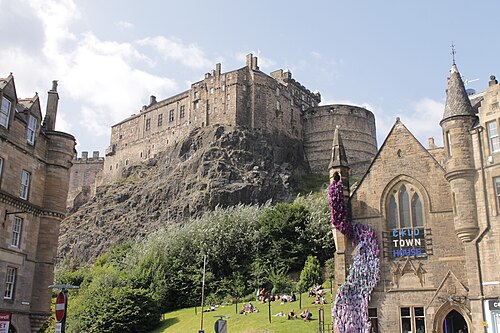 Edinburgh CastleRestored · prime 1520
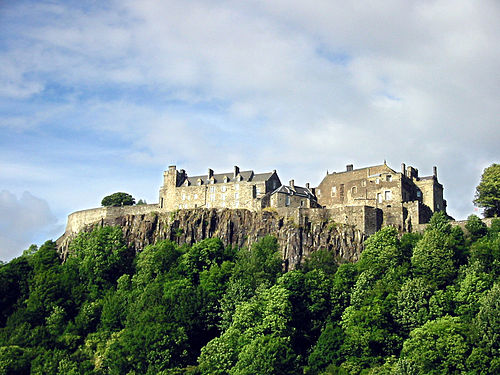 Stirling CastleRestored · prime 1542
 Glamis CastleStill standing · prime 1900
All castles in Scotland → · Strongest castles in Scotland → · Castles of Europe
Play As Your Clan
Hold a real castle against whatever you choose to send at it, take a ship out in her own service years, or stand at the shoulder of someone the record remembers. The chronicler sets the scene; the deeds are yours.
Notable bearers of the Fletcher name
- Andrew Fletcher of Saltoun (1653–1716), patriot and political theorist