Busbie Castle
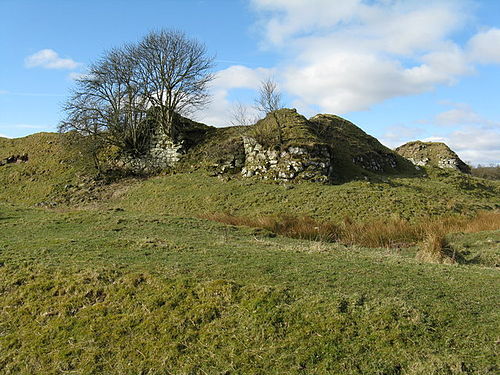
Busbie Castle was a medieval rectangular keep that stood near Knockentiber in East Ayrshire, overlooking the Carmel Glen and its burn. Built by the Mowat family in the medieval period, it survived in habitation into the 17th century, became ruinous by the 18th century and was demolished in the mid-20th century.
Its prime
1540
Today
Demolished
As it stood in 1540
What Busbie Castle looked like in its prime.
A compact rectangular stone keep roughly 40 by 25 feet and about 50 feet high, of three storeys with an entrance at ground level. A wheel-stair occupies the north-west angle, giving access to a large first-floor hall with a big fireplace and two window-seats; two cellars or stores lie at ground level. The fabric shows narrow arrow-slits and later gun-ports and a sculptured cable moulding winding around the walls. The keep sits on a rise overlooking the Carmel Glen, its burn and a nearby mill and hamlet.
Its story
The story of Busbie Castle.
Busbie Castle overlooked the Carmel Glen at what is now Knockentiber in East Ayrshire, a simple keep about 50 feet high, its first-floor hall reached by a wheel-stair, with two cellars on the ground floor. MacIntosh, writing in 1894, judged it 14th-century work, probably built by the Mowat family, who came from Flintshire in the 12th century.
The Mowat lairds cut violent figures in 16th-century Ayrshire: Charles Mowat, tutor to Hugh, Earl of Eglinton, in 1546, was involved with Lord Boyd in the 1547 murder of Sir Neil Montgomerie of Lainshaw, and the Mowat concerned was in turn slain in 1577 by William and Harrie Stewart, sons of Lord Ochiltree. In 1661 Hugh, Earl of Eglinton, inherited the lands of Busbie, Knockentiber and Robertown, his family having possessed them as far back as 1638.
James Ritchie of Craigton obtained the lands in 1763, succeeded by his son Henry in 1799, and the property later passed through General Sir James Wallace, who died in 1867, to William Wallace of Busbie and Cloncaird. A ruin since at least the 1770s, the castle was demolished in 1949 or 1952, having been unsafe for many years, and H. Ritchie had Busbie House erected as its replacement.
Step inside
10 places to explore in 1540.
The record describes 10 distinct spots at Busbie Castle, including 4 interiors: wheel-stair in the north-west angle, ground-floor cellars and stores, first-floor hall with fireplace and more. Create your own photoreal reconstruction and explore every one, more scenes means more rooms, more angles, and more of the place to stand in.
Build Your Own Castle
Recreate Busbie Castle with AI to explore it.
The artist rebuilds it as it stood in 1540, a photoreal reconstruction that belongs to you alone. Pay with coins, no subscription needed.
Recreate this castle →Defend this castle →Whose castle
Clans who held Busbie Castle.
The families that held Busbie Castle for a decade or more across its history, follow a name to its clan.
Mowat
Probably built by the Mowats, who came from Flintshire in the 12th century; Mowat lairds of Busbie held it through the 16th century.
Montgomerie
The Earls of Eglinton possessed the Busbie lands from at least 1638; Hugh, Earl of Eglinton, inherited them in 1661.
Ritchie
James Ritchie of Craigton obtained the lands in 1763, succeeded by his son Henry in 1799.
Passed through General Sir James Wallace (d. 1867) to William Wallace of Busbie and Cloncaird.
From the archive
Busbie Castle on paper: the measured plan and period views.
The survey plan and photographs below are the ground truth this page's reconstructions are checked against, drawn and photographed while the castle was still a working garrison. Every image is public-domain or openly licensed, with its source named.
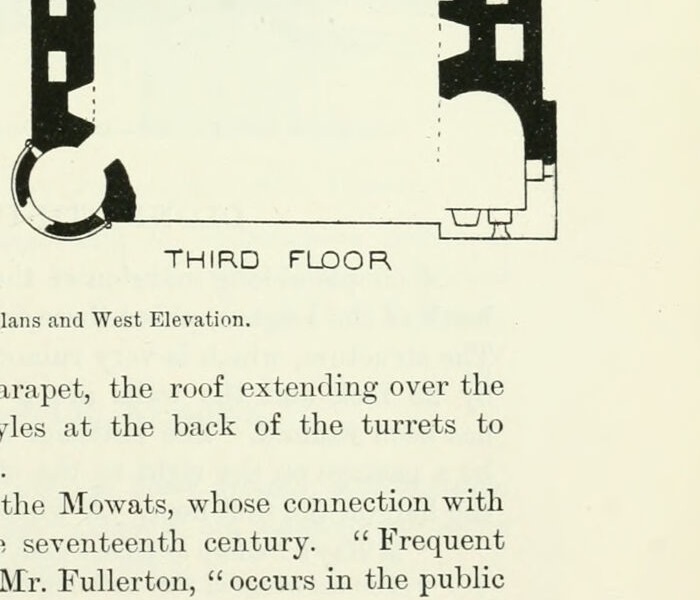
SECOND FLOOR
1889 · MacGibbon & Ross, vol. 3 (1889)
Public domain
FIRST FLOOR
1889 · MacGibbon & Ross, vol. 3 (1889)
Public domain
GROUND FLOOR
1889 · MacGibbon & Ross, vol. 3 (1889)
Public domain
Nearby