
Scotland · Ruin
Coeffin
Coeffin Castle is a medieval ruin on the north-west promontory of Lismore island in Loch Linnhe, Argyll, Scotland. Built in the 13th century, it comprises an oblong hall-house with a later irregular bailey and has not been regularly occupied since the post-medieval period. The site sits on a rocky headland facing Glensanda across the loch.
Its prime
1400
Today
Ruin
As it stood in 1400
What Coeffin looked like in its prime.
Set on a rocky north-west promontory of Lismore, the castle in its prime is a compact stone complex: a single large oblong hall-house (about 20.3 by 10.4 m) with very thick masonry walls and an attached, irregularly shaped bailey defended by lower stone enclosures. The entrance lies in the north-east wall with an external stair linking down to the bailey; a second doorway opens to the sea on the south-west side. The site faces Loch Linnhe with open sea views to Glensanda.
Its story
The story of Coeffin.
Castle Coeffin stands on a promontory on the north-west coast of Lismore in Loch Linnhe, facing Glensanda across the water, the island that was also home to Moluag's Cathedral, seat of the Bishop of Argyll. Built in the 13th century, the castle comprises an oblong hall-house with a later, irregular bailey.
The castle's first written record comes in 1469–70, when it was granted to Sir Colin Campbell of Glenorchy by Colin Campbell, 1st Earl of Argyll. It has not been regularly occupied since the post-medieval period, and survives as a ruin on its rocky headland.
Step inside
7 places to explore in 1400.
The record describes 7 distinct spots at Coeffin, including 1 interior: great hall interior. Create your own photoreal reconstruction and explore every one, more scenes means more rooms, more angles, and more of the place to stand in.
Build Your Own Castle
Recreate Coeffin with AI to explore it.
The artist rebuilds it as it stood in 1400, a photoreal reconstruction that belongs to you alone. Pay with coins, no subscription needed.
Recreate this castle →Defend this castle →Whose castle
Clans who held Coeffin.
The families that held Coeffin for a decade or more across its history, follow a name to its clan.
Granted to Sir Colin Campbell of Glenorchy by Colin Campbell, 1st Earl of Argyll, in 1469–70, the castle's first written record.
From the archive
Coeffin on paper: the measured plan and period views.
The survey plan and photographs below are the ground truth this page's reconstructions are checked against, drawn and photographed while the castle was still a working garrison. Every image is public-domain or openly licensed, with its source named.
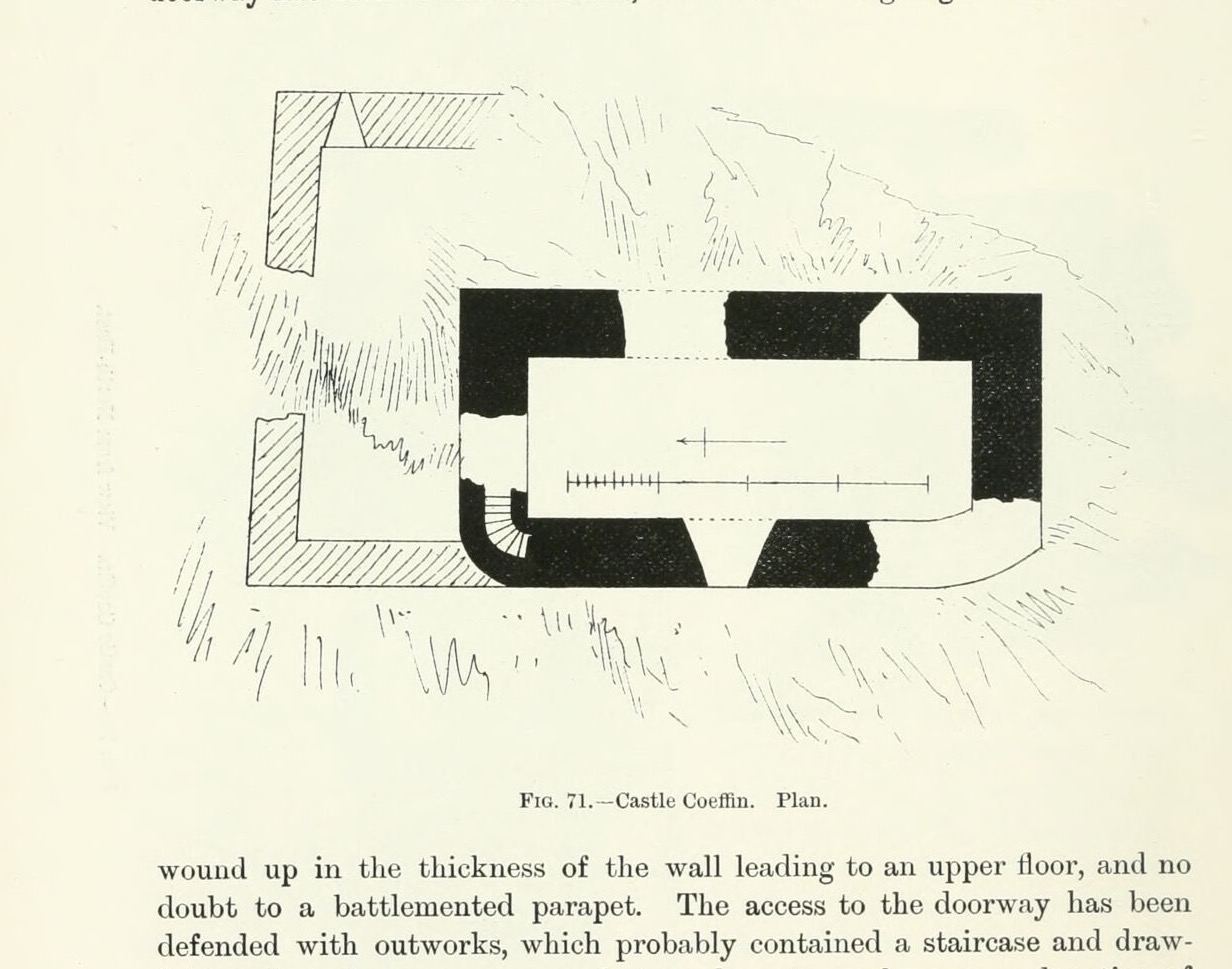
Fig. 71. Castle Coeffin. Plan.
1889 · MacGibbon & Ross, vol. 3 (1889)
Public domain


