Scotland · Partial ruin
Dundonald Castle
Caisteal Dhùn Dòmhnaill
Dundonald Castle is a late 14th-century Scottish tower house and barmkin standing on a low hill above the village of Dundonald in South Ayrshire. Built for Robert II around his accession, the present stone keep and enclosing courtyard survive as the principal visible fabric and are interpreted and conserved as a scheduled monument.
Its prime
1390
Today
Partial ruin
As it stood in 1390
What Dundonald Castle looked like in its prime.
A three-storey rectangular stone tower house of grey rubble and ashlar, set on a low hill with a low enclosing barmkin curtain wall and ancillary ranges abutting it. The keep rises as a blocky vertical mass with irregular arched and slit openings and a visible single course of projecting ashlar at its base; masonry is roughly coursed local stone. In its prime the tower and adjoining courtyard buildings presented a complete defended household complex with stone-vaulted lower levels and open courtyard.
Its story
The story of Dundonald Castle.
The Vitrified Hillfort and the Name Dundonald
Before any castle stood on the hill above Dundonald, a hillfort occupied the site, its interior a mix of large timber-built roundhouses and straight-sided structures enclosed by a timber-laced stone rampart. The timber lacing caught fire and burned so fiercely that the surrounding stonework melted, or vitrified, a firing that took place around 1000 AD and appears to mark the end of the hillfort's use, at roughly the time the British kingdom of Strathclyde was absorbed into the kingdom of Scotland.
The name Dundonald means "fort of Donald", derived from the British Din Dyfnwal; the personal name Dyfnwal it contains is cognate with the Scottish Gaelic Dòmhnall and the English Donald. The king it commemorates is unknown, though he may have been one of the several kings of Alt Clut, or Strathclyde, who bore the name Dyfnwal between the eighth and tenth centuries.
Alexander Stewart's Castle and Bruce's Slighting, Early 14th Century
The first castle on the hill was built by one of the stewards of the king of Scots, probably Walter, the first steward, who came to Scotland in 1136; no trace of it survives above ground. In the late 13th century Alexander Stewart, 4th High Steward, replaced it with a predominantly stone castle that would have ranked among the grandest baronial residences of its time.
It did not last: the castle was largely destroyed by the Scots during the Wars of Scottish Independence in the early 14th century, part of Robert the Bruce's policy of slighting castles (including far greater ones, such as Edinburgh and Roxburgh), so they could not be held by an enemy. Little of Alexander Stewart's castle remains beyond a well and the rounded stump of a tower.
Robert II's Tower House, 1371
The third castle, built by Robert Stewart probably to mark his accession to the Scottish throne as Robert II in 1371, is substantially what still stands on the hill today. Three storeys tall, its top floor held the great hall for the private use of the king and his family, the floor below, the laigh hall, was used for public feasting and the baron court, and the ground floor served as storage, probably subdivided into cellars for wine, ale, foodstuffs and fuel.
The tower house was extended in the late 14th century with further private chambers and a prison, and its outer courtyard, or barmkin, was completed with stables, bakehouses, brewhouses and a smithy ranged against the wall. It had its own chapel, dedicated to Saint Inan, and served as a royal residence for Robert II and his son Robert III.
From the Wallaces to the Earls of Dundonald, 1520–1953
By 1520 the castle belonged to the Wallaces of Craigie. In 1536 James V granted it and its estates to Robert Boyd, but Boyd could not make good his claim, and after a second failed attempt at eviction he ceded control back to the Wallaces. Debt forced the family to sell in 1632 (by then they had already built Auchens House, in part with stone taken from Dundonald itself), and the castle passed to James Mathieson before Sir William Cochrane bought it, together with Auchens, in 1638.
Cochrane was created 1st Earl of Dundonald in 1669 for his support of the Royalist cause in the Wars of the Three Kingdoms. The Cochranes sold the Dundonald estate in 1726 but kept the by-then ruined castle, which stayed in the family until 1953, when the 13th Earl gave it to the state and a programme of reconstruction began. It had been scheduled as a monument in 1920, and the castle is now owned by Historic Scotland, operated together with its visitor centre by the Friends of Dundonald Castle.
Step inside
9 places to explore in 1390.
The record describes 9 distinct spots at Dundonald Castle, including 5 interiors: upper hall (great hall), laigh hall (lower hall), ground-floor cellars and stores and more. Create your own photoreal reconstruction and explore every one, more scenes means more rooms, more angles, and more of the place to stand in.
Build Your Own Castle
Recreate Dundonald Castle with AI to explore it.
The artist rebuilds it as it stood in 1390, a photoreal reconstruction that belongs to you alone. Pay with coins, no subscription needed.
Recreate this castle →Defend this castle →Whose castle
Clans who held Dundonald Castle.
The families that held Dundonald Castle for a decade or more across its history, follow a name to its clan.
Seat of the Stewarts from the first steward's castle of the 12th century; rebuilt by Robert Stewart on his accession as Robert II in 1371.
Held by the Wallaces from the 1530s until debt forced its sale in 1632.
Cochrane
Bought by Sir William Cochrane in 1638; created Earl of Dundonald in 1669, the family kept the ruined castle even after selling the estate in 1726.
From the archive
Dundonald Castle on paper: the measured plan and period views.
The survey plan and photographs below are the ground truth this page's reconstructions are checked against, drawn and photographed while the castle was still a working garrison. Every image is public-domain or openly licensed, with its source named.
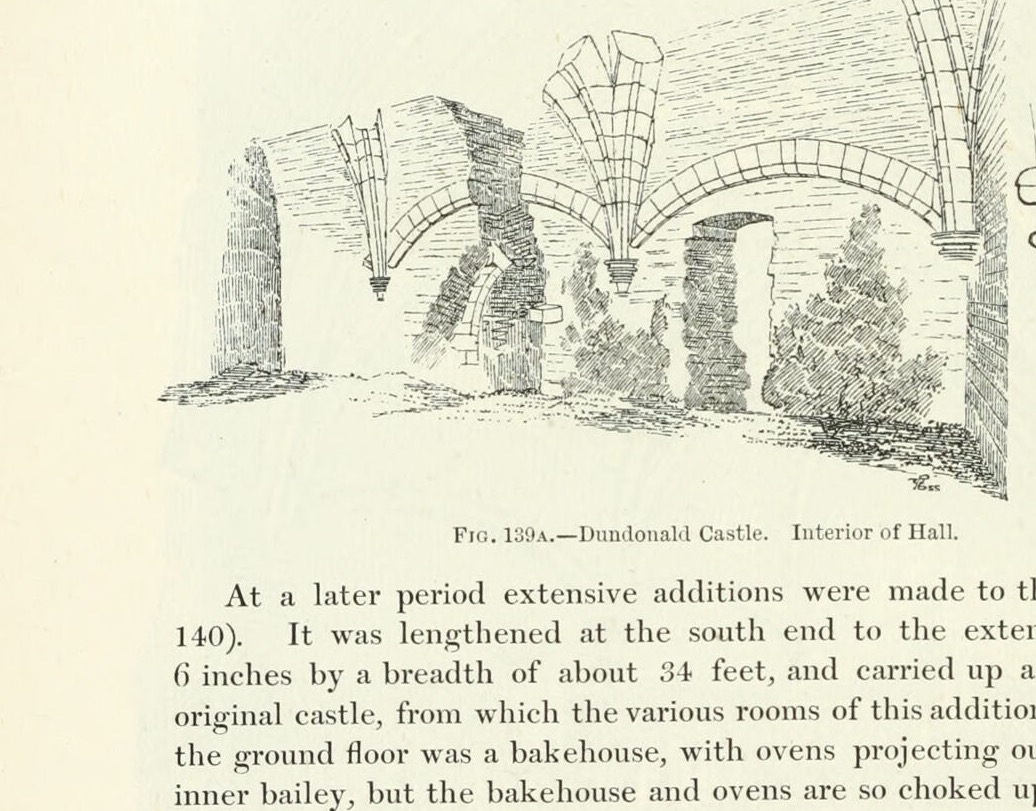
Fig. 139A. Dundonald Castle. Interior of Hall.
1887 · MacGibbon & Ross, Castellated and Domestic Architecture of Scotland, vol. 1 (1887)
Public domain
Nearby