Davitt
also Mac Dáibhéid
The Mayo cottier family that came back from Lancashire to found the Land League.
- Origin
- Connacht, Ireland
- Famous bearer
- Michael Davitt (1846–1906), founder of the Irish National Land League
- Register
- Irish family
Where the Davitt name comes from
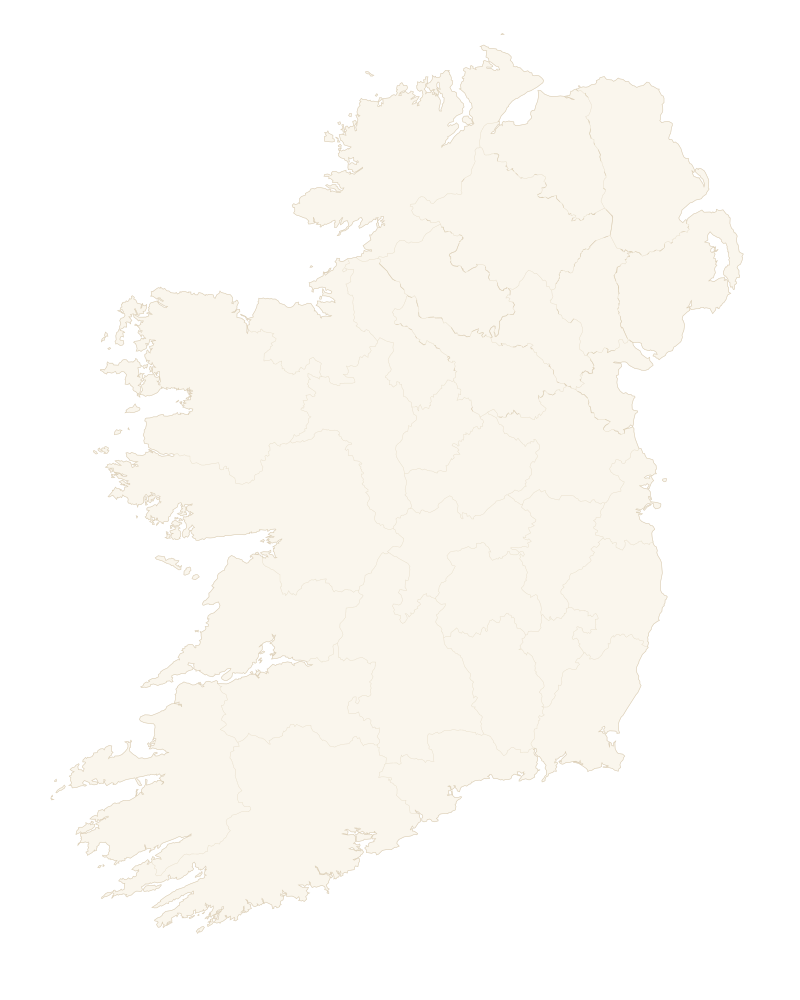
The seat of Davitt
Seat vacantChief
No one leads the Davitt community yet. When the movement opens, you can stand for its leadership, or help elect whoever does.
Current mission
No shared goal set yet. Once Davitt has leadership, it sets the public focus: a restoration, a gathering, a real-world project that helps its own.
The Davitt clan is being rebuilt. Join the waiting list for the movement today, and you help decide who leads it and what it does.
Help rebuild the Davitt clan →What does the Davitt name mean?
From the Gaelic Mac Dáibhéid, son of Dáibhéad (the Irish form of David). The Davitts were a Mayo-Irish-Catholic landholding family of the western county whose Catholic-tenant line was largely dispossessed in the eighteenth-century Penal Laws. The most famous bearer, Michael Davitt, was the son of an evicted Mayo cottier family who emigrated to Lancashire in the famine years and grew up in Haslingden.
The history of Davitt
Mac Dáibhéid, and the Mac the clerks dropped
Two small words built most Irish surnames. Mac meant son, Ó meant descendant, and either could be set in front of a father's name to make a family out of a household: Mac Siúrtáin from Jordan, Ó Dónaill from Dónall. Davitt is one of these. The Irish form is Mac Dáibhéid, son of Dáibhéad, which is the Irish shape of David, and the name belongs to Mayo in the Connacht west.
Anglicising clerks then did to it what they did to thousands of Gaelic names, stripping the prefix off. Mac Dáibhéid lost its Mac and reached the registers as Davitt. The Mayo family carrying the shortened spelling were Catholic landholders whose tenure was largely broken up under the eighteenth-century Penal Laws, and by the nineteenth century they held ground as small tenants on another man's estate.
Straide, 1846, and the crowbar four years later
Michael Davitt was born at Straide in County Mayo on the twenty-fifth of March 1846, during the Great Famine, to Martin and Catherine Davitt. They held a few acres on the Lucan estate and Irish was the language of the house. Martin was literate and had English too, and he had been out in the Ribbon movement in the 1830s, the agrarian secret societies of the Irish countryside; the politics his son later made national were already at the family hearth. In 1850 the family was evicted for arrears of rent. Michael was four, and he remembered it: he said afterwards that every misfortune the family suffered came out of that morning. They took ship to Liverpool and walked from the docks to Haslingden in east Lancashire.
Davitt argued about what was taken from them for the rest of his life. He held that Irish landlordism was feudal in nature and imposed from outside, and called his 1904 book The Fall of Feudalism in Ireland. The irony he was pressing is real: under the manorial and open-field arrangements of medieval Europe almost nobody owned land outright, and the lord could not turn a tenant off without legal cause. Treating land as a commodity dissolved that security, and the Mayo cottier of 1850 held on worse terms than a medieval villein.
Haslingden: the cotton mill, the arm, and Ernest Jones
In Lancashire both parents sold fruit and took whatever work was going, and the house was shared with other Irish families; Martin ran a night school in it. They met the settled hostility of the English working class towards Irish incomers, who were held to be undercutting wages. Michael went into a cotton mill as a labourer at nine. Two years later his right arm was caught in a cogwheel and so badly crushed that it was amputated ten days after. He received no compensation, which was normal for the time.
His biographer Carla King judges that the accident saved him from a lifetime of mill drudgery. While he recovered, a local philanthropist named John Dean paid for him to attend a Wesleyan school, and in August 1861, at fifteen, he found work in a post office that also ran a printing business. He joined the Mechanics' Institute and went to lectures on anything offered. Chartism ran on longer there than elsewhere, and the Chartist leader Ernest Charles Jones was, Davitt said, the first Englishman he ever heard denounce landlordism in Ireland. King reads him as headed for life as an upwardly mobile working-class radical. In 1865 he joined the Irish Republican Brotherhood instead.
Chester Castle, Paddington, and seven and a half years
The IRB was a secret society committed to ending British rule by force, and among the Irish of Haslingden it was close to universal; one member recalled that every smart respectable young fellow in the town was in it. Davitt was soon elected head of the Rossendale chapter, about fifty men. In February 1867 he led fifty Fenians on a raid on Chester Castle to seize arms for the rising planned for later that year, worked out that the police had been told and were waiting, and got every one of his men away uncaught. In 1868 he went full time for the IRB as its organising secretary and arms agent for England and Scotland, travelling under cover as a commercial salesman.
The authorities had wanted him since 1867 without grasping how important he was. He was arrested at Paddington Station on the fourteenth of May 1870 while waiting for a delivery of arms, tried at the Old Bailey that July, convicted of treason felony and given fifteen years' penal servitude.
He was held at Millbank, Dartmoor and Portsmouth, spent months in solitary confinement, and did hard labour on rations that damaged his health for good. His objection was to being handled as an ordinary criminal when he considered himself a political prisoner, and in 1872 he smuggled out a letter that was printed in several newspapers and forced the Home Secretary to open an inquiry. Pressure from the Home Rule League for a general amnesty got him out on parole on the nineteenth of December 1877, after seven and a half years. The experience left him a lifelong advocate of humane conditions for every prisoner and not merely political ones, which set him apart from almost every other Irish nationalist who had done time.
The New Departure and the Land League of Mayo
In July 1878, his father now dead, Davitt crossed to the United States to see the family he had sent out before his arrest and to raise the fare home for his mother and youngest sister by lecturing. Clan na Gael and its leader John Devoy ran him on a tour that lasted until December, and out of those meetings came the strategy he called the New Departure: an informal alliance between the physical-force and parliamentary wings of Irish nationalism, with the land question as the ground both could stand on. It was sealed in Dublin on the first of June 1879 between Davitt, Devoy and Charles Stewart Parnell.
The west then supplied the crisis. The 1879 famine was a compound of heavy rain, failed yields and collapsed prices, and it brought real hunger back to Mayo. Davitt spent that year organising mass meetings across the county, at one of which he called for the liberation of Ireland from the land robbers who seized it. On the sixteenth of August 1879 the Land League of Mayo was founded at Castlebar; on the twenty-first of October it was superseded by a national body in Dublin, the Irish National Land League, with Parnell as president and Davitt as one of its secretaries.
Its slogan, the land for the people, was loose enough for nationalists of every stripe to sign up to, and its speed of growth alarmed Dublin Castle. It cost Davitt his standing among the men he had come from: the IRB expelled him from its Supreme Council in May 1880 for working with a parliamentarian.
Branches, dollars, and the Ladies' Land League
A movement of tenant farmers had no money of its own, and the money came from America. In May 1880 Davitt went out to raise it, telling audiences that what he wanted funded was political action to lift the Irish peasant out of the humiliation of a beggar's position. At the first convention of the Central Provisional Council of the American Land League he was made its secretary, which put the machinery as well as the funds in his hands: his brief was to improve the League's organisation and get local branches set up. He was there thirteen weeks, and for that stretch he and Lawrence Walsh were effectively the only national leaders working, with Anna Parnell assisting them closely.
That was Davitt's particular contribution and it is the part most easily missed. He was the organiser, the man who built the branch structure and the funding line that turned scattered Mayo meetings into a national body with an American treasury behind it. The ostracism of Captain Charles Boycott at Lough Mask outside Ballinrobe in the autumn of 1880 was the method working as designed.
When the Liberal government answered with the Protection of Persons and Property Act of 1881, allowing internment without trial, everyone knew the male leadership would be lifted. It was Davitt's idea to set up a Ladies' Land League to carry the work on when they were, and he backed it in early 1882 after Parnell had denounced it.
Coercion, Portland, and the Act of 1881
On the third of February 1881 Davitt's ticket of leave was revoked; he was arrested in Dublin and sent back to Millbank. The Irish members protested so violently in the Commons that thirty-six were expelled from the chamber. Close to a thousand people were taken up under the Coercion Act, and agrarian crime went on rising regardless. In April the government brought in the Land Law (Ireland) Act 1881, which granted the three things the tenants had demanded: fair rent, fixity of tenure, free sale. The League attacked it as insufficient because it stopped short of the tenant owning his farm. Davitt's own later verdict was that it had struck a mortal blow at Irish landlordism.
He served most of this second sentence at Portland, where his fame and his health bought better conditions, and he came out of it with a changed position. Reading Henry George convinced him that even peasant proprietorship would not deliver the land to the people: public money spent buying out landlords would never reach the landless labourer, and the smallholdings created would be consolidated back into estates soon enough. From 1882 he argued instead for compulsory land nationalisation with compensation, the ground rent going to the state and back out on public works.
Parnell and the other leaders were arrested in October 1881. The League replied on the eighteenth with the No Rent Manifesto, calling on tenants to pay nothing until the leadership was freed, and two days later the government suppressed the League. Davitt was released in May 1882 under the Kilmainham Treaty: some 130,000 tenants in arrears, shut out of the rent-fixing the 1881 Act allowed, were amnestied, and in exchange the parliamentary party dropped agrarian agitation and withdrew the manifesto. That was the end of the Land League.
Skye, Ballybrack, and a penny weekly called Labour World
Arrested for sedition in February 1883, Davitt served four months, his last time in a cell. He had agreed the previous September to shelve his land-nationalisation campaign and join Parnell in founding the Irish National League, which took a few of his ideas and was otherwise run by the conservative wing. He went often to Scotland instead and tied himself into the crofters' fight in the Highlands and Islands, working with John Ferguson, the Irish leader in Glasgow. On the centenary of his death a plaque went up at the Portree Hotel on Skye for his part in the Highland land agitation of the 1880s, unveiled by his grandson, Fr. Tom Davitt.
He married Mary Yore, an Irish-American he had met on the 1880 tour, at Oakland in California on the thirtieth of December 1886. They settled in a cottage at Ballybrack in County Dublin, the only gift he ever accepted from his admirers, and had five children; their son Robert became a TD and their son Cahir President of the High Court. From 1880 Davitt earned his living by journalism, and in September 1890 he founded the socialist penny weekly Labour World, which ran foreign news, the condition of agricultural labourers and the position of women in the workplace, sold sixty thousand copies of its second number, and closed the following year.
South Mayo, the Boer War, and the grave at Straide
Through the 1880s Davitt refused to stand for parliament at all, on the grounds that he was more use as an agitator; he called the place the parliamentary penitentiary. He was elected for North Meath in 1892 and unseated on petition, then returned unopposed for North East Cork in February 1893, making his maiden speech in April for the Home Rule Bill, which carried the Commons and was thrown out by the Lords in September. Bankrupted in 1893 by the money he had put into his own campaign, he gave up the seat and spent seven months of 1895 touring Australia and New Zealand, which produced Life and Progress in Australasia.
He was returned in his absence for both South Mayo and East Kerry, and took Mayo because he was born there. After the Local Government (Ireland) Act of 1898 handed county and district councils control of local affairs in place of Home Rule, he joined William O'Brien in founding the United Irish League to press for grazing land to be redistributed to small farmers. He left the Commons for good on the twenty-sixth of October 1899, after denouncing the Second Boer War and the ten million pounds Ireland was required to pay towards a war it opposed, calling it the greatest infamy of the nineteenth century. Commissioned by the New York American and the Freeman's Journal, he reached Pretoria on the twenty-sixth of March 1900 and spent three months visiting the Irish units serving with the Boers.
The United Irish League grew to an estimated 989 branches and a hundred thousand members by August 1901, and Davitt was in America raising funds with John Dillon when the 1902 land conference sat, so the Land Purchase (Ireland) Act of 1903 was settled before he got back. He criticised its generosity to landlords selling up, and the tenant left paying land annuities to the Land Commission in place of rent, on the principle that the land had belonged to the people in the first place. He died at Elpis Hospital in Dublin on the thirtieth of May 1906, at sixty. He had asked for no public notice and got none, but Dublin shut its shops and the procession from the station at Foxford out to Straide ran almost a mile. To all my friends I leave kind thoughts, he wrote in his will, to my enemies the fullest possible forgiveness and to Ireland the undying prayer for absolute freedom and independence, which it was my life's ambition to try and obtain for her. The old penal church at Straide is now his museum, and the bridge he opened to Achill Island in 1887 was rebuilt in 1947 and kept his name.
Champions of the Davitt name
The bearers whose lives are inseparable from this surname. Each has their own page, biography, achievements, geography, connection to the family.
The castles of the homeland
The great strongholds of the homeland, look one up, see what it looked like in its prime, and recreate it to explore.
 Ashford Castle, County MayoRestored · prime 1880
 Manderley CastleRestored · prime 1840
 Dublin CastleRestored · prime 1790
All castles in Ireland → · Strongest castles in Ireland → · Castles of Europe
Play As Your Clan
Hold a real castle against whatever you choose to send at it, take a ship out in her own service years, or stand at the shoulder of someone the record remembers. The chronicler sets the scene; the deeds are yours.
Notable bearers of the Davitt name
- Michael Davitt (1846–1906), founder of the Irish National Land League