Walsh
also Welsh, Welch, Breathnach, Brannagh
The fourth most common Irish surname, the families the Irish called 'the Welsh'.
- Origin
- Connacht, Ireland
- Motto
- Transfixus sed non mortuus
- Famous bearer
- Maurice Walsh (1879–1964), writer, author of The Quiet Man
- Register
- Irish family
The Walsh arms and country

Coat of armsArms of WalshEccekevin · CC BY-SA 4.0 
Coat of armsWalsh Family Coat of ArmsZooFari · Public domain


- Coat of arms: Granted to an individual and inherited down that one documented line. These are the arms of particular families of the name, not of everyone who shares the surname.
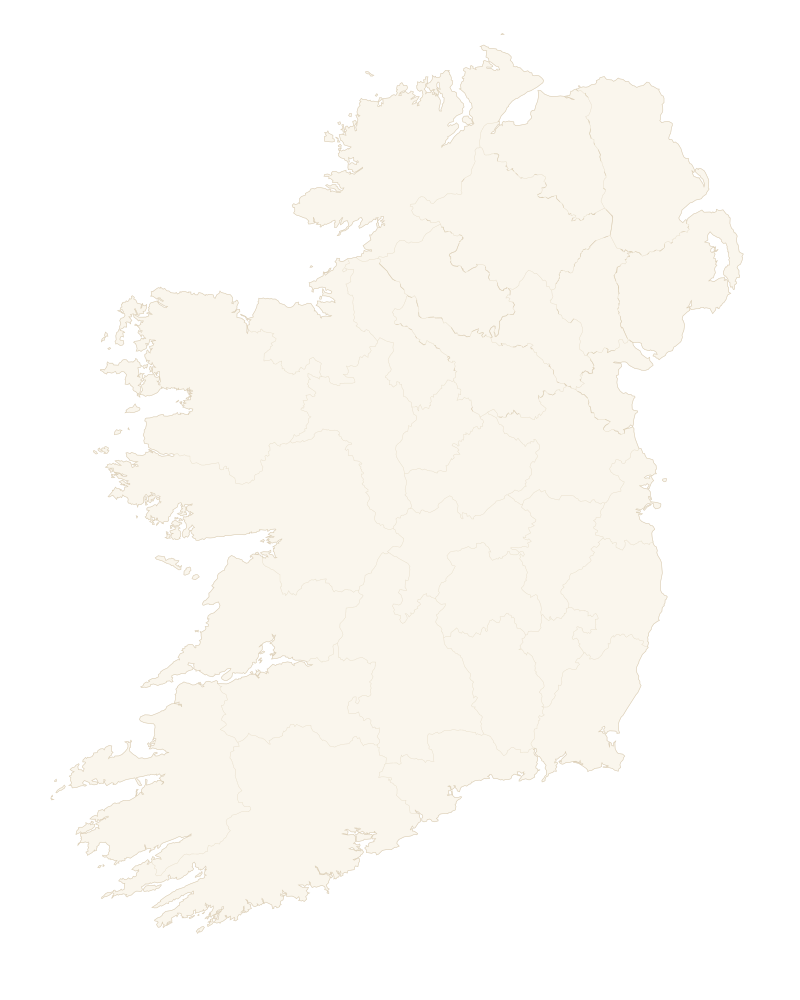
CoreHistoric reach
The seat of Walsh
Seat vacantChief
No one leads the Walsh community yet. When the movement opens, you can stand for its leadership, or help elect whoever does.
Current mission
No shared goal set yet. Once Walsh has leadership, it sets the public focus: a restoration, a gathering, a real-world project that helps its own.
The Walsh clan is being rebuilt. Join the waiting list for the movement today, and you help decide who leads it and what it does.
Help rebuild the Walsh clan →Motto
Transfixus sed non mortuus
“Pierced but not dead”
What does the Walsh name mean?
Descriptive, 'the Welshman'. Walsh translates the Gaelic Breathnach, which in turn translated the Old French le Waleys, applied by Norman record-keepers to the Welshmen and Welsh-Marchers who joined Strongbow's invasion force in 1169. By the 13th century the descriptive byname had hardened into a hereditary surname for at least four entirely separate Welsh-Norman families on Irish ground, none related to each other, all called the same thing by their Irish neighbours. Anglicised back from Breathnach to Walsh in the early modern period; Brannagh and Brannock are the surviving variants of the Gaelic form.
The history of Walsh
The word the Irish used for the men off the Welsh ships
Walsh is not a Gaelic name. It is a description: the Welshman. Norman clerks wrote it in Old French as le Waleys, the Irish said Breathnach, English record-keepers settled on Walsh: three words for the same men, the Welsh speakers and Welsh-Marchers who crossed with the invasion force of 1169 and stayed. What mattered to the Gaelic families whose land they landed on was not Norman or English but the coast the ships had come from, and the ships had come from Wales. The same Old French word produced Wallace in Scotland.
Which part of Wales was disputed before anyone wrote it down. One tradition gives the Walshes a common ancestor in 'Walynus', who came over in the retinue of Maurice FitzGerald, Lord of Lanstephan; another names Philip of Wales, possibly the same man, whose son Howel gave his name to the stronghold Castle Hoel. Others point to Pembrokeshire, to the barons of Cornwall, or to Owen Gwynnes, a prince of north Wales. The traditions cannot be reconciled, and that is the point of the name.
Four families, one description, no common ancestor
Because 'the Welshman' was a description and not a lineage, it was applied independently, in places a hundred miles apart. Four separate Welsh-Norman families settled in Ireland in the late 12th century and all four ended up called the same thing: Howel Walsh's line at Carrickmines in Dublin, the Mountgarret Walshes of Kilkenny, Philip the Welshman's line in the Decies of Waterford, and the Connacht Walshes of Mayo who rode west with the de Burgo invasion. None were related, and within two generations all had married into the Gaelic families around them.
The heraldry is the proof, because kinsmen do not need four coats of arms. The Walshes of Ballykilcaven in Laois bear a griffin's head and the motto "Firm"; those of Carrickmines a demi-lion rampant, with a motto warning against irritating lions; those of Castlehale in Kilkenny a swan pierced by an arrow and the words Transfixus sed non mortuus: pierced but not dead. Drop the swan and the arrow, as most modern renderings do, and the motto reads as a boast rather than what it is: struck clean through and still standing.
Carrickmines: a warning sent to Dublin, and a pit cut in bedrock
In 1402 the O'Byrnes of Wicklow, who raided Dublin whenever it suited them, brought a large mercenary force to the banks of the Dargle at Bray. The direct road to the city ran close under the Walsh stronghold at Carrickmines, and they hesitated. The delay was long enough for the Walshes to get an urgent warning into Dublin. The Mayor came out with a large force and broke them, in a fight remembered for its casualties as the Battle of Bloody Bank.
Carrickmines was no tower house: a curtain wall flanked with towers enclosed some acres of ground holding mills, timber and stone buildings and a keep at the centre, its defences hewn into the bedrock and impressive still. In the Irish Rebellion of 1641 the Catholic Walshes who owned it sided with the native Irish and the Confederate attempt to create the first independent Irish parliament, and they paid dearly. English forces besieged the castle, and when it was retaken over 300 of the Walshes, O'Byrnes and O'Tooles were massacred; the human remains in the rock date from 1642.
Castlehale, and the Walshes of the Mountains
The Kilkenny line were the principal Walshes: lords of the hills still called the Walsh Mountains, barons by Norman tenure, holders of a substantial palatinate and patrons of one of the great manuscript collections of medieval Ireland. Their seat carried the founder's name down the centuries under three spellings (Castle Hoel, Castlehale, Castlehowel), one stronghold, all of them named for Howel.
In the Wars of the Three Kingdoms they took up arms against Oliver Cromwell. Castlehale was besieged and taken in 1650; the survivors were executed and thrown into a burial pit at the bottom of a hill near the castle, where they lay until the nineteenth century, when men building a road uncovered their remains. A family that had held those mountains since the invasion was finished as a power in a single summer.
Breathnach, and becoming more Irish than the Irish themselves
Ireland was among the first countries in Europe to adopt hereditary surnames, and the Gaelic machinery for making them was patronymic: Ó for a descendant, Mac for a son, Ní and Bean Uí for the women. Walsh has never carried an Ó or a Mac in any spelling, and that absence is the name's origin certificate. It was never anybody's father's name. It was where the man came from.
The families it named went native fast. The Norman 'Old English' of Ireland were described as having become more Irish than the Irish themselves, and the Walshes are the clean case: the Connacht line at Carrowbrowne in Mayo took the Gaelic form Brannagh, and by the 16th century the Tudor administration dealt with them as a Gaelic clan in fact. It helped that an Irish clan was never only a bloodline: unrelated clients of a chief took the leading family's name as a show of allegiance, which is one reason there are far more Walshes than four founding households could account for.
Then the system that held them was taken apart: English common law throughout Ireland, the sheriff replacing the chief, the Kingdom of Ireland created in 1541, surrender and regrant swapping election by kinsmen for primogeniture and new arms in 1552, and the Flight of the Earls in 1607. Breathnach was anglicised back to Walsh in the early modern period, leaving Brannagh and Brannock as survivors of the Gaelic form.
Fourth in Ireland, and the name that sailed again
Walsh is the fourth most common surname in Ireland and, uniquely among the top five, not Gaelic in origin at all; John Grenham, writing in 1993, counted it among the five most numerous names in the country. In the south and west it is still pronounced "Welsh", and Walshe, Welch, Welsh and Brannagh all belong to the same pool. In Great Britain, Guppy encountered the name only in Lancashire. In the United States it stands 265th.
The bearers are the argument for the name. Maurice Walsh (1879–1964), a Kerry-born Customs officer, wrote a short story called The Quiet Man in 1933; John Ford filmed it in 1952 with John Wayne and Maureen O'Hara, took an Academy Award for it, and fixed a particular idea of Ireland onto twentieth-century cinema. Edward Walsh (1756–1832) became the fourth bishop of Charleston, South Carolina. Tom Walsh, born in 1994, throws the shot for New Zealand at the Olympics. Eight centuries after a clerk wrote le Waleys because he had no other word for the man in front of him, the Irish word for a stranger off a boat is one of the most Irish names there is.
Champions of the Walsh name
The bearers whose lives are inseparable from this surname. Each has their own page, biography, achievements, geography, connection to the family.
Historic Places, Rebuilt
Explore the streets and seats the Walsh name knew, rebuilt with AI as they stood in history.
Historic Places, Rebuilt · New
Georgian Dublin in the year of Rocque's great map, College Green, the Liberties' weavers, the Liffey quays and Christ Church.
Historic Places, Rebuilt · New
The walled City of the Tribes at its Spanish-trade height, the quays, Lynch's Castle, and the fourteen merchant families.
Historic Places, Rebuilt · New
The cathedral citadel of the Kings of Munster, whole and roofed on its rock, round tower, Cormac's Chapel and Gothic cathedral.
Castles the Walsh held
Strongholds this name held for a decade or more, look one up, or rebuild it to explore.
- Carrickmines Castle
Owned Carrickmines from the medieval period through the 1641 Rebellion.
The castles of the homeland
The great strongholds of the homeland, look one up, see what it looked like in its prime, and recreate it to explore.
 Ashford Castle, County MayoRestored · prime 1880
 Manderley CastleRestored · prime 1840
 Dublin CastleRestored · prime 1790
All castles in Ireland → · Strongest castles in Ireland → · Castles of Europe
Play As Your Clan
Hold a real castle against whatever you choose to send at it, take a ship out in her own service years, or stand at the shoulder of someone the record remembers. The chronicler sets the scene; the deeds are yours.
Notable bearers of the Walsh name
- Maurice Walsh (1879–1964), writer, author of The Quiet Man
- Bishop Edward Walsh (1756–1832), fourth bishop of Charleston, South Carolina
- Tom Walsh (b. 1994), Olympic shot-putter, New Zealand of Irish descent