Burke
also Bourke, de Burgh, de Búrca, Búrcach
The de Burgo Lords of Connacht, Hibernis ipsis Hiberniores.
- Origin
- Connacht, Ireland
- Motto
- Ung roy, ung foy, ung loy
- Famous bearer
- Richard Mór de Burgo (d. 1242), first Anglo-Norman lord of Connacht
- Register
- Irish family
Ranked of all time
The 10 Most Powerful Irish Clans of All Time
The Burke arms and country

Coat of armsBurke armsKINGHB190 · CC BY-SA 4.0 
Coat of armsDe Burgh armsCC BY-SA 4.0


- Coat of arms: Granted to an individual and inherited down that one documented line. These are the arms of particular families of the name, not of everyone who shares the surname.
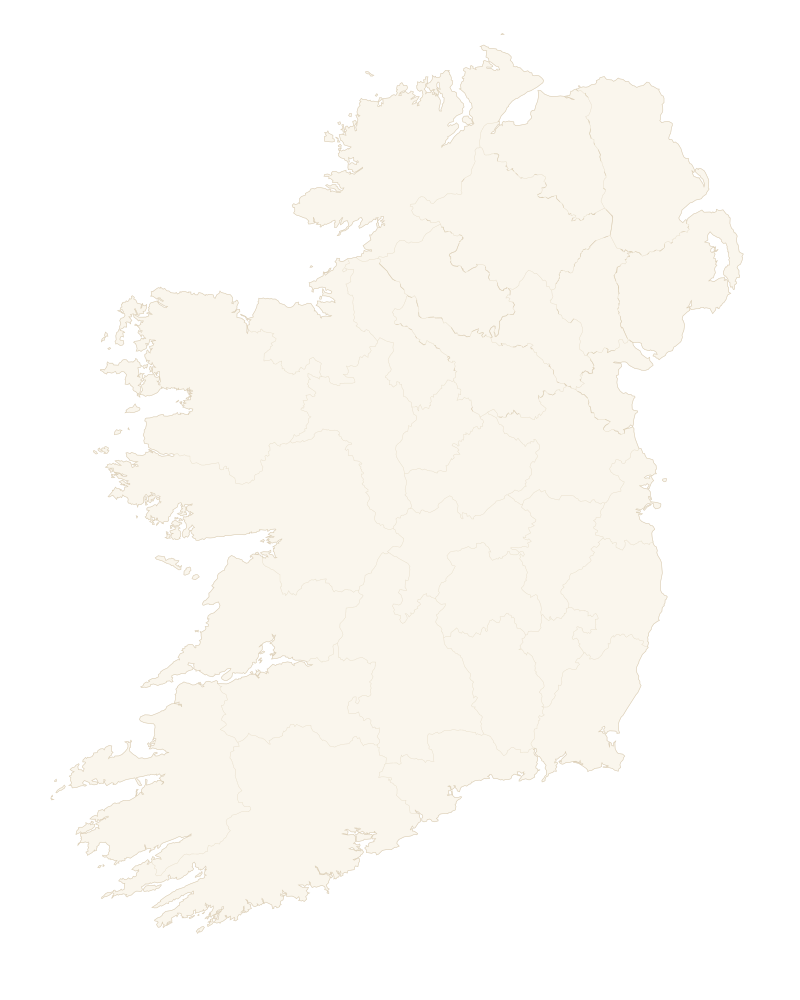
CoreHistoric reach
The seat of Burke
Seat vacantChief
No one leads the Burke community yet. When the movement opens, you can stand for its leadership, or help elect whoever does.
Current mission
No shared goal set yet. Once Burke has leadership, it sets the public focus: a restoration, a gathering, a real-world project that helps its own.
The Burke clan is being rebuilt. Join the waiting list for the movement today, and you help decide who leads it and what it does.
Help rebuild the Burke clan →Motto
Ung roy, ung foy, ung loy
“One king, one faith, one law”
What does the Burke name mean?
From de Burgo, the Anglo-Norman family seated at Burgh-by-Sands in Cumberland whose head William de Burgo came to Ireland in the train of Prince John in 1185. The name derives from Old English burh, fortified place. Within two generations the family had Gaelicised, de Búrca was the Irish form, Búrcach the broader collective, and in the 14th century the line was titled the Mac William Bourkes of Connacht, half-Norman, half-Gaelic, and entirely Irish.
The history of Burke
The name that came ashore with Prince John
The surname begins as a place rather than a person. de Burgo is the Latin of Burgh-by-Sands in Cumberland, seat of the Anglo-Norman family whose head, William de Burgh (c. 1160-1205/6), landed in Ireland in 1185 in the train of Prince John. The root is Old English burh, a fortified place, so the name carries no trade and no father's name: it says stronghold. The family took its identity from a defended site and then spent centuries raising defended sites across the west of Ireland.
William received a grant of lands from Henry II, and on John's accession in 1199 he was installed in Thomond and made governor of Limerick. Between 1199 and 1201 he backed first Cathal Carrach and then Cathal Crovderg for the native throne of Connacht, and was expelled from the province after a battle with Crovderg over payment for himself and his army. He returned, defeated Crovderg, and left him on the throne as a sworn man. He married a daughter of Domnall Mór Ó Briain, king of Thomond and of Limerick and a descendant of Brian Boru, so within one generation the Norman name was tied by marriage into the senior royal dynasty of Munster.
Three brothers stood beside him. Hubert de Burgh (c. 1170 to before 1243) was Chief Justiciar and Regent of England, Justiciar of Ireland and earl of Kent; Thomas became castellan of Norwich; Geoffrey (c. 1180-1228) became bishop of Ely. King John gave Hubert the Monnow valley lordship of the Three Castles in 1201, and after regaining them in 1219 he rebuilt in stone: a new hall, curtain wall, gatehouse and mural towers at Grosmont, and at Skenfrith an entirely new polygonal fortification of Old Red Sandstone with round towers, a circular keep and a moat fed from the river. At White Castle the rebuilding of these decades ringed the inner ward with a deep water-filled moat cut from the rock, work the historian Paul Remfry calls a masterpiece of military engineering. Hubert also built Hadleigh Castle after 1215 on a ridge of London clay above the Thames estuary, with a tidal watermill on a wharf reaching into the water by 1249.
The arms adopted as heraldry was taking shape in the thirteenth century were Or, a cross gules, a red cross on gold. Family tradition set their origin in the Crusades, a plain gold shield marked with a cross of blood by Richard the Lionheart for an ancestor's bravery, though origin stories of that kind were attached to many noble houses and the historicity is doubtful; the same arms belonged at the same date to the Bigods, the ruling family of Norfolk, and the second earl of Ulster had Bigod descent through his mother's line. The crest is a seated and chained mountain cat, and the motto has moved between A Cruce Salus, salvation from the cross, and Ung roy, ung foy, ung loy: one king, one faith, one law.
Lords of Connacht, earls of Ulster
William's son Richard Mór de Burgh (c. 1194-1242/3) received in 1227 the land of Connacht as forfeited by the king he had helped to fight, and became first lord of Connacht. He was Justiciar of Ireland from 1228 to 1232, and in 1234 he took the crown's side against Richard, Earl Marshal, who fell in battle against him. The grant was paper laid over a working Gaelic kingdom, and the family made it real by force. In 1228 the Burkes raised a stronghold on the shore of Lough Corrib at Ashford, which stayed in their hands for over three centuries.
His eldest son, Sir Richard de Burgh (d. 1248), held Connacht briefly. The second son, Walter de Burgh (c. 1210-71), kept up the war against the native chieftains and obtained from the Lord Edward, about 1255, a grant of the county of Ulster, from which he was afterwards styled earl of Ulster. Inside two generations an adventurer's following had become a lordship reaching from Connacht to Lough Foyle.
Walter's son Richard Óg de Burgh, second earl of Ulster and known as the Red Earl, was the greatest noble of his day in Ireland. In 1286 he ravaged and subdued Connacht, deposed the native king Brian O'Neill and installed his own nominee, and fought the king of Connacht in favour of the branch of O'Conors his family supported. The patent roll of 1290 shows that beyond his lands in Ulster, Connacht and Munster he held the Isle of Man, later surrendered to the crown. Summoned only occasionally to English parliaments, he spent most of his forty years of activity in Ireland, and he led his own forces out of the country to support Edward I in the Scottish campaigns; Edward knighted him at Rhuddlan.
He built for permanence. Around 1300, to hold newly won possessions in County Sligo, he raised Ballymote Castle, the last of the Norman castles in Connacht: a large keepless rectangle with thick curtain walls, six three-quarter round towers and a double-towered north gate, close enough in plan to Beaumaris in Anglesey to show where he had been looking. In 1305 he completed Northburgh above Lough Foyle, whose gatehouse has been compared with Harlech and the rest of it with Caernarfon, a deliberate echo by a man who had been knighted by the king who built them. The de Burgh earls also held Greencastle on Carlingford Lough for the English crown from 1264 to 1333.
Elizabeth de Burgh, queen of Scots
In 1302 the Red Earl's daughter Elizabeth de Burgh married Robert Bruce. She was thirteen. The wedding most likely took place at Writtle near Chelmsford in Essex, arranged by her father or by Edward I, who encouraged it heavily as a way of holding the loyalty of the Scottish nobility. It did not hold for long.
Bruce was cut off from his English allies by the killing of John Comyn, his greatest rival for the Scottish throne, in the Chapel of the Greyfriars. Knowing that a killing inside a church would bring excommunication, he rode for Scone and was crowned Robert I, king of Scots, six weeks later, before a papal bull could be issued, with Elizabeth beside him as consort. They had four children, among them the boy who became David II, king of Scots, in 1329. A Burke daughter was queen consort of Scots and mother of a king of Scots, and the family also gave a queen consort to Thomond.
The marriage did not soften the family's politics. When Edward Bruce, Robert's brother, invaded Ulster in 1315, Richard Óg marched against him. Edward Bruce took Greencastle in 1316 and captured Northburgh in the same year, holding it until his death in 1318, when Richard recovered it. The Burkes were by then fighting a war in Ireland against the brother of a king of Scots whose queen was a Burke.
The Brown Earl and the year everything broke, 1333
William Donn de Burgh, the Brown Earl (1312-33), succeeded as third earl of Ulster. He was the son of John de Burgh (d. 1313) and Elizabeth, Lady of Clare (d. 1360), sister and co-heir of the last Clare earl of Hertford, and he married Maud of Lancaster, daughter of Henry, third earl of Lancaster. In 1331 he was appointed Lieutenant of Ireland. In 1333, in his twenty-first year, he was murdered on the road outside Belfast, and the de Burgh lordship came apart.
His only child was a daughter, Elizabeth de Burgh, sole heiress of the de Burgh possessions and of the vast Clare estates besides. She was married in childhood to Lionel of Antwerp, first duke of Clarence and third son of Edward III, who was recognised as earl of Ulster in her right. From that marriage the Yorkist Plantagenets drew their claim to the English throne: their descendant Edward, fourth duke of York, took it in 1461 as Edward IV, and through Edward's eldest daughter Elizabeth the descent runs into the reigning British royal house. The earldom of Ulster has been held by members of the royal family ever since.
The kinsmen left in Connacht took a different view. By native Irish reckoning a girl child did not carry a lordship over grown male cousins, and the de Burgh men of the west said so with weapons. The fighting known as the Burke civil war ran from 1333 to 1338 and ended with those kinsmen holding the bulk of the family's Irish territory as chieftains in their own right, adopting Irish names and Irish customs as they went. The original Ulster line became extinct in 1363. Almost everything the surname did afterwards in Ireland comes out of that refusal.
Hibernis ipsis Hiberniores: the Normans who became an Irish clan
What the western Burkes did next was to stop being Norman. They became one of the Old English houses of whom it was said that they had grown more Irish than the Irish themselves, and the surname went with them. de Burgh was Gaelicised as de Búrca, which wore down to Búrc and surfaced in English as Burke and Bourke; a man of the name was a Búrcach. Some branches took the older form de Burgh back in the eighteenth century. Burke, Bourke, de Burgh and de Búrca have all been Connacht names for more than seven centuries.
In Irish the name kept its Norman grammar and still does. Nearly every Irish surname is built with Ó, descendant, or Mac, son, and inflects for the bearer: Ó Dónaill for a man, Ní Dhónaill for his daughter. de Búrca belongs instead to the small class formed with the lowercase Norman de, of, alongside de Paor (Power) and de hÍde (Hyde). The word itself is a record of arrival: whenever an Irish speaker says de Búrca, the shape of the name remembers that this family came from somewhere else and then stayed.
Custom followed language. Irish lordship passed not by primogeniture but by tanistry, election from among the agnatic cousins descended from a common grandfather or great-grandfather, and the Burke chieftaincies were filled that way until the Tudor century. The chiefs' own names show the same conversion: Ulick an Fhiona, Ulick Ruadh, Ulick Fionn, Ulick Óge, Richard Mór, Richard Bacach, Ulick na gCeann, a roll of Irish epithets fixed to Norman given names. Óg and Mór, young and big, were the ordinary Irish way of distinguishing a father from a son where English says senior and junior, and here they are doing that work inside a family called Burke.
One further point explains why so many people carry the name. An Irish clan, a fine, was not purely a matter of blood. It took in unrelated clients of the chief, who assumed the name of the leading lineage as a show of allegiance even though they and their male descendants could never be elected chief. A great lordship therefore made Burkes faster than any family could breed them.
Mac William Uachtar: the Clanricarde chiefs
The two great branches took their titles from the founder's given name. Mac William Uachtar, son of the upper William de Burgh, denoted the head of the Burkes of upper or southern Connacht and Galway, though the chief was better known by a second Gaelic title, Clanricarde, head of Richard's family. The line opens with Sir Ulick Burke, Uilleag de Burgh, first Clanricarde, who died in 1343 or 1353, and runs through the fourteenth and fifteenth centuries: Richard Óg, second (d. 1387); Ulick an Fhiona, third (d. 1424); William mac Ulick, fourth (d. 1430); Ulick Ruadh, fifth (d. 1485); Ulick Fionn, sixth (d. 1509).
The sixteenth century opens with a fast succession: Richard Óge, seventh (d. 1519); Ulick Óge, eighth (d. 1520); Richard Mór, ninth (d. 1530); John mac Richard Mór, tenth (d. 1536); Richard Bacach, eleventh (d. 1538). Alongside the chieftaincy the family filled the churches of the west. John MacSeonin Burke was archbishop of Tuam from 1441 to 1450; Raymond Burke was a priest at his death in 1562; Dominic Burke was bishop of Elphin from 1671 to 1704, and Francis Burke archbishop of Tuam until his death in 1723. William Burke was an Irish Dominican prior (c. 1611 to c. 1685), and Francis Burke a Franciscan friar and writer who died in 1697.
They built as well as ruled. The tower house at Ballylee near Gort in County Galway was raised by the de Burgo septs in the fifteenth century on the enormous Clanricarde estate: four floors of one room each, linked by a spiral stair set into the seven-foot thickness of the outer wall, every window looking over the Streamstown River. It passed later to the Gregory family with the Coole estate, and W. B. Yeats lived there with his family from 1921 to 1929, prizing the ground-floor chamber as the pleasantest room he had yet seen and calling the winding stair his ancestral stair. Seamus Heaney described Thoor Ballylee as the most important public building in Ireland. It started life as a Burke tower.
The Gaelic chieftaincy ended by agreement rather than by defeat. The Kingdom of Ireland was created in 1541, and the Dublin administration set out to bring the Gaelic chiefs inside it by surrender and regrant, a policy that replaced election by tanistry with succession by English primogeniture. In 1543 the twelfth Clanricarde, Ulick na gCeann Burke, surrendered his Connacht lands to Henry VIII and received them back to hold by English custom as earl of Clanricarde and Lord Dunkellin. The chief of Mac William Uachtar went to bed a Gaelic lord and rose an English peer without moving house.
The earls and marquesses of Clanricarde
Richard Burke, second earl, called Richard Sassanach, died in 1582 and Ulick, third earl, in 1601. The fourth earl, Richard Burke (1572-1635), distinguished himself on the English side in O'Neill's Rebellion and afterwards obtained the English earldom of St Albans in 1628, so that a Gaelicised Norman house of Connacht carried an English earldom as well as an Irish one. His son Ulick Burke (1604-1657) received the Irish marquessate of Clanricarde in 1646. Two countesses of the house are separately on record, Frances Burke, countess of Clanricarde (1567-1633), and Helen Burke, countess Clanricarde (c. 1641-1722).
The house then paid for the Jacobite cause. Richard Burke, eighth earl (d. 1709), and John Burke, ninth earl (1642-1722), both fought for James II and paid the penalty for it in 1691; John was restored in 1702. The line and the Galway estate came through. Michael Burke was tenth earl (1686-1726) and John Smith de Burgh eleventh (1720-1782), and the ninth earl's great-grandson Henry de Burgh, twelfth earl, was created marquess of Clanricarde in 1789.
Henry left no son. His brother John de Burgh, thirteenth earl, was created earl of Clanricarde again in 1800, and the marquessate was revived in 1825 for John's son Ulick de Burgh (1802-1874), who sat at Westminster as a Whig politician; Ulick Canning de Burgh, Lord Dunkellin (1827-1867), was a soldier and politician of the same house. The family changed its own surname twice more, back from Burke to de Burgh in 1752 and adding Canning in 1862, and held a vast estate in County Galway to the last. Hubert de Burgh-Canning was second and final marquess, the Clanricarde line closing in 1916, when the earldom of the second creation passed by special remainder to the marquess of Sligo.
Mac William Íochtar: the Bourkes of Mayo
The northern branch, Mac William Íochtar, son of the lower William, ruled in Mayo and spelled the name Bourke more often than Burke. A distinct line, the Bourkes of the Owles, traces to Ulick Burke of Umhaill, who died in 1343. The best-remembered chief of the northern branch is Risdeárd an Iarainn Burke (d. 1583), chief of the Mac William Íochtarach, who around 1566 married Gráinne Ní Mháille, Gráinne Mhaol, the sea-queen of Iar Connacht. Theirs is among the most fully documented of all the joins between the Norman-Irish world and the Gaelic one, and it is a Mayo Bourke marriage.
Mayo went through the Tudor settlement in its own way and in more than one direction. Seaán mac Oliver Bourke, seventeenth Mac William Íochtar, was created Baron Ardenerie in 1580. In 1603 the nineteenth lord, Tiobóid na Long Bourke (d. 1629), resigned his territories in Mayo and received them back to hold by English tenure, and was created Viscount Mayo in 1627. The twenty-first lord, Tibbot MacWalter Kittagh Bourke, took the opposite road: he went to Spain, and in 1602 was created marquess of Mayo in the Spanish peerage. Others of the name held Irish lordships in the same generation, among them John Burke, first Baron Leitrim (d. 1583), and William Burke, Lord of Bealatury.
The Tudor and Stuart centuries cost the branch dearly. Ashford, the castle their ancestors had built on Lough Corrib in 1228, fell to the English commander Sir Richard Bingham in 1589 after three and a half centuries in Burke hands. Miles, second Viscount Mayo (d. 1649), and Theobald, third viscount (d. 1652), suffered at Cromwell's hands, and Theobald, fourth viscount, was restored to some fifty thousand acres in 1666. Deel Castle, the sixteenth-century Bourke tower house near Crossmolina at the northern end of Lough Conn, was forfeited after Colonel Thomas Bourke fought for James II, and the baronies of Bourke of Castleconnell (1580) and Bourke of Brittas (1618) were forfeited in the same cause in 1691.
The Mayo title came back all the same. The first-creation viscountcy went dormant with John, eighth viscount, in 1767, and in 1781 John Bourke was created Viscount Mayo and in 1785 earl of Mayo; he descended from the fourth son of Sir Thomas Bourke, who died in 1397. The first earl's great-grandson Richard Bourke, sixth earl of Mayo, was appointed viceroy of India in 1869, and the sixth earl's younger brother Robert Bourke, first Baron Connemara, became governor of Madras. Of the three great titles of the House of Burgh, the Ulster line ended in 1363 and Clanricarde closed in 1916; the Mayo earldom is carried by a Bourke still.
Edmund Burke of Arran Quay
Edmund Burke was born at 12 Arran Quay on the north bank of the Liffey in Dublin on 12 January 1729, second surviving son of Richard Burke, a Dublin attorney, and Mary Nagle of Ballyduff in County Cork. His father was Anglican and his mother Catholic; he was raised in the Church of Ireland but kept lifelong ties to the Catholic Nagles of north Cork, a doubleness that shaped the religious sympathy of his later work. He was schooled at the Quaker boarding school at Ballitore in County Kildare under Abraham Shackleton, and at fifteen entered Trinity College Dublin, taking his BA in the classical course in 1748.
He moved to London in 1750 to read for the bar at the Middle Temple, abandoned the law within two years, and made his living from 1752 to 1765 as a working man of letters. A Philosophical Enquiry into the Origin of Our Ideas of the Sublime and Beautiful, published in 1756, put the sublime and the beautiful into the central vocabulary of late eighteenth-century English aesthetics and carried as far as Kant's Critique of Judgement of 1790. In 1758 he launched the Annual Register, the founding English-language journal of contemporary political history, and edited or co-edited it for thirty years.
He entered the Marquis of Rockingham's patronage as private secretary in July 1765 and was returned to Parliament for Wendover in Buckinghamshire that December, sitting for it nine years, then for Bristol from 1774 to 1780 and for Malton in Yorkshire from 1781 to 1794. He held cabinet office only in the briefest intervals, as Paymaster of the Forces in 1782 and again in 1783; his power was that of an opposition orator and a writer. He was the leading parliamentary advocate of conciliation with the American colonies, and his Speech on Conciliation with America of 22 March 1775 closes with the line that magnanimity in politics is not seldom the truest wisdom, and a great empire and little minds go ill together. From 1786 to 1795 he led the impeachment of Warren Hastings, governor-general of Bengal, an eight-year prosecution that established the constitutional principle of parliamentary accountability for imperial administration, and through the late 1770s and 1780s he was the leading advocate of Catholic relief in Ireland and the easing of the Penal Laws.
Reflections on the Revolution in France was written through the summer of 1790, published that November, and ran through eleven editions in its first year. It set out constitutional inheritance as something organic, prescription and prejudice as the foundations of stable government, and the small platoon of family and locality as the schoolhouse of political affection. It has been continuously in print since 1790 in every major European language and stands at the head of every list of the founding texts of political conservatism in English. Burke died at Gregories, his Buckinghamshire estate near Beaconsfield, on 9 July 1797. His son Richard Burke (1758-1794) was also a Member of Parliament.
Burke's Peerage, and where else the name went
One Burke made a career of recording other families. John Burke (1786-1848), an Irish genealogist, founded the reference work that still carries the surname as its title; Sir John Bernard Burke (1814-1892) is recorded as its editor, and Henry Farnham Burke (1859-1930) rose to be Garter Principal King of Arms. A family that had spent centuries arguing about succession ended up owning the book the rest of the aristocracy argued from.
In Ireland the name kept turning up in pulpits, studios and sessions. Thomas Nicholas Burke (1830-1882) was a Roman Catholic theologian and preacher; Augustus Nicholas Burke (1838-1891) was a painter and Thomas Burke (1749-1815) an engraver known for mezzotint. Ricard O'Sullivan Burke (1838-1922) was an Irish nationalist, American soldier and engineer. Aoife de Búrca (1885-1974), born Eva Burke, served as a Red Cross nurse in the Easter Rising and took the Irish form of the name back for herself. In the music the name is everywhere: Nicholas Burke, born 1837, the uilleann piper, the fiddler Kevin Burke, born 1950, and the accordion player Joe Burke (1939-2021).
Emigration carried it further. Aedanus Burke (1743-1802) was an Irish-American soldier, judge and politician, and Thomas Burke (c. 1747-1783) an Irish-born physician, lawyer and politician in North Carolina. John Burke (1859-1937) was tenth governor of North Dakota and Treasurer of the United States; Arleigh Burke (1901-1996) was an American admiral; Thomas Burke (1875-1929) was an American sprinter at the 1896 Athens Olympics. Robert O'Hara Burke (1821-1861) is the explorer of the 1860 Burke and Wills expedition across Australia. Kenneth Burke (1897-1993) was an American literary theorist and philosopher and Peter Burke, born 1937, a British historian. The Connacht chieftaincy is gone, but the name it made travelled about as far as a name can.
Champions of the Burke name
The bearers whose lives are inseparable from this surname. Each has their own page, biography, achievements, geography, connection to the family.
Historic Places, Rebuilt
Explore the streets and seats the Burke name knew, rebuilt with AI as they stood in history.
Historic Places, Rebuilt · New
The walled City of the Tribes at its Spanish-trade height, the quays, Lynch's Castle, and the fourteen merchant families.
Historic Places, Rebuilt · New
The O'Brien Earls of Thomond's great four-towered tower-house, hung with banners and famed for its feasts.
Historic Places, Rebuilt · New
The cathedral citadel of the Kings of Munster, whole and roofed on its rock, round tower, Cormac's Chapel and Gothic cathedral.
Castles the Burke held
Strongholds this name held for a decade or more, look one up, or rebuild it to explore.
- Ashford Castle, County Mayo
Built by the Anglo-Norman de Burgo (Burke) family in 1228 and held for three and a half centuries.
- Hadleigh Castle
Built after 1215 by Hubert de Burgh, 1st Earl of Kent, a key supporter of King John.
- Thoor Ballylee
Built in the 15th century by the de Burgo, or Burke, septs; part of the estates of the Burke Earls of Clanricarde.
- White Castle
Granted to Hubert de Burgh by King John in 1201; he recovered the Three Castles in 1219.
- Grosmont Castle
Given to Hubert de Burgh by King John in 1201; he recovered the Three Castles in 1219 and rebuilt Grosmont in stone.
- Greencastle
Held for the English Crown by Richard de Burgh, Earl of Ulster, 1264–1333.
- Ballymote Castle
Probably built around 1300 by Richard Óg de Burgh, 2nd Earl of Ulster, the Red Earl.
- Skenfrith Castle
Given by King John to Hubert de Burgh in 1201; despite losing and regaining it amid rivalry with the de Braose family and the Crown, Hubert levelled the old castle and built the present round-towered fortification.
- Northburgh Castle
Built by Richard Óg de Burgh, 2nd Earl of Ulster, in 1305; held by the de Burgh earls until the death of William Donn de Burgh, 3rd Earl of Ulster.
- Deel Castle
Built by the Bourkes in the 16th century; forfeited after Colonel Thomas Bourke fought for James II.
The castles of the homeland
The great strongholds of the homeland, look one up, see what it looked like in its prime, and recreate it to explore.
 Ashford Castle, County MayoRestored · prime 1880
 Manderley CastleRestored · prime 1840
 Dublin CastleRestored · prime 1790
All castles in Ireland → · Strongest castles in Ireland → · Castles of Europe
Play As Your Clan
Hold a real castle against whatever you choose to send at it, take a ship out in her own service years, or stand at the shoulder of someone the record remembers. The chronicler sets the scene; the deeds are yours.
Notable bearers of the Burke name
- Richard Mór de Burgo (d. 1242), first Anglo-Norman lord of Connacht
- Risdeárd an Iarainn Burke (d. 1583), chief of the Mac William Íochtarach, husband of Gráinne Mhaol
- Edmund Burke (1729–1797), political philosopher
- Robert O'Hara Burke (1821–1861), Australian explorer
- William Burke (1792–1829), perpetrator of the Edinburgh murders
Stories of Burke
Edmund Burke and the Reflections on the Revolution in France
1790On the first of November 1790 the London publisher James Dodsley issued a octavo volume of three hundred and fifty-six pages, written by Edmund Burke, Member of Parliament for Malton, on the subject of the political experiments then in progress at Paris. The book had been written over the spring and summer of 1790 in answer to a letter from a young French acquaintance, Charles-Jean-François Depont, who had asked Burke whether the events of the previous year should be celebrated. Burke had at first been thought, by the Whig friends of his old age, likely to be sympathetic to the Revolution; he had spent thirty years on the Whig side of the House on the side of America in the 1770s and on the side of the Indians against Warren Hastings in the 1780s. The book changed the impression. By the end of 1790 it had sold nineteen thousand copies in seven editions; by the end of 1791, thirty thousand; by 1796, sixty thousand. Reflections on the Revolution in France is, by every careful judgment, the founding text of modern political conservatism in the English-speaking world. Burke was sixty-one years old. He had eight years to live. He spent five of them broken from the Whig caucus and taking the political-philosophical argument the book had begun out across Europe.
Read the story →
William Burke and the Edinburgh murders
1828William Burke was born at Orrery in County Cork in 1792, emigrated to Ulster as a young man, served as an officer's servant in the Donegal militia, and came to Edinburgh in 1818 to find labouring work on the Union Canal. He met William Hare in West Port, Edinburgh, in 1827. Through November 1827 to October 1828 the two men killed sixteen people in lodging-houses in West Port, mostly the lonely poor of the city, and sold the bodies for between seven and ten pounds apiece to the anatomist Dr Robert Knox of 10 Surgeons' Square for use in his teaching dissections. The murders were discovered when a body was found behind a curtain in Burke's lodgings on the morning of the second of November 1828, and Hare turned king's evidence in exchange for immunity. Burke was tried at the High Court of Justiciary on the twenty-fourth of December 1828 on a single count of murder, was convicted on a unanimous jury, and was hanged at Liberton Wynd in Edinburgh before a crowd of twenty-five thousand on the twenty-eighth of January 1829. His body was publicly dissected by Professor Alexander Monro III at the University, his skeleton hung in the medical museum of the medical school. The skeleton is still there.
Read the story →
Frequently asked
What does the surname Burke mean?
Where does the Burke family come from?
Where did the Burke family historically hold territory?
Is Burke Irish or Scottish?
How old is the Burke surname?
What is the Burke family known for?
What is the Burke motto?
What does "Ung roy, ung foy, ung loy" mean in English?
Is there a Burke family crest or coat of arms?
Who is the most famous Burke?
Who are some famous Burkes?
What stories are told about the Burke family?
What is the story of Edmund Burke and the Reflections on the Revolution in France?
Is Bourke the same family as Burke?
Is de Burgh the same family as Burke?
Is de Búrca the same family as Burke?
Where is the Burke surname found today?
What does the Clan Rising page for the Burke family cover?
Who is the head of the Burke family today?
Neighbouring clans
- KellySecond most common Irish surname, the Uí Maine of Galway, and six other dynasties besides.
- WalshThe fourth most common Irish surname, the families the Irish called 'the Welsh'.
- JoyceOf Iar Connacht and Galway city, one of the Tribes, and the family of James Joyce.
- LynchOf the Tribes of Galway, and, by tradition, of the phrase 'Lynch law'.