Wales · Ruin
Grosmont Castle
Castell y Grysmwnt
Grosmont Castle is a medieval stone castle in Grosmont, Monmouthshire, Wales, now a ruin managed by Cadw. The visible remains largely reflect 13th-century rebuilding by Hubert de Burgh and 14th-century domestic additions that created a compact inner ward with a hall, accommodation block and mural towers.
Its prime
1340
Today
Ruin
As it stood in 1340
What Grosmont Castle looked like in its prime.
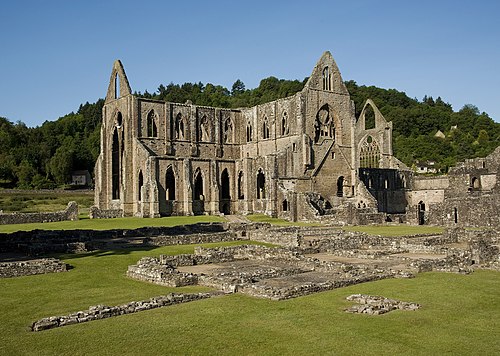
A compact stone inner ward set above a grassy outer enclosure, dominated by two large circular mural towers and a rectangular gatehouse in the curtain wall; walls are built of roughly coursed local sandstone with narrow arrow loops and larger 14th-century window openings. A pilaster-buttressed two-storey hall block sits against the inner wall, and a north accommodation block rises as a three-storey residential tower capped by a distinctive octagonal chimney with a carved top. The whole is enclosed by a defensive ditch and approach.
Its story
The story of Grosmont Castle.
Norman Origins and the Three Castles Lordship, 1066–1185
Grosmont was raised in the wake of the Norman conquest of England, possibly by William FitzOsbern, 1st Earl of Hereford, to guard the route from Wales to Hereford. The first castle on the site was earth and timber, a keep and motte behind a palisade and ditch, with a borough established alongside it that became the village of Grosmont. FitzOsbern's landholdings in the region were broken up after his son Roger de Breteuil rebelled against the Crown in 1075, and by the early 12th century Grosmont belonged to the Anglo-Norman nobleman Pain fitzJohn.
A major Welsh revolt in 1135 prompted King Stephen to bring Grosmont back under Crown control together with its sister fortifications of Skenfrith and White Castle, forming the lordship known as the Three Castles. After a period of détente under Henry II in the 1160s, the De Braose and De Mortimer Marcher families attacked their Welsh rivals in the 1170s, provoking a Welsh assault on nearby Abergavenny Castle in 1182; in response the Crown spent £15 readying Grosmont over the next three years under the royal official Ralph of Grosmont, probably on its timber defences.
Hubert de Burgh's Stone Castle and the Marshal Rebellion, 1201–1234
King John granted the Three Castles to his rising household official Hubert de Burgh in 1201, and Hubert began rebuilding Grosmont's hall in stone. Captured fighting the French in 1205, Hubert lost the castles to his rival William de Braose while imprisoned; John later dispossessed de Braose too, and de Braose's son seized the castles back amid the chaos of the First Barons' War.
Once free, Hubert rose to become royal justiciar and Earl of Kent, recovering the Three Castles in 1219 under Henry III. He rebuilt Grosmont's timber walls in stone and added three mural towers and a gatehouse, turning it into secure, high-status accommodation. Stripped of the castles again after his fall from power in 1232, Hubert saw them pass to the royal servant Walerund Teutonicus. In November 1233 Henry III camped an army outside Grosmont while campaigning against the rebel Richard Marshal, Earl of Pembroke; Marshal's night attack on the camp failed to take the castle but sent the King's army fleeing in confusion. Hubert was reconciled with the King the following year and the castles were returned to him.
Lancaster Lordship and a Comfortable Residence, 1239–1350
Hubert fell out with Henry III again in 1239 and Grosmont reverted to Walerund, who completed a new chapel. The Three Castles passed to the future Edward I in 1254, and after Llywelyn ap Gruffudd's attack on Abergavenny in 1262, Grosmont's constable Gilbert Talbot was ordered to garrison it "by every man, and at whatever cost"; the threat passed without incident. Edmund, Earl of Lancaster, received the Three Castles in 1267, and they remained held by the earldom and later the Duchy of Lancaster for centuries.
Edward I's conquest of Wales in 1282 removed much of Grosmont's military purpose, and under Henry of Lancaster or his son Henry of Grosmont the interior was modernised in the first half of the 14th century into a suite of high-quality apartments set beside a deer park; the historian Jeremy Knight describes the castle of this period as "a small but very comfortable residence".
The Glyndŵr Rising and Ruin, 1404–1613
Grosmont's last military role came during Owain Glyndŵr's revolt: a battle near the castle in 1404 between the Welsh and Richard Beauchamp, Earl of Warwick, ended in an English victory, and the castle itself was besieged the following year by Owain's son Gruffudd before being relieved by a force sent by Prince Henry. By 1538 it had fallen into disuse; a 1563 survey found its bridge collapsed and its interior decayed, its building materials stripped or rotten though the outer walls stood, and a 1613 description called it "ruynous and decayed".
From the Beaufort Estate to Cadw Custody, 1825–Present
The Three Castles estates were sold in 1825 to Henry Somerset, 6th Duke of Beaufort, and in 1902 the 9th Duke sold Grosmont to Sir Joseph Bradney, a soldier and local historian. Evidence given to the Royal Commission on Ancient Monuments in Wales and Monmouthshire in 1909 described the castle as exceptionally well looked after. Frances Lucas-Scudamore placed it into state care in 1922, and conservation work followed, including clearing debris from the basement of the north block. Grosmont is now managed by Cadw, protected as a Grade I listed building and scheduled monument; its 14th-century north block, with its distinctive carved octagonal chimney, survives among the ruins.
Step inside
10 places to explore in 1340.
The record describes 10 distinct spots at Grosmont Castle, including 7 interiors: great hall (first floor), solar (private chamber), north accommodation block and tower and more. Create your own photoreal reconstruction and explore every one, more scenes means more rooms, more angles, and more of the place to stand in.
Build Your Own Castle
Recreate Grosmont Castle with AI to explore it.
The artist rebuilds it as it stood in 1340, a photoreal reconstruction that belongs to you alone. Pay with coins, no subscription needed.
Recreate this castle →Defend this castle →Whose castle
Clans who held Grosmont Castle.
The families that held Grosmont Castle for a decade or more across its history, follow a name to its clan.
Given to Hubert de Burgh by King John in 1201; he recovered the Three Castles in 1219 and rebuilt Grosmont in stone.
Lancaster
Held by the Earls and later Duchy of Lancaster from 1267 until 1825.