
England · Ruin
Hadleigh Castle
Hadleigh Castle is a medieval fortification on a clay ridge overlooking the Thames Estuary in Essex, England. Built and expanded across the 13th–14th centuries, it comprised a ring of curtain walls and multiple large circular towers with royal lodgings facing the estuary; today the site survives as a ruin managed by English Heritage.
First raised
1230
Its prime
1370
Today
Ruin
As it stood in 1370
What Hadleigh Castle looked like in its prime.
Sited along a low, elongated ridge above the Thames Estuary, the castle at its prime presented a continuous pale Kentish ragstone curtain wall pierced by several large, regularly spaced circular towers, notably two broad round towers on the east and a dominant ‘High Tower’ guarding the north entrance. The south side contained a run of royal lodgings and terraced gardens stepping down the slope toward the estuary; a wharf and tidal mill lay off the southern base. Roofed domestic ranges sat against the taller masonry of the towers and battlemented wall-walk.
Its story
The story of Hadleigh Castle.
Hubert de Burgh's Castle, after 1215
When King John rewarded Hubert de Burgh, Earl of Kent, with the honour of Rayleigh in 1215, de Burgh chose not to develop the existing stronghold there and instead raised a new castle on the ridge south of Hadleigh, overlooking the Thames estuary. The exact date of construction is uncertain, confirmed only retrospectively by a licence to crenellate in 1230 under Henry III. The castle was probably octagonal, defended by square and semicircular mural towers and a barbican guarding the entrance, and built of Kentish ragstone, its mortar bulked out with cockleshells.
By 1235 a park had grown up around the castle, with woodland, a fishpond, stables and a lodge. A tidal watermill essential for the castle's bread stood by 1249 on a wharf reaching into the estuary, and terraced gardens along the south side looked out over the water. De Burgh did not hold the castle long: he fell from Henry III's favour, was imprisoned, and stripped of Hadleigh in 1239.
Royal Neglect and Two Queens' Repairs, 1239–1324
Hadleigh remained a royal castle for the rest of the century, part of an estate of some 142 acres together with its park and mill. By the 1250s it had fallen into neglect, and though it passed to Queen Eleanor in 1273 and saw some investment, only the mill appears to have been properly maintained. A hall and solar built around 1290 collapsed to subsidence shortly after going up, and when the castle passed to Queen Margaret in 1299 she complained about the quality of the building and insisted on repairs.
Edward II took a closer interest, staying there first in 1311 after ordering the royal quarters renovated and the walls repaired. The castle then held a hall, larder, kitchen, cellar, a prison and an armoury, guarded by a garrison of 24. Edward returned often until 1324.
Edward III's Grand Rebuilding, 1361–1370
Edward III recovered Hadleigh in 1330 from his mother, Isabella of France, who had taken it when she deposed him in 1326, but showed little interest until the 1360s, when he ordered large-scale rebuilding costing more than £2,200. Between 1361 and 1363 the interior was renovated and new royal lodgings raised along the south walls; the east side was then rebuilt entirely, with two large circular towers set into a new curtain wall completed by 1365. The north side followed, gaining an entrance with portcullis and drawbridge defended by a barbican and a circular tower known as the High Tower, finished by 1370.
Historians once read the rebuilding as a response to rising tension with France, casting Hadleigh as a coastal defence against French raids, but relations with France were in fact unusually good while the work was under way, and it is now thought the ageing king wanted Hadleigh chiefly as a private retreat near London. The inland entrance stayed plain, but the castle's river face was built to impress: travellers to London would have passed Queenborough Castle on the south bank and Hadleigh on the north, a deliberate statement of royal power.
Dower Property and Dismantling, 1400–1575
Edward III's grandson Richard II made little use of Hadleigh, granting it to Aubrey de Vere until de Vere's death in 1400. It then passed through a string of absentee owners (the Dukes of York, Humphrey of Lancaster and Edmund Tudor), before the old custom of granting the castle to the queen was revived and it went to Elizabeth Woodville, wife of Edward IV. Henry VIII never used it, but it was part of the dower of three of his wives, Catherine of Aragon, Anne of Cleves and Catherine Parr.
The estate was broken up after 1544: the parks were sold first, then the castle itself, bought from Edward VI by Lord Richard Rich for £700 in 1551. Rich stripped it for the value of its stone, mostly between 1551 and 1575, leaving the ruin that passed down through his descendants.
Constable's Ruin and the Salvation Army Farm
The painter John Constable visited the ruin in 1814, sketching it as preparation for ten oil studies and a single finished painting exhibited at the Royal Academy in 1829; one sketch now hangs in the Tate Gallery, the finished canvas at the Yale Center for British Art in the United States.
William Booth bought the castle in 1891 for the Salvation Army, which ran a farm there to train the English poor before they were sent overseas to the British colonies. Subsidence and slippage between 1898 and 1923 brought down the southern curtain wall, and after the Salvation Army passed the castle to the Ministry of Works in 1948, further collapses followed; the north-east tower fell in the 1950s, with major slips in 1969, 1970 and 2002. It is now owned by English Heritage as a Grade I listed building and scheduled monument.
Step inside
8 places to explore in 1370.
The record describes 8 distinct spots at Hadleigh Castle, including 2 interiors: great hall and solar range (south side), kitchen, larder and service range. Create your own photoreal reconstruction and explore every one, more scenes means more rooms, more angles, and more of the place to stand in.
Build Your Own Castle
Recreate Hadleigh Castle with AI to explore it.
The artist rebuilds it as it stood in 1370, a photoreal reconstruction that belongs to you alone. Pay with coins, no subscription needed.
Recreate this castle →Defend this castle →Whose castle
Clans who held Hadleigh Castle.
The families that held Hadleigh Castle for a decade or more across its history, follow a name to its clan.
Built after 1215 by Hubert de Burgh, 1st Earl of Kent, a key supporter of King John.
de Vere
Granted to Aubrey de Vere until his death in 1400.
From the archive
Hadleigh Castle on paper: the measured plan and period views.
The survey plan and photographs below are the ground truth this page's reconstructions are checked against, drawn and photographed while the castle was still a working garrison. Every image is public-domain or openly licensed, with its source named.

Hadleigh Castle, Southend-on-Sea, England-LCCN2002708115
ca. 1890-1900 · Photochrom Prints Collection (via Wikimedia Commons)
Public domain
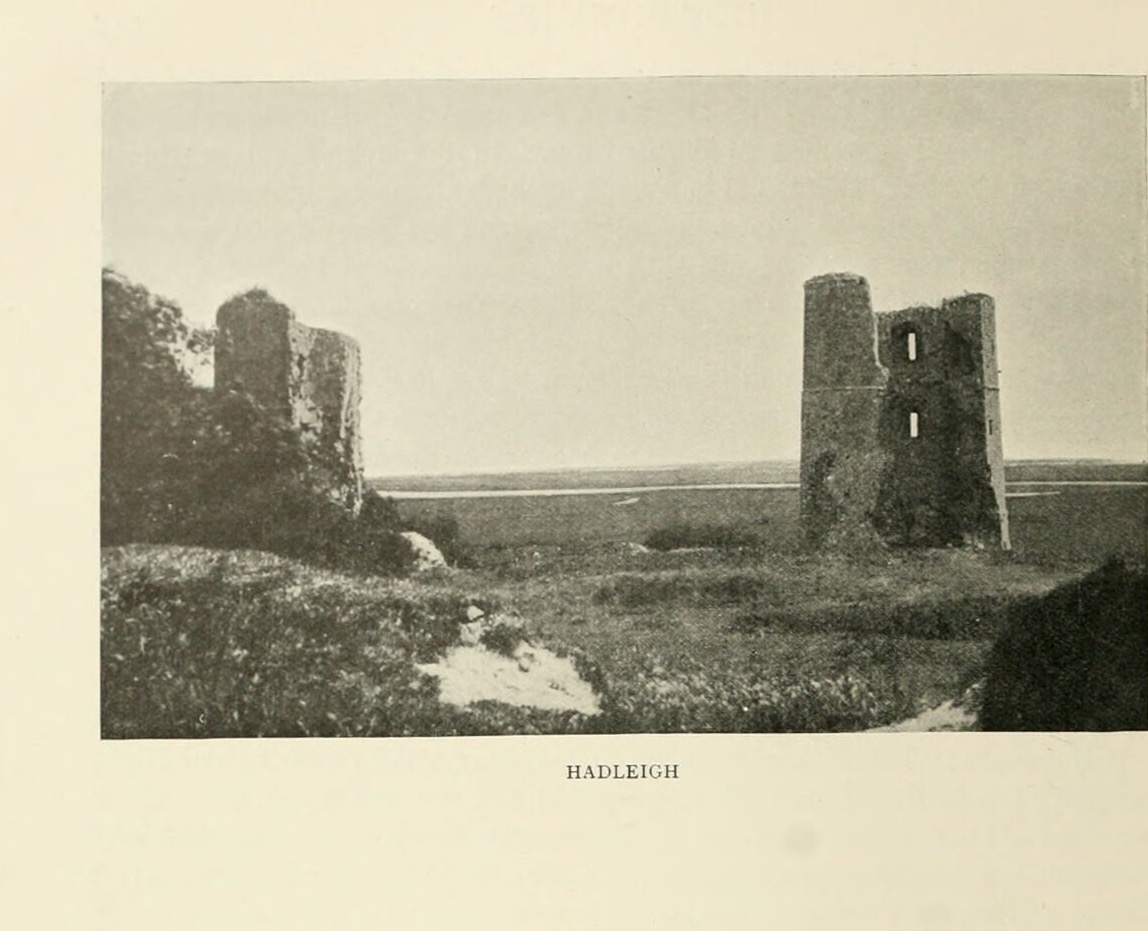
HADLEIGH
1897 · J. D. Mackenzie, The Castles of England, vol. 1 (1897)
Public domain
Nearby


