Joyce
also Seoighe
Of Iar Connacht and Galway city, one of the Tribes, and the family of James Joyce.
- Origin
- Connacht, Ireland
- Motto
- Mors potius macula
- Famous bearer
- James Joyce (1882–1941), novelist, Dubliners / Ulysses / Finnegans Wake
- Register
- Irish family
Where the Joyce name comes from
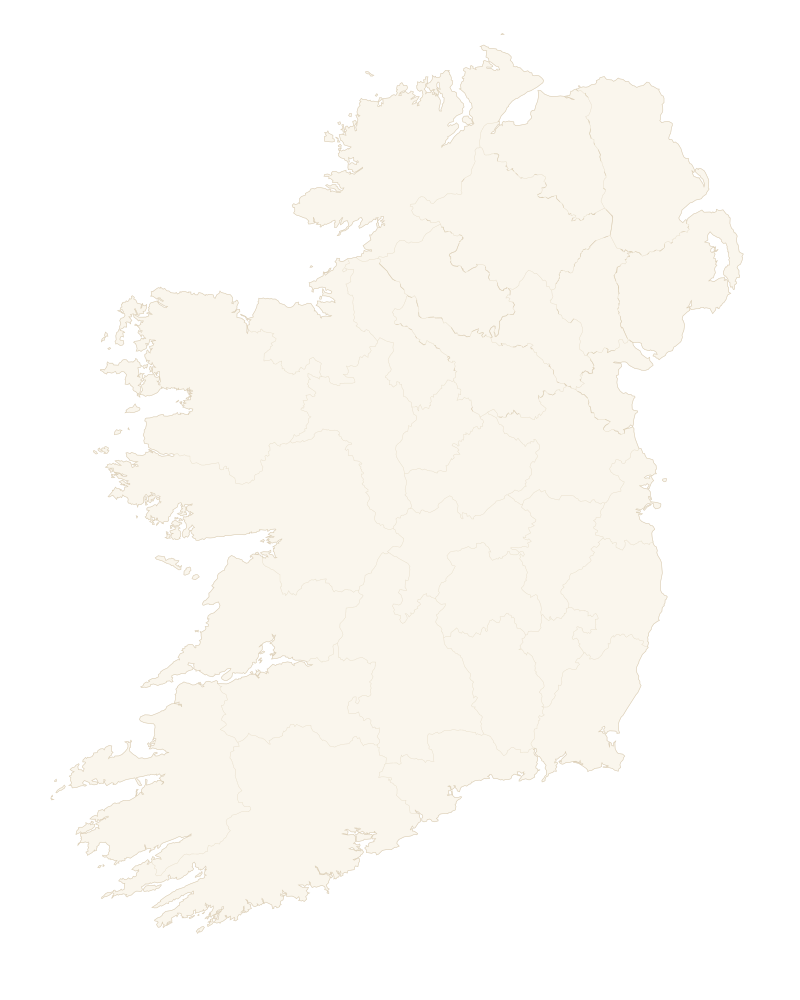
CoreHistoric reach
The seat of Joyce
Seat vacantChief
No one leads the Joyce community yet. When the movement opens, you can stand for its leadership, or help elect whoever does.
Current mission
No shared goal set yet. Once Joyce has leadership, it sets the public focus: a restoration, a gathering, a real-world project that helps its own.
The Joyce clan is being rebuilt. Join the waiting list for the movement today, and you help decide who leads it and what it does.
Help rebuild the Joyce clan →Motto
Mors potius macula
“Death rather than disgrace”
What does the Joyce name mean?
From Norman French Joyse, itself a form of the Latin gaudium (joy), used as a personal name. The Joyces of Galway descend from Thomas de Jorse, a Welsh-Norman knight who settled in west Connacht in the late 13th century with his Bermingham wife. Within two generations they were thoroughly Gaelicised, the Irish form Seoighe rendered the original Norman, and they remained one of the great Tribes of Galway, the fourteen Anglo-Norman merchant families that dominated the city of Galway from the 14th to the 17th centuries.
The history of Joyce
Judoc, gaudium, and Seoighe
The sources do not agree about the name. One account takes Joyce from the Norman French Joyse, a form of the Latin gaudium, joy, used as a personal name. The other takes it from the Old French Josse, from the Latin Iudocus, the Latinised form of the Breton Judoc, meaning lord, and running back to Saint Judoc (600-668), a Breton prince and hermit, son of Judicael, king of Brittany. The second line explains what the first does not: why Joyce is both an old Irish surname and a woman's first name in English. The personal name grew rare after the fourteenth century, then came back as a female given name, read by then through the Middle English joise, to rejoice.
In Ireland the name was taken into the language as Seoighe, and that direction of travel is unusual. Most Gaelic surnames of Ireland, Scotland and the Isle of Man were anglicised at some point. The Joyces went the other way: a Norman name naturalised into Irish, and only afterwards written back out in English. The motto keeps the older register, Mors potius macula, death rather than disgrace.
The Welsh knight who married a Bermingham
The Joyces of Galway descend from Thomas de Jorse, a Welsh-Norman knight who settled in west Connacht in the late thirteenth century with his Bermingham wife. The Irish clan lists sort the incoming surnames by where they came from before they came, and Joyce does not sit where a reader might expect. The Norman-origin group holds Burke, Fitzgerald, Butler, Power, Lynch and Martin, the great colonial houses. Joyce belongs to a shorter list of names believed to have arrived with the Norman invasion but to have been Welsh in origin: Roche, Blake, Rice, Taffe, Walsh, Savage and MacQuillan. Within two generations the family was thoroughly Gaelicised, as many of the Old English houses were, but it did not end as a title. It ended as a country.
Dúiche Sheoighe, the family that became a place
The Joyces took substantial territory in Iar Connacht, the rugged western mountains and lakes of north Connemara, and the district took their name. Joyce Country, Dúiche Sheoighe in Irish, is still what that ground is called: the parishes of Cong and the upper reaches of Lough Corrib. Very few surnames end up printed on a map as the name of a region, and fewer keep it for centuries after the family stopped ruling anything. The name spread past it, into Mayo and Clare, but those mountains are the heartland it is measured from.
The Gaelic record adds a detail the family never lost hold of: the Joyces were noted for unusual physical stature, and one Joyce of the fourteenth century was reputed to have stood seven feet tall. That is a tradition rather than a measurement, though such traditions attach to families who made an impression on their neighbours.
One of the Tribes of Galway
While kinsmen held the hills, the name also took a place in the merchant town at the mouth of the Corrib. The Joyces are counted among the Tribes of Galway, the fourteen Anglo-Norman merchant families that dominated the city from the fourteenth century to the seventeenth. That gave the surname two kinds of standing at once: mountain country in the west, and a seat among the houses that ran the town's trade and its government, on the side of the counting house rather than the cattle raid.
Maamtrasna, and a man tried in a language he did not speak
Myles Joyce, Maolra Seoighe, born about 1842, was a Connemara Joyce hanged at Galway Gaol on 15 December 1882 for the Maamtrasna murders. He was convicted on the testimony of accomplices, in a trial conducted entirely in English. He spoke only Irish and did not understand the proceedings that condemned him.
The case became a cause célèbre of late-Victorian Britain. James Joyce, then a young man, wrote about the trial for the Trieste paper Il Piccolo della Sera; an Irish speaker sentenced in a courtroom whose words he could not follow needed no embellishing. Myles Joyce was formally exonerated and granted a posthumous presidential pardon by Michael D. Higgins in 2018.
The Cork branch, a Dublin house, and Bloomsday
James Joyce (1882-1941) is the most internationally famous bearer of the surname: the Dublin-born author of Dubliners, of Ulysses in 1922 and of Finnegans Wake in 1939. His direct paternal line runs not from Galway but from a Cork branch of the family, and his grandfather John Joyce moved from Cork to Dublin in the 1850s, so the novelist was born in the city he spent his life writing about.
He knew where the name had started and said so, referring repeatedly in interviews and letters to the family's Galway origin and to Joyce Country in particular. The Connemara mountains sit behind the most thoroughly urban body of work in Irish literature. Ulysses compresses itself into one Dublin day in 1904, and that day is kept now as Bloomsday, an ordinary date in one city turned into a fixture of the literary calendar.
He was not the first of the name in Irish letters. Patrick Weston Joyce (1827-1914), the author, and his brother Robert Dwyer Joyce (1830-1883), the poet, were writing a generation before Ulysses. Lucia Joyce (1907-1982), the novelist's daughter, was a ballet dancer.
From St George in Queensland to the deputy prime ministership
Barnaby Thomas Gerard Joyce was born at Tamworth in the New England region of New South Wales on 17 April 1967, the son of a grazier. He qualified as an accountant and built a practice at St George in south-western Queensland, serving the farming towns of the inland. Elected to the Senate for Queensland as a National in 2004, he took his seat in 2005 and became one of the most recognisable figures of his party, known for his advocacy of agriculture, water policy and the interests of regional Australia.
In 2013 he moved to the House of Representatives, winning the New South Wales seat of New England, his home region. He was elected leader of the National Party in 2016 and served as Deputy Prime Minister of Australia from 2016 to 2018 and again from 2021 to 2022, with portfolios running to Agriculture and Water Resources, Infrastructure and Transport, and Veterans' Affairs. A consistent champion of decentralisation, he drove the relocation of the Australian Pesticides and Veterinary Medicines Authority from Canberra to Armidale, arguing that federal agencies should be spread beyond the capital cities.
Where the name went, and where it stayed
Emigration took the surname a long way from Lough Corrib. Alan Joyce, born in 1966, became chief executive of Qantas as an Irish-Australian; Ron Joyce (1930-2019) co-founded the Tim Hortons chain in Canada; Eileen Joyce (1912-1991) was an Australian pianist and Mike Joyce (born 1963) the drummer of The Smiths.
At home the name stayed loudest in sport. Pádraic Joyce, born in 1977, played Gaelic football for County Galway; Ed Joyce (born 1978), Isobel Joyce (born 1983), Cecelia Joyce (born 1983), Dominick Joyce (born 1981) and Gus Joyce (born 1974) all played cricket for Ireland, an unusual concentration of one surname in one national side; David Oliver Joyce (born 1987) boxed for Ireland, and the Seoighe crews of Inish Bearachain took rowing championships under the Irish form of the name. Nan Joyce (1940-2018) was an activist for Irish Travellers' rights.
Between a Welsh-Norman knight in the thirteenth century and a deputy prime minister of Australia in the twenty-first, the name has been a Breton saint's, a Galway merchant house, a stretch of Connemara mountain, a wrongful hanging put right in 2018, and the signature on Ulysses.
Champions of the Joyce name
The bearers whose lives are inseparable from this surname. Each has their own page, biography, achievements, geography, connection to the family.
Historic Places, Rebuilt
Explore the streets and seats the Joyce name knew, rebuilt with AI as they stood in history.
Historic Places, Rebuilt · New
The walled City of the Tribes at its Spanish-trade height, the quays, Lynch's Castle, and the fourteen merchant families.
Historic Places, Rebuilt · New
The O'Brien Earls of Thomond's great four-towered tower-house, hung with banners and famed for its feasts.
The castles of the homeland
The great strongholds of the homeland, look one up, see what it looked like in its prime, and recreate it to explore.
 Ashford Castle, County MayoRestored · prime 1880
 Manderley CastleRestored · prime 1840
 Dublin CastleRestored · prime 1790
All castles in Ireland → · Strongest castles in Ireland → · Castles of Europe
Play As Your Clan
Hold a real castle against whatever you choose to send at it, take a ship out in her own service years, or stand at the shoulder of someone the record remembers. The chronicler sets the scene; the deeds are yours.
Notable bearers of the Joyce name
- James Joyce (1882–1941), novelist, Dubliners / Ulysses / Finnegans Wake
- Myles Joyce (c.1842–1882), Connemara man, hanged at Galway Gaol; pardoned 2018
- William Joyce (1906–1946), 'Lord Haw-Haw', Brooklyn-born of Galway-Joyce descent
Stories of Joyce
Frequently asked
What does the surname Joyce mean?
Where does the Joyce family come from?
Where did the Joyce family historically hold territory?
Is Joyce Irish or Scottish?
How old is the Joyce surname?
What is the Joyce family known for?
What is the Joyce motto?
What does "Mors potius macula" mean in English?
Is there a Joyce family crest or coat of arms?
Who is the most famous Joyce?
Who are some famous Joyces?
What stories are told about the Joyce family?
What is the story of Bloomsday?
Is Seoighe the same family as Joyce?
Where is the Joyce surname found today?
What does the Clan Rising page for the Joyce family cover?
Who is the head of the Joyce family today?
Neighbouring clans
- KellySecond most common Irish surname, the Uí Maine of Galway, and six other dynasties besides.
- BurkeThe de Burgo Lords of Connacht, Hibernis ipsis Hiberniores.
- LynchOf the Tribes of Galway, and, by tradition, of the phrase 'Lynch law'.
- ConnollyOf Connemara and the Fews, and the founder of Irish socialism.