Connolly
also Conneely, Ó Conghaile, Ó Coingheallaigh
Of Connemara and the Fews, and the founder of Irish socialism.
- Origin
- Connacht, Ireland
- Famous bearer
- James Connolly (1868–1916), socialist, signatory of the 1916 Proclamation, executed in his chair
- Register
- Irish family
Where the Connolly name comes from
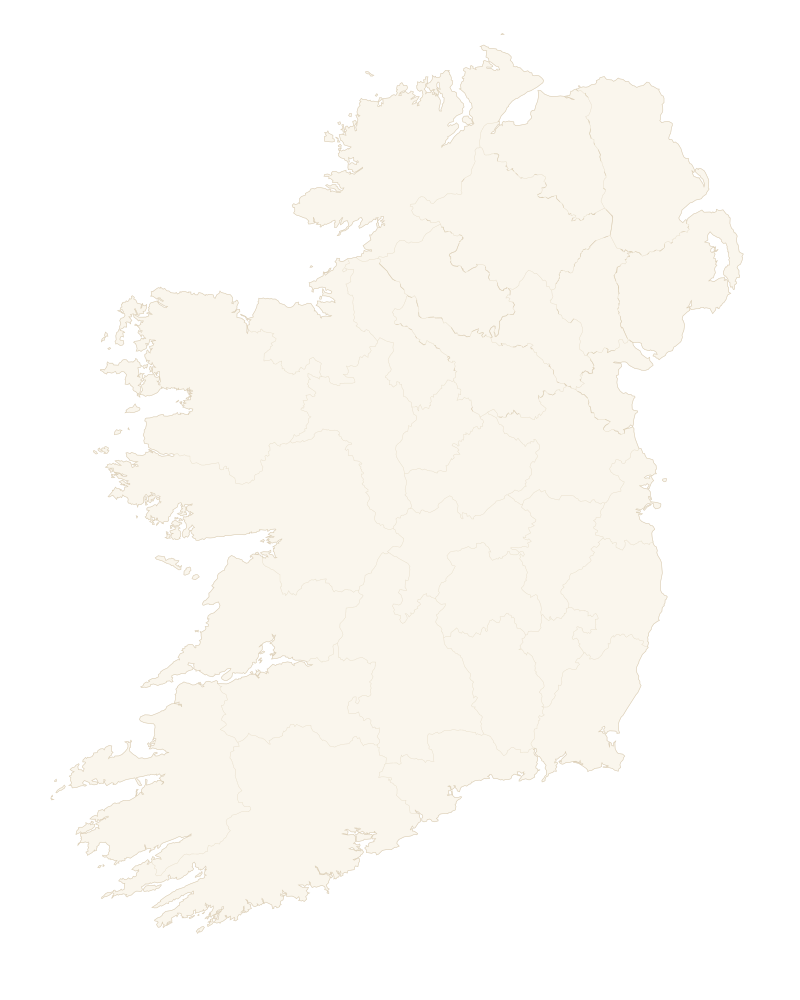
CoreHistoric reach
The seat of Connolly
Seat vacantChief
No one leads the Connolly community yet. When the movement opens, you can stand for its leadership, or help elect whoever does.
Current mission
No shared goal set yet. Once Connolly has leadership, it sets the public focus: a restoration, a gathering, a real-world project that helps its own.
The Connolly clan is being rebuilt. Join the waiting list for the movement today, and you help decide who leads it and what it does.
Help rebuild the Connolly clan →What does the Connolly name mean?
From Ó Conghaile, descendant of Conghal. Conghal is an Old Irish personal name often glossed as 'fierce as a wolf' (cú, hound + gal, valour), though the etymology is contested. Three distinct Ó Conghaile kindreds gave rise to the modern Connollys: the Galway Connollys of Connemara (the line, also Anglicised as Conneely), the Monaghan Connollys of the Fews, and the Meath Connollys of Allenstown. All Anglicised as Connolly by the 18th century.
The history of Connolly
Five unrelated kindreds funnelled into one spelling
Ó Conghaile and Ó Conghalaigh descend from the personal name Conghal, glossed as 'fierce as a hound', from cú and gal, valour, though the etymology is contested. What matters more for a modern Connolly is that the anglicised spelling covers at least five Gaelic kindreds never related to one another: the Ó Conghalaigh of Iar Connacht in County Galway, the Ó Coingheallaigh of Desmond in west Cork, the Ó Conghalaigh of Derrygonnelly in Fermanagh, the Ó Conghalaigh of Airgíalla in Monaghan and Meath, and the Ó Conghaile Muirthemne of Louth.
The English-language clerk flattened all of them, stripping the Ó and refitting the vowels to English habits, so that Connolly, Connally, Connelly and Conley came out of names that had sounded quite distinct in Irish. The result was one of the largest surname pools in the country: in 1890 Connolly was the twenty-third most common surname in Ireland, with three hundred and eighty-one births recorded in that single year, most of them in Ulster. By 1996 it had slipped to thirty-third.
Chiefs of the Name, and the ruin of 1641
The Ó Conghalaighs of Airgíalla held ground in what is now Monaghan and Meath. Their descent is disputed between two accounts: a branch of the Southern Uí Néill who removed into Airgíalla, or a branch of the Mac Mathghamna, kings of Airgíalla from the mid-thirteenth century until 1590. The genealogist John Grenham records that they came to prominence in the fifteenth century and kept recognised Chiefs of the Name into the seventeenth.
That lordship ended with a single decision. The Airgíalla Connollys were, in Grenham's phrase, instrumental in organising the native Irish Rebellion of 1641, and when the rising failed they lost their power and their possessions with it. The estates went; the name did not. It is from this dispossessed Monaghan stock that the two most consequential bearers of the surname descend.
From forfeiture to the Speaker's chair
The same Monaghan line produced the wealthiest man in early-Hanoverian Ireland. William Conolly (1662-1729) spelled the name with a single n and sat as Speaker of the Irish House of Commons.
He spent it on stone. Castletown House at Celbridge in County Kildare is the earliest and largest of the great Palladian country houses of Ireland. A family stripped of its lands after the rebellion of 1641 produced the builder of Castletown.
Ballyconneely, and the branch that stayed in Irish
The Iar Connacht kindred went another way. Its name was also anglicised as Conneely, and Conneely stayed put: in 1890 it was found exclusively in Connacht, most of its bearers in County Galway, and it gave Ballyconneely in Connemara its name. It is an entirely separate sept.
Its people carry the Irish forms still, and those forms are a grammar as much as a name: a man is Ó Conghaile, descendant of Conghal, while his daughter is Ní Chonghaile, the consonant lenited after the feminine prefix. The Connemara descendants include the scribe and writer Micheál Ó Conghaile, the writer Seán Ó Conghaile, the TG4 presenter Eibhlín Ní Chonghaile, the musician Johnny Óg Connolly, and the sportspeople Joe Connolly and Aislinn Connolly. Martin Connolly served as Mayor of Galway.
The Cowgate boy who founded an Irish Marxist party
James Connolly was born on 5 June 1868 at 107 Cowgate, in the Irish quarter of Edinburgh's Old Town, third son of John Connolly, a carter from County Monaghan, and Mary McGinn, also of Monaghan, both emigrants of the Famine generation. He left the parish school at eleven for a printer's devil job at the Edinburgh Evening News, then a Leith bakery and a Leith tile-works. At fourteen, in 1882, below the regulation age, he enlisted under his elder brother's name and served seven years with the Royal Scots in Ireland, principally at Cork and the Curragh. He deserted in 1889 and married Lillie Reynolds of Carlow at Dublin in April 1890.
Back in Edinburgh he worked as a carter and a council scavenger, joined the Scottish Socialist Federation in 1892 and by 1894 was its full-time organiser for Dundee and Aberdeen. In May 1896 the Dublin Socialist Club offered him a paid post; he took it, moved the family over, and on 29 May 1896 founded the Irish Socialist Republican Party in a basement office on Thomas Street, the first explicitly Marxist party in the country and the first to set the national demand and the labour demand in one programme.
Belfast docks, the Lock-Out, and a workers' army
He took the family to the United States in 1903, organised for the Socialist Labor Party and from 1905 for the Industrial Workers of the World in New York and New Jersey, and wrote his mature theory there: Labour, Nationality and Religion and Labour in Irish History, both 1910, the second the founding work of historical materialist analysis applied to the Irish national question.
The Socialist Party of Ireland called him home in July 1910. In 1911 he took the Belfast organisership of the Irish Transport and General Workers' Union under James Larkin, and built the Belfast and Dublin docks-and-carting membership to the strength it carried into the Dublin Lock-Out of August 1913 to February 1914, in which the employers under William Martin Murphy locked out twenty thousand ITGWU members. On 23 November 1913, in the middle of it, he co-founded with Larkin and Captain Jack White the Irish Citizen Army, raised to keep the Dublin Metropolitan Police off ITGWU pickets and the first standing workers' army in the English-speaking world.
Six days in the General Post Office
When Larkin sailed for an American lecture tour in October 1914, Connolly took both the acting general secretaryship of the ITGWU and the command of the Citizen Army. Through 1915 he moved it into closer co-operation with the left of the Irish Volunteers and with the Irish Republican Brotherhood, was sworn into the IRB, and in January 1916 was elected to its seven-man Military Council. At Easter 1916 he was named Commandant of the Dublin Brigade and Vice-President of the Provisional Government under Pearse.
He drafted the military plan of the Rising with Joseph Mary Plunkett, commanded the General Post Office garrison through the six days of Easter Week, was wounded in the foot and shoulder in the fighting of Thursday 27 April, and signed the surrender alongside Pearse on the 29th. A field general court martial at Dublin Castle sentenced him to death. He was taken by ambulance to Kilmainham Gaol unable to stand, shot in the prison yard at dawn on 12 May 1916, and buried at Arbour Hill with the other executed leaders.
The union, the terminus and the two books
The institutions outlived the man. The ITGWU became the foundational body of twentieth-century Irish labour, passing to a generation that included Roddy Connolly (1901-1980), himself an Irish socialist, and Nora Connolly; in 1990 it merged with the Federated Workers' Union of Ireland to form SIPTU, the largest trade union in modern Ireland. Connolly Station, the central east-coast railway terminus of Dublin, has carried his name since 1966, and The Workers' Republic and Labour in Irish History remain foundational texts of the Irish socialist tradition.
The name in print, on stage and on the field
Away from politics the surname settled into letters and performance. Cyril Connolly (1903-1974), of Anglo-Irish Connolly descent, was an English man of letters; Myles Connolly (1897-1964) a writer and screenwriter, an Oscar nominee for Music for Millions in 1944; Sybil Connolly (1921-1998) an Irish fashion designer; Walter Connolly (1887-1940) an American character actor; and Matthew William Kemble Connolly (1872-1947) a British army officer who was also a malacologist.
Billy Connolly, born in Glasgow in 1942, is a comedian and actor; Brian Connolly (1945-1997) sang for the band Sweet and Nathan Connolly plays guitar for Snow Patrol. Maureen Connolly (1934-1969) was an American professional tennis player and Hal Connolly (1931-2010) an American hammer thrower.
Champions of the Connolly name
The bearers whose lives are inseparable from this surname. Each has their own page, biography, achievements, geography, connection to the family.
Historic Places, Rebuilt
Explore the streets and seats the Connolly name knew, rebuilt with AI as they stood in history.
The castles of the homeland
The great strongholds of the homeland, look one up, see what it looked like in its prime, and recreate it to explore.
 Ashford Castle, County MayoRestored · prime 1880
 Manderley CastleRestored · prime 1840
 Dublin CastleRestored · prime 1790
All castles in Ireland → · Strongest castles in Ireland → · Castles of Europe
Play As Your Clan
Hold a real castle against whatever you choose to send at it, take a ship out in her own service years, or stand at the shoulder of someone the record remembers. The chronicler sets the scene; the deeds are yours.
Notable bearers of the Connolly name
- James Connolly (1868–1916), socialist, signatory of the 1916 Proclamation, executed in his chair
- William Conolly (1662–1729), Speaker of the Irish House of Commons, builder of Castletown
- Cyril Connolly (1903–1974), English literary critic of Anglo-Irish-Connolly descent
- Billy Connolly (b. 1942), Glaswegian comedian and actor
Stories of Connolly
Frequently asked
What does the surname Connolly mean?
Where does the Connolly family come from?
Where did the Connolly family historically hold territory?
Is Connolly Irish or Scottish?
How old is the Connolly surname?
What is the Connolly family known for?
Is there a Connolly family crest or coat of arms?
Who is the most famous Connolly?
Who are some famous Connollys?
What stories are told about the Connolly family?
What is the story of Tied to a chair at Kilmainham?
Is Conneely the same family as Connolly?
Is Ó Conghaile the same family as Connolly?
Is Ó Coingheallaigh the same family as Connolly?
Where is the Connolly surname found today?
What does the Clan Rising page for the Connolly family cover?
Who is the head of the Connolly family today?
Neighbouring clans
- KellySecond most common Irish surname, the Uí Maine of Galway, and six other dynasties besides.
- BurkeThe de Burgo Lords of Connacht, Hibernis ipsis Hiberniores.
- JoyceOf Iar Connacht and Galway city, one of the Tribes, and the family of James Joyce.
- LynchOf the Tribes of Galway, and, by tradition, of the phrase 'Lynch law'.