Lynch
also Loingseach, Ó Loingsigh, de Lench
Of the Tribes of Galway, and, by tradition, of the phrase 'Lynch law'.
- Origin
- Connacht, Ireland
- Motto
- Semper fidelis
- Famous bearer
- James Lynch FitzStephen (15th c.), Mayor of Galway, the figure of the 1493 hanging legend
- Register
- Irish family
The Lynch arms and country

Coat of armsLynch coat of armsself-created · CC BY-SA 3.0

- Coat of arms: Granted to an individual and inherited down that one documented line. These are the arms of particular families of the name, not of everyone who shares the surname.
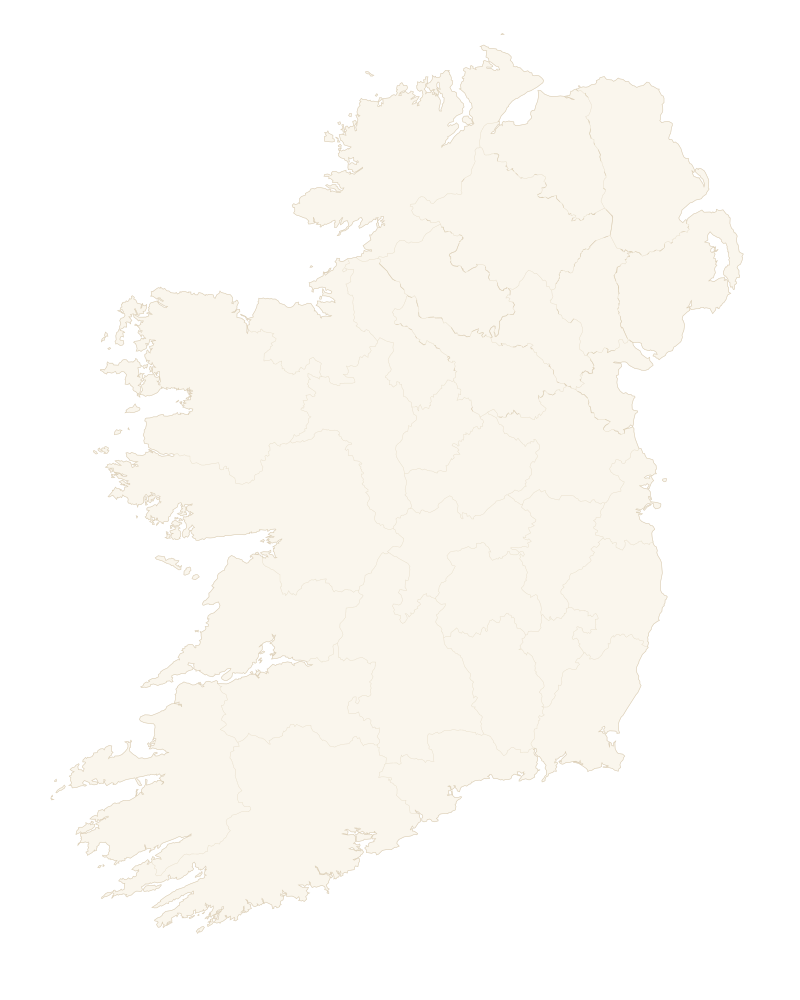
CoreHistoric reach
The seat of Lynch
Seat vacantChief
No one leads the Lynch community yet. When the movement opens, you can stand for its leadership, or help elect whoever does.
Current mission
No shared goal set yet. Once Lynch has leadership, it sets the public focus: a restoration, a gathering, a real-world project that helps its own.
The Lynch clan is being rebuilt. Join the waiting list for the movement today, and you help decide who leads it and what it does.
Help rebuild the Lynch clan →Motto
Semper fidelis
“Always faithful”
What does the Lynch name mean?
Two distinct origins, both Anglicised as Lynch. The Galway Lynches descend from the Anglo-Norman family de Lench, settled at Knock outside Galway by the late 13th century, one of the fourteen Tribes of Galway, the merchant families that ran the city of Galway as a chartered Anglo-Irish enclave from the 14th to the 17th centuries. Separately, several Gaelic Ó Loingsigh families (descendant of Loingseach, 'mariner') in Cork, Sligo and Antrim Anglicised independently as Lynch by the early modern period.
The history of Lynch
Two names that fell together
Lynch is not one family. It is at least two, and they are unrelated. One is Anglo-Norman: de Lench, from the same root as the Kentish hlinc, a hill, carried into Ireland after the invasion of the late twelfth century, settled at Knock outside Galway by the late thirteenth, and risen there to be one of the fourteen Tribes of Galway. The other is Gaelic: Ó Loingsigh, descendant of Loingseach, from the word for a fleet of ships, a man of the sea. There was never a single Ó Loingsigh kindred either. The genealogist the Rev. Patrick Wolfe recorded several: lords of Dál Riata in north-eastern Ulster in the eleventh century, until the Normans displaced them; others in Tipperary, in Briefne (modern Leitrim) and in Thomond (Clare and Limerick); and in West Cork a branch of the Corca Laoighe. Not one family with branches. Several families with one spelling.
They fell together by accident of translation. Written into English records the prefixes Ó and Mac were stripped and what remained spelled by ear: Ó Loingsigh gave Lynchy, Lynskey and Lindsey, Mac Loingsigh gave Clynch, MacClintock and McClinton as well as Lynch. A Lynch of Cork and a Lynch of Galway may share nothing but a page in a ledger.
How de Lench got inside the walls of Galway
Galway made the Lynches and the Lynches made Galway. The town grew around the fort at the mouth of the river Gaillimh raised in 1124 by Tairrdelbach Ua Conchobair, King of Connacht, and taken by Richard Mor de Burgh in 1232. When the de Burgh dynasty sundered in 1333 the townsmen moved to hold their own affairs, free of the Gaelicised and often feuding Burkes. A murage charter, the right to build a wall, came from the Crown in 1396, and a municipal charter in December 1484 secured the town's independence from the Clanrickard Burkes and put the parish church of St Nicholas under the townsmen's own wardenship.
The first mayor elected under that charter, in 1485, was a Lynch: Peirce Lynch Fitzjohn. Power lay with fourteen merchant families, twelve of Norman origin and two of Irish, known together as the Tribes of Galway. Galway was the only medieval city in Connacht, and perhaps three thousand people lived inside its walls: fourteen families governing three thousand people is not a figure of speech for an oligarchy but the arithmetic of one.
Eighty-four mayors, Shop Street and the Spanish trade
Between the charter of 1484 and the Cromwellian dispossession of 1654, eighty-four Lynches served as mayor of Galway: the longest single-family hold on a chartered Irish municipal office in the medieval record. The office was neither ceremonial nor safe: a mayor sat as chief magistrate at the Tholsel, licensed who might trade and hold property inside the walls, and stood personally behind the town's word to foreign merchants.
The family built to match. Lynch's Castle stands on the corner of Shop Street, a fortified merchant town-house of the late fifteenth century: not a countryside fortress but a strongbox with a shopfront, which is what a merchant dynasty in a walled port needed. It still stands, and still works, as a bank. East of the city they held Merlinpark Castle, a tall tower of the fifteenth or sixteenth century, lived in until the mid-nineteenth and a national monument today.
The town lived on the sea, not on Connacht. Galway was the principal Irish port for trade with Spain and France, and the main source of trade to the Western Isles of Scotland during the Lordship of the Isles; the Lynches traded principally with Spain and the Spanish Netherlands. The wall called ceann an bhalla, now the Spanish Arch, went up under Mayor Wylliam Martin in 1519 and 1520. A Lynch son not bound for the bench went to sea, to a foreign counting-house, a Continental seminary or a Spanish regiment.
The window on Lombard Street, and the word that is not theirs
The most famous Lynch story is a hanging. By the Galway tradition set down in print in 1820 by James Hardiman, in 1493 the mayor James Lynch FitzStephen tried his own son Walter for the murder of a Spanish guest, sentenced him personally, and, when the city's executioner refused and the crowd would let no other man near the gallows, hanged the boy himself from the upper window of his own house in Lombard Street. Lynch's Window is still marked in the building, with a stone tablet carrying a crow above a skull and the Latin Memorate Mori, remember death. It is a tradition of the town rather than a court record.
It has also been made to carry something it cannot. The English phrase lynch law is popularly traced to that window, and that derivation is folk etymology, not history: the likelier source is Charles Lynch, a Virginia magistrate of the seventeen-eighties, and the link to Galway is by surname only. Worth saying plainly, because the alternative is a family credited with the origin of mob murder on a coincidence of spelling.
Neither O nor Mac: a wall that cut both ways
The pride and the hard part here are the same fact. The tribes governed Galway by keeping the Gaelic Irish out of it, and did so by statute. A bylaw of 1460 forbade any resident to sell or lease land within the town to an Irishman without the council's licence, on pain of forfeiting the property and a hundred shillings; another barred the native Irish from unrestricted entry, in the notorious phrase that neither O nor Mac shall strutte nor swagger through the streets of Galway. Mayor Thomas Óge Martyn finished a notice over the west gate in 1562 asking God to protect the town from the Ferocious O'Flahertys. Lynch mayors administered those rules, and Ó Loingsigh families carrying what would become the identical surname stood outside them.
The wall cut the other way too. An Act of Henry VIII of 1536 ordered the inhabitants of Galway to shave their moustaches, wear English caps and English-cut clothes, use no saffron, speak English and put their children to school to learn it. Loyal enough to hold a charter, Irish enough to be legislated at.
Siege, forfeiture, and where the name went
The end came in one long generation. After the rebellion of 1641 the Catholic citizens turned on the English garrison at Fort Hill and took the Confederate side; the city surrendered to Cromwellian forces in 1652 after a nine-month siege, and plague and the expulsion of Catholic citizens followed. Galway then took the Jacobite side, and in 1691, after that army was destroyed at nearby Aughrim, passed to the Williamites under the Articles of Galway. Its great merchant families were ruined and their capital spent overseas, and the Popery Act of 1704 barred new Catholics other than seamen and day labourers from moving to the city at all.
The landowning Galway line was raised to the baronetage as the Lynch baronets of Galway, and reached Argentina with the emigration of Patrick Lynch. Eliza Lynch (1833–1886), the Cork-born Madame Lynch, became consort of Francisco Solano López, dictator of Paraguay through the War of the Triple Alliance of 1864 to 1870. Jack Lynch (1917–1999) took six successive All-Ireland senior medals on the Cork hurling and football fields between 1941 and 1946 and served as Taoiseach from 1966 to 1973 and from 1977 to 1979: a Cork Lynch, not a Galway one, which is the whole point of the name. Whether your line runs back to a merchant house inside the walls or to a seafaring Ó Loingsigh kindred who never set foot in them, both are real and both are Irish.
Champions of the Lynch name
The bearers whose lives are inseparable from this surname. Each has their own page, biography, achievements, geography, connection to the family.
Historic Places, Rebuilt
Explore the streets and seats the Lynch name knew, rebuilt with AI as they stood in history.
Historic Places, Rebuilt · New
The walled City of the Tribes at its Spanish-trade height, the quays, Lynch's Castle, and the fourteen merchant families.
Historic Places, Rebuilt · New
The MacCarthy lords' great tower-house in its prime, the battlements and the famous stone, high over wooded Muskerry.
Castles the Lynch held
Strongholds this name held for a decade or more, look one up, or rebuild it to explore.
- Merlinpark Castle
Owned by the Lynch family (Ó Loingsigh) in the 16th century.
The castles of the homeland
The great strongholds of the homeland, look one up, see what it looked like in its prime, and recreate it to explore.
 Ashford Castle, County MayoRestored · prime 1880
 Manderley CastleRestored · prime 1840
 Dublin CastleRestored · prime 1790
All castles in Ireland → · Strongest castles in Ireland → · Castles of Europe
Play As Your Clan
Hold a real castle against whatever you choose to send at it, take a ship out in her own service years, or stand at the shoulder of someone the record remembers. The chronicler sets the scene; the deeds are yours.
Notable bearers of the Lynch name
- James Lynch FitzStephen (15th c.), Mayor of Galway, the figure of the 1493 hanging legend
- Jack Lynch (1917–1999), Taoiseach of Ireland
- Eliza Lynch (1833–1886), consort of Francisco Solano López of Paraguay
Stories of Lynch
Frequently asked
What does the surname Lynch mean?
Where does the Lynch family come from?
Where did the Lynch family historically hold territory?
Is Lynch Irish or Scottish?
How old is the Lynch surname?
What is the Lynch family known for?
What is the Lynch motto?
What does "Semper fidelis" mean in English?
Is there a Lynch family crest or coat of arms?
Who is the most famous Lynch?
Who are some famous Lynchs?
What stories are told about the Lynch family?
What is the story of the hanging of Walter Lynch?
Is Loingseach the same family as Lynch?
Is Ó Loingsigh the same family as Lynch?
Is de Lench the same family as Lynch?
Where is the Lynch surname found today?
What does the Clan Rising page for the Lynch family cover?
Who is the head of the Lynch family today?
Neighbouring clans
- KellySecond most common Irish surname, the Uí Maine of Galway, and six other dynasties besides.
- BurkeThe de Burgo Lords of Connacht, Hibernis ipsis Hiberniores.
- JoyceOf Iar Connacht and Galway city, one of the Tribes, and the family of James Joyce.
- ConnollyOf Connemara and the Fews, and the founder of Irish socialism.