Fitzpatrick
also Mac Giolla Phádraig, Kilpatrick
The only Mac to become a Fitz, kings of Osraighe, by Tudor grant.
- Origin
- Leinster, Ireland
- Motto
- Fortis sub forte fatiscet
- Famous bearer
- Brian Mac Giolla Phádraig (d. 1575), first Baron of Upper Ossory, 1537 surrender-and-regrant
- Register
- Irish family
The Fitzpatrick arms and country

Coat of armsArms of FitzPatrick, Barons CastletownBorne by Barons Castletown: the ennobled line of the name, not the name at large.Wikimandia · CC BY-SA 4.0

- Coat of arms: Granted to an individual and inherited down that one documented line. These are the arms of particular families of the name, not of everyone who shares the surname.
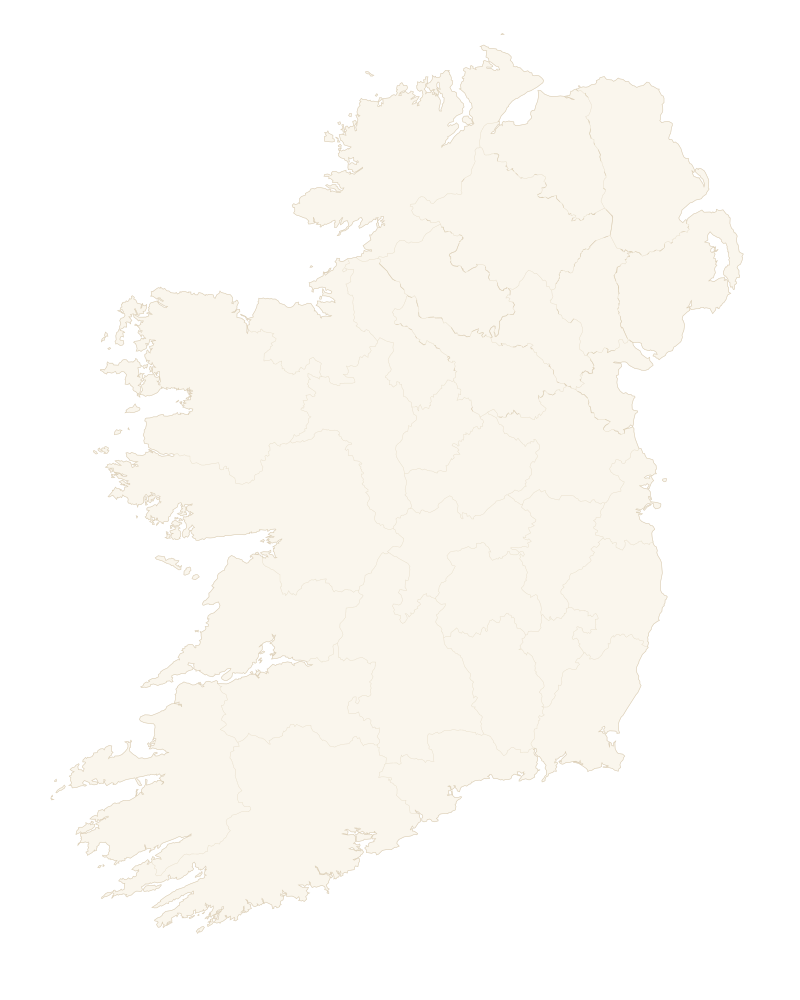
CoreHistoric reach
The seat of Fitzpatrick
Seat vacantChief
No one leads the Fitzpatrick community yet. When the movement opens, you can stand for its leadership, or help elect whoever does.
Current mission
No shared goal set yet. Once Fitzpatrick has leadership, it sets the public focus: a restoration, a gathering, a real-world project that helps its own.
The Fitzpatrick clan is being rebuilt. Join the waiting list for the movement today, and you help decide who leads it and what it does.
Help rebuild the Fitzpatrick clan →Motto
Fortis sub forte fatiscet
“The brave shall yield to the brave”
What does the Fitzpatrick name mean?
Uniquely among Irish surnames, Fitzpatrick is a Gaelic Mac translated into the Norman Fitz form. The original is Mac Giolla Phádraig, son of the devotee of Patrick, a 10th-century Gaelic surname of the kings of Osraighe (Ossory), the kingdom that occupied modern Kilkenny and Laois. In 1537, Brian Mac Giolla Phádraig submitted to Henry VIII under the policy of surrender-and-regrant and was raised to the peerage as Baron of Upper Ossory. He took the new English-style surname Fitzpatrick, translating the Gaelic Mac as the Norman Fitz, in the same act. Every other Irish Fitz- surname (Fitzgerald, Fitzgibbon, Fitzmaurice) is genuinely Norman in origin; Fitzpatrick alone is a Gaelic surname in Norman dress.
The history of Fitzpatrick
The only Mac that became a Fitz
Every other Fitz- surname in Ireland is Norman. Fitzgerald, Fitzgibbon and Fitzmaurice all open with the Norman French fitz, son of, carried in by the invaders of the late twelfth century. Fitzpatrick runs the other way: a Gaelic surname that put itself into Norman dress, by the act of the Gaelic family that already held the land.
The original is Mac Giolla Phádraig, son of the servant of Saint Patrick. Giolla Phádraig was a man's name, not a title: that of Gilla Patráic mac Donnchada, a tenth-century king of Ossory, whose sons were styled Mac Giolla Phádraig after him. Ireland began fixing hereditary surnames in the century after 1002, when the Uí Néill lost the high kingship to Brian Boru, which puts the Gaels among the first in Europe to carry family names at all.
Kings between the Slieve Bloom and the Suir
The kingdom behind the name is Osraighe, Ossory, the country between the Slieve Bloom mountains and the river Suir, covering what is now Kilkenny and Laois. The Mac Giolla Phádraig ruled it from the ninth century to the sixteenth, from a seat at Aghaboe in modern Laois, beside the monastery Saint Cainnech founded there around 577.
Seven hundred years of that was not luck. Ossory sat on the edge of the Pale with Norman power on both sides, the Butler earls of Ormond east and south, the FitzGerald earls of Kildare north. The Mac Giolla Phádraig negotiated with both and kept the kingdom whole, so that when the Tudors turned to Ireland the surviving Gaelic dynasty they found nearest Dublin was this one.
The first surrender and regrant
Brian Mac Giolla Phádraig gave up a kingship he held from his kinsmen by election and took it back from the Crown as a barony held by grant. The title was Baron of Upper Ossory, and it stands with the peerages (Earl of Tyrone, Baron Inchiquin) created as the Kingdom of Ireland was founded in 1541 to draw the Gaelic chiefs inside the new state. The dating is disputed: the submission is placed in 1537 and the barony among the 1541 creations, and accounts differ over which year to fix the grant.
He was the first Gaelic lord to go through it, and what it altered was not the man but the law beneath him. A Gaelic chief succeeded by tanistry, elected from the agnatic cousins of a shared grandfather, and held his country as custodian of his kin under Brehon law. A baron did neither. He succeeded by primogeniture, eldest son after eldest son, and held his land as the king's tenant. New arms followed for the converted chiefs in 1552, and English common law was pushed out over the island in the same century, the county and the sheriff replacing the country and the clan chief.
It should be said plainly. Surrender and regrant was the instrument by which Gaelic Ireland was taken apart, worked on most of the remaining chiefs over the next forty years, and where the paper failed conquest followed: by 1607 the senior chiefs of Ulster had left for Spain, ended in Rome, and the Plantation of Ulster went ahead on the ground they vacated. Brian, who died in 1575, took the parchment instead of the war. That is harder to be proud of than a battle, and it is why the name came out of the century with land still under it.
Barons of Upper Ossory
The Fitzpatricks went on as Anglo-Irish nobility through the seventeenth and eighteenth centuries, barons of Upper Ossory in the Irish peerage until the title fell into abeyance in the nineteenth.
The motto is Fortis sub forte fatiscet, the brave shall yield to the brave. It is a line about honourable submission rather than defeat, and on this name of all names that is unlikely to be an accident.
Not every Fitzpatrick is a king of Ossory
The surname has other doors. A second Irish name, Ó Maol Phádraig, descendant of the follower of Patrick, is likely distinct in origin and was anglicised into the same spelling. A third route is a genuine Anglo-Irish patronymic, Norman fitz set on the name Patrick. Other Irish families took the name up later with no descent from Ossory at all, the Maguires of Fermanagh among them.
An Irish clan was never a bloodline only. The fine held the chief's kin and also unrelated clients, who took the leading family's surname as a show of allegiance and were barred from election as chief because they were not of that blood. The medieval genealogies look reasonably accurate back through the Middle Ages and unreliable before the seventh century, so a line traced all the way to Gilla Patráic is tradition rather than record.
Anglicisation broke the name up as well as translating it. Mac Giolla Phádraig also produced Kilpatrick and Mulpatrick, and some families were reduced simply to Patrick. By the 1901 census the counties holding the most Fitzpatricks by birth were Cavan, then Laois, Dublin, Down and Cork; Laois is the old kingdom, and Cavan at the head of the list shows how far the name outgrew Ossory.
The name carried out of Ireland
The emigrants kept the name intact, having done their translating three hundred years earlier, and it needed no altering to survive in English. Contrary to the story many families tell, no surname was ever legally changed at Ellis Island; the immigrants who altered a spelling did it themselves.
Columbus Fitzpatrick (1810-1877) went out to Australia as a builder and became a political activist and amateur historian of the colony. Alfred Fitzpatrick (1862-1936) founded Frontier College in Canada to put teachers into the lumber camps. Brian Fitzpatrick, a Warrnambool dairy farmer's son turned Melbourne University historian, wrote British Imperialism and Australia, founded the Australian Council for Civil Liberties, and is the foundational figure of Australian economic history. Sean Fitzpatrick captained the All Blacks.
In Ireland the name is still on its own ground. Killiney Castle was acquired by a Fitzpatrick family who turned it into a hotel, open since 1971. The kingdom went and the barony went; the one Gaelic surname that walked into Norman clothes on its own two feet is still being answered to.
Champions of the Fitzpatrick name
The bearers whose lives are inseparable from this surname. Each has their own page, biography, achievements, geography, connection to the family.
Historic Places, Rebuilt
Explore the streets and seats the Fitzpatrick name knew, rebuilt with AI as they stood in history.
Castles the Fitzpatrick held
Strongholds this name held for a decade or more, look one up, or rebuild it to explore.
- Killiney Castle
Acquired by the Fitzpatrick family, who converted the castle into a hotel, open since 1971.
The castles of the homeland
The great strongholds of the homeland, look one up, see what it looked like in its prime, and recreate it to explore.
 Ashford Castle, County MayoRestored · prime 1880
 Manderley CastleRestored · prime 1840
 Dublin CastleRestored · prime 1790
All castles in Ireland → · Strongest castles in Ireland → · Castles of Europe
Play As Your Clan
Hold a real castle against whatever you choose to send at it, take a ship out in her own service years, or stand at the shoulder of someone the record remembers. The chronicler sets the scene; the deeds are yours.
Notable bearers of the Fitzpatrick name
- Brian Mac Giolla Phádraig (d. 1575), first Baron of Upper Ossory, 1537 surrender-and-regrant
- Sean Fitzpatrick (b. 1963), All Black rugby captain
- Patrick Fitzpatrick, many bearers in 19th-century Catholic American clergy and politics