Brennan
also Ó Braonáin, Mac Branáin, Brannan
Of Idough and Corcachlann, and the highwayman of the ballad.
- Origin
- Leinster, Ireland
- Famous bearer
- Willie 'Brennan on the Moor' Brennan (c.1790–1812), highwayman, ballad subject
- Register
- Irish family
Where the Brennan name comes from
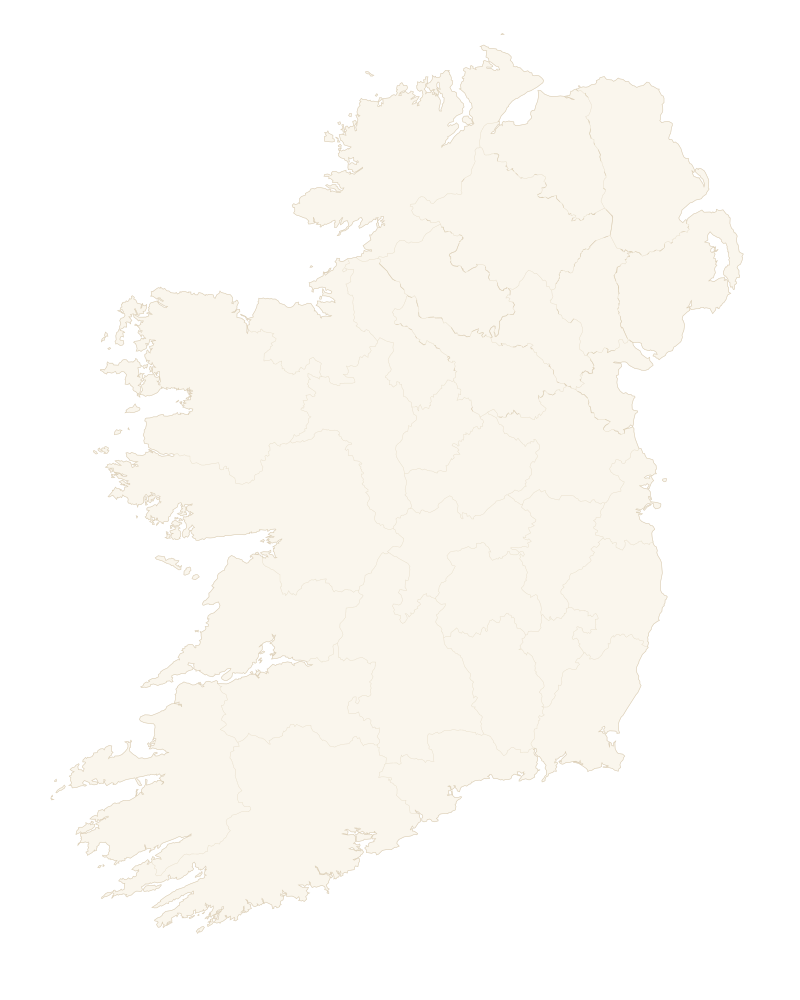
CoreHistoric reach
The seat of Brennan
Seat vacantChief
No one leads the Brennan community yet. When the movement opens, you can stand for its leadership, or help elect whoever does.
Current mission
No shared goal set yet. Once Brennan has leadership, it sets the public focus: a restoration, a gathering, a real-world project that helps its own.
The Brennan clan is being rebuilt. Join the waiting list for the movement today, and you help decide who leads it and what it does.
Help rebuild the Brennan clan →What does the Brennan name mean?
Two parallel Gaelic origins, both Anglicised as Brennan. Ó Braonáin, descendant of Braonán ('moisture' or 'sorrow'), gave rise to the principal Kilkenny line, the chiefs of Idough in north Kilkenny. Mac Branáin, son of Branán ('little raven'), produced the Roscommon and Connacht Brennans, chiefs of Corcachlann under the Ó Conchobhair kings. The two Brennan surname pools are unrelated and remained geographically distinct into the 19th century.
The history of Brennan
One spelling, at least four families
A Brennan abroad usually assumes the name is a family. It is not. Brennan is an English spelling into which several separate Irish surnames were poured. Ó Braonáin means descendant of Braonán, from a personal name built on a word meaning moisture or drop. Ó Branáin means descendant of Branán, from a word meaning little raven. Mac Branáin is that same little-raven root with the other prefix, son rather than descendant. The kindreds who carried them sat in different provinces, answered to different overlords, and share no ancestor any surviving genealogy can honestly name.
The collapse happened in clerks' ledgers, not in Ireland's own memory. The Gaels were among the first peoples in Europe to take hereditary surnames, and when those names were written down in English the prefixes Mac, Nic and Ó were very often dropped outright, taking with them the one element that told two unrelated houses apart. Brennan is one instance of a documented pattern: Ó Leannáin and Ó Lionáin both surface in English as Lennon, Ó Ceallaigh and Ó Cadhla both as Kelly, Ó Fathaigh as Fahey or as Fay. Distinct lineages went into the funnel and one word came out.
Brennan sits among the top thirty Irish surnames, and the pools stayed geographically distinct into the nineteenth century: north Kilkenny in the south-east, Roscommon and west Mayo in the west, with older Brennan ground in Westmeath and in Kerry. The lesson is blunt and freeing. The spelling proves nothing about descent. The county your people left proves a great deal.
The Brennans of Idough, in the kingdom of Ossory
The most prominent line is the Ua Braonáin of Uí Duach, anglicised Idough, in Osraige, the kingdom that became County Kilkenny and its borders. They were reckoned a junior sept of the Dál Birn, the ruling stock of Osraige, springing from a younger son of Cerball mac Dúnlainge, who died in 888. Junior is the operative word. They were not the kings of Ossory; they were kin of the kings, holding a defined country of their own inside the larger lordship, which is exactly how the Gaelic political order worked.
Their ground was the barony of Idough in the north of the county, and modern surname studies find the lineage strikingly consistent there. That is a rare thing to be able to say. Where most Irish names smear across half a province, the Idough Brennans stayed put long enough that the barony boundary and the surname distribution still line up on a map. If your people came out of north Kilkenny, this is your country, and it is small enough to stand in.
The pedigree that will not settle
The descent from Cerball is disputed, and this page will not pretend otherwise. Dubhaltach Mac Fhirbhisigh, whose Leabhar Mór na nGenealach is the ultimate authority on such questions, puts the Brennans not among the Osraige at all but out of the Uí Dhuinn, the O'Dunns, which makes them an Uí Failghe kindred of the midlands rather than a Dál Birn branch of Kilkenny. The modern scholar Bart Jaski takes the same view.
The likeliest explanation is a copying error rather than a lie. John O'Hart's widely reprinted pedigree of the family is plainly wrong, and Ó Cléirigh, whose Book of Genealogies stands alongside Rawlinson B 502, the Book of Ballymote and the Book of Lecan, appears to have got confused while transcribing from Mac Fhirbhisigh. Later genealogists copied the confusion forward. Anyone who tells a Brennan flatly that they descend from the kings of Ossory is repeating a claim the best authority on Irish pedigree contradicts.
There is a harder limit behind that argument. Genealogical collections were compiled from the eighth century onward, and at least one genetic study finds them broadly accurate back to the Middle Ages and unreliable before the seventh. They also recorded only what they set out to record: the agnatic descent of the chiefs, not the ancestry of everyone in the clan. And an Irish clan was never only a bloodline. It took in unrelated clients of the chief, who assumed the leading lineage's name as a show of allegiance and passed it to their descendants, while remaining ineligible to be elected chief. Brennans by loyalty are as old as Brennans by blood.
Mac Branáin of Corcachlann and the western name
The Connacht Brennans are a different name entirely, not a branch. Mac Branáin, the little raven's son, were chiefs of Corcachlann in Roscommon, holding their country under the Ó Conchobhair kings of Connacht, the ruling family of the Síol Muireadaigh within the great Uí Briúin grouping that also produced the MacDermots and the O'Rourkes. Shave the Mac off the front, as English spelling did, and Mac Branáin and Ó Braonáin are left looking like the same word two hundred miles apart.
The midlands add a third strand. Among the chiefly families of Fir Teathbha, a southern Uí Néill grouping, the genealogists list an O'Brenna beside the O'Dallys, the MacAwleys, the MacCarons and the O'Shiels, and Westmeath remains one of the historic Brennan territories on this atlas, as Kerry and west Mayo do. Whether O'Brenna and Brennan are the same name in two dresses is not settled, and should not be asserted as though it were. By the time the name was reaching parish registers and ships' manifests there were Brennans in four or five countries of Ireland, and no two of those groups could name a shared grandfather.
The end of the clan and the scattering of the name
The Gaelic order these families belonged to was dismantled inside a century. English common law came in across Ireland in the sixteenth century, and the county and the sheriff replaced the country and the clan chief. When the Kingdom of Ireland was created in 1541 the Dublin administration set out to co-opt the Gaelic chiefs, inventing titles for them such as Baron Upper Ossory and granting new coats of arms in 1552. The accompanying policy of surrender and regrant swapped Irish tanistry, under which a chief was elected from among the agnatic cousins, for succession by primogeniture. It looked like recognition. It removed the mechanism by which a clan chose its own head.
The early seventeenth century finished the work. The Tudor reconquest destroyed the ancient Gaelic aristocracy, the Plantation of Ulster followed, the senior northern chiefs left in 1607 in the Flight of the Earls and never came back. Both Brennan heartlands lost their political ground in that century's confiscations and the families dispersed into the general Irish population. Two hundred years later the Famine pushed them out of Ireland altogether, to North America and Australia, in numbers that put Brennans in every English-speaking country on earth.
Brennan on the Moor
The most famous Brennan of all left no pedigree, only a song. Willie Brennan, born about 1790, worked the Kilcrumper and Knockmealdown mountains of north Cork as a highwayman until he was hanged at Clonmel in May 1812, aged around twenty-two. He belongs to no chiefly line anyone has traced, which is rather the point of him.
The ballad written shortly after his death did what no genealogy managed. Brennan on the Moor travelled the nineteenth-century English-speaking folk tradition and became the most-recorded Irish highwayman ballad in the modern repertoire, carried on by the Clancy Brothers, the Irish Rovers and the Pogues among many others. For a century and a half, in bars from Boston to Sydney, the first thing most people heard about the surname was a chorus about a young man who robbed the rich on the road to Clonmel.
Ní Bhraonáin: the name that never left Irish
In the Donegal Gaeltacht the name never went into English at all. In Dore, a parish in Gweedore where Irish is the everyday language, Leo Brennan, who had toured Ireland and Scotland with the showband Slieve Foy, and Máire "Baba" Duggan, a music teacher who led the local choir Cór Mhúire Doire Beaga, raised nine children. In 1968 they bought a derelict pub in Meenaleck for one thousand five hundred Irish pounds, reopened it as Leo's Tavern, and their children played there.
In 1970 three of them, Ciarán, Pól and Máire, formed a band with their twin uncles Noel and Pádraig Ó Dúgáin and called it An Clann as Dobhar, the Family from Dore, shortened in 1973 to Clannad. Singing in Irish was held against them at first, because the language was associated with poverty; as Pól Brennan put it, once they said that, they just had to do it even more. Theme from Harry's Game in 1982 made them famous internationally in a language most of the audience did not speak, and a younger sister, Eithne, went on as Enya; by 2005 the combined sales of Clannad and Enya had passed seventy million records. Máire, who sang as Moya, died in 2026 aged seventy-three. In Irish these are Uí Bhraonáin and Ní Bhraonáin, the forms that mark whether the bearer is a man, a daughter or a wife, and which no clerk's pen ever flattened.
The Brennans the crossing made
The diaspora Brennans did not have their names changed for them on arrival. The Ellis Island story is a myth: no immigrant's name was ever legally altered at the depot, and those who changed a spelling did it at their own discretion. Brennan was already English enough on the page to need no help.
What they did with it is the part worth carrying. Walter Brennan, 1894 to 1974, became the first person ever to win three Academy Awards, taking them across the 1930s and 1940s as a character actor rather than a star. William J. Brennan Jr., 1906 to 1997, sat on the Supreme Court of the United States. Maeve Brennan, 1917 to 1993, daughter of a Dublin Republican family, went to New York at seventeen, joined the New Yorker in 1949, and wrote the Manhattan column The Long-Winded Lady and the Ranelagh stories that William Maxwell called the Irish-English short-story voice of the post-war American magazine. Four or five unrelated septs, one spelling, and a name that has done more travelling than most of the kingdoms it started in.
Champions of the Brennan name
The bearers whose lives are inseparable from this surname. Each has their own page, biography, achievements, geography, connection to the family.
The castles of the homeland
The great strongholds of the homeland, look one up, see what it looked like in its prime, and recreate it to explore.
 Ashford Castle, County MayoRestored · prime 1880
 Manderley CastleRestored · prime 1840
 Dublin CastleRestored · prime 1790
All castles in Ireland → · Strongest castles in Ireland → · Castles of Europe
Play As Your Clan
Hold a real castle against whatever you choose to send at it, take a ship out in her own service years, or stand at the shoulder of someone the record remembers. The chronicler sets the scene; the deeds are yours.
Notable bearers of the Brennan name
- Willie 'Brennan on the Moor' Brennan (c.1790–1812), highwayman, ballad subject
- Walter Brennan (1894–1974), actor, three-time Oscar winner
- Maeve Brennan (1917–1993), short-story writer (The New Yorker)
- William J. Brennan Jr. (1906–1997), US Supreme Court Justice