Dunne
also Dunn, Ó Duinn
Lords of Iregan, the great surname of Slieve Bloom.
- Origin
- Leinster, Ireland
- Motto
- Mullach Abú
- Famous bearer
- Ben Dunne Sr. (1908–1983), founder of Dunnes Stores
- Register
- Irish family
The Dunne arms and country

Coat of armsArms of DunneEccekevin · CC BY-SA 4.0

- Coat of arms: Granted to an individual and inherited down that one documented line. These are the arms of particular families of the name, not of everyone who shares the surname.
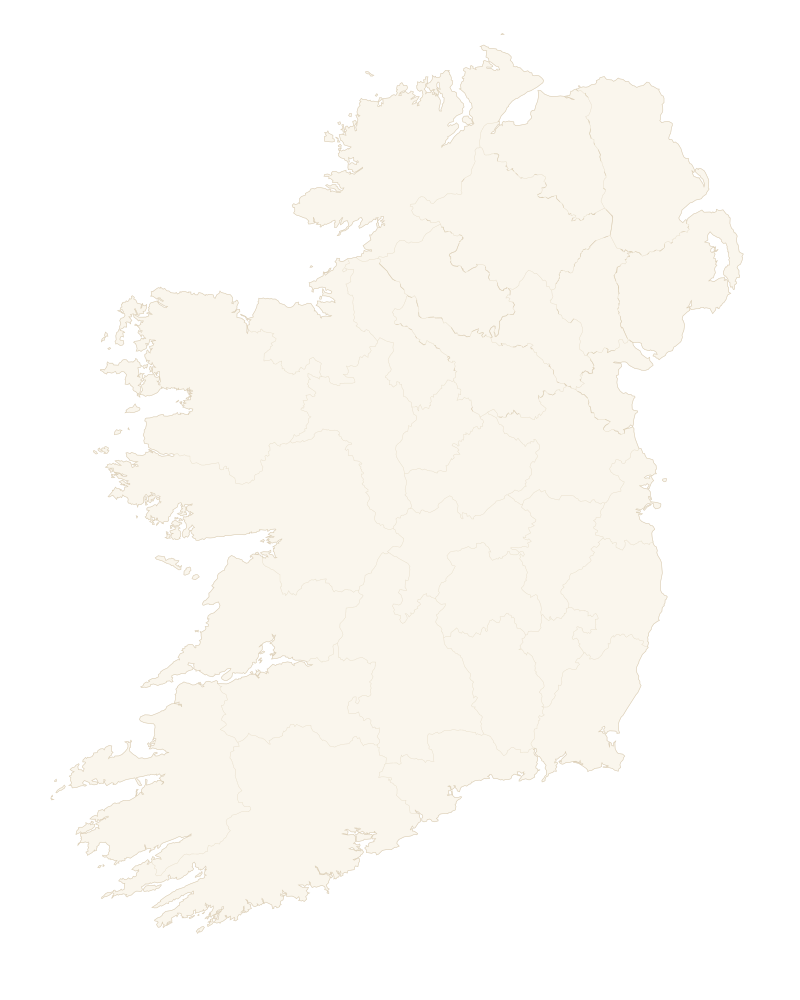
CoreHistoric reach
The seat of Dunne
Seat vacantChief
No one leads the Dunne community yet. When the movement opens, you can stand for its leadership, or help elect whoever does.
Current mission
No shared goal set yet. Once Dunne has leadership, it sets the public focus: a restoration, a gathering, a real-world project that helps its own.
The Dunne clan is being rebuilt. Join the waiting list for the movement today, and you help decide who leads it and what it does.
Help rebuild the Dunne clan →Motto
Mullach Abú
“The summit to victory”
What does the Dunne name mean?
From Ó Duinn, descendant of Donn ('the brown one', or 'the noble one'). The eponymous Donn flourished in the 11th century in Iregan (Uí Riagáin), a substantial lordship in modern Laois. The Ó Duinn ruled Iregan from their seat at Brittas, on the Slieve Bloom slopes south of Mountmellick, into the Tudor era. Outside the Iregan-Laois heartland the surname is also independently Anglicised from Ó Doinn / Ó Donn elsewhere, but the great Laois sept is the principal source of the Irish Dunnes.
The history of Dunne
Donn's people, and the hill country called Iregan
Dunne is the anglicised Ó Duinn, with its genitive variant Ó Doinn, both built on the Irish donn, 'brown' or 'dark'. The O marks descent where Mac marks a son. The Donn from whom the name descends flourished in the 11th century in Iregan, the lordship called Uí Riagáin in Irish, in what is now County Laois. Ireland was among the first countries in Europe to use surnames at all, fixing them during the century of declining Uí Néill dominance that ended when Brian Boru took the high kingship in 1002.
The historian C. Thomas Cairney reckons the O'Dunnes among the chiefly families of the Uí Failghe, the Leinster grouping that also produced the O'Connors of Offaly and the O'Dempseys, and the septs carrying the name were seated in Laois, Meath and Wicklow. The family's own tradition takes the line from the O'Regan house, the sense preserved in the lordship's Irish name: Iregan and the surname are one story told twice, once as a territory and once as a family.
A lordship the crown could not get its hands around
Iregan was hill country wedged between the Slieve Bloom mountains and the Bog of Allen, and its geography was its politics. Ground like that is awkward to march an army across and expensive to hold once taken, and Iregan was accordingly one of the more durable Gaelic lordships of the midlands, with the Ó Duinn as its lord-house from the 11th century onward. The motto, Mullach Abú, 'the summit to victory', belongs to a family that owned the high ground.
Under Brehon law the chief was a custodian rather than an owner, and succession ran by tanistry: the next chief was elected from the cousins descended from a shared grandfather. One feature of that system explains why Dunne is still the densest surname in Laois. A fine held the chief and his patrilineal relatives, but it also took in unrelated clients who assumed the leading lineage's name as a show of allegiance. The name spread across a territory rather than down a bloodline.
Tadhg's two castles, both raised in 1475
The principal seat was Tinnahinch Castle, built in 1475 by Tadhg MacLaighnigh Ui Duinn and known before that as Baun Riaganach. It stood on the River Barrow, a mile south of Tinnahinch bridge, and its name means 'house of the island': a tributary stream loops the site and gives it the look of one. In the same year Tadhg raised Castlebrack, second only to Tinnahinch in size and built expressly for the tanist, the clan's deputy chief. Housing the elected deputy in the second castle of the country was succession law written in stone.
Other Dunne castles filled out the midlands. Donal O'Dunne built Raskeen in 1584. Teige O'Doyne, under one of the name's variant spellings, built Coolnamoney Lower near the Glenlahan River, where original features can still be picked out of the ruins. A junior branch built Clarahill in 1600, and Ballinahemmy, near Corrigeen in County Laois, is another Dunne building whose site is marked on the Ordnance Survey map.
Surrender, regrant, and the sheriff who replaced the chief
The 16th century took the Gaelic lordships apart with paper before it did so with artillery. English common law was extended through Ireland, and the county and the sheriff replaced the country and the clan chief. When the Kingdom of Ireland was created in 1541 Dublin set about bringing the Gaelic chiefs inside the new structure, inventing titles such as Baron Upper Ossory and Earl of Tyrone and granting new coats of arms in 1552.
The instrument was surrender and regrant. A chief gave up his lands to the crown and received them back by grant, but the succession came back changed: title now passed by primogeniture instead of by tanistry, so the cousins who had elected a chief for centuries were written out in a sentence. Iregan surrendered formally under Henry VIII in 1542, and the family lost remarkably little by it: the Ó Duinn kept their lands and their influence in Laois through the following century, still seated at Tinnahinch.
Charles Dunne, and what it cost to take Tinnahinch in 1653
In 1653 a force under Colonel John Hewson was sent against Tinnahinch, which was strongly defended by Charles Dunne. Hewson could not carry it by assault: levelling Tinnahinch required a full park of artillery brought up against it. Of the principal seat of the Dunnes there now survives a single wall that may have belonged to the original building, and the family lost its Laois lands in the Cromwellian settlement of the 1650s.
The response was to rebuild. With Tinnahinch gone the chief's house moved to Brittas, near Clonaslee, where a thatched lodge stood and the Ó Duinns put up a mansion in its place. At Ballinakill, on the site of an earlier castle Cromwellian forces had destroyed, Colonel Terence O'Dunne built a new house in 1680 of coursed rubble and limestone, between the River Clodiagh and the River Gorragh; he was killed at the Battle of Aughrim and is buried at Killeigh. In 1688 a Terence O'Dunne refurbished Castlebrack.
Brittas, and a name that never left Laois
Brittas carried the family into the modern era. In 1869 Major-General Francis Plunkett Dunne built a neo-gothic mansion there, with extensive gardens and a lake originally dug as a reservoir. The house stood until a fire in 1942, and the demesne on the Slieve Bloom slopes south of Mountmellick remains the ground the name is anchored to.
Anglicisation stripped the Gaelic prefix away, so that one Laois sept ended up looking on paper like several families: Dunne and Dunn, and also Dun, Duen, Doine, Doin and O'Doyne. The map, though, still shows where the sept sat. Through Mountmellick, Mountrath and Portlaoise, Dunne is the locally densest surname into the present day.
The garrison officer who taught an aeroplane to fly itself
John William Dunne was born at the Curragh garrison, County Roscommon, on 2 December 1875, elder son of General Sir John Hart Dunne of the Royal Engineers. He finished school at Stonyhurst College, took a commission in the Imperial Yeomanry and went to South Africa on the Boer War mobilisation of 1900. Mounted-infantry work gave him the idea that made his career: a steady pilot in an inherently stable machine could bring back more usable reconnaissance in an hour than a cavalry patrol could gather in a day.
Invalided home in 1902, he persuaded the Army's Balloon Factory at Farnborough to fund a programme on a principle he had worked out himself, a swept-wing arrowhead monoplane with a forward centre of gravity that could hold itself steady in all three axes. The Dunne D.1 was built in 1907 and first tested on the ridge above Blair Atholl; the Dunne D.5 flew at Eastchurch in March 1910, the first inherently stable powered aircraft in Europe; and in 1913 the Dunne D.8 was flown hands-off at the Paris Air Show.
The aircraft programme closed at the outbreak of the First World War and Dunne turned to writing. An Experiment with Time (1927) set out a theory of time and dreams drawn from a journal method he had kept since 1898, developed further across The Serial Universe (1934) and Nothing Dies (1940). Its literary reach was extraordinary: J. B. Priestley's Time and the Conways and An Inspector Calls run on explicit Dunne premises, and Jorge Luis Borges acknowledged the influence on The Garden of Forking Paths and The Aleph.
A Cork draper's shop, a Mountrath emigration, and Manchester United
Ben Dunne Sr. (1908–1983) started from a single draper's shop in Cork city in 1944; with his son Ben Dunne Jr. (born 1949) he built it into Dunnes Stores, the largest retail chain in Ireland. In the United States the brothers Dominick Dunne (1925–2009) and John Gregory Dunne (1932–2003) became journalists and novelists, John Gregory the author of True Confessions. They were Connecticut Irish, descended from a family that had left Mountrath in County Laois in the 1840s, which puts the American Dunne writers back on the same ground as the castles.
Tony Dunne (1941–2020), born in Dublin, was the left-back of the Manchester United side that won the European Cup in 1968, and his 530 appearances make him one of the longest-serving Irish footballers in the history of English club football.
Champions of the Dunne name
The bearers whose lives are inseparable from this surname. Each has their own page, biography, achievements, geography, connection to the family.
The castles of the homeland
The great strongholds of the homeland, look one up, see what it looked like in its prime, and recreate it to explore.
 Ashford Castle, County MayoRestored · prime 1880
 Manderley CastleRestored · prime 1840
 Dublin CastleRestored · prime 1790
All castles in Ireland → · Strongest castles in Ireland → · Castles of Europe
Play As Your Clan
Hold a real castle against whatever you choose to send at it, take a ship out in her own service years, or stand at the shoulder of someone the record remembers. The chronicler sets the scene; the deeds are yours.
Notable bearers of the Dunne name
- Ben Dunne Sr. (1908–1983), founder of Dunnes Stores
- Dominick Dunne (1925–2009), American journalist and novelist
- John Gregory Dunne (1932–2003), novelist (True Confessions)
- Tony Dunne (1941–2020), Manchester United and Republic of Ireland footballer