Power
also le Poer, de Paor, Poer
The Decies of Waterford, Norman barons since 1170, still resident.
- Origin
- Munster, Ireland
- Motto
- Per crucem ad coronam
- Famous bearer
- Robert le Poer (12th c.), first Norman baron of the Decies
- Register
- Irish family
The Power arms and country

Coat of armsEscutcheon of the Power baronets of Kilfane (1836)Borne by the Kilfane line, one branch of the name rather than all of it.Charles Matthews · CC BY-SA 4.0 
Coat of armsEscutcheon of the Power baronets of Edermine (1841)Borne by the Edermine line, one branch of the name rather than all of it.Charles Matthews · CC BY-SA 4.0
.svg)
.svg)
- Coat of arms: Granted to an individual and inherited down that one documented line. These are the arms of particular families of the name, not of everyone who shares the surname.
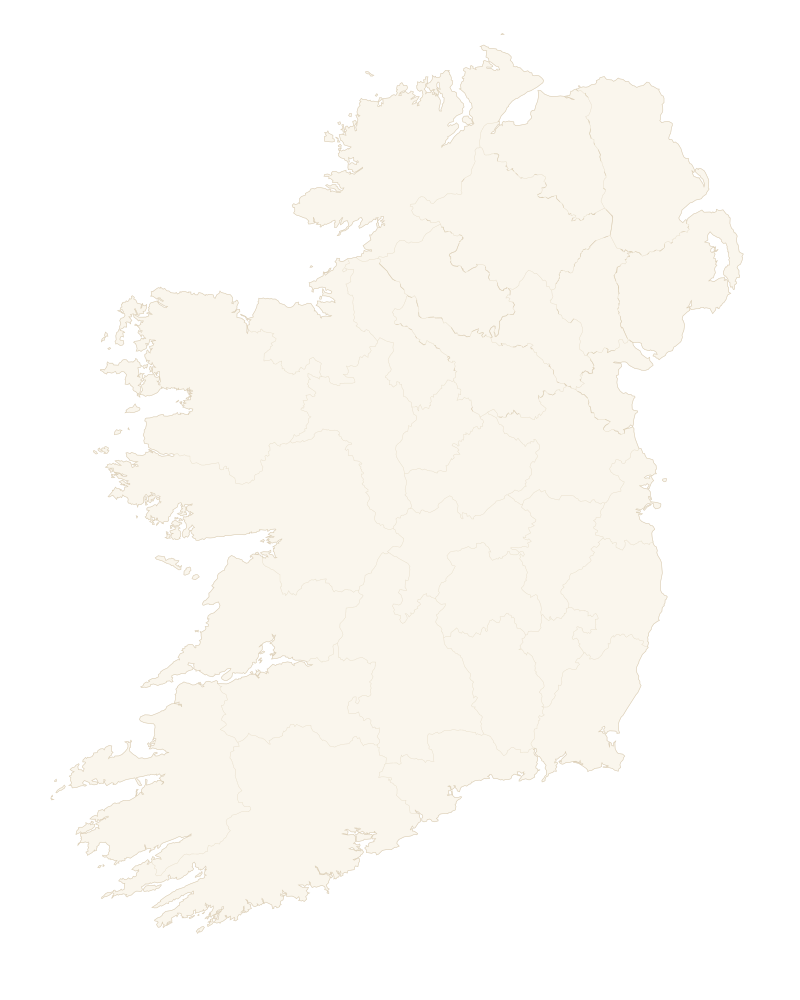
CoreHistoric reach
The seat of Power
Seat vacantChief
No one leads the Power community yet. When the movement opens, you can stand for its leadership, or help elect whoever does.
Current mission
No shared goal set yet. Once Power has leadership, it sets the public focus: a restoration, a gathering, a real-world project that helps its own.
The Power clan is being rebuilt. Join the waiting list for the movement today, and you help decide who leads it and what it does.
Help rebuild the Power clan →Motto
Per crucem ad coronam
“Through the cross to the crown”
What does the Power name mean?
From Old French le Poher / le Pohier, 'the man from Poix' (Poix-de-Picardie, Somme). The Power family came to Ireland with Strongbow in 1170 and were granted extensive lands in the Decies of Waterford. They Gaelicised within two generations, de Paor was the Irish form, and retained their Waterford patrimony almost continuously from the 12th century to the present, an unusual feat of Norman territorial persistence in Ireland.
The history of Power
The man from Poix, and how he became a Power
The name is Old French, le Poher or le Pohier, meaning the man from Poix, in Picardy in the modern department of the Somme. That was how the conquering French-speaking nobility named itself: an early Norman lord attached de or le to the village or estate he had come from, and the result, a territorial surname, was a consequence of feudal landownership rather than of ancestry. Hereditary surnames in England are generally dated to the preparation of the Domesday Book in 1086, taken up first by the nobility and gentry and spreading downward, until by the 14th century most English and most Scottish people carried one.
What happened to le Poher next happened to other French names in English mouths: the spelling was dragged towards the sound, the way Carpentier became Carpenter and Cartier became Carter. Poher became Poer, and Poer became Power. In Ireland the name went the other way as well. Irish has no use for le, but it does have a class of surnames built on a lowercase de, and this one entered it as de Paor, alongside de Búrca for Burke and de hÍde for Hyde.
Robert le Poer and the grant of the Decies
The family came to Ireland with Strongbow in 1170. Robert le Poer was the first of the Anglo-Normans to receive substantial land in the south-east: before 1175 he was granted the Decies, an Déise, the eastern half of what is now County Waterford. This was not the spoil of a raid but a working feudal lordship, and the Powers held it as feudal barons for the next four centuries.
The country it was carved out of ran on an entirely different plan. Gaelic Ireland was organised around the fine, the kin-group of a chief and his patrilineal relatives, which also took in unrelated clients who assumed the leading lineage's name as a show of allegiance. It was led by a taoiseach, and the succession went by tanistry, an election among the agnatic cousins descended from a common grandfather. Norman lordship worked instead by charter, by primogeniture, and by the mounted knight, which the Normans introduced to Ireland. The Decies grant laid one system directly on top of the other, and the older one went on as the basis of Irish society into the 17th century.
More Irish than the Irish themselves
The Powers Gaelicised within two generations. That was the pattern for the whole settler generation, and it is why the Old English families of Ireland, the Norman stock, have been described ever since as having become more Irish than the Irish themselves. They were influenced quite as much as they influenced, in the way the Vikings before them had been thoroughly Gaelicised after founding Ireland's first towns.
The Irish language kept the record of it. A native surname was built on Ó, meaning descendant, or Mac, meaning son, and it shifted form for a woman, with Ní and Nic, and again for a wife, with Bean Uí and Bean Mhic. The settler names took a construction of their own: de and a place, the particle always lowercase. Power is de Paor in that system, and it belongs to the short list of surnames in Ireland reckoned to be of Norman origin and to have arrived with the invasion, in company with Barry, Burke, Butler, Fitzgerald, Nugent, Purcell, Sarsfield and Wall.
Curraghmore, 1535 and 1717
In 1535 the head of the line was raised to the peerage as Baron le Poer of Curraghmore. The date sits on the hinge of Irish government. The Kingdom of Ireland was created in 1541, and Dublin set about drawing the Gaelic chiefs into it with new titles and, in 1552, new grants of arms; the surrender and regrant policy that came with them replaced Irish tanistry with European primogeniture. English common law spread across the island in the same century, and the county and the sheriff took the place of the country and the clan chief. The Powers, holding by charter and feudal barony, were already inside the system the Gaelic lords were being fitted into.
In 1717 the title and the Curraghmore estate passed by marriage and inheritance to the de la Poer Beresfords, who hold both still as Marquesses of Waterford. Curraghmore House, outside Portlaw, is reckoned the only Norman-era family seat in Ireland still inhabited by descendants of its original twelfth-century grantee: eight and a half centuries of one family on one piece of ground.
What the Wexford Powers kept
Through the seventeenth century the Powers stood at the centre of the Old English Catholic interest in Munster, and that is what it cost them. Cadet Power lines were dispossessed in the Cromwellian confiscations and again in the Williamite ones, their estates parcelled out to other men. One of those lines came down to small farming at Dunkitt in County Kilkenny, where James Power was born in 1763. The family had kept the surname, the Catholic faith, and very little else.
He went up to Dublin in his early twenties, took the licence of a small inn on the corner of Thomas Street and John's Lane, on the south-western edge of the medieval city, and married Ellen Walsh in 1788. Behind that counter he learned the one trade a Catholic of his class could legally practise to its full extent in the Dublin of the late Penal Laws: the sale of drink to other Catholics.
The pot-still in the yard, autumn 1791
In January 1791 the Irish parliament, half-reformed and short of revenue, cut the pot-still duty on small distillers to one shilling and threepence the gallon, the lowest rate in twenty years, against a London retail rate of eight shillings. Power was in his twenty-eighth year. He worked out the margin, committed his savings, and that autumn built a small pot-still in the backyard shed behind the John's Lane inn, registering the private distillery as James Power and Son.
The arrangement was unusual for the period: the same man made the whiskey and sold it over his own bar. It handed him a working capital structure and a direct retail customer base at once, and the next forty years of expansion rested on both. James Power died in Dublin in 1817, in his fifty-fourth year, and was buried in the family vault at St Catherine's on Thomas Street, the parish of the original inn.
Two million gallons, then four
His son John Power (1771 to 1855) took over the active management in his father's last years and turned a yard into a works. Through the 1820s and 1830s the site grew until it ran the whole southern side of John's Lane: stables, malt-houses, the pot-still still-house, a cooperage and a bonded warehouse. By the middle of the century it was producing more than two million imperial gallons of pure spirit a year. He was created first Baronet of Edermine in 1841 and served as Lord Mayor of Dublin from 1851 to 1852.
The third generation went further again. Under John William Power, Lord Mayor of Dublin in 1865, the John's Lane distillery was by 1880 the largest in the world by single-site output, four million gallons of pure spirit a year, and one of the four classic Dublin pot-still houses. The Three Swallows trademark was registered in 1888, and the Edinburgh and London spirits journals of the 1890s judged it the most consistently respected Irish single-distillery brand and the leading Irish whiskey export to the British, American and Australian markets.
Powers merged with Jameson and the Cork Distilleries Company in 1966 to form Irish Distillers, the firm that carried the Irish whiskey export through the later twentieth century and now sits inside Pernod Ricard. The original John's Lane pot-still closed in 1974 and production moved to Midleton in County Cork, where Powers Three Swallows is still made under the name a Kilkenny farmer's son put on it.
Tramore, and the ground the name never left
The Catholic Powers of Tramore were the family of Tyrone Power (1797–1841), the comic actor, and of his great-grandson Tyrone Power (1914–1958), the Hollywood film actor. Ronan O'Gara, the Munster rugby player, descends from a Cork Power line on his mother's side.
The plainest fact about the surname, though, is on the map. Power is densest today in County Waterford, the same ground Robert le Poer was granted before 1175, one of the longest stable surname-to-county anchorings in Irish demography. Per crucem ad coronam, through the cross to the crown, is the family motto, and it has had eight and a half centuries in one place to be tested.
Champions of the Power name
The bearers whose lives are inseparable from this surname. Each has their own page, biography, achievements, geography, connection to the family.
Historic Places, Rebuilt
Explore the streets and seats the Power name knew, rebuilt with AI as they stood in history.
The castles of the homeland
The great strongholds of the homeland, look one up, see what it looked like in its prime, and recreate it to explore.
 Ashford Castle, County MayoRestored · prime 1880
 Manderley CastleRestored · prime 1840
 Dublin CastleRestored · prime 1790
All castles in Ireland → · Strongest castles in Ireland → · Castles of Europe
Play As Your Clan
Hold a real castle against whatever you choose to send at it, take a ship out in her own service years, or stand at the shoulder of someone the record remembers. The chronicler sets the scene; the deeds are yours.
Notable bearers of the Power name
- Robert le Poer (12th c.), first Norman baron of the Decies
- Tyrone Power (1797–1841), comic actor
- Tyrone Power (1914–1958), Hollywood film actor
- Sir John Power, 1st Baronet (1771–1855), distiller, founder of Power's Whiskey