Pearse
also Mac Piarais
The surname of the first signatory of the Proclamation of the Irish Republic.
- Origin
- Leinster, Ireland
- Famous bearer
- Patrick Pearse (1879–1916), schoolmaster, poet, first signatory of the 1916 Proclamation
- Register
- Irish family
The Pearse arms and country

Coat of armsPearse (of Shelton, Norfolk) armsBorne by the Shelton line, one branch of the name rather than all of it.Lobsterthermidor · CC BY-SA 3.0
_arms.svg)
- Coat of arms: Granted to an individual and inherited down that one documented line. These are the arms of particular families of the name, not of everyone who shares the surname.
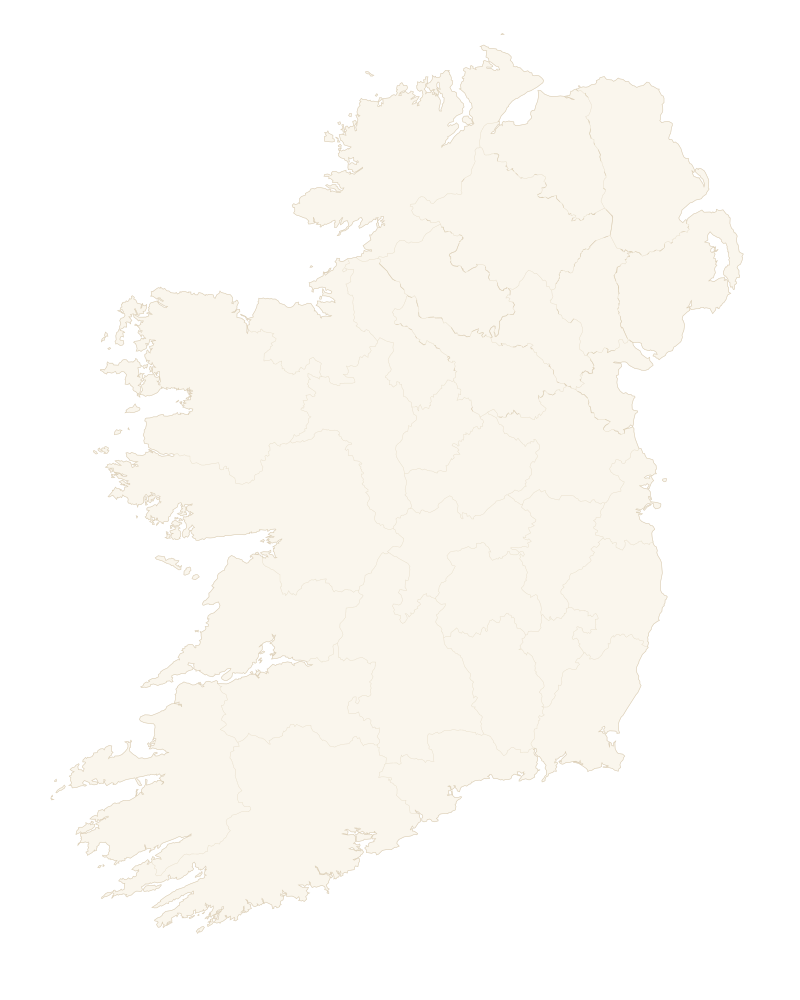
CoreHistoric reach
The seat of Pearse
Seat vacantChief
No one leads the Pearse community yet. When the movement opens, you can stand for its leadership, or help elect whoever does.
Current mission
No shared goal set yet. Once Pearse has leadership, it sets the public focus: a restoration, a gathering, a real-world project that helps its own.
The Pearse clan is being rebuilt. Join the waiting list for the movement today, and you help decide who leads it and what it does.
Help rebuild the Pearse clan →What does the Pearse name mean?
From the Old French Piers (the French form of Peter), used as a Norman first-name and frozen into surname duty in English usage by the late mediaeval period. The Pearse surname in Ireland is principally English-origin, brought to Dublin in the nineteenth century; the most famous bearer, Patrick Pearse, was the son of an English sculptor James Pearse of Birmingham (who emigrated to Dublin in the 1850s to work on the city's neo-Gothic churches) and a Dublin-Irish mother, Margaret Brady. The Gaelic patronymic Mac Piarais is Patrick Pearse's own Gaelicisation of the surname for his Irish-language writing and his publications in An Claidheamh Soluis.
The history of Pearse
Piers, the font-name that went to work as a surname
Pearse begins as Piers, the Old French form of Peter, carried into England as a Norman first name and still doing duty as one long after the Conquest. What turned it into a surname was administrative habit rather than decree: English family names are generally traced to the preparation of the Domesday Book in 1086, when the Norman nobility and gentry began fixing an identifier on a household, and by 1400 most English and Lowland Scots families had one.
Names built from a father's font-name are the oldest and commonest class there is, which is why one given name can spawn a thicket of them: something like ninety Italian surnames grow out of Giovanni alone. Richardson, Jackson and Jones work that way, and so does Pearse, without the visible -son. It marks a household identified by a christening rather than by land or craft, and so belongs to no district and no kindred.
Ó, Mac and the Irish machinery the name walked into
Ireland was among the earliest countries in Europe to use surnames at all. They came in during the century of declining Uí Néill dominance, after the high kingship passed in 1002 to Brian Boru of the Dál gCais, and ran on a plain formula: Ó ("descendant") or Mac ("son") followed by a name in the genitive, so Mac Siúrtáin is the son of Jordan. A daughter of Seán Ó Dónaill is Ní Dhónaill, and a wife of his Bean Uí Dhónaill.
The formula was never reserved for Gaelic stock. Norman arrivals were fitted into it with de: de Búrca for Burke, de Paor for Power. Norman font-names went in the same way, and MacPhearais, Mac plus Pearas, is simply son of Pierce; anglicised back out it can surface as Corish. Nor did the Irish surname mean blood alone. A fine, the kinship group behind the word clan, held the chief's patrilineal relatives and also unrelated clients who took the leading lineage's name in allegiance.
The century that flattened the Gaelic name
The system did not fade; it was dismantled. English common law was extended through Ireland in the sixteenth century, and the county and the sheriff replaced the country and the clan chief. When the Kingdom of Ireland was created in 1541 the Dublin administration drew the Gaelic chiefs in with new titles, and surrender and regrant swapped tanistry for primogeniture. The Tudor reconquest broke the old aristocracy, the senior Ulster chiefs left in 1607, and the Plantation of Ulster followed.
What followed for the names was cosmetic and total. Mac, Nic and Ó were stripped off, so that Ó Fathaigh came out as Fahey and Ó Ceallaigh as Kelly; a surviving prefix flattened to Mc or Mag, which is how Mac Uidhir became Maguire. An English surname reaching Dublin in the nineteenth century arrived in a country whose own names had already been through that mill.
The stone-cutter of Great Brunswick Street
The Pearse surname in Ireland traces principally to one household. James Pearse (1839–1900), a stone-cutter and ecclesiastical sculptor from Birmingham, emigrated to Dublin in the 1850s to work on the city's neo-Gothic churches and stayed to build the leading business of its kind in the capital. The Pearse atelier on Great Brunswick Street was the principal Dublin firm cutting the stone sculpture of the Catholic churches raised in the revival of the late nineteenth century. He married Margaret Brady of Nobber in County Meath.
Their eldest son, Patrick Henry Pearse, was born at 27 Great Brunswick Street on the tenth of November 1879. His younger brother William, known as Willie, was born in 1881 and followed his father's trade as a sculptor. The street has carried the name Pearse Street since 1923, so the family's address and its memorial are now one.
Mac Piarais: the barrister who translated his own surname
Pearse was schooled at the Christian Brothers' Westland Row School and at the Royal University of Ireland, taking a BA in modern languages and Celtic studies in 1901 and a Doctor in Laws in 1905. He was called to the Irish bar in 1901, but the bar was a career taken to satisfy his father; the Irish language and Irish-medium education were his real work. He joined the Gaelic League at sixteen, was elected to its executive committee, the Coiste Gnótha, at twenty-one, and from March 1903 to August 1909 edited the League's weekly An Claidheamh Soluis.
For that Irish-language writing he rendered the surname as Mac Piarais: Mac plus a Norman font-name in the genitive, the same formula that turns Jordan into Mac Siúrtáin, now applied to a name his father brought from Birmingham. He travelled every year to the Galway Gaeltacht and built a cottage on the Atlantic shore at Ros Muc, and the Connacht Irish he learned there became the centre of his prose and verse. The story collections Íosagán and Other Stories (1907) and An Mháthair (1916) are central texts of the Irish-language literary revival.
Scoil Éanna, from Cullenswood House to the Hermitage
On the eighth of September 1908 Pearse opened Scoil Éanna, St Enda's School, at Cullenswood House in Ranelagh: the first Irish-medium secondary school in the country, a working demonstration of bilingual Catholic education in the heroic Cuchulain tradition. In 1910 it moved to the Hermitage at Rathfarnham, a Georgian house and grounds at the foot of the Dublin mountains, and ran there for twenty-five years, continuing in various forms until 1935. Historians of Irish education rate it the most consequential single private school of the revival.
The school was precarious throughout, and Pearse kept it open with American lecture tours in 1914 and 1915. Its curriculum was bilingual and openly nationalist, set out in his 1912 pamphlet The Murder Machine, the foundational critique of the anglicising National School system of the day. Among the pupils at the Hermitage were several of the men who fought beside him in 1916, Willie included.
The Volunteers and the Proclamation on the GPO steps
Pearse joined the Irish Volunteers at their founding on the twenty-fifth of November 1913, raised as the constitutional defensive answer to the Ulster Volunteer Force of 1912, and was elected to the provisional committee. After the split of September 1914 between John Redmond's pro-war majority and the minority who would not back the British war effort, he took the directorship of organisation of the breakaway Volunteers under Eoin MacNeill, and through 1915 was sworn into the Irish Republican Brotherhood and its Military Council. His oration over the grave of the Fenian O'Donovan Rossa at Glasnevin on the first of August 1915, charging that Ireland's rulers had been fools to leave the Fenian dead their graves, is a central document of the Irish republican tradition.
On Easter Monday, the twenty-fourth of April 1916, he stood with James Connolly, Tom Clarke, Seán Mac Diarmada, Joseph Mary Plunkett, Éamonn Ceannt and Thomas MacDonagh as the seven signatories of the Proclamation of the Irish Republic, signed at Liberty Hall. Pearse read it aloud at noon from the steps of the General Post Office in Sackville Street, now O'Connell Street, and was named President of the Provisional Government and Commandant-General of its army. The Rising held central Dublin for six days. He died on the third of May 1916, in his thirty-seventh year, and Willie on the fourth.
Where the name stands now, and the Pearses elsewhere
The Republic proclaimed from the GPO portico was constituted as the modern Republic of Ireland by the Act of 1948, and the surname is fixed into the capital: Pearse Street, the railway station in central Dublin, the museum at the Hermitage, the square at Ros Muc. The reading of the Proclamation is re-enacted before the General Post Office by the President of Ireland every Easter Sunday morning. Two Irish politicians of the name also sit in the record, Margaret Pearse (1857–1932) and Margaret Mary Pearse (1878–1968).
Elsewhere the surname stayed English and travelled with English emigration: John Pearse (1760–1836) an English politician, Mark Guy Pearse (1842–1930) and Lesley Pearse (born 1945) British writers, Samuel Pearse (1897–1919) a recipient of the Victoria Cross, Richard Pearse (1877–1953) a New Zealand aviation pioneer. None of those households need be connected to any other, which is the nature of a name made from a common Christian name.
Champions of the Pearse name
The bearers whose lives are inseparable from this surname. Each has their own page, biography, achievements, geography, connection to the family.
Historic Places, Rebuilt
Explore the streets and seats the Pearse name knew, rebuilt with AI as they stood in history.
Historic Places, Rebuilt · New
Georgian Dublin in the year of Rocque's great map, College Green, the Liberties' weavers, the Liffey quays and Christ Church.
Historic Places, Rebuilt · New
The walled City of the Tribes at its Spanish-trade height, the quays, Lynch's Castle, and the fourteen merchant families.
The castles of the homeland
The great strongholds of the homeland, look one up, see what it looked like in its prime, and recreate it to explore.
 Ashford Castle, County MayoRestored · prime 1880
 Manderley CastleRestored · prime 1840
 Dublin CastleRestored · prime 1790
All castles in Ireland → · Strongest castles in Ireland → · Castles of Europe
Play As Your Clan
Hold a real castle against whatever you choose to send at it, take a ship out in her own service years, or stand at the shoulder of someone the record remembers. The chronicler sets the scene; the deeds are yours.
Notable bearers of the Pearse name
- Patrick Pearse (1879–1916), schoolmaster, poet, first signatory of the 1916 Proclamation
- William Pearse (1881–1916), sculptor, executed at Kilmainham 4 May 1916
- James Pearse (1839–1900), Birmingham-born ecclesiastical sculptor