Wilde
also Wild
The Roscommon planter line, the surgeon-archaeologist, and the writer who lost his name to a trial.
- Origin
- Leinster, Ireland
- Famous bearer
- Oscar Wilde (1854–1900), playwright, poet, novelist
- Register
- Irish family
The Wilde arms and country

Coat of armsArms of Wilde of LondonAergia · CC BY-SA 4.0

- Coat of arms: Granted to an individual and inherited down that one documented line. These are the arms of particular families of the name, not of everyone who shares the surname.
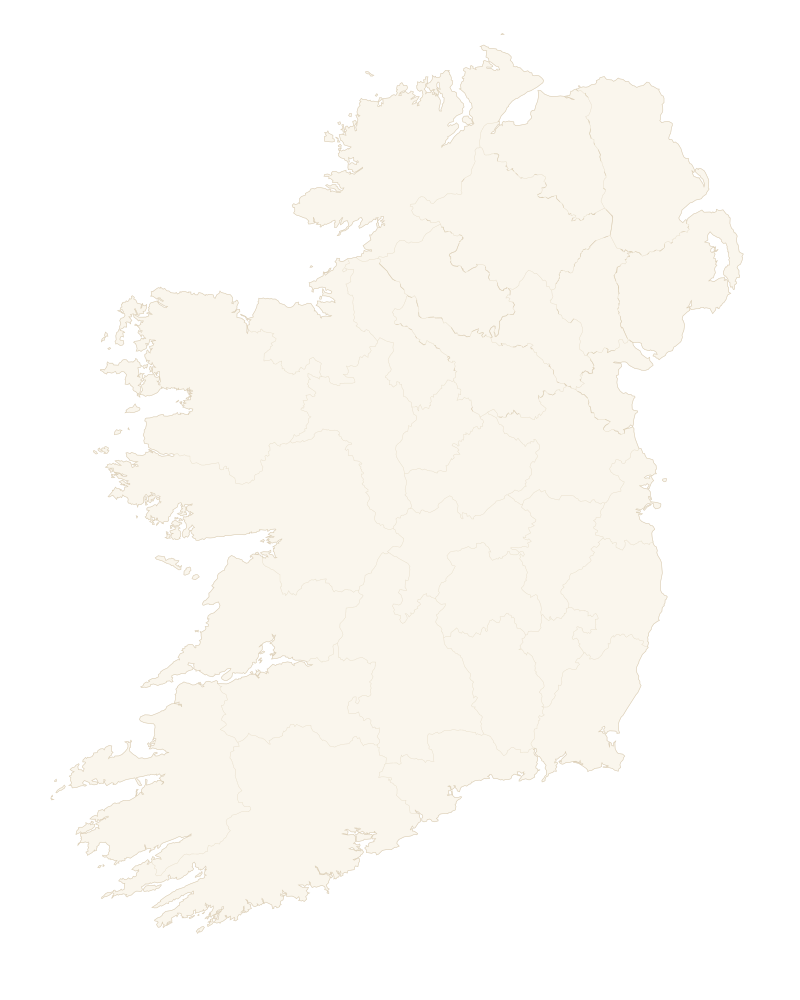
CoreHistoric reach
The seat of Wilde
Seat vacantChief
No one leads the Wilde community yet. When the movement opens, you can stand for its leadership, or help elect whoever does.
Current mission
No shared goal set yet. Once Wilde has leadership, it sets the public focus: a restoration, a gathering, a real-world project that helps its own.
The Wilde clan is being rebuilt. Join the waiting list for the movement today, and you help decide who leads it and what it does.
Help rebuild the Wilde clan →What does the Wilde name mean?
From Old English wilde (untamed), as a descriptive byname for an unrestrained or wild-tempered person, or possibly from Old English wille (a stream). The surname is principally English-origin and was brought to Ireland in the seventeenth century with the Cromwellian and Williamite planter movements. The Wildes of Dublin were a Protestant medical and literary family of the nineteenth century, descended from a Durham-Wilde line settled in Castlerea, County Roscommon, in the late eighteenth century.
The history of Wilde
The Durham name that came west to Castlerea
Wilde is an English name, and it describes a man rather than naming his father or his trade. It comes from the Old English wilde, untamed, fixed as a byname on the unrestrained or the wild-tempered; a second derivation takes it from Old English wille, a stream, and the household that stood beside one. The name reached Ireland in the seventeenth century, carried over with the Cromwellian and Williamite planter movements, and it settled into the Protestant professional class rather than onto a great estate.
The Dublin Wildes trace to a Durham-Wilde line that had put down roots at Castlerea in County Roscommon by the late eighteenth century. That is the ground the family came off: a west-of-Ireland market town, provincial standing, and then a move east that turned a Roscommon name into a Dublin one. There is no tower house in this story and no forfeiture. The address the name is remembered by is 1 Merrion Square.
The surgeon-oculist who measured a country
William Wilde (1815-1876) built the family's standing out of two careers that had no obvious business with one another. The first was medicine. He was an eminent oto-ophthalmic surgeon, working on the ear and the eye, and from 1853 he held the appointment of Surgeon-Oculist in Ordinary to Queen Victoria for Ireland.
The second was the census. The knighthood conferred on him in 1864 came not for his surgery but for his work on the census of Ireland. The antiquarian labour that ran alongside the medicine made him the foundational figure of nineteenth-century Irish archaeology and folklore, and it is the rarer half of the achievement: a working Dublin surgeon who spent the other half of his life on the monuments and the collected tradition of the country he was counting. In Dublin the Wilde name meant a surgeon and an antiquary a full generation before it meant a playwright.
Speranza of the Nation, and the salon at Merrion Square
Jane Francesca Elgee (1821-1896) wrote as Speranza, and some of the central verse of the Young Ireland movement of the 1840s appeared in the Nation over that signature. The pen name was hers on its own account, made in a political paper and known to its readership.
She married William Wilde, and the house at 1 Merrion Square became the principal Dublin literary salon of the mid-nineteenth century. That is the room the two Wilde boys grew up in: a surgeon's household in Georgian Dublin where the talk was archaeology on one side and nationalist poetry on the other. Willie Wilde (1852-1899), the elder son, went into journalism. The second son, Oscar Fingal O'Flahertie Wills Wilde, was born at 21 Westland Row on the sixteenth of October 1854.
The Berkeley Gold Medal and a demyship to Magdalen
Oscar was schooled at Portora Royal in Enniskillen, and at seventeen won the Royal School Scholarship to Trinity College, Dublin. He read Greek and Latin there under the Hellenist Robert Tyrrell and under Mahaffy, took a first-class degree and the Berkeley Gold Medal in Greek, and on the strength of it carried a demyship in classics to Magdalen College, Oxford.
At Oxford between 1874 and 1878 he took a double first in Mods and Greats and won the Newdigate Prize in 1878 for his long poem Ravenna, absorbing at the same time the Aesthetic doctrine of Walter Pater and the Florentine Renaissance criticism of John Ruskin. He came down with a public reputation already built: long hair, peacock feathers, a sunflower in the buttonhole, the Grosvenor Gallery set. The classicist and the aesthete were the same young man, and the Greek came first.
A hundred American cities, 1882
In 1882 he took the aesthetic argument across the Atlantic on a lecture tour of the United States and Canada, speaking in over a hundred American cities on the philosophy of decoration and the use of art in everyday life. The customs officer at New York is said to have asked whether he had anything to declare, and to have been answered: Nothing but my genius.
He returned to settle in London in 1883 with a transatlantic reputation assembled before he had published a novel or staged a play. It was an unusual order of business for a writer, and London knew precisely who was speaking by the time the work arrived.
Four comedies, the St James's and the Haymarket
The Picture of Dorian Gray appeared in 1890, the great late-Victorian novel of the cost of the aesthetic life. Then, in five years, came the sequence of stage comedies that stands as the high-water mark of English-language comic theatre: Lady Windermere's Fan at the St James's in 1892, A Woman of No Importance at the Haymarket in 1893, An Ideal Husband at the Haymarket in 1895, and The Importance of Being Earnest at the St James's on the fourteenth of February 1895.
Earnest is the masterpiece, and the room knew it on the night. By Henry James's diary entry of the next morning it was the most polished comedy of manners the London stage had seen since Sheridan. In the same decade Wilde wrote the dark verse-tragedy Salomé in French; banned in England, it was premiered in Paris in 1896 and served as the libretto of Richard Strauss's opera of 1905.
C.3.3, and the poem that sold seven editions
The later writing carried a different register altogether. De Profundis, published in 1905, is a sustained prose meditation on sorrow, repentance and the imaginative life. The Ballad of Reading Gaol came last: seven hundred lines published under the pseudonym C.3.3 in February 1898, turning on its refrain that each man kills the thing he loves. It sold seven editions in its first year and stayed on the English poetry lists through the twentieth century.
He left England in May 1897 and lived his last three years in France under the name Sebastian Melmoth, dying at the Hôtel d'Alsace on the rue des Beaux-Arts in Paris on the thirtieth of November 1900, in his forty-seventh year, received into the Catholic Church on his deathbed by Father Cuthbert Dunne of the Passionists. He was buried at Bagneux and reinterred in 1909 at Père Lachaise, under the great winged-sphinx tomb commissioned from Jacob Epstein by Robert Ross and paid for by an English public subscription.
One Dublin household, and the other Wilds
The Importance of Being Earnest has not been off an English-speaking stage in a single year since 1900. The Picture of Dorian Gray has been continuously in print in over thirty languages, and the Ballad sits in every twentieth-century anthology of English verse. That is a great deal of work to come out of one household: a knighted surgeon and antiquary, a Young Ireland poet who ran the city's literary salon, a journalist son and a playwright son, all of them at 1 Merrion Square.
The plainer spelling belongs to families with no connection to Dublin at all. Frank Wild (1873-1939) was a British Antarctic explorer and Sir Ernest Wild (1869-1934) a British judge and Conservative Member of Parliament; Heinrich Wild (1877-1951) designed geodetic instruments in Switzerland, Earl Wild (1915-2010) was an American pianist, Franz Wild (1791-1860) an Austrian opera singer, Allan Wild (1927-2019) a New Zealand architect and academic, and Jack Wild (1952-2006) a British actor.
Champions of the Wilde name
The bearers whose lives are inseparable from this surname. Each has their own page, biography, achievements, geography, connection to the family.
Historic Places, Rebuilt
Explore the streets and seats the Wilde name knew, rebuilt with AI as they stood in history.
The castles of the homeland
The great strongholds of the homeland, look one up, see what it looked like in its prime, and recreate it to explore.
 Ashford Castle, County MayoRestored · prime 1880
 Manderley CastleRestored · prime 1840
 Dublin CastleRestored · prime 1790
All castles in Ireland → · Strongest castles in Ireland → · Castles of Europe
Play As Your Clan
Hold a real castle against whatever you choose to send at it, take a ship out in her own service years, or stand at the shoulder of someone the record remembers. The chronicler sets the scene; the deeds are yours.
Notable bearers of the Wilde name
- Oscar Wilde (1854–1900), playwright, poet, novelist
- Sir William Wilde (1815–1876), surgeon and archaeologist
- Jane Wilde (Speranza, 1821–1896), Young Ireland poet
- Willie Wilde (1852–1899), journalist, elder brother of Oscar