O'Sullivan
also Sullivan, Ó Súilleabháin
The third most common Irish surname, and the family of Donal Cam's march.
- Origin
- Munster, Ireland
- Motto
- Lámh Foistineach an Uachtar
- Famous bearer
- Donal Cam O'Sullivan Beare (1561–1618), last Gaelic lord of Beara, leader of the 1603 march
- Register
- Irish family
Ranked of all time
The 10 Oldest Clans in Ireland
Where the O'Sullivan name comes from
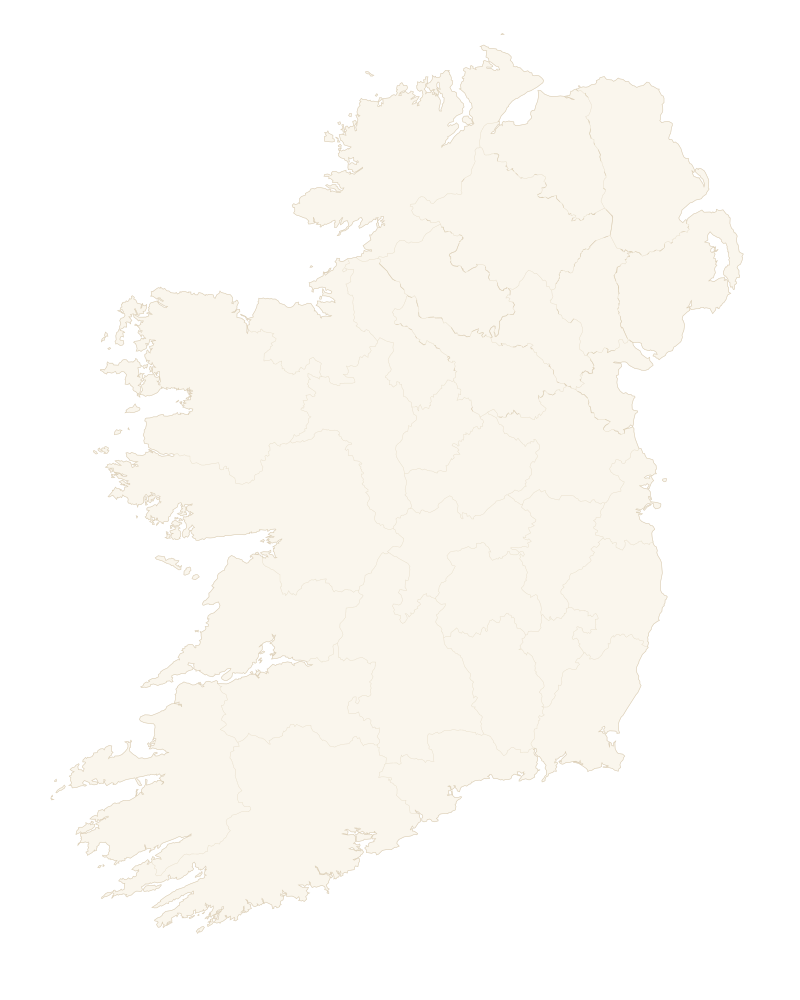
CoreHistoric reach
The seat of O'Sullivan
Seat vacantChief
No one leads the O'Sullivan community yet. When the movement opens, you can stand for its leadership, or help elect whoever does.
Current mission
No shared goal set yet. Once O'Sullivan has leadership, it sets the public focus: a restoration, a gathering, a real-world project that helps its own.
The O'Sullivan clan is being rebuilt. Join the waiting list for the movement today, and you help decide who leads it and what it does.
Help rebuild the O'Sullivan clan →Motto
Lámh Foistineach an Uachtar
“The gentle hand uppermost”
What does the O'Sullivan name mean?
From Ó Súilleabháin, descendant of Súilleabhán. The personal name Súilleabhán is most often glossed as 'one-eyed' or 'hawk-eyed' (súil, eye + dubhán, dark, or súil + amháin, single), though the etymology is contested. The eponymous Súilleabhán was a 10th-century chief of the Eóganacht Cnoc Raffan, a Munster sept seated in modern Tipperary. Pushed south and west by the Anglo-Norman conquest of the 1170s, the family re-established itself across the Beara and Iveragh peninsulas of west Cork and south Kerry, where it has held ground ever since.
The history of O'Sullivan
The eye in the name, and the argument about what it means
Ó Súilleabháin breaks into two clear parts and one contested one. Ó, Old Irish úa, means grandson or descendant, and the rest of the name is the personal name Súileabhán in the genitive: the descendant of Súileabhán. Everyone agrees the root word is súil, eye. Nobody agrees on the ending. The genealogist Edward MacLysaght put it plainly in The Surnames of Ireland: while there is no doubt that the basic word is súil, there is disagreement as to the meaning of the last part of the name. Patrick Woulfe, in Sloinnte Gaedheal is Gall, read it as súildubhán, the little dark-eyed one, from súil plus dubh, dark or black, plus the diminutive -án. Others have read it as one-eyed, and others again as hawk-eyed. The name of one of the largest families in Ireland is a word its own scholars cannot finish translating.
In Irish the surname still bends to the person carrying it. A man is Ó Súilleabháin; his daughter is Ní Shúileabháin, from iníon uí, the descendant's daughter; a woman who takes her husband's name becomes Bean Uí Shúilleabháin, or simply Uí Shúilleabháin. Generation is marked inside the name rather than after it, so that Seán Óg Ó Súilleabháin is exactly what an English speaker means by John O'Sullivan Jr. Anglicisation flattened all of this. The prefix Ó became O' where it survived at all and was dropped entirely where it did not, which is how Sullivan and O'Sullivan came to be the same family wearing two spellings, and why an anglicised Sullivan Jr. carries no trace of the Ó that was there in the Irish.
O'Sullivan is the regular anglicisation. The rarer variants are worth knowing because emigrant families often travel under them: Sullavan, Sullivant, Sillivant, Silliphant and Sillifant. One group is not originally the same name at all. MacLysaght identified Sullivans of the midlands and south Ulster as (O) Sullahan, from Ó Súileacháin, probably from súileach, quick-eyed: a separate name that has now almost entirely been absorbed into Sullivan. If your family came from Cavan or Monaghan rather than Cork or Kerry, that may be the reason.
Cashel, Milesius, and what an Irish pedigree is actually worth
The traditional descent is grand and it should be handled with care. The genealogy set down in the seventeenth-century Leabhar na nGenealach, compiled by Dubhaltach MacFhirbhisigh, traces the family from the Eóganachta, the dynasty of the kings of Munster who ruled from Cashel, through the sept of Cenél Fíngin, and beyond them, in the fashion of the time, back through Milesius and Fénius Farsaid to Adam. The eponymous ancestor, Suilebhan mac Maolura, is recorded as born in 834 and placed eight generations after Fíngen mac Áedo Duib, king of Cashel from 601 to 618; his grandson Eochaid, from whom the Uí Súilleabháin take their name, is given a birth of 874. Other accounts place Súilleabhán a century later as a chief of the Eóganacht Cnoc Raffan in what is now Tipperary. The sources do not agree on the century, let alone the man.
That should not be read as a slur on the record-keepers. At least one genetic study has concluded that the Irish genealogies appear fairly accurate back to the Middle Ages and become unreliable only before the seventh century, which is a remarkable verdict for documents that begin in the eighth. But those pedigrees were compiled to state the agnatic descent of chiefs, not of every man who carried the name, and there is a second reason the line will not hold for most readers. An Irish fine included the chief and his patrilineal kin, and it also included unrelated clients of the chief, who took the leading lineage's name as a show of allegiance and whose descendants kept it while remaining ineligible to be elected chief.
So the honest sentence is this: O'Sullivan is the third most numerous surname in Ireland, after Murphy and Kelly, and roughly half of all O'Sullivans still live there, and that many people cannot all descend from one ninth-century man. Some do. Many more descend from the farmers, boatmen, fighting men and dependants who lived under an O'Sullivan chief and answered to his name. Both are the family. The second route is not a lesser one; it is how a Gaelic lordship actually worked.
Driven out of Tipperary, 1193
The family did not begin in the south-west. Their homeland was in modern County Tipperary, and the Norman invasion of 1169-71 took it from them. Norman incursions pushed into Munster in the 1180s, and in 1193 the O'Sullivans were forced off their land. In 1196 Dunlong, son of Giolla Mochoda, led them out of Tipperary into County Kerry. They arrived as a displaced people in country already held by others, and rebuilt a lordship there that lasted more than four hundred years.
In the new country the name divided. O'Sullivan Mór, mór meaning the greater, took south Kerry, with the family seat at Dunkerron Castle from the late sixteenth century until the chief's household moved to Cappanacush in the seventeenth. O'Sullivan Beare took the Beara peninsula, west Cork and south Kerry, with their harbour at Berehaven; the suffix comes from Beara itself, traditionally named for Bera, the Spanish princess said to have been wife to the first king of Munster. From the Mór line came the cadet branch of MacGillycuddy of the Reeks, Mac Giolla Mochuda, whose name is still on the mountains; MacLysaght lists MacCrohan, Mac Criomhthain, alongside them as a Kerry branch. From the Beare line came the sept of Mac Fineen Duff, Mac Fíghin Dúibh, now thought to be extinct.
Both principal lines held their lordships into the early seventeenth century, and both lost them in the Tudor and Williamite confiscations. The lordship was destroyed. The surname was not, which is the whole shape of this family's history in one sentence.
Caisglin, 1261: the border the Gaelic families drew for themselves
Under the kings of Desmond the O'Sullivans were chief princes beneath their close kinsmen the MacCarthys, in the kingdom that succeeded Cashel as the Gaelic power in Munster. That position was worth nothing unless it could be defended, and the Normans kept coming. Harassed in their new country, the O'Sullivans allied with the MacCarthys and the O'Donoghues.
In 1261 the three families defeated the Normans at the battle of Caisglin, near Kilgarvan just north of Kenmare, and beat them again the following year. Those two victories did something rare in thirteenth-century Ireland: they fixed a border. The line between the FitzGeralds of north Kerry and the three Gaelic families of south Kerry and west Cork was settled by the O'Sullivans and their allies on the field, and it held. Everything the family did for the next three hundred and forty years was done on ground they had won and kept themselves.
Two claimants and an English court, 1563-1592
The lordship's undoing began as a family quarrel. When the chief, Dónal O'Sullivan, was killed in 1563, his son of the same name was two years old. Under the Irish law of tanistry the title passed not to the infant but to the most capable man of the dead chief's kin, so the clan chose Owen, the dead chief's brother, as Lord of Beare and Bantry. Sir Owen acknowledged the English crown and was knighted by Queen Elizabeth.
In 1587 the boy, now twenty-six, came for his inheritance. Dónal petitioned the authorities in Dublin on the basis of primogeniture: that the eldest son inherits regardless of his age when his father died. The English Commission was receptive, because primogeniture was precisely the succession rule the crown wanted imposed across Ireland in place of tanistry, and because Sir Owen's standing in Dublin had suffered through his implication in the Desmond Rebellion. The Commission found for Dónal, who became The O'Sullivan Beare. Sir Owen was left with Whiddy Island and part of Bantry, died the following year, and was succeeded by his son, another Sir Owen. The clan was divided again in 1592.
It is one of the sharper ironies in Irish history. Donal Cam O'Sullivan Beare won his lordship by asking an English court to apply English law against Gaelic custom, and within fifteen years English law and English arms had taken from him everything the ruling gave. The family was not simply loyal to the old order either: when troops hunted the twelve-year-old Gerald FitzGerald, last heir to the earldom of Desmond, the O'Sullivans were among the clans who hid him.
Kinsale, Dursey and Dunboy, 1601-1602
By 1600 Munster was in turmoil and the price of the Desmond Rebellion had already been paid in land: the Munster clans lost over 500,000 acres, some 2,000 square kilometres, to English settlers, and when the Earl of Clancarty died in 1596 his estates were parcelled out to settlers as well. Then the help came. Philip III of Spain agreed to send an expedition to his co-religionists in Ireland, and the fourth Spanish Armada sailed under Don Juan del Águila. Against O'Neill's advice that they land in Ulster, the Spanish put ashore at Kinsale in County Cork, to avoid English warships in the Irish Sea. Spanish troops took over the garrisons of the O'Driscoll and O'Sullivan castles to free Irish fighting men for the field, and the rest of the four thousand Spaniards held Kinsale to wait for the Ulster army.
Donal Cam was given command of the Munster forces: his own clan with the O'Driscolls, McSweeneys and O'Connor Kerry, since Daniel O'Sullivan Mór could offer only token support after the losses of the previous years, when it had been the Mór line and the McSweenys who bore the brunt of the fighting. Donal marched to Kinsale with a thousand men. He also wrote to King Philip swearing allegiance to him as sovereign; English agents intercepted the letter, and it was used afterwards as the reason for refusing him pardon. On 24 December 1601, at first light, the battle began. It was over in hours, and it was a rout, in large part because the Spanish would not come out from behind the walls of Kinsale until the fighting had finished. O'Neill fell back to Tyrone. O'Donnell handed his soldiers to his brother and sailed for Spain to beg for more help.
What followed was worse than the defeat. Águila sued for peace, Lord Mountjoy accepted gladly, and the terms surrendered the castles the Spanish had been holding, which meant the O'Sullivans and the O'Driscolls now had to fight Spaniards to get their own fortresses back. Donal wrote to Philip complaining of Águila's conduct; on his return to Spain Águila was held in contempt by his king and placed under house arrest. Meanwhile the O'Sullivans had sent their non-combatants to Dursey Island for safety. An English force under John Bostock stormed it and killed the entire population (the garrison, the women and the children) and threw the bodies from the cliff onto the rocks below, some of them still alive. In 1602 the family's principal fortress, Dunboy Castle, fell to siege and was destroyed, and its garrison was hanged.
A thousand set out on 31 December 1602. Thirty-five arrived.
With his castle gone, his island dead and his pardon refused, Donal Cam O'Sullivan Beare did the only thing left. He would walk to Leitrim, to the castle of his friend Ó Ruairc (O'Rourke) in the belief that among his northern allies, the O'Donnells and O'Neills, he could hold out longer. Roughly a thousand people went with him: four hundred fighting men, and the rest civilians. Women, children and old people. They started on 31 December 1602, in midwinter, with three hundred miles of Ireland in front of them.
Sir George Carew declared them outlaws and decreed that anyone who aided them would be treated as outlaws too. That decree did most of the killing. Across four hundred and eighty kilometres they were attacked by English forces and by Irish loyal to Elizabeth, and the country they crossed had been stripped by war and famine until the people living in it could barely feed themselves, let alone a thousand strangers whom the law forbade them to help. The march was pursued, harried, starved and frozen the whole way.
Thirty-five of them reached Leitrim. Out of about a thousand who set out a fortnight before, thirty-five arrived, and the survivors were not one intact community but a remnant. It is one of the most extraordinary episodes in Irish history and most people who carry the name have never been told it. It is not lost history either: Philip O'Sullivan Beare, Donal's nephew, wrote a detailed account of the march, so the reason we know the route, the numbers and the ordeal is that a member of the family survived to write it down. Donal Cam himself (1561-1618, though the surname lists commonly give 1613) never recovered his lordship, and died in Spain.
The name after the lordship
What the family lost in land it kept in words. Philip O'Sullivan Beare (c.1590-1660) wrote the Historiae Catholicae Iberniae Compendium in Spanish exile, one of the foundational accounts of the Tudor wars in Ireland told from the Gaelic side. Eoghan Rua Ó Súilleabháin (1748-1782) was one of the last great Gaelic poets of Munster, working in a language that the century was busy demoting. Muiris Ó Súilleabháin (1904-1950) wrote Fiche Blian ag Fás (Twenty Years A-Growing), the account of a childhood on the Great Blasket Island, off the same south-western coast. Sir John O'Sullivan (c.1700-c.1760) took the other road out, a professional soldier in French service, and served in the Jacobite rising of 1745.
The emigrations carried the name everywhere, and two of the most consequential bearers were born to it abroad. Anne Sullivan, of Limerick descent and raised an orphan in Massachusetts, walked into a house at Tuscumbia, Alabama in March 1887 and finger-spelled water into the hand of a blind and deaf six-year-old named Helen Keller; the partnership the two of them built ran for forty-nine years and is the most-told teacher-and-pupil story of the twentieth century. Sir Arthur Sullivan, a Lambeth bandmaster's son, spent twenty-two years from 1875 to 1896 with the librettist W. S. Gilbert at the Savoy Theatre producing the fourteen Savoy Operas (HMS Pinafore, The Pirates of Penzance, Iolanthe, The Mikado, The Yeomen of the Guard, The Gondoliers) that founded English-language musical theatre. John L. Sullivan (1858-1918), Boston-Irish, became world heavyweight boxing champion. Maureen O'Sullivan (1911-1998), born in Boyle, played Jane in the Tarzan films of the 1930s, and her daughter Mia Farrow carried the family into a third generation of public life. Timothy H. O'Sullivan (c.1840-1882) photographed the American Civil War.
At home the name never left the front rank. Gerald Robert O'Sullivan (1888-1915) won the Victoria Cross; Gearóid O'Sullivan (1891-1948) was an IRA officer, barrister and politician; Mícheál Ó Súilleabháin (1950-2018) rebuilt Irish traditional music as concert music; Nóirín O'Sullivan became the first woman to command the Garda Síochána; Sonia O'Sullivan ran for Ireland at the Olympics and her daughter Sophie runs still; Ronnie O'Sullivan and Gilbert O'Sullivan made the name ordinary in British sport and pop.
On 30 May 2026, 1,848 people named O'Sullivan and Sullivan gathered at Castletownbere in County Cork and were certified by Guinness World Records as the largest recorded gathering of people sharing a surname, beating the 1,488 Gallaghers who assembled at Letterkenny in 2007. Castletownbere is on the Beara peninsula. It is a few miles from the ruin of Dunboy, and a short walk from the water the survivors of Dursey were thrown into. Four hundred and twenty-four years after a thousand of them walked out of that country and thirty-five arrived, 1,848 came back to it to say the name out loud.
Champions of the O'Sullivan name
The bearers whose lives are inseparable from this surname. Each has their own page, biography, achievements, geography, connection to the family.
- Anne Sullivan
The Limerick-descent Massachusetts orphan girl who in March 1887 at Tuscumbia, Alabama, broke through to the blind-and-deaf six-year-old Helen Keller by finger-spelling water into the pump-house and through the next forty-nine years built with Keller the most-told single teacher-pupil partnership of the twentieth century.
- Sir Arthur Sullivan
The Lambeth bandmaster's son whose twenty-two-year partnership with the librettist W. S. Gilbert at the Savoy Theatre from 1875 to 1896 produced the fourteen Savoy Operas (HMS Pinafore, The Pirates of Penzance, Iolanthe, The Mikado, The Yeomen of the Guard, The Gondoliers) that founded the modern English-language musical theatre tradition.
Historic Places, Rebuilt
Explore the streets and seats the O'Sullivan name knew, rebuilt with AI as they stood in history.
Historic Places, Rebuilt · New
The MacCarthy lords' great tower-house in its prime, the battlements and the famous stone, high over wooded Muskerry.
Historic Places, Rebuilt · New
The cathedral citadel of the Kings of Munster, whole and roofed on its rock, round tower, Cormac's Chapel and Gothic cathedral.
Castles the O'Sullivan held
Strongholds this name held for a decade or more, look one up, or rebuild it to explore.
- Dunkerron Castle
Family seat of the O'Sullivan Mór from the late 16th century, until the main seat moved to Cappanacush Castle in the 17th century.
The castles of the homeland
The great strongholds of the homeland, look one up, see what it looked like in its prime, and recreate it to explore.
 Ashford Castle, County MayoRestored · prime 1880
 Manderley CastleRestored · prime 1840
 Dublin CastleRestored · prime 1790
All castles in Ireland → · Strongest castles in Ireland → · Castles of Europe
Play As Your Clan
Hold a real castle against whatever you choose to send at it, take a ship out in her own service years, or stand at the shoulder of someone the record remembers. The chronicler sets the scene; the deeds are yours.
Notable bearers of the O'Sullivan name
- Donal Cam O'Sullivan Beare (1561–1618), last Gaelic lord of Beara, leader of the 1603 march
- Philip O'Sullivan Beare (c.1590–1660), historian of Catholic Ireland in Spanish exile
- Maureen O'Sullivan (1911–1998), actress
- John L. Sullivan (1858–1918), Boston-Irish, world heavyweight boxing champion
Stories of O'Sullivan
Donal Cam's march
1602–1603On the last day of December 1602 a thousand O'Sullivans, men, women and children, set out from the burnt country of Beara on the south-west tip of Munster to walk to safety in Leitrim, two hundred and fifteen Irish miles north, through country garrisoned by their enemies, in midwinter. Their leader was Donal Cam O'Sullivan Beare, the last Gaelic lord of the peninsula, whose strongholds had been taken one by one through the year and whose cattle had been driven off and whose harbour had been blockaded. The walk took fifteen days. Thirty-five reached the gates of Leitrim Castle. The march itself, recorded in detail in the Historiae Catholicae Iberniae Compendium of 1621, is one of the most affecting episodes of seventeenth-century Europe.
Read the story →
Anne Sullivan at the well
1887On the early afternoon of the fifth of April 1887, in the back-garden of the Keller family house Ivy Green at Tuscumbia in northern Alabama, Anne Sullivan, twenty years old, the Irish-American Anne Mansfield Sullivan, born at Feeding Hills in Massachusetts on the fourteenth of April 1866 to Famine-emigrant Irish-Limerick parents (her father had emigrated from Limerick in 1860), schooled at the Perkins School for the Blind in Boston 1880–86, in her fourth week as the private-tutor of the six-year-old Helen Keller, the deaf-and-blind daughter of the Keller family, brought Helen out into the back-garden to pump water into a mug at the water pump beside the house. As Helen held the mug under the pumped water, Anne Sullivan spelled the finger-letter pattern W-A-T-E-R into Helen's right palm, slowly, three times. The fourth time, Helen's face changed. By Sullivan's letter to her Perkins teacher Sophia Hopkins the next day (the Sullivan-Hopkins correspondence is the primary source for the event): I see a tear come down her cheek. The word and the cool flowing thing came together. It was the key. Helen Keller, by her 1903 autobiography The Story of My Life, had her six-year-old's mind opened to the fact that the world has names: that the objects she had felt for the previous five years are not only the objects-themselves but are also the names-of-the-objects, and that the names can be spelled into her hand. The finger-spelling lessons of Anne Sullivan over the next forty-nine years (until Sullivan's death in 1936) gave the deaf-blind Helen Keller her language, her Radcliffe College education (Helen Keller, Radcliffe BA 1904, the first deaf-blind person in the world to take a university degree), her twelve published books, and her fifty-year-career as the most-recognised disability-rights advocate of the twentieth century. The water-pump in the back-garden at Ivy Green is preserved on the original spot.
Read the story →
Frequently asked
What does the surname O'Sullivan mean?
Where does the O'Sullivan family come from?
Where did the O'Sullivan family historically hold territory?
Is O'Sullivan Irish or Scottish?
How old is the O'Sullivan surname?
What is the O'Sullivan family known for?
What is the O'Sullivan motto?
What does "Lámh Foistineach an Uachtar" mean in English?
Is there a O'Sullivan family crest or coat of arms?
Who is the most famous O'Sullivan?
Who are some famous O'Sullivans?
What stories are told about the O'Sullivan family?
What is the story of Donal Cam's march?
Is Sullivan the same family as O'Sullivan?
Is Ó Súilleabháin the same family as O'Sullivan?
Where is the O'Sullivan surname found today?
What does the Clan Rising page for the O'Sullivan family cover?
Who is the head of the O'Sullivan family today?
Neighbouring clans
- McCarthyOf Desmond and Cashel, the line of the Eóganachta.
- FitzGeraldHibernis ipsis Hiberniores, the Geraldines of Kildare and Desmond.
- CollinsThe man who beat the Empire, and the family of west Cork.
- O'ConnellThe family of Daniel O'Connell, The Liberator, and the most influential Catholic of 19th-century Britain.