McCarthy
also MacCarthy, Mac Cárthaigh, Carthy
Of Desmond and Cashel, the line of the Eóganachta.
- Origin
- Munster, Ireland
- Motto
- Forti et Fideli Nihil Difficile
- Famous bearer
- Cormac Láidir Mac Cárthaigh (d. 1494), lord of Muskerry, builder of Blarney Castle
- Register
- Irish family
Ranked of all time
The 10 Most Powerful Irish Clans of All Time
Ranked of all time
The 10 Oldest Clans in Ireland
The McCarthy arms and country

Coat of armsMcCarthy ArmsJohn O'Hart · Public domain

- Coat of arms: Granted to an individual and inherited down that one documented line. These are the arms of particular families of the name, not of everyone who shares the surname.
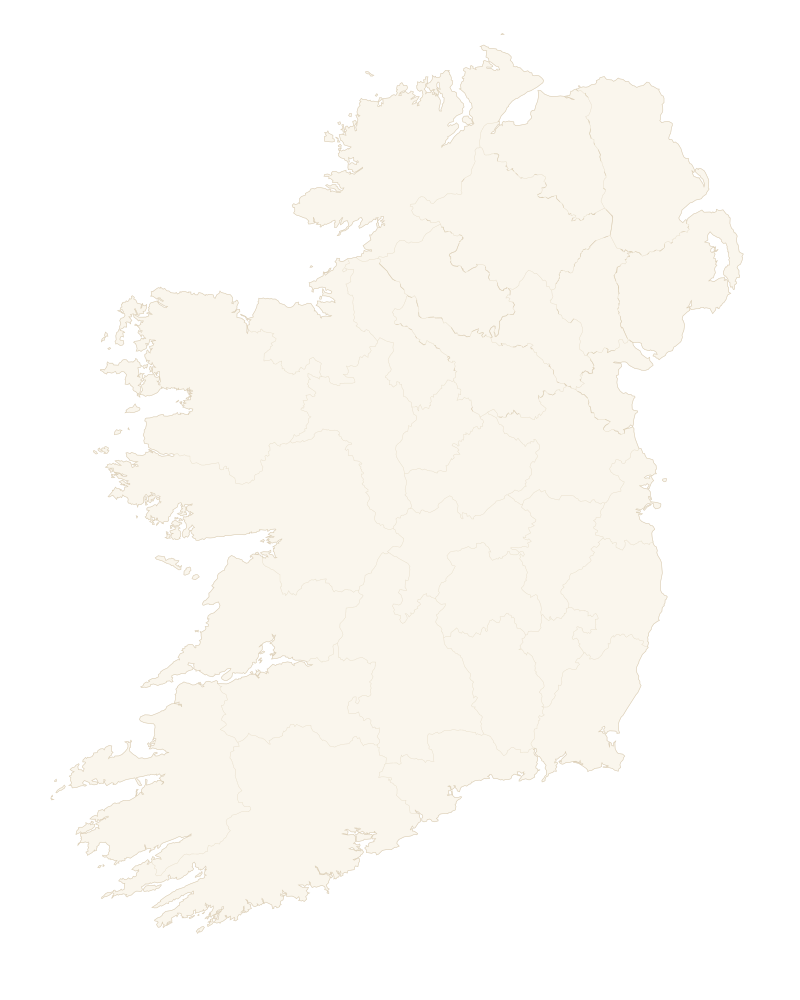
CoreHistoric reach
The seat of McCarthy
Seat vacantChief
No one leads the McCarthy community yet. When the movement opens, you can stand for its leadership, or help elect whoever does.
Current mission
No shared goal set yet. Once McCarthy has leadership, it sets the public focus: a restoration, a gathering, a real-world project that helps its own.
The McCarthy clan is being rebuilt. Join the waiting list for the movement today, and you help decide who leads it and what it does.
Help rebuild the McCarthy clan →Motto
Forti et Fideli Nihil Difficile
“To the brave and faithful nothing is difficult”
What does the McCarthy name mean?
From Mac Cárthaigh, son of Cárthach. Cárthach mac Sáebrethaig (d. 1045) was king of Eóganacht Caisil. His grandson Muiredach Mac Cárthaigh first used the surname around the 1080s. The McCarthys are the surviving line of the Eóganachta, the dynasty that ruled Munster from the 5th to the 10th century, before being displaced from the high kingship of the province by Brian Boru's Dál Cais. The McCarthys then governed the southern half of Munster, Desmond, 'south Munster', for a further six centuries.
The history of McCarthy
Four MacCarthys where Glanmire had left one king
By the later Middle Ages there were four ruling MacCarthys, not one. The MacCarthy Mór held much of south Kerry and was nominal head of the whole name; the Duhallow line held north-west Cork; the MacCarthy Reagh, or Riabhach, 'grey', sat as kings of Carbery around Rosscarbery in the south-west; and Muskerry, on the Cork–Kerry border, began about 1353, when it was given as an appanage to Dermot MacCarthy, second son of Cormac MacCarthy Mór.
Carbery became the most independent of the four, a small wealthy kingdom with its own army, standing apart from Desmond and from England into the mid-seventeenth century. Below the branches sat the septs: Kerry alone counted eleven in King's History of County Kerry, among them Sliocht Owen of Coshmaing and Sliocht Fineen Duff of Ardeanaght. A Gaelic fine held the chief's kin and also unrelated clients, who took the leading lineage's name as a declaration of allegiance.
Cormac Láidir and the towers he left standing
Cormac Láidir MacCarthy, ninth Lord of Muskerry (1411–1494), is the builder the family is measured by. Beyond the great keep of 1446, he had Kilcrea Castle finished by 1465 beside the River Bride west of Cork city, raised on marshy ground over an older fort, and founded Kilcrea Friary next to it. The two have gone separate ways since: the friary is in state care, the tower stands hidden by trees on a working cattle farm.
His brother Dermot Mór of Drishane is credited by some sources with Carrigaphooca in the same years: Caisleán Charraig a' Phúca, 'castle on the rock of the fairy', five storeys on a jagged rock above the Sullane, built for protection rather than comfort and containing no fireplace at all. Macroom, whose Irish name Caisleán Uí Fhloinn suggests the O'Flynns held it before 1353, was enlarged by Teige MacCarthy, eleventh Lord Muskerry, who died there in 1565.
Tanistry surrendered, and the kingdom dissolved in 1596
When the Kingdom of Ireland was created in 1541, Dublin set about turning chiefs into peers, granting new arms in 1552 and, through surrender and regrant, replacing tanistry with primogeniture. Tanistry had elected a chief from the agnatic cousins of a shared grandfather; the crown of Desmond was vested in the Mac Carthy Mór on those terms until the kingdom was dissolved in 1596. The change did more damage than any siege: it made every succession a matter for English courts.
The Second Desmond Rebellion of the 1580s moved Ross Castle, on Lough Leane, from the O'Donoghues Mór to the MacCarthy Mór, who promptly leased castle and lands to Sir Valentine Browne, ancestor of the Earls of Kenmare. The same Browne took Ballycarbery, above the sea near Cahersiveen, on the death of Donal McCarthy More. After Kinsale in 1601, Cormac Teige McCarthy of Blarney took refuge at Carrigaphooca; in 1602 that rock was stormed by Donal Cam O'Sullivan Beare, a McCarthy kinsman beside him.
The Nuncio at Macroom and the garrison that fired its own gate
In 1645 the papal Nuncio Rinuccini was received at Macroom by Lady Muskerry and her eleven-year-old son Charles. The year after, Parliamentarians seized Blarney. In 1650, with Lord Broghill's troops closing, the Macroom garrison set fire to the building rather than surrender it and marched out to join the Confederate army that Boetius MacEgan, Bishop of Ross, had assembled at the castle.
At Killarney, Lord Muskerry held Ross against Edmund Ludlow, who came up with four thousand foot and two hundred horse and then took the place by water rather than by land. Owen MacCarthy had still held Drishane at his death in 1637; after the Confederate Wars of 1641–53 the family lands were forfeit almost entirely. Charles II's return in 1660 handed much of it back to Donough MacCarty, made first Earl of Clancarty.
1691, and the estates that went to the Hollow Sword Blade Company
Donough MacCarthy, fourth Earl of Clancarty (1670–1734), fought for James II in the Williamite War and was attainted at the defeat in 1691. Macroom went that year, definitively. The earldom of Clancarty, the viscountcy of Muskerry and the barony of Blarney fell with him, and by 1694 the family had lost every title and peerage it held in Ireland. Blarney passed eventually to the Jefferyes.
The forfeited Cork and Kerry estates went to the Hollow Sword Blade Company, a speculation that broke up in resale what six centuries had assembled: Drishane to Henry Wallis in 1709, Carrignacurra to the Masters family in the 1720s. The men of the name went abroad to soldier: Justin MacCarthy, Viscount Mountcashel, dead in 1694; Charles MacCarthy (1764–1824), who served the French, Dutch and British armies in turn.
Justin, Florence, and the shapes the name took in English
Two forenames travel with this family. Cárthach's father was Saoirbhreathach, anglicised as Justin, and Justin has run unbroken through the branches since. Finghin, anglice Fineen, was rendered in English as Florence, colloquially Flurry, the name of the Fineen who broke the Geraldines in 1261, of Florence MacCarthy (1563–1640), and of the Irish poet Denis Florence MacCarthy (1818–1882). Where English used numbers, Irish used epithets: Láidir for the strong, Oge the younger, Riabhach the grey.
The written form fractured when Gaelic went into English script. Mac was rendered Mc or M'; where the prefix was struck off entirely the hard c survived it, which is how Mac Cárthaigh flattens to plain Carthy. Nic, the prefix marking a daughter, vanished into Mac regardless of sex. What survived is McCarthy in the main, MacCarthy in Anglo-Irish usage, McCarty across much of America, and sixty per cent of those carrying the name in Ireland still trace to County Cork.
The Knoxville boy who took a Muskerry lord's forename
Charles Joseph McCarthy was born at Providence, Rhode Island, on 20 July 1933, third of six children of a Tennessee Valley Authority lawyer descended from the West Cork McCarthys. The family followed his father's TVA posting to Knoxville in 1937, and in his twenties he took the name Cormac (the forename of the Muskerry lords, including the man who built the keep at Blarney) to separate the writing from his father. The Orchard Keeper appeared in 1965 under Albert Erskine, Faulkner's editor.
Blood Meridian came in April 1985, the Border Trilogy from 1992, and The Road took the 2007 Pulitzer; he spent thirty years as the only novelist among the physicists of the Santa Fe Institute, and died there on 13 June 2023. The name forks elsewhere: Mary McCarthy (1912–1989) in letters, Eugene McCarthy (1916–2005) of Minnesota in the 1968 primaries, and under the McCarty spelling the outlaw Henry 'Billy the Kid' McCarty (1859–1881) and Ted McCarty (1910–2001), who built electric guitars.
Champions of the McCarthy name
The bearers whose lives are inseparable from this surname. Each has their own page, biography, achievements, geography, connection to the family.
Historic Places, Rebuilt
Explore the streets and seats the McCarthy name knew, rebuilt with AI as they stood in history.
Historic Places, Rebuilt · New
The MacCarthy lords' great tower-house in its prime, the battlements and the famous stone, high over wooded Muskerry.
Historic Places, Rebuilt · New
The cathedral citadel of the Kings of Munster, whole and roofed on its rock, round tower, Cormac's Chapel and Gothic cathedral.
Castles the McCarthy held
Strongholds this name held for a decade or more, look one up, or rebuild it to explore.
- Blarney Castle
Held by the MacCarthys of Muskerry, 1446–1690s.
- Ross Castle
Passed to the MacCarthy Mór during the Second Desmond Rebellion of the 1580s; Lord Muskerry later held it against Ludlow's army.
- Macroom Castle
Held by the MacCarthys of Muskerry, with interruptions, from about 1353 until Donogh MacCarthy, 4th Earl of Clancarty, lost it in 1691.
- Ballycarbery Castle
Held by the MacCarthys; on the death of Donal McCarthy More the castle passed to Sir Valentine Browne.
- Carrigaphooca Castle
Built by the MacCarthys of Muskerry in the early 15th century; a refuge for Cormac Teige McCarthy of Blarney after the Siege of Kinsale in 1601.
- Kilcrea Castle
Built by 1465 by Cormac Laidir MacCarthy, 9th Lord of Muskerry, founder of Kilcrea Friary.
- Dunasead Castle
Purchased and restored by members of the McCarthy family, 1997–2005.
- Drishane Castle
Built by the MacCarthys in the 15th century; restored to Donough MacCarty, 1st Earl of Clancarty, in 1660.
- Carrigrohane Castle
Credited with the original construction of the castle above the River Lee.
- Carrignacurra Castle
Restored to the MacCarthys after the 1641 forfeiture, with the O'Learys as tenants.
The castles of the homeland
The great strongholds of the homeland, look one up, see what it looked like in its prime, and recreate it to explore.
 Ashford Castle, County MayoRestored · prime 1880
 Manderley CastleRestored · prime 1840
 Dublin CastleRestored · prime 1790
All castles in Ireland → · Strongest castles in Ireland → · Castles of Europe
Play As Your Clan
Hold a real castle against whatever you choose to send at it, take a ship out in her own service years, or stand at the shoulder of someone the record remembers. The chronicler sets the scene; the deeds are yours.
Notable bearers of the McCarthy name
- Cormac Láidir Mac Cárthaigh (d. 1494), lord of Muskerry, builder of Blarney Castle
- Cormac McCarthy (1933–2023), American novelist
- Eugene McCarthy (1916–2005), US Senator, 1968 presidential candidate
- Mary McCarthy (1912–1989), American writer
Stories of McCarthy
Frequently asked
What does the surname McCarthy mean?
Where does the McCarthy family come from?
Where did the McCarthy family historically hold territory?
Is McCarthy Irish or Scottish?
How old is the McCarthy surname?
What is the McCarthy family known for?
What is the McCarthy motto?
What does "Forti et Fideli Nihil Difficile" mean in English?
Is there a McCarthy family crest or coat of arms?
Who is the most famous McCarthy?
Who are some famous McCarthys?
What stories are told about the McCarthy family?
What is the story of the Blarney Stone?
Is MacCarthy the same family as McCarthy?
Is Mac Cárthaigh the same family as McCarthy?
Is Carthy the same family as McCarthy?
Where is the McCarthy surname found today?
What does the Clan Rising page for the McCarthy family cover?
Who is the head of the McCarthy family today?
Neighbouring clans
- FitzGeraldHibernis ipsis Hiberniores, the Geraldines of Kildare and Desmond.
- O'SullivanThe third most common Irish surname, and the family of Donal Cam's march.
- CollinsThe man who beat the Empire, and the family of west Cork.
- O'ConnellThe family of Daniel O'Connell, The Liberator, and the most influential Catholic of 19th-century Britain.