O'Connell
also Connell, Ó Conaill
The family of Daniel O'Connell, The Liberator, and the most influential Catholic of 19th-century Britain.
- Origin
- Munster, Ireland
- Motto
- Ciall agus neart
- Famous bearer
- Daniel O'Connell (1775–1847), 'The Liberator', leader of Catholic Emancipation
- Register
- Irish family
Where the O'Connell name comes from
CoreHistoric reach
The seat of O'Connell
Seat vacantChief
No one leads the O'Connell community yet. When the movement opens, you can stand for its leadership, or help elect whoever does.
Current mission
No shared goal set yet. Once O'Connell has leadership, it sets the public focus: a restoration, a gathering, a real-world project that helps its own.
The O'Connell clan is being rebuilt. Join the waiting list for the movement today, and you help decide who leads it and what it does.
Help rebuild the O'Connell clan →Motto
Ciall agus neart
“Wisdom and strength”
What does the O'Connell name mean?
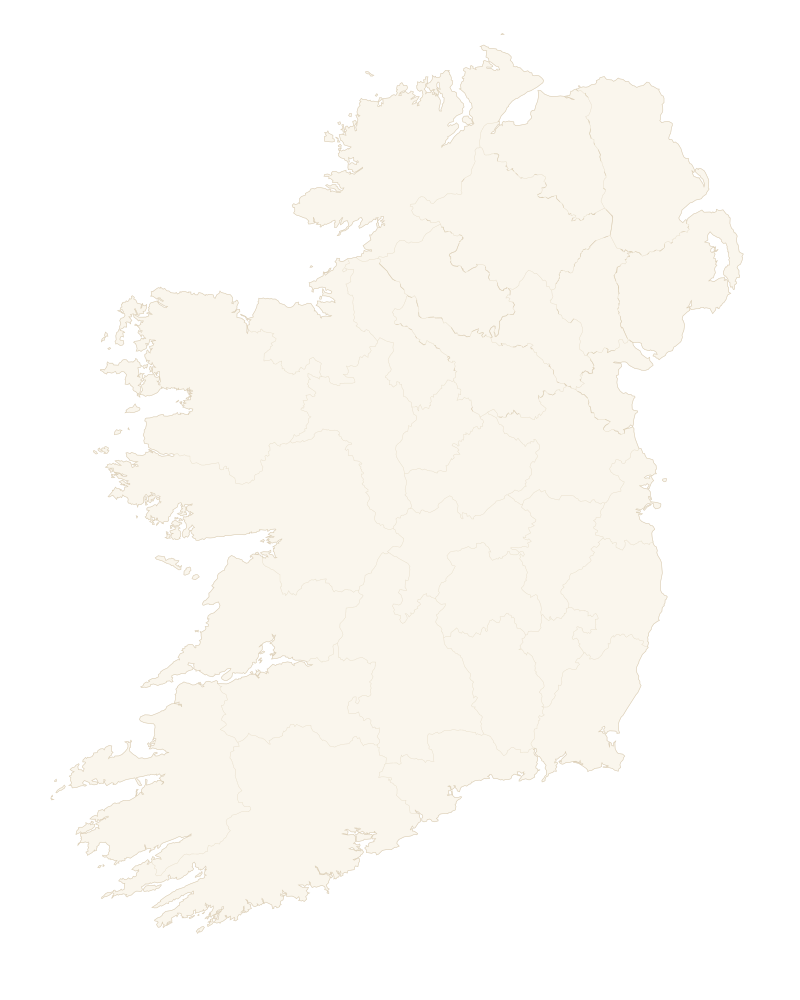
From Ó Conaill, descendant of Conall (a personal name probably derived from cú, 'wolf' or 'hound'). The Ó Conaill were a Munster sept anciently seated near Lough Currane in south Kerry, the Iveragh peninsula. The Anglicised O'Connell remained densely Kerry-rooted through the medieval and modern periods, with the family's principal seat at Derrynane on the Atlantic coast at the south-west tip of Iveragh, the seat from which Daniel O'Connell, 'The Liberator', emerged in the 19th century.
The history of O'Connell
Descendant of Conall, and three arguments about which Conall
Ó Conaill means the descendant of Conall, a personal name most likely built on cú, wolf or hound. The Anglicised O'Connell fixes the spelling and settles nothing else: three separate ancestries are claimed for the Derrynane family. One derives it from Conall Gulban, son of Niall of the Nine Hostages, which would make the name northern and Uí Néill; the family's own tradition is Munster and looks nothing like that. A third strand has the O'Connells claiming Eoghanacht descent alongside the O'Sullivans and the MacCarthys.
The strongest Munster claim sends the family into County Limerick: descent from the Uí Chonaill Gabra, a sept of the Uí Fidgenti, through Dáire Cerbba, which would make them cousins of the O'Donovans and the O'Collins. The rival case keeps them in Kerry. C. Thomas Cairney placed them in the Corcu Duibne, the Ua Congaile, a kingdom native to the county, and a survey of the Irish septs likewise names the O'Connells and the O'Sheas as the chiefly families of the Corca Dhuibhne. That descent would tie them to the O'Sheas and O'Falveys, and to Conaire Mór, ancestor also of the Dál Riata kings of Scotland.
The Limerick case is the less romantic and the better supported. A family taking the name of the kingdom it had lost and wearing it as a surname is not unusual in Ireland, and Count O'Connell's claim to Dáire Cerbba is hard to read as career-minded: the Uí Fidgenti had long since faded, and a Corcu Duibne ancestry would have flattered him just as well. Nobody can prove a male line of kings, so the O'Connells are not technically of royal extraction. What they had instead was marriage: into the O'Briens of Thomond, the MacCarthy Mor of Desmond, both O'Sullivan dynasties of Beare and Mor, the O'Callaghans, the O'Connor Kerry, the O'Donovans of Clancahill and the O'Donoghue Dhuv of the Glens. Munster was cut into exclusive lordships that did not mix. This one family bridged them.
The key of all the county, and the rock the name gave up
Carrigogunnell stands on an outcrop of volcanic trap rock near Clarina in County Limerick, above the low ground and the Shannon. The site is first named in 1209, when Carrac Ui Conaing was granted to Donnchad Cairbreach, King of Thomond, and there was building on the rock by the early thirteenth century. In 1536 the Lord Deputy, Leonard Grey, 1st Viscount Grane, marched on what he called "the very strong castle called Carekogunyel", which "stands on a high rock and... is the key of all the county". Lenihan's history of Limerick records that the O'Connell family occupied Carrigogunnell before surrendering it to the Fitzgeralds.
That one line is the whole of the family's recorded tenure of the rock, and it sits in the county the Limerick descent tradition points at. Everything after it belongs to other people. The Crown later claimed the rock on the apparently unfounded statement that the O'Briens held it from "Lord Clerre", probably Richard de Clare. It was taken during the second siege of Limerick and slighted in September 1691; its last owner, Donough Brien, had prudently sold it on to Michael Boyle, afterwards Archbishop of Dublin. The outer ward still stands, with an inset upper ward and its ranges of stone buildings, and a keep that once rose more than fifty feet through five storeys.
Derrynane, the Catholic house that kept its land
The seat of the senior line was Derrynane Abbey, on the Atlantic at the south-western tip of the Iveragh peninsula, with the older seating of the name near Lough Currane in south Kerry. Under the penal laws, the code that shut Ireland's Catholic majority out of the professions, out of property, out of Parliament and out of public life, a Catholic landed family holding on in Kerry was an anomaly that had to be worked at. The roll of the house runs unbroken through the worst of it: John Ó Connell, dead in 1740; Maurice O'Connell of Tarmons (1703-1770); Patrick O'Connell (1703-1794), remembered as the Forefather; Morgan O'Connell (1739-1809).
Part of the answer lay abroad, in the Wild Geese trade that carried the sons of such houses into the armies of Catholic Europe, and Count Daniel Charles O'Connell (1745-1833) is the name the roll of the house sends out of Kerry into that world. Part of it shows in the roll itself: Eibhlín Dubh Ní Chonaill (1743-1800) is entered in the Irish form of the name while the men of the house were signing themselves in English, with Baron Moritz O'Connell (1738-1830) and Geoffrey O'Connell (1728-1820) alongside her. The house came through the penal century intact, which is why the son born to it in 1775 had land, standing and a French education waiting for him.
A penny a month from the Catholic millions
The French schooling produced a barrister, and one of the most formidable advocates in Ireland: a courtroom master whose wit and handling of a jury made him famous and wealthy, and who turned the law again and again against an unequal system for people with no other defence. He held throughout that the wrongs of his people had to be put right by lawful means and never by bloodshed.
In 1823 he founded the Catholic Association and did what nobody had done before: he organised the Catholic masses. The Catholic rent was a penny a month, collected from millions of ordinary people, and it turned a grievance into a disciplined national movement with a treasury, a membership and a reach into every parish. Nothing of the kind existed yet anywhere. It was assembled in Ireland, out of pennies.
Clare, 1828, and the seat he could not lawfully take
He forced the question by standing for Parliament himself. At the County Clare by-election of 1828 he won by a landslide, and as a Catholic he could not legally sit. That left the government two options and no comfortable one: refuse the plain verdict of the Irish electorate, or give way.
They gave way. The Catholic Relief Act of 1829 opened Parliament and the high offices of the state to Catholics for the first time in a century and a half, the most consequential single Catholic-rights measure in the history of the British state, and it was carried by organisation and moral force with not a shot fired. The millions who had paid the penny gave him the name he has carried ever since: the Liberator.
The monster meetings, and the one that did not happen
The next campaign was repeal of the Act of Union. Through the 1830s and 1840s the Repeal Association worked the same method at greater scale, and the monster meetings drew hundreds of thousands into open ground to hear him. The size was the argument: a country assembling itself peacefully, in numbers no government could ignore.
In October 1843 Peel's government banned the greatest of them, called for Clontarf. O'Connell called it off rather than put the people who had come for him in front of soldiers, and the principle that had guided him from the start cost him the campaign; the momentum never came back. Worn down and in failing health, he set out for Rome in 1847 and got as far as Genoa, where he died on 15 May. By his own wish his heart went on to Rome and his body came home to Ireland.
Tralee, Kilkenny, and a street in every Irish city
The family went into the Parliament he had opened. His son Maurice O'Connell (1803-1853) sat for Tralee and his son John O'Connell (1810-1858) for Kilkenny. Sir James O'Connell (1786-1872) was created first of the O'Connell baronets, a title the family carried on after him. Morgan O'Connell (1804-1885) and Daniel O'Connell Jnr (1816-1897) stand on the same roll of the house, born into a family barred from public life and grown old in a country it helped to run. The name travelled as well: cousins of the Derrynane O'Connells included Sir Maurice Charles O'Connell and his son Maurice Charles O'Connell, an Australian politician.
Derrynane Abbey is an Irish National Monument now, kept as a state house-museum in the corner of Kerry the family never left. The rest of the memorial is public space: Dublin's main thoroughfare is O'Connell Street, O'Connell Bridge carries the name too, and Limerick, Ennis, Sligo and Cork each have an O'Connell Street of their own. Few surnames are written across the map of Irish towns on that scale, and this one goes back to a single Catholic house on the Iveragh coast.
Champions of the O'Connell name
The bearers whose lives are inseparable from this surname. Each has their own page, biography, achievements, geography, connection to the family.
Historic Places, Rebuilt
Explore the streets and seats the O'Connell name knew, rebuilt with AI as they stood in history.
Castles the O'Connell held
Strongholds this name held for a decade or more, look one up, or rebuild it to explore.
- Carrigogunnell
According to Lenihan, the O'Connell family occupied the castle before surrendering it to the Fitzgeralds.
The castles of the homeland
The great strongholds of the homeland, look one up, see what it looked like in its prime, and recreate it to explore.
 Ashford Castle, County MayoRestored · prime 1880
 Manderley CastleRestored · prime 1840
 Dublin CastleRestored · prime 1790
All castles in Ireland → · Strongest castles in Ireland → · Castles of Europe
Play As Your Clan
Hold a real castle against whatever you choose to send at it, take a ship out in her own service years, or stand at the shoulder of someone the record remembers. The chronicler sets the scene; the deeds are yours.
Notable bearers of the O'Connell name
- Daniel O'Connell (1775–1847), 'The Liberator', leader of Catholic Emancipation
- Count Daniel Charles O'Connell (1745–1833), Wild Goose general in the French royal army
- Maurice O'Connell (1803–1853), MP for Tralee
- John O'Connell (1810–1858), MP for Kilkenny, son of the Liberator
Stories of O'Connell
The duel with D'Esterre
1815On the late afternoon of the first of February 1815, in a snowy field at Bishop's Court near Naas in County Kildare, Daniel O'Connell, then thirty-nine years old, the rising Catholic barrister of the Munster Bar and the principal organiser of the Catholic Association, met John D'Esterre, a Protestant member of the Dublin Corporation, in a formal duel with pistols. D'Esterre had taken offence at O'Connell's description of the Corporation, in a public meeting two weeks earlier, as a beggarly corporation. O'Connell, by his second the surgeon Sir Edward O'Connell of Lyons, refused to retract. The two men met at Bishop's Court at four in the afternoon. O'Connell hit D'Esterre at the first exchange in the right hip; the ball lodged in the bladder. D'Esterre died two days later, on the third of February 1815, at his Dublin lodgings. O'Connell never challenged or accepted another duel for the rest of his life. He wore a black silk glove on his right hand at every public function in Ireland for the next thirty-two years, in mourning for the man he had killed.
Read the story →
Clontarf, the cancelled meeting
1843On the afternoon of Saturday the seventh of October 1843, on the eve of the great public meeting Daniel O'Connell had called for the next day, Sunday the eighth, on the strand at Clontarf outside Dublin (intended to draw, by the Repeal Association's planning, between five hundred thousand and one million people, the largest political assembly ever held in Britain or Ireland), the Lord Lieutenant of Ireland Earl De Grey, on the personal direction of the Prime Minister Sir Robert Peel, issued a formal proclamation banning the meeting. Peel had moved British army regiments and a battery of artillery into Dublin during the previous week. The proclamation was posted at the Pillar at four o'clock in the afternoon. O'Connell, who had been at the Repeal Association headquarters in Burgh Quay since noon, summoned the committee at five and, after two hours' debate, ordered the cancellation of the meeting on the grounds that he would not lead a peaceful assembly into the muskets of the British army. The cancellation was, by every careful reading of subsequent Irish political history, the moment at which Repeal as a constitutional movement died. O'Connell himself was tried and convicted for sedition the following year, served four months of a one-year sentence in Richmond Bridewell, and emerged a broken political force. He died at Genoa in May 1847 on a pilgrimage to Rome.
Read the story →