FitzGerald
also Fitzgerald, Mac Gearailt, Geraldine
Hibernis ipsis Hiberniores, the Geraldines of Kildare and Desmond.
- Origin
- Leinster, Ireland
- Motto
- Crom Abú
- Famous bearer
- Garret Mór FitzGerald, 8th Earl of Kildare (c.1456–1513), the 'Great Earl', Lord Deputy
- Register
- Irish family
Ranked of all time
The 10 Most Powerful Irish Clans of All Time
The FitzGerald arms and country

Coat of armsFitzGerald armsWikimandia · CC BY-SA 4.0

- Coat of arms: Granted to an individual and inherited down that one documented line. These are the arms of particular families of the name, not of everyone who shares the surname.
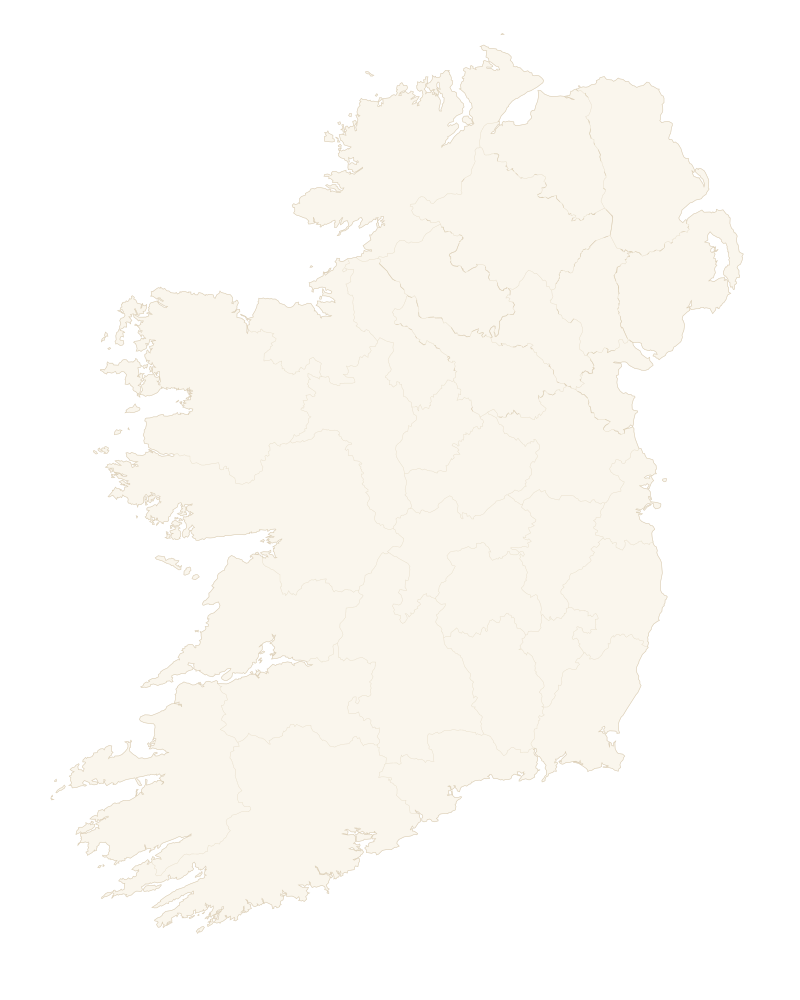
CoreHistoric reach
The seat of FitzGerald
Seat vacantChief
No one leads the FitzGerald community yet. When the movement opens, you can stand for its leadership, or help elect whoever does.
Current mission
No shared goal set yet. Once FitzGerald has leadership, it sets the public focus: a restoration, a gathering, a real-world project that helps its own.
The FitzGerald clan is being rebuilt. Join the waiting list for the movement today, and you help decide who leads it and what it does.
Help rebuild the FitzGerald clan →Motto
Crom Abú
“Crom for ever (the Geraldine war-cry, after Croom Castle)”
What does the FitzGerald name mean?
Norman patronymic, son of Gerald. Old French fils (later fils, contracted to Fitz in Norman record-keeping) attached to the Christian name. The eponymous Gerald was Gerald FitzWalter of Windsor (c.1075–1135), constable of Pembroke Castle and the man who married Nest, daughter of Rhys ap Tewdwr of Deheubarth, the union from which the Geraldines and Tudors and most of the great Welsh-Marcher houses descend. The Gaelic form Mac Gearailt translated the Norman patronymic when the family Gaelicised; the common collective name 'the Geraldines' is the English form of the same.
The history of FitzGerald
The Windsor constable's youngest son
The surname is a Norman patronymic and nothing more complicated than that: fitz, from the Anglo-Norman fils and behind it the Latin filius, meaning son, fixed in front of a Christian name. Gerald itself is a Germanic compound of ger, spear, and waltan, rule. The earliest recorded use of the form belongs to a Norman baron with no Irish connection at all: Raoul fitz Gerald le Chambellan of the Tancarville family, Chamberlain of Normandy and tutor of the young William who would conquer England, whose son William de Tancarville became chief chamberlain of Normandy and England after 1066. The Geraldines of Ireland take their name from a different Gerald, and the Irish language would eventually translate the whole construction back into its own grammar as Mac Gearailt.
That Gerald was born into one of the Conqueror's service families, the households the King relied on for soldiering rather than for blood. His father, Walter fitz Otho, was the first Constable and Governor of Windsor Castle for William the Conqueror and the King's Keeper of the Forests of Berkshire, lord of thirty-eight manors, recorded in Domesday Book as tenant-in-chief of lands taken from conquered Englishmen in Berkshire, Buckinghamshire, Hampshire and Middlesex. Walter's offices and the bulk of his estates went to his elder sons Robert, Maurice and William, the eldest being the ancestor of the earls of Plymouth. Gerald, the youngest, inherited the single estate of Moulsford, now in Oxfordshire, near his father's fortified house at Wallingford. A younger son with one manor either stayed small or went where land could still be taken.
Gerald went west. In 1093 he took part in the Norman invasion of South Wales that followed the death in battle of Rhys ap Tewdwr, the last king of Deheubarth, and he became the first castellan of Pembroke Castle. Then he made the marriage that made the family: he married Nest ferch Rhys, daughter of the dead king by Gwladys ferch Rhiwallon ap Cynfyn of Powys. Every Geraldine in Ireland descends from that union, and it is why the family is Cambro-Norman rather than simply Norman: Welsh royal blood on one side, the Conqueror's military service class on the other. It is also the basis of the family's long-asserted kinship with the Tudors, who came from the same Deheubarth line through Rhys ap Tewdwr; Tudor is the English form of Tewdwr, and the FitzGeralds have claimed cousinship with the dynasty on that ground for centuries.
1169: the grandsons of Nest take Ireland
The Norman invasion of Ireland was, at the level of its commanders, close to a family expedition. Maurice FitzGerald, Lord of Lanstephan, son of Gerald and Nest, died 1176, is reckoned the progenitor of the Irish Geraldines and was one of the principal captains at the Wexford and Waterford landings of 1169. Beside him were his half-brother Robert FitzStephen, Nest's son by her second marriage; his kinsmen Raymond le Gros and Philip de Barry, both grandchildren of Gerald and Nest; and William de Hay, married to one of their granddaughters. Meiler FitzHenry, Nest's grandson through the son she bore Henry I of England, was later appointed Lord Justice of Ireland by his cousin Henry II. Maurice himself had married a daughter of Arnulf de Montgomery, of a house that held 150 manors and 30 castles and stood among the most powerful magnates in both England and Normandy; his wife's maternal grandfather was Muirchertach Ua Briain, High King of Ireland, a connection that may bear directly on the part Maurice played in 1169.
The family also supplied the invasion's historian. Gerald of Wales, the most renowned of Gerald and Nest's grandchildren, wrote the account of the Norman landings and left the liveliest surviving descriptions of Ireland and Wales in the late twelfth century. He became Archdeacon of Brecon, travelled with Archbishop Baldwin of Forde recruiting for Richard the Lionheart's Third Crusade, tried repeatedly and failed to be made Bishop of St Davids despite pleading his case in Rome before Innocent III, and produced more than twenty works. His statue stands today in City Hall, Cardiff. Much of what is known about both countries in that generation is known because a Geraldine wrote it down.
What followed the landings was land, and then office. Gerald FitzMaurice, 1st Lord of Offaly (c. 1150–1204), was granted estates in Ireland confirmed by Prince John. His successors ran the country for the Crown as often as they fought it: Maurice FitzMaurice FitzGerald, 2nd Lord of Offaly (1194–1257), was Justiciar of Ireland, accompanied Henry III to Poitou and Gascony, and in 1245 built Sligo Castle; Maurice FitzGerald, 3rd Lord of Offaly (1238–1286), was Justiciar in his turn and was summoned by the Lord Edward, the future Edward I, as a chief magnate over the wars in Ireland with Walter de Burgh, Earl of Ulster. In the far south-west a second Geraldine trunk was growing at the same time: the Barons Desmond, created in 1259, beginning with John FitzThomas, 1st Baron Desmond, who died in 1261 after fighting Finghin Mac Carthaigh, king of Desmond, and the O'Sullivans for the ground his family meant to keep.
Two earldoms out of one family: Kildare and Desmond
Within two generations the Geraldines had become two great houses with two different Irelands around them. John FitzGerald, already 4th Lord of Offaly, was made 1st Earl of Kildare in 1316, rewarded for serving Edward I in Scotland. Maurice FitzThomas FitzGerald, 4th Baron Desmond, married to a daughter of the Prince of Thomond, was created Earl of Desmond in 1329. Kildare sat in Leinster, close enough to Dublin to run the English administration and to be run by it. Desmond sat in south-western Munster, far from the Pale, where the writ of Dublin arrived late or not at all. The same surname, the same descent from Gerald and Nest, and from the fourteenth century onward two entirely different political weathers.
Both houses spent the fourteenth century in the Crown's wars. Thomas FitzGerald, 2nd Earl of Kildare, who died in 1328, was placed in charge of a reported thirty thousand men against Edward Bruce, brother of Robert the Bruce: a chronicler's figure, and to be read as one. Maurice FitzGerald, 4th Earl of Kildare (1318–1390), led the army serving Edward III at the siege of Calais. Maurice, 1st Earl of Desmond, assisted in the war against Philip VI of France. But the other habit was setting in as well: Gerald FitzGerald, 5th Earl of Kildare, who died in 1410, is remembered chiefly as the leading opponent of the Crown's own Lord Lieutenant of Ireland, John Talbot, 1st Earl of Shrewsbury. Serving the King and obstructing the King's governor were, for a Geraldine, entirely compatible activities.
The family threw off branches as it went, and two of them outlasted the main lines. The FitzMaurices of Kerry descend not from the Offaly-Kildare stem but from Thomas FitzMaurice, 1st Baron of Kerry, nephew of the 1st Baron Desmond, which makes them a sister branch of the Munster Geraldines and technically nearer to Desmond than either is to Kildare. They continue in the male line as the Petty-FitzMaurice Marquesses of Lansdowne, and they produced William Petty Fitzmaurice, 1st Marquess of Lansdowne, the British Prime Minister who negotiated with Benjamin Franklin and secured peace with America; the Treaty of Paris of 1783 was drafted at his home, Lansdowne House. A second offshoot went the other way across the Irish Sea: Osborn Wyddel, a descendant of Gerald de Windsor, came from Ireland into Gwynedd in the thirteenth century with Llywelyn the Great, was granted estates and arms, married a ward of Llywelyn who was heiress of Corsygedol and Plas Hen, and founded a Welsh house that flourished in North Wales for centuries before the Corsygedol estates passed by marriage to the Mostyn baronets in the eighteenth century.
Hibernis ipsis Hiberniores: more Irish than the Irish themselves
The phrase attached to the Geraldines by the Annals of the Four Masters is the one thing most people know about them, and it is not a compliment paid lightly. The Norman families who took Irish land in the twelfth century were supposed to hold it as an English colony. Within a few generations many of them (the Old English, as they came to be called) had absorbed Gaelic law, language, dress and patronage so thoroughly that Dublin regarded them as a problem rather than a garrison. The FitzGeralds went furthest of all. Irish rendered the name as Mac Gearailt; the collective English name, the Geraldines, is the same idea in another language. The Kildare war-cry and motto, Crom Abu, Crom for ever, is Irish, and it comes from Croom Castle in County Limerick, one of the principal Kildare residences. A family of Norman descent went into battle shouting the name of an Irish fortress in the Irish language.
The clearest single case is Gerald FitzGerald, 3rd Earl of Desmond (1335–1398), known in Irish as Gearoid Iarla, Earl Gerald. He was made Lord Chief Justice of Ireland in 1367 and was an accomplished poet in Norman French, and he also wrote poetry in the Irish language, most famously Mairg adeir olc ris na mnaibh, Woe to Those who Speak Ill of Womankind. He was instrumental in moving the Desmond Geraldines toward the Irish language, and he did it while holding one of the highest legal offices the English administration in Ireland could confer. He is not a footnote in Gaelic literature; he is part of it.
In Munster the family did not merely adopt Irish custom, it exercised something close to native lordship. The Earls of Desmond acted as Earls Palatine, holding jurisdiction in their own right, and out of that authority they created three hereditary knighthoods for their kinsmen: the Knight of Kerry, the Green Knight; the Knight of Glin, the Black Knight; and the White Knight, held by the Fitzgibbon family. Two are now dormant: the White Knight since 1611 and the death of Maurice Oge Fitzgibbon, the twelfth holder, and the Knight of Glin since 2011 and the death of Desmond FitzGerald, twenty-ninth Knight of Glin, whose family had held Glin Castle for more than seven hundred years. The Knight of Kerry survives: Sir Adrian FitzGerald, 6th Baronet of Valencia, is the twenty-fourth to hold it. Titles created by an Irish earl for his own cousins, rather than by any king, are still carried today.
Alongside the Gaelic identity ran an entirely different claim, and the family has held both at once for five hundred years: that the Geraldines descend from the Gherardini of Florence. The documentary trail is real even if the descent is unproven. A priest named Maurice Fitzgerald appears in the Florentine accounts of Antonio d'Ottaviano di Rossellino Gherardini in 1413; in 1440 Leonardo Bruni, Chancellor of Florence, wrote of Giovanni Betti di Gherardini being sent to Ireland to become acquainted with the Kildare kinsmen; in 1507 Gerald FitzGerald, then Viceroy of Ireland, signed a letter to the Florentine merchant Giovanni Manni as Gerald, Chief in Ireland of the family of the Gherardini. Cristoforo Landino, tutor to Lorenzo de' Medici, stated in his preface to Dante's Divine Comedy that the descendants of Tommaso, Gherardo and Maurizio Gherardini were the ancestors of the Earls of Kildare and Desmond. Henry Howard, Earl of Surrey, alluded to the Florentine ancestral seat when he called Elizabeth FitzGerald (1527–89) the Fair Geraldine. What is certain is not the bloodline but the relationship: both families have acknowledged the kinship and kept it up since the fifteenth century, and were still doing so in an Italian magazine cover story in 2014.
The uncrowned kings, and the ruin of Silken Thomas
Kildare's century was the fifteenth. Thomas FitzGerald, 7th Earl, who died in 1478, was appointed Lord Deputy of Ireland by Richard Plantagenet, 3rd Duke of York. His son Gerald FitzGerald, 8th Earl of Kildare (c. 1456–1513), Garret Mor, the Great Earl, held the deputyship for almost the whole of his adult life and was known as the uncrowned King of Ireland. He was a Yorkist who survived the fall of his party at Bosworth and went on governing Ireland for the Tudors, married a cousin of Henry VII, and could put the largest private army in the kingdom into the field. Maynooth Castle had been the principal seat of the Kildare Geraldines since the early thirteenth century and Kilkea was theirs for over seven hundred years; after 1505 the Great Earl was asked to rebuild the derelict castle at Athy, and the arms of the Earls of Kildare are still carved beside the main doorway of White's Castle there.
His son Gerald, 9th Earl (1487–1534), called Young Gerald or Gearoid Og, followed him as Lord Deputy and married Elizabeth Grey, great-granddaughter of Elizabeth Woodville and a cousin of Henry VIII. The family stood at the very top of Irish government and inside the Tudor royal kinship network at the same time. Then it collapsed inside three years.
In 1534 Thomas FitzGerald, 10th Earl of Kildare (1513–1537), remembered as Silken Thomas, renounced his allegiance and rose in arms. The rebellion was put down by force; Maynooth, the seat held since the thirteenth century, was lost with it. Thomas was hanged at Tyburn in 1537 together with five of his uncles, died unmarried, and his honours and the Kildare estates were forfeited. The house that had governed Ireland in all but name for fifty years was destroyed by a single decision, and the Crown did not have to defeat it twice.
It survived anyway, by a thread and a long exile. Thomas's half-brother Gerald FitzGerald, second son of the 9th Earl, escaped abroad, joined the Geraldine League, entered the household of the Duke of Mantua and became Master of Horse to Cosimo I de' Medici, Grand Duke of Tuscany. He is known as the Wizard Earl. In 1554 he was given a new creation, and in 1569 he was restored to his brother's honours as 11th Earl of Kildare, dying in 1585. The line then ran unbroken enough to matter: the 12th Earl, Henry, married a daughter of Charles Howard, the Lord High Admiral who commanded against the Spanish Armada; Lettice FitzGerald, suo jure 1st Baroness Offaly (1580–1658), whose maternal great-grandmother was Mary Boleyn, held her own title; and the earldom passed down to the nineteenth holder and beyond.
The Desmond rebellions and the breaking of Munster
The Munster Geraldines played a bigger and more dangerous game than Kildare ever did, because distance from Dublin gave them room to treat with foreign powers directly. Maurice FitzGerald, 9th Earl of Desmond, who died in 1520, had backed the pretender Perkin Warbeck at the siege of Waterford. James FitzGerald, 10th Earl, who died in 1529, conspired during the Italian War of 1521–1526 with the Venetians and Francis I of France against the Habsburgs, the Tudors and the Medici, then reversed himself and fought for Charles V in the War of the League of Cognac. Thomas FitzGerald, 11th Earl (1454–1534), signed the Treaty of Dingle with Don Gonzalez Fernandez, ambassador of the same emperor. These were Irish earls conducting their own foreign policy. The commercial side of the lordship is still standing at Kinsale, where the Desmonds built a tower house around 1500 to serve as the port's customs house, following Henry VII's grant of the customs to them in 1497.
Under Elizabeth the collision came. Gerald FitzGerald, 14th Earl of Desmond (c. 1533–1583; the Desmond succession is disputed enough in the 1530s that some reckonings count him the 16th) fought the Butlers at the Battle of Affane and then found himself the target of English policy for Munster. The first rising, from 1569 to 1573, was led by his cousin, the commander James Fitzmaurice FitzGerald, who went abroad to raise support and negotiated with Catherine de' Medici with the ambition of making her son Henry III of France the new King of Ireland. The second, from 1579 to 1583, was Gerald's own, fought with the help of Philip II of Spain and Pope Gregory XIII and with a plan to place Giacomo Boncompagni on an Irish throne. The Desmond rebellions were never simply a local revolt; they were an attempt to detach Ireland from the Tudor state and hand it to a Catholic power.
They failed completely, and the punishment was designed to be final. Gerald's lands were declared forfeit in 1582. In November 1583 he was hunted down in the Slieve Mish mountains and beheaded; his head was sent to Elizabeth and his body buried in an unmarked grave at Kilnamannagh. Within five years the Munster Plantation had begun. Kilcolman Castle, built in the 1420s by James FitzGerald, 6th Earl of Desmond, was confiscated by the Crown; Lismore, held by the Desmond earls, went the same way when their lands were broken up after 1583. The war was the end of a Geraldine Munster, but the machinery behind it was broader: over the sixteenth century English common law and a centralised administration replaced Gaelic lordship across Ireland, the Kingdom of Ireland was created in 1541, and the policy of surrender and regrant converted chiefs into titled landlords who inherited by primogeniture rather than by election.
Two afterlives followed. James FitzThomas FitzGerald, remembered as the Sugan Earl, was appointed 16th Earl of Desmond by Hugh O'Neill and held that position from 1598 to 1601 during the Nine Years' War; he was hunted by George Carew, 1st Earl of Totnes, and died in the Tower of London about 1607. James FitzGerald, the Tower Earl (1571–1601), son of Eleanor Butler, Countess of Desmond, was given a second creation of the earldom in 1600 and was dead within the year. The line of the Earls of Desmond has been extinct since the seventeenth century, and the Munster Geraldines survive only in their distant collateral kinsmen, the hereditary knights.
Leinster House, Lord Edward, and the Kildare line's long survival
While Desmond ended, Kildare climbed. The earldom passed through the seventeenth century and into the eighteenth, and in 1761 James FitzGerald, 20th Earl of Kildare, was created Marquess of Kildare; in 1766 he was created Duke of Leinster. The Dukes of Leinster are the Premier Peers of Ireland, and the head of the family today, Maurice FitzGerald, 9th Duke of Leinster, is also 28th Earl of Kildare, holding a title created in 1316 and lordships in Offaly older still. Very few European families can point to an unbroken run of that length through forfeiture, exile and restoration.
The first Duke built the family a palace in Dublin. Leinster House was raised between 1745 and 1748 as the ducal seat of the Dukes of Leinster, and it now houses Dail Eireann, the Irish parliament. Its afterlife reached further than that: the White House in Washington, designed by the Irish architect James Hoban for George Washington, was based on Leinster House. The Geraldine ducal palace is the model for the residence of the President of the United States, and Hoban went on to supervise construction of the Capitol for Thomas Jefferson.
The most famous FitzGerald of the age turned against the state his family had served. Lord Edward FitzGerald (1763–1798), fifth son of the 1st Duke of Leinster and a cousin of Charles James Fox, fought on the British side in the American War of Independence and then became a leading figure of the United Irishmen and of the 1798 rebellion against George III. He was taken in Dublin and died in Dublin Castle that year. His wife, known as Pamela (c. 1773–1831), was the adopted daughter of the comtesse Stephanie Felicite, and her family had fled France during the Revolution. Elsewhere the family kept to the older pattern: Augustus FitzGerald, 3rd Duke (1791–1874), was Lord High Constable of Ireland for William IV and Queen Victoria, and Charles FitzGerald, Baron Lecale, turned Ardglass Castle into a castellated house in the late eighteenth century, later a home of Emily FitzGerald, Duchess of Leinster.
The great estates went the way of great estates. Lady Maurice FitzGerald was the last owner to live in the house at Johnstown Castle before the estate passed to the Irish State in 1945. Thomas FitzGerald, Earl of Offaly, only son of the present Duke, died unmarried in a road collision in 1997, and the heir presumptive is his cousin Edward FitzGerald, born 1988. The Geraldines are still there, still Premier Peers of Ireland, seven hundred years after the first earldom.
What the name carries now
FitzGerald is a large name as well as an old one. The Matheson report of 1890 found Fitzgerald the 36th most common surname in Ireland. It is the 692nd most frequent surname in the United Kingdom, concentrated in Greater London, Greater Manchester and the West Midlands, the industrial destinations of Irish migration. In the United States census of 2000 it stood 390th, with 73,522 bearers counted. Most people carrying it today are descended not from earls but from the tenants, kinsmen, clients and followers who took the lord's name in a country where doing so was the normal expression of allegiance.
The name also carries a large amount of Irish cultural memory. Thomas Osborne Davis, chief organiser and poet of the Young Ireland movement, wrote a poem simply called The Geraldines. Thomas Moore set the ill-fated romance of Thomas FitzGerald, 5th Earl of Desmond, and Catherine MacCormac as the air Desmond's Song; that earl withdrew to France, died at Rouen in 1420 and was buried in Paris with two kings in attendance. The family arms, a white shield with a red saltire, are the probable origin of Saint Patrick's Saltire, which is still used to represent Ireland in modern flags, and they form the basis of the coat of arms of the destroyer USS Fitzgerald, named for Lieutenant William Charles Fitzgerald of the United States Navy.
The modern bearers cover an unusual range. George Francis FitzGerald (1851–1901), professor at Trinity College Dublin, set out in 1883 the principle on which Hertz built the first radio waves, and in 1889 proposed the length contraction that became one half of the foundation of special relativity; a crater on the far side of the Moon is named for him. Garret FitzGerald (1926–2011) was Taoiseach of Ireland from 1981 to 1987, and Desmond FitzGerald (1888–1947) was a revolutionary, poet and government minister before him. Penelope Fitzgerald (1916–2000) and F. Scott Fitzgerald (1896–1940) wrote novels on either side of the Atlantic; Barry Fitzgerald (1888–1961) acted in them. John Fitzgerald Kennedy carried the name as a middle name through his grandfather, John F. Fitzgerald, Mayor of Boston, and the coat of arms granted to him by the Chief Herald of Ireland records the Desmond connection.
That is the shape of the thing. A younger son with one manor in Berkshire married a Welsh king's daughter; their grandsons took a large part of Ireland in 1169; their descendants learned Irish, wrote Irish poetry, made their own knights, treated with popes and emperors, governed Ireland for the English Crown and rebelled against it, lost their heads at Tyburn and in the Slieve Mish mountains, and are still holding the earldom of Kildare seven centuries after it was granted. Crom Abu, Crom for ever, is not a decorative motto. It is the name of a castle in Limerick, shouted in Irish by a family that arrived speaking French.
Champions of the FitzGerald name
The bearers whose lives are inseparable from this surname. Each has their own page, biography, achievements, geography, connection to the family.
Historic Places, Rebuilt
Explore the streets and seats the FitzGerald name knew, rebuilt with AI as they stood in history.
Historic Places, Rebuilt · New
Georgian Dublin in the year of Rocque's great map, College Green, the Liberties' weavers, the Liffey quays and Christ Church.
Historic Places, Rebuilt · New
The MacCarthy lords' great tower-house in its prime, the battlements and the famous stone, high over wooded Muskerry.
Castles the FitzGerald held
Strongholds this name held for a decade or more, look one up, or rebuild it to explore.
- Lismore Castle
Held by the FitzGerald Earls of Desmond until their lands were broken up after 1583.
- Kilkea Castle
Stronghold of the Fitzgeralds, Earls of Kildare, for over 700 years.
- Johnstown Castle
Lady Maurice FitzGerald was the last owner to live in the house before the estate passed to the State in 1945.
- Maynooth Castle
Principal seat of the Fitzmaurice and Fitzgerald Earls of Kildare from the early 13th century until the 1534 rebellion of Silken Thomas.
- Desmond Castle
The FitzGerald Earls of Desmond built the tower c.1500 as Kinsale's customs house, following Henry VII's 1497 grant of the port customs.
- Croom Castle
One of the principal residences of the Kildare FitzGeralds, whose war cry and motto "Crom Abú" comes from the fortress.
- Kilcolman Castle
Built in the 1420s by James FitzGerald, 6th Earl of Desmond; held until confiscated by the Crown after the Second Desmond Rebellion (1579–1583).
- Whites Castle
Gerald FitzGerald, 8th Earl of Kildare, was asked to rebuild the derelict castle after 1505, and the arms of the Earls of Kildare are carved beside the main doorway.
- Ardglass Castle
Converted into a castellated house in the late 18th century by Charles FitzGerald, Baron Lecale; home to Emily FitzGerald, Duchess of Leinster.
- Sligo Castle
Built in 1245 by Maurice FitzGerald, Justiciar of Ireland.
The castles of the homeland
The great strongholds of the homeland, look one up, see what it looked like in its prime, and recreate it to explore.
 Ashford Castle, County MayoRestored · prime 1880
 Manderley CastleRestored · prime 1840
 Dublin CastleRestored · prime 1790
All castles in Ireland → · Strongest castles in Ireland → · Castles of Europe
Play As Your Clan
Hold a real castle against whatever you choose to send at it, take a ship out in her own service years, or stand at the shoulder of someone the record remembers. The chronicler sets the scene; the deeds are yours.
Notable bearers of the FitzGerald name
- Garret Mór FitzGerald, 8th Earl of Kildare (c.1456–1513), the 'Great Earl', Lord Deputy
- Silken Thomas FitzGerald (1513–1537), leader of the 1534 Kildare rebellion
- Lord Edward FitzGerald (1763–1798), United Irish leader
- Garret FitzGerald (1926–2011), Taoiseach of Ireland
- Penelope Fitzgerald (1916–2000), English novelist of Geraldine descent
Stories of FitzGerald
Silken Thomas
1534On the eleventh of June 1534, Thomas FitzGerald, twenty-one years old and deputy-governor of Ireland in his father's absence in London, rode into the council chamber at St Mary's Abbey in Dublin with a hundred and forty horsemen of his Kildare retainers, threw the Sword of State on the table, and renounced his allegiance to Henry VIII. He had heard a false rumour that his father had been executed in the Tower. The Geraldines of Kildare had been the effective government of Ireland for almost a century. The renunciation was, by the lights of any participant in the room, a more serious thing than a Continental noble's defiance: it was the largest private army in Ireland declaring against the king. The campaign that followed cost him his life and the dynasty its earldom.
Read the story →
Lord Edward Fitzgerald at Thomas Street
1798On the evening of the nineteenth of May 1798, in the upper bedroom of a house at 153 (since renumbered 151) Thomas Street in the Liberties of Dublin, Lord Edward FitzGerald, fifth son of the first Duke of Leinster, in his thirty-fifth year, the principal field commander of the Society of United Irishmen and the aristocratic figure of the planned republican rising, was arrested in his bed by Major Henry Charles Sirr of the Dublin Castle police on a tip-off from Francis Higgins (the Sham Squire) the Freeman's Journal proprietor. He was wounded twice in the struggle, killing the police officer Captain Daniel Ryan with the dagger he kept under his pillow. He was carried to Newgate Gaol on the upper Liffey quays, was attended in the gaol by his physician Dr Garnett, but the wounds turned septic; he died of fever and infection in his cell on the fourth of June 1798, six weeks before the failure of the United Irish rising at Vinegar Hill on the twenty-first of June. The arrest at 153 Thomas Street is, by every careful Irish republican history, the moment at which the United Irish rising lost its only commander capable of welding the geographically scattered risings into a coherent national insurrection.
Read the story →