O'Shea
also Shea, Ó Séaghdha
Stately ones, lords of Iveragh.
- Origin
- Munster, Ireland
- Famous bearer
- Katharine O'Shea (1846–1921), partner and later wife of Charles Stewart Parnell
- Register
- Irish family
Where the O'Shea name comes from
CoreHistoric reach
The seat of O'Shea
Seat vacantChief
No one leads the O'Shea community yet. When the movement opens, you can stand for its leadership, or help elect whoever does.
Current mission
No shared goal set yet. Once O'Shea has leadership, it sets the public focus: a restoration, a gathering, a real-world project that helps its own.
The O'Shea clan is being rebuilt. Join the waiting list for the movement today, and you help decide who leads it and what it does.
Help rebuild the O'Shea clan →What does the O'Shea name mean?
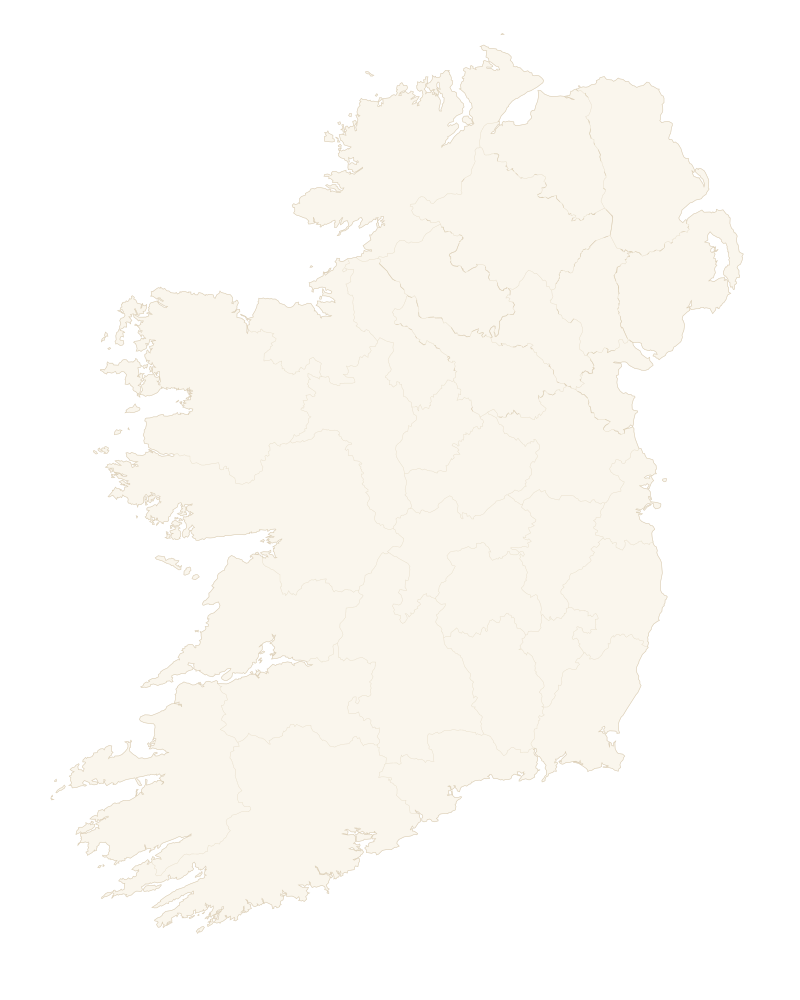
From Ó Séaghdha, descendant of Séaghdha ('hawk-like' or 'stately'). The Ó Séaghdha were the principal sept of Iveragh, the great peninsula of south Kerry running from Killorglin to Cahersiveen and Valentia Island. Their stronghold was at Ballycarbery Castle on the Cahersiveen coast, in continuous Ó Séaghdha possession from the 13th century to the Cromwellian confiscation. The Anglicised O'Shea remained densely Kerry-rooted into the modern era, with secondary concentration in west Cork.
The history of O'Shea
Séaghdha, the hawk-like man of Corca Dhuibhne
The surname is Ó Séaghdha, shortened in speech to Ó Sé: descendant of Séaghdha, a personal name read as hawk-like or stately. It is a man's name, not a trade. The name did not spread the way a craft name spreads, from a forge in every parish; it spread from one ancestor in one corner of Ireland, the kingdom of Corcu Duibne in County Kerry.
The Corca Dhuibhne had two chiefly families, the O'Connells and the O'Sheas. C. Thomas Cairney assigned that tribe to the Erainn, a wave of Celtic settlers dated to between 500 and 100 BC, following T. F. O'Rahilly's account of Celtic invasions of Ireland; that account, drawn from the eleventh-century Lebor Gabála Érenn, was rejected outright by Francis John Byrne. A genetic study of the Irish genealogies found them fairly accurate back to the Middle Ages and unreliable before the seventh century. The deep pedigree is poetry; the medieval record puts the Ó Séaghdha in south Kerry, in charge of a coastline.
The lordship of Iveragh and the castle at Cahersiveen
Iveragh is the great peninsula of south Kerry, running from Killorglin out to Cahersiveen and Valentia Island, and the Ó Séaghdha were its principal sept. They held it from the thirteenth century to the Tudor era under the MacCarthy Mór kings of Desmond.
The chiefly seat was Ballycarbery Castle on the Cahersiveen coast, in continuous Ó Séaghdha possession from the thirteenth century until the Cromwellian confiscation; a smaller fortress stood at Castlecove, with the family lands running between them. Gaelic Ireland was divided into as many as 150 small units called túatha, whose names survive in the Irish baronies, each under a petty king who owed allegiance to an over-king of three or more túatha. The Ó Séaghdha ran a particular stretch of Atlantic coast, and they ran it for four hundred years.
Chief by election, not by birth
The Ó Séaghdha chief was not simply the eldest son of the last one. Under Brehon law an Irish chief was appointed by his kinsmen as custodian of the clan, responsible for maintaining and protecting its people and its property, and succession went by tanistry: the next chief was elected from the agnatic cousins descended from a shared grandfather or great-grandfather. Eoin MacNeill held that tanistry proper arrived only with Norman feudalism, preceded by a similar system called Rigdomna; Gearóid Mac Niocaill thought the two synonymous.
An Irish clan, a fine, was also wider than its bloodline: it took in unrelated clients who assumed the name of the leading lineage as a show of allegiance and whose descendants stayed ineligible for election as chief. The pedigrees, the Book of Ballymote and Dubhaltach MacFhirbisigh's Leabhar Mór na nGenealach among them, record the descent of chiefs and not of every man who carried the name.
1541 to 1607, and the paperwork that ended a lordship
The Kingdom of Ireland was created in 1541 and the Dublin administration set about drawing the Gaelic chiefs inside it, inventing titles such as Baron Upper Ossory and Baron Inchiquin and granting new coats of arms in 1552. The instrument was surrender and regrant: a chief handed his lands to the crown and took them back on English terms, succession by primogeniture instead of by the election of cousins. The Ó Séaghdha lands of Iveragh went through that surrender and regrant under Henry VIII in 1543.
The rest came as policy rather than as battle. English common law was introduced throughout Ireland across the sixteenth century, and the county and the sheriff replaced the country and the clan chief. The Tudor reconquest broke the old Gaelic aristocracy; in 1607 the senior Ulster chiefs left to recruit support in Spain, failed, and remained in Rome for the rest of their lives. Ballycarbery and the Iveragh estates were lost in the Cromwellian settlement. The people were not: every census since has found the name densely planted on the same peninsula, with a second concentration in west Cork.
How Ó Sé became O'Shea
Surnames are documented in England from the eleventh century, and Ireland was among the first countries in Europe to take them up: they began during the century of declining Uí Néill dominance, after Brian Boru of the Dál gCais took the high kingship from that dynasty in 1002. Séaghdha's descendants carried a hereditary name for a long time before any English clerk had to write it down.
When one did, two things could happen, and both happened here. In anglicising Gaelic names the prefixes Mac, Nic and Ó were frequently dropped, so that Ó Fathaigh came out as Fahey and Ó Ceallaigh as Kelly; where the prefix survived, Ó became O'. Shea and O'Shea are the same family in two registers. Irish also inflects the name by gender, which English flattens: Ó means descendant, a daughter takes Ní and a wife who adopts her husband's name takes Bean Uí or simply Uí, so the daughter of Seán Ó Dónaill is Ní Dhónaill. One household held three grammatical forms of one surname, and the English register recorded a single spelling for all of them.
Carvers, actors, and the name that crossed the water
The Kerry O'Shea diaspora is heaviest in the Catholic Irish communities of New York and Boston, which is why the name is commoner abroad than one peninsula could account for. A myth is worth killing on the way: no name was ever legally changed at Ellis Island, and immigrants almost always altered their surnames at their own discretion. An O'Shea who became a Shea in America chose it.
James O'Shea and John O'Shea were Victorian stone carvers whose work is associated with John Ruskin, which puts the name into the stonework of nineteenth-century building and not merely into its registers. Milo O'Shea (1926-2013), the Dublin-born actor, played opposite Vanessa Redgrave in Ulysses in 1967 and the Pope in The Verdict in 1982. Tessie O'Shea (1913-1995), born in Cardiff, was 'Two-Ton Tessa' of the British music halls.
John O'Shea, born in 1944, founded GOAL, the international humanitarian organisation based in Ireland; Timothy O'Shea, born in 1949, served as vice-chancellor and principal of the University of Edinburgh. Others carried the name well clear of Kerry: Donal O'Shea the Canadian mathematician, Lucius Trant O'Shea (1858-1920) the British chemist and mining engineer, and Paloma O'Shea, born in 1936, the Spanish pianist who is 1st Marchioness of O'Shea.
The All-Ireland winner and the Waterford defender
The name came back to the front of Irish life through sport, and first in the county it came from. Jack O'Shea, born in 1957, is an All-Ireland winning Gaelic footballer from County Kerry; Seán O'Shea, born in 1998, is an Irish Gaelic footballer; Conor O'Shea, born in 1970, is an Irish rugby player and coach.
The most decorated is John Francis O'Shea, born at Waterford on 30 April 1981, son of a Waterford construction worker. Schooled at De La Salle College, he was picked out at fifteen at a Manchester United trial at the Waterford Regional Sports Centre by the scout Joe Corcoran, signed for the United academy in November 1996, and came up through the FA Youth Cup-winning side of 1999 alongside Wes Brown and Phil Neville. He debuted on 13 October 1999 at Aston Villa in the League Cup and broke into the side in 2002-03 under Sir Alex Ferguson as a defender who could play centre-half, either full-back position and defensive midfield.
He held that place for nine years and made 393 competitive appearances. His honours run to five Premier League titles (2002-03, 2006-07, 2007-08, 2008-09, 2010-11), the FA Cup of 2004, three League Cups, four Community Shields, the FIFA Club World Cup of 2008 and the UEFA Champions League of the same year: the all-English final at the Luzhniki Stadium in Moscow that went to penalties after extra time, with O'Shea on the field throughout. He joined Sunderland in August 2011 and captained it from 2014 to 2017.
He won 118 caps for the Republic of Ireland between 2001 and 2018, the joint third-most in the history of the national team behind only Robbie Keane and Shay Given. He joined the senior international coaching staff under Stephen Kenny in 2020 and was appointed interim Republic of Ireland manager in January 2024.
Champions of the O'Shea name
The bearers whose lives are inseparable from this surname. Each has their own page, biography, achievements, geography, connection to the family.
Historic Places, Rebuilt
Explore the streets and seats the O'Shea name knew, rebuilt with AI as they stood in history.
The castles of the homeland
The great strongholds of the homeland, look one up, see what it looked like in its prime, and recreate it to explore.
 Ashford Castle, County MayoRestored · prime 1880
 Manderley CastleRestored · prime 1840
 Dublin CastleRestored · prime 1790
All castles in Ireland → · Strongest castles in Ireland → · Castles of Europe
Play As Your Clan
Hold a real castle against whatever you choose to send at it, take a ship out in her own service years, or stand at the shoulder of someone the record remembers. The chronicler sets the scene; the deeds are yours.
Notable bearers of the O'Shea name
- Katharine O'Shea (1846–1921), partner and later wife of Charles Stewart Parnell
- Milo O'Shea (1926–2013), actor (Ulysses, The Verdict)
- Tessa O'Shea (1913–1995), Welsh singer and entertainer
Stories of O'Shea
Frequently asked
What does the surname O'Shea mean?
Where does the O'Shea family come from?
Where did the O'Shea family historically hold territory?
Is O'Shea Irish or Scottish?
How old is the O'Shea surname?
What is the O'Shea family known for?
Is there a O'Shea family crest or coat of arms?
Who is the most famous O'Shea?
Who are some famous O'Sheas?
What stories are told about the O'Shea family?
What is the story of Kitty O'Shea and the Parnell divorce?
Is Shea the same family as O'Shea?
Is Ó Séaghdha the same family as O'Shea?
Where is the O'Shea surname found today?
What does the Clan Rising page for the O'Shea family cover?
Who is the head of the O'Shea family today?
Neighbouring clans
- McCarthyOf Desmond and Cashel, the line of the Eóganachta.
- FitzGeraldHibernis ipsis Hiberniores, the Geraldines of Kildare and Desmond.
- O'SullivanThe third most common Irish surname, and the family of Donal Cam's march.
- O'ConnellThe family of Daniel O'Connell, The Liberator, and the most influential Catholic of 19th-century Britain.