Collins
also Ó Coileáin, Ó Cuilleáin
The man who beat the Empire, and the family of west Cork.
- Origin
- Munster, Ireland
- Famous bearer
- Michael Collins (1890–1922), IRA director of intelligence, Treaty signatory, Free State leader
- Register
- Irish family
Where the Collins name comes from
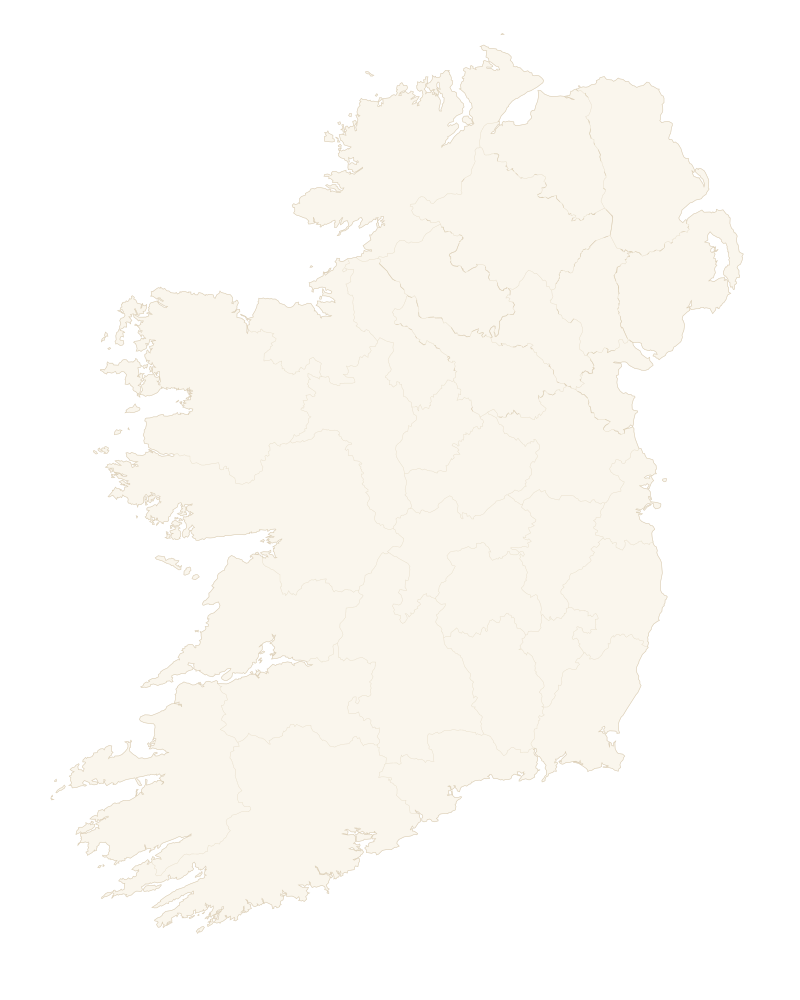
CoreHistoric reach
The seat of Collins
Seat vacantChief
No one leads the Collins community yet. When the movement opens, you can stand for its leadership, or help elect whoever does.
Current mission
No shared goal set yet. Once Collins has leadership, it sets the public focus: a restoration, a gathering, a real-world project that helps its own.
The Collins clan is being rebuilt. Join the waiting list for the movement today, and you help decide who leads it and what it does.
Help rebuild the Collins clan →What does the Collins name mean?
From Ó Coileáin (or Ó Cuilleáin), descendant of Coileán ('whelp', 'young hound'). The Ó Coileáin were a noble Munster sept who ruled the territory of Uí Conaill Gabhra in west Limerick until pushed south into west Cork by Anglo-Norman expansion in the 13th century. From Cork the surname spread densely through the Munster south-west; today Cork and Limerick remain the densest counties for Collins on the island. Some English Collins lines are independently of English origin (a diminutive of Nicholas), but Irish Collins overwhelmingly traces to Ó Coileáin.
The history of Collins
Two families, one spelling
Collins is one of the commonest surnames in Ireland, ranked number thirty on the island, and it reached that position by two separate routes that happen to end in the same six letters. The larger by far is Gaelic: Ó Coileáin, also written Ó Cuilleáin, the name of a Munster sept pressed into English spelling. The smaller is English and entirely independent, a diminutive of Coll or Colin, itself a pet form of the Greek name Nicholas. Neither line borrowed from the other. They are two different names that collided in the English alphabet.
The reference works do not agree even on that much. Alongside the Ó Coileáin derivation and the Colin diminutive, the surname has been traced to the Irish cuilein, meaning 'darling'; to the Welsh collen, a grove of hazel trees; and to the French colline, a hill, with 'victory-people' and 'puppy' also offered. What is not in doubt is the English documentary trail, and it is old. One Colinus de Andresia appears in the pipe rolls of Berkshire in 1191, and a Colinus is entered in Hartopp's Register of the Freemen of Leicester in 1196. Those are twelfth-century English Colins, not Irish Coileáns.
For a reader working out which line is theirs, geography is the strongest single clue. Irish Collins is overwhelmingly Ó Coileáin, and Cork and Limerick remain the densest counties for the name on the island. A Collins family that came out of west Cork, Kerry or west Limerick is almost certainly Gaelic in origin. A Collins family with an unbroken English parish record and no Irish crossing behind it is likely the Nicholas line. Both histories that follow are real. Only one of them is yours.
Coileán, the young hound
The Gaelic name means what it says. Coileán is a whelp, a young hound, and Ó Coileáin is 'descendant of Coileán', the Ó being not a decoration but a working word, historically Ua, meaning descendant, exactly as Mac means son. A Gaelic surname of this kind is a sentence about ancestry rather than a label.
The system around it was more precise than the English one that replaced it. A man was Ó Coileáin; his daughter took Ní, the reduction of Iníon Uí, 'descendant's daughter', with the following name lenited, so that a daughter of the house was Ní Choileáin; a woman who married into it could take Bean Uí, 'descendant's wife', or simply Uí. Where Ireland still speaks Irish, an older layer survives on top of that: a man is known by his own name followed by his father's and grandfather's in the genitive, so neighbours can tell two men of the same surname apart without knowing whether they are kin at all.
Ireland fixed its surnames early. They began to come into use during the century of declining Uí Néill dominance, after the Dalcassian Brian Boru took the high kingship in 1002, which puts Ireland among the first countries in Europe to adopt hereditary family names at all. Surnames only came into general use in western Europe in the eleventh century, and most English families had not settled theirs until around 1400. A Collins descended from Ó Coileáin carries one of the older continuously inherited surnames on the continent.
What a sept actually was
An Irish clan, fine in Irish, was the chief and his patrilineal relatives, but it was never only them. Unrelated clients of the chief lived under his protection and took his name as a show of allegiance, and their descendants kept it. Those families could never be elected chief, but they were Collinses in every sense that mattered locally and their descendants are Collinses today. This is worth saying plainly to anyone tracing the name: bearing it does not prove blood descent from a chief, and it never did. It proves your people stood with that house.
What the sept's own descent looked like was written down. From the eighth century onward Irish genealogical collections traced these kinship groups: the genealogies in Rawlinson B 502, the Book of Ballymote, the Book of Lecan, the Leabhar Mór na nGenealach compiled by Dubhaltach MacFhirbisigh, and the Ó Cléirigh Book of Genealogies. They record the agnatic descent of chiefs and chieftains rather than of every member, and genetic study suggests they are broadly accurate back into the Middle Ages but unreliable before the seventh century. Treat the deep end of any Collins pedigree as tradition rather than record.
In those genealogies the family sits in Munster, among the tribes reckoned to descend from the Erainn. The chiefly families of the Uí Fidgenti of west Limerick are listed as the O'Cullanes, O'Kinneallys, O'Donovans and MacEnerys, and O'Cullane is one of the anglicised spellings this same Limerick name took. The identification is traditional, and it belongs to the body of material the scholars themselves caution about, so read it as tradition.
Uí Conaill Gabhra and the road south
By the late Middle Ages the Ó Coileáin lordship of Uí Conaill Gabhra was not a family holding but a distinct kingdom in Munster, anchored at Glenmore in west Limerick. Ireland at that period was divided into small territories, each with its own ruler owing allegiance upward to an over-king and, above him, to a provincial king. Succession ran by tanistry: when a chief died, the next was elected from among the agnatic cousins descended from a shared grandfather or great-grandfather. It produced fighting men rather than infants on thrones, and it was one of the first things English administration set out to abolish.
The kingdom did not survive the Normans. The FitzGerald advance after 1200 pushed the family south over the Mullaghareirk Mountains, out of Limerick and into west Cork, where they re-established themselves at Inchiquin. That displacement is the single most important fact in the surname's geography. The Cork base became permanent, the name spread densely through the Munster south-west from there, and the Collins diaspora scattered across America, Australia and New Zealand is overwhelmingly west-Cork-rooted. When a Collins in Boston or Ballarat traces the line back, it very often stops in the country between Clonakilty and the Kerry border.
Surrender, regrant, and the losing of it
In the sixteenth century English common law was extended across Ireland with a centralised royal administration behind it, and the county and the sheriff replaced the country and the clan chief. When the Kingdom of Ireland was created in 1541 the Dublin administration set out to draw Gaelic chiefs into the new order, granting them new titles and, in 1552, new coats of arms. The policy of surrender and regrant was the mechanism: a chief handed his lands to the crown and received them back under English law, with succession switched from tanistry to primogeniture. It looked like security. It was the quiet end of the Gaelic system, because it made a lordship a piece of property the crown could grant and the crown could take.
The family took that bargain in 1542, and stayed a notable Catholic Old Irish line through the sixteenth and seventeenth centuries. The early seventeenth century was the watershed for every house like theirs. The Tudor reconquest destroyed the old Gaelic aristocracy, the senior Ulster chiefs left the country in 1607 and never returned, and for the first time English authority in Dublin held the whole island and had disarmed the native lordships.
The land went in stages after that. The Cromwellian settlement stripped the family of holdings; some were recovered under James II; and the Williamite confiscation that followed extinguished the title outright. What survived the confiscations was not the lordship but the people and the name, which is why the story of Collins from that point is a story of ordinary Cork families rather than of a titled house.
How Ó Coileáin became Collins
Almost every Gaelic surname in Ireland, Scotland and the Isle of Man was anglicised at some point, and the commonest change was the crudest: the prefix was simply removed. Where Mac survived it became Mc or M'; where Ó survived it became O'. Very often neither survived, and the descendant-word at the heart of the name vanished, leaving no trace of the original Ó. That is what happened here. Ó Coileáin lost its Ó and its Gaelic spelling in one step and came out looking like an English name.
The process also flattened distinctions. Ó Ceallaigh and Ó Cadhla, two separate names, both became Kelly. Ó Leannáin and Ó Lionáin both became Lennon. Ó Fathaigh went to Fahey or Fay. English clerks wrote what they heard, and unrelated Gaelic lineages landed on the same English spelling and stayed there. Collins is a case of the same collapse working across languages instead of within one: an Irish sept name and an English pet form of Nicholas were pushed into a single word, and their descendants now share a surname and nothing else.
One myth is worth killing for the American branches. Names were not legally changed at Ellis Island. No official there had the power to do it, and the spelling shifts that show up in nineteenth- and twentieth-century immigrant families were made by the families themselves, at their own discretion, for their own reasons: to be readable, to be pronounceable, to get work. If your Collins line changed shape on crossing, an ancestor decided that. It was not done to them by a clerk.
The man who beat the Empire
Michael Collins was born in 1890 at Sam's Cross outside Clonakilty, in exactly the west Cork country the sept had been driven into seven centuries earlier. As director of intelligence for the IRA during the Irish War of Independence he did something no Irish leader had managed before: he attacked the British administration not in the field but in its own files. He ran a network of clerks inside Dublin Castle, so that the machinery of government was reporting to him almost as fast as it reported to itself, and his unit, the Squad, removed the men who might have unpicked it, most notoriously in the Cairo Gang assassinations of 21 November 1920.
It worked, and it brought the British to the table. Collins was the chief negotiator of the Anglo-Irish Treaty signed in December 1921, and he signed it knowing what it would cost him: it split the movement he had built down the middle. He led the Free State forces in the civil war that followed, against men who had been his own, and he was killed in an ambush at Béal na mBláth in his native west Cork on 22 August 1922, two months short of his thirty-second birthday.
The homestead at Sam's Cross is preserved as a national monument. For most people who carry this surname anywhere in the world, he is the reason they have heard of it, and the fact that he came out of the same few parishes the family was pushed into after 1200 is not coincidence but the shape of the whole story.
The name carried out
The English line produced writers early and kept producing them. Anthony Collins (1676–1729) was a philosopher; Arthur Collins (1682–1760) a genealogist and historian; William Collins (1721–1759) was a poet; and Wilkie Collins (1824–1889) was one of the defining British writers of the Victorian age. In Scotland, William Collins (1789–1853) founded the Collins publishing house, and the surname has been on book spines ever since; William Collins (1817–1895) became a Scottish temperance campaigner and Lord Provost.
The Irish line stayed close to Munster and to public life. Michael Collins (1771–1832) was Roman Catholic Bishop of Cloyne and Ross, the diocese covering the family's own Cork country. Seán Collins (1918–1975) sat as a Fine Gael TD for Cork from 1948 to 1957 and again from 1961 to 1969, and Gerry Collins, born 1938, served as a Fianna Fáil politician. Steve Collins, born 1964, was an Irish boxer, and the name recurs steadily in the Gaelic games (the hurlers Paddy Collins (1903–1995), Michael Collins (1941–2009) and David Collins, born 1984, and a Kerry dual player who died in 2008), which is its own kind of continuity.
The twentieth-century diaspora carried it further than any lordship reached. Michael Collins (1930–2021), an American astronaut, was a member of the Apollo 11 crew. Eileen Collins, born 1956, became the first woman to pilot a Space Shuttle, on STS-63, and the first to command one, on STS-93. Joan Collins, born 1933, and Jackie Collins (1937–2015) made the name a fixture of screen and paperback, and Phil Collins, born 1951, the English drummer, singer and songwriter, carried it into popular music. Between the pipe rolls of 1191 and the flight deck of a Space Shuttle, the name has had a longer run than most.
Champions of the Collins name
The bearers whose lives are inseparable from this surname. Each has their own page, biography, achievements, geography, connection to the family.
Historic Places, Rebuilt
Explore the streets and seats the Collins name knew, rebuilt with AI as they stood in history.
The castles of the homeland
The great strongholds of the homeland, look one up, see what it looked like in its prime, and recreate it to explore.
 Ashford Castle, County MayoRestored · prime 1880
 Manderley CastleRestored · prime 1840
 Dublin CastleRestored · prime 1790
All castles in Ireland → · Strongest castles in Ireland → · Castles of Europe
Play As Your Clan
Hold a real castle against whatever you choose to send at it, take a ship out in her own service years, or stand at the shoulder of someone the record remembers. The chronicler sets the scene; the deeds are yours.
Notable bearers of the Collins name
- Michael Collins (1890–1922), IRA director of intelligence, Treaty signatory, Free State leader
- Joan Collins (b. 1933), actress (Dynasty)
- Jackie Collins (1937–2015), novelist
- Eileen Collins (b. 1956), astronaut, first woman to command a Space Shuttle mission
Stories of Collins
Béal na mBláth
1922On the afternoon of the twenty-second of August 1922, eight months after the signing of the Anglo-Irish Treaty in London, with the Civil War running into its eleventh week and the anti-Treaty IRA reduced to flying-column operations across south Munster, Michael Collins, Commander-in-Chief of the National Army of the Provisional Government, drove west into his native County Cork on a tour of inspection that the local commanders had counselled him not to make. He had attended the funeral of Arthur Griffith four days earlier in Dublin. He was thirty-one years old. He had told the friends who tried to dissuade him that he would not be shot in his own county. The convoy of an armoured car, a Crossley tender of soldiers, the Leyland touring-car and a motorcycle scout was ambushed at the bend of the road at Béal na mBláth, three miles west of Bandon, at twenty minutes past eight in the evening on the way back to Cork city. Collins was hit in the back of the head by a single rifle bullet from the high ground above the road, fired by a man at long range, and was dead at the scene within five minutes. The remaining ambushers withdrew within twenty. He was the only fatality of the action.
Read the story →
The Treaty signature
1921On the morning of the sixth of December 1921, at twenty past two in the morning, in the Cabinet Room at 10 Downing Street, after eight weeks of formal Anglo-Irish Treaty negotiations and a final twenty-four-hour stretch in which the British Prime Minister David Lloyd George had presented Michael Collins, Arthur Griffith and three other Irish plenipotentiaries with the now-celebrated ultimatum of immediate and terrible war if a settlement was not reached by midnight, the Articles of Agreement for a Treaty between Great Britain and Ireland were signed by Lloyd George, Austen Chamberlain, Lord Birkenhead and Winston Churchill on the British side and by Griffith, Collins, Robert Barton, Eamonn Duggan and George Gavan Duffy on the Irish side. Collins, by his own letter written from Hans Place to his fiancée Kitty Kiernan in the hours of the morning afterwards, signed his own death warrant. He was thirty-one years old. The settlement granted Ireland dominion status on the model of Canada, with the partition of the six north-east counties as Northern Ireland under a separate parliament, and required an oath of allegiance from Irish parliamentarians to the Crown. The Treaty was ratified by the Dáil on the seventh of January 1922 by sixty-four votes to fifty-seven. The Civil War broke out in June. Collins was killed in eight months and twenty-six days.
Read the story →