Mahony
also O'Mahony, Mahoney, Ó Mathghamhna
Sons of the bear, lords of the Mizen Head.
- Origin
- Munster, Ireland
- Motto
- Lasair Romham Abú
- Famous bearer
- Father Prout / Francis Sylvester Mahony (1804–1866), priest, poet ('Bells of Shandon')
- Register
- Irish family
Where the Mahony name comes from
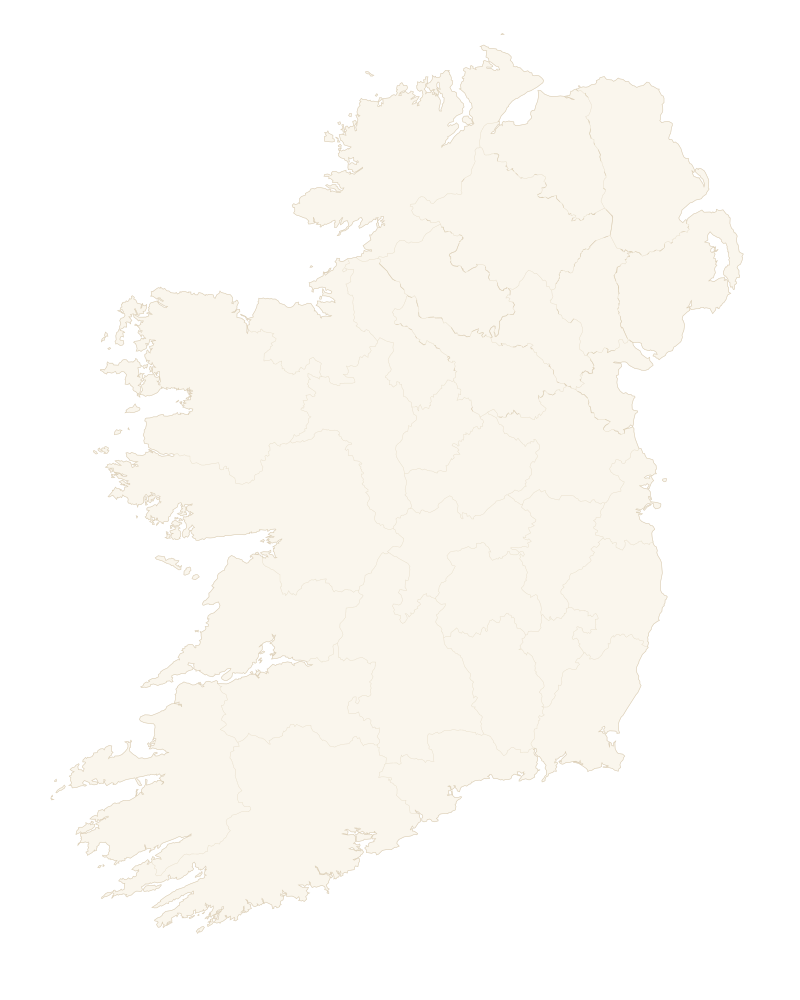
CoreHistoric reach
The seat of Mahony
Seat vacantChief
No one leads the Mahony community yet. When the movement opens, you can stand for its leadership, or help elect whoever does.
Current mission
No shared goal set yet. Once Mahony has leadership, it sets the public focus: a restoration, a gathering, a real-world project that helps its own.
The Mahony clan is being rebuilt. Join the waiting list for the movement today, and you help decide who leads it and what it does.
Help rebuild the Mahony clan →Motto
Lasair Romham Abú
“A flame before me to victory”
What does the Mahony name mean?
From Ó Mathghamhna, descendant of Mathghamhain ('bear'). The Ó Mathghamhna were a Eóganacht sept of west Cork, distinct from but cousin to the Ó Ceallacháin. Their lordship of Fonn Iartharach ('the western land') ran from Bantry along the south-west Cork coast to the Mizen Head; their stronghold at Ardintenant Castle on Cape Clear Island, and at Dunbeacon and Dunmanus on the mainland, dominated the south-west coast through the late mediaeval period. The Anglicisations Mahony (Irish-modern) and Mahoney (American) are the same name.
The history of Mahony
Mathghamhain means bear, and the sons of the bear took the sea
The name is Ó Mathghamhna, descendant of Mathghamhain, and Mathghamhain means bear. The sept belonged to the Eóganacht of Munster and was cousin to the Ó Ceallacháin; in the old divisions of the province the Uí Eachach Mumhan counted the O'Mahonys among its chief families alongside the O'Donoghues and the O'Callaghans. The motto, Lasair Romham Abú, a flame before me to victory, belongs to a family that took its ground at the far end of the country and held it.
That ground was Fonn Iartharach, the western land, running from Bantry out along the south-west Cork coast to the Mizen Head. It was a lordship of headlands, inlets and islands rather than of ploughland, and the sea was the greater part of its wealth. Two spellings carry it into the modern world: Mahony, the form that stayed in Ireland, and Mahoney, the form that went to America. They are one name.
Donagh the Migrator and the three keeps above the Atlantic
Dunlough Castle stands at the northern tip of the Mizen peninsula, on the cliffs at the extreme south-west point of Ireland with nothing beyond it but the Atlantic. Donagh O'Mahony, called the Migrator, founded it in 1207, leading his people out to the furthest point of the peninsula as the Normans took hold of southern Ireland. It is one of the oldest castles in the country, dry stone masonry built to a Norman pattern.
The plan is unusual. Three rectangular keeps, each of three storeys and each of a different design, are strung along a low curtain wall thrown across the isthmus between the cliffs and a man-made lake dammed at its eastern shore. The largest, the western tower, was most likely where the family lived; the eastern one, with its spiral stair, was probably the gate; the central keep was there to stiffen the wall between them.
No army is recorded as having attacked it, and it is not known whether any ever tried. The O'Mahonys held Dunlough for four hundred years, until the crown confiscated it in 1627. Its plain rectangular towers set the pattern for the later castles standing along both shores of the Mizen, many of them O'Mahony keeps, unornamented and built for the same work.
Pilchards, and the fishing rights from the Mizen to Skibbereen
The lordship's income came out of the water. The Ó Mathghamhna of Fonn Iartharach held hereditary control of the fishing rights from the Mizen Head east to Skibbereen, and the Cork pilchard fishery was for two centuries the principal economic activity of the whole south-west. A coast of small harbours and offshore shoals was worth more to this family than good land further inland would have been.
The castles follow the money. Ardintenant, Dunbeacon and Dunmanus: strongholds set where boats could be watched and sheltered, dominating the south-west coast through the late mediaeval period. Holding the shore meant holding the catch, and the Mahonys stood at the head of a sea trade rather than at the head of a plough-land estate.
The lordship broken, and the road to Spain
The seventeenth century took it all. The Cromwellian settlement broke the lordship of Fonn Iartharach, and many of the ruling Mahonys left for the continent with the Wild Geese, into the Irish service of Spain and France.
Daniel O'Mahony, count of Castile, distinguished himself in the War of the Spanish Succession, and the line he founded survives among the Spanish nobility today. It is one of the more complete endings a Gaelic lordship could have: the castles confiscated, the fishing rights gone, and the name continuing in another kingdom's peerage.
Clonkilla, Ballingarry, and a scholar's escape to Paris
John O'Mahony was born on 12 April 1815 at Clonkilla House, Kilbeheny, in the Galtee mountain country of east County Limerick, son of a Catholic gentleman-farmer who had organised the parish for Catholic Emancipation. He went to the Catholic Latin school at Hospital, then Carlow College, then Trinity College Dublin, taking his BA in 1836 with the Trinity class prize in Gaelic philology and history for work on the Annals of the Four Masters.
He inherited Clonkilla at twenty-six and managed it through the early Famine years, reading the Old Irish manuscript texts then appearing in the Royal Irish Academy's publications. In 1847 he joined the Young Ireland Repeal faction, where he met Thomas Francis Meagher, John Mitchel, William Smith O'Brien and James Stephens.
The rising of 1848 at Ballingarry broke Young Ireland. O'Mahony had brought a contingent of Limerick Confederates to the Tipperary meeting-point; he got away over the mountains to the Wexford coast, took a Welsh fishing boat to Cardigan Bay and a packet on to Paris, and spent ten years there among the post-1848 exiles, alongside Stephens and the Polish, Hungarian and Italian republican networks.
17 March 1858: the Fianna named again, in New York
O'Mahony moved to New York in 1856 and, on 17 March 1858, founded the Fenian Brotherhood with the core of Young Ireland exiles he had reassembled there. He named it for the medieval Irish Fianna warrior bands of the manuscript tradition he had been reading since Trinity, and constituted it as the diaspora counterpart of Stephens's Irish Republican Brotherhood in Dublin.
As its head centre he built it, at its peak, to about two hundred thousand subscribed members across the Irish-American working class. The scholarship never stopped: his translation of Geoffrey Keating's Foras Feasa ar Éirinn out of the Old Irish appeared in 1857 and stood as the standard English edition for a generation.
He died in New York on 7 February 1877. A public subscription brought his body home to Ireland, and he was buried in the Fenian plot at Glasnevin Cemetery in Dublin, near the graves of Parnell and Casement. He had carried a west Cork patronymic out of a Limerick farmhouse and made it the founding name of Irish-American republicanism.
Dromore above the Kenmare River, 1831–1839
Denis Mahony built new. Work on Dromore Castle began in 1831 and was finished in 1839, on a site looking out over the Kenmare River at Templenoe in County Kerry, to a neo-Gothic design by the architect Sir Thomas Deane, probably with his brother Kearns Deane assisting.
It is castellated Gothic Revival, finished in Roman cement with limestone dressings and entered through a castellated gatehouse also by Deane. A grand pointed-arch window faces south; the entrance hall runs as a long gallery taking up half the ground floor; the west wing rises as a round tower with a spiral staircase in an attached turret.
Richard Mahony's son Harold Segerson Mahony was killed in a bicycle accident in 1905 and left no heir. Dromore passed to his sister Norah Hood, then to her cousin Hugh Bolton Waller, and stayed with the Waller family until it was offered for sale in 1993. An investment company holds it now and is attempting a restoration; most of the old grounds belong to Coillte, the Irish forestry board, with the Kerry Way running through them.
Father Prout's bells, and the name in America
Francis Sylvester Mahony (1804–1866), born in Cork, was a Jesuit priest, journalist and translator who wrote as Father Prout. His verse The Bells of Shandon is one of the best loved Irish poems of the nineteenth century, and it is a Cork poem, out of the county the sept came from.
The Mahoney spelling went to America and stayed audible there. John Mahoney (1940–2018), born in Blackpool, played Martin Crane on Frasier across all eleven seasons. Edward Joseph Mahoney (1949–2019), the Brooklyn-born rock singer of Two Tickets to Paradise, took his stage name, Eddie Money, from the family surname.
Champions of the Mahony name
The bearers whose lives are inseparable from this surname. Each has their own page, biography, achievements, geography, connection to the family.
Historic Places, Rebuilt
Explore the streets and seats the Mahony name knew, rebuilt with AI as they stood in history.
Castles the Mahony held
Strongholds this name held for a decade or more, look one up, or rebuild it to explore.
- Dunlough Castle
Founded by Donagh O'Mahony in 1207; the family held it for 400 years until confiscated by the crown in 1627.
- Dromore Castle
Built for the Mahony family in the 1830s; held until Harold Segerson Mahony died without heirs in 1905.
The castles of the homeland
The great strongholds of the homeland, look one up, see what it looked like in its prime, and recreate it to explore.
 Ashford Castle, County MayoRestored · prime 1880
 Manderley CastleRestored · prime 1840
 Dublin CastleRestored · prime 1790
All castles in Ireland → · Strongest castles in Ireland → · Castles of Europe
Play As Your Clan
Hold a real castle against whatever you choose to send at it, take a ship out in her own service years, or stand at the shoulder of someone the record remembers. The chronicler sets the scene; the deeds are yours.
Notable bearers of the Mahony name
- Father Prout / Francis Sylvester Mahony (1804–1866), priest, poet ('Bells of Shandon')
- Eddie Money / Edward Mahoney (1949–2019), American rock singer
- John Mahoney (1940–2018), actor (Frasier, Martin Crane)