
Austria · Still standing
Burg Hollenburg
Burg Hollenburg is a medieval castle perched on a rocky outcrop above the Drava valley near Köttmannsdorf in Carinthia, Austria. It occupies a long, continuous building mass with end pavilions and a terrace, and remains a visible landmark on its wooded slope.
First raised
1100
Its prime
1588
Today
Still standing
As it stood in 1588
What Burg Hollenburg looked like in its prime.
Long, low rectangular main block with two slightly projecting end pavilions under broad, grey hipped roofs; continuous ridge line and shallow roof pitches. Pale plastered stone façades punctuated by regular small rectangular windows and a few paired arched windows; a stone terrace and parapet run along the visible face. The castle sits directly on a steep rocky promontory with a stepped retaining curtain wall and dense tree cover below.
Its story
The story of Burg Hollenburg.
Swiker, Lord of Hollenburg, first appears as a witness in the 1142 foundation deed of Viktring Abbey, believed to have been a vassal of the ducal House of Sponheim; his son Reginher accompanied King Conrad III of Germany on the Second Crusade in 1147. The castle's rock on the northern slope of the Drava valley, near Köttmannsdorf in Carinthia, carried real strategic weight, it commanded a Drava river crossing and the road to the Loibl Pass and Carniola.
When the Hollenburg dynasty died out in 1246, ownership passed to the Styrian Lords of Pettau, and in 1438 the castle was inherited by the House of Stubenberg; the Friuli earthquake of 1348 had meanwhile done severe damage. In 1514 the Habsburg emperor Maximilian I, deep in debt from his war against Venice, sold Hollenburg to his son-in-law Siegmund of Dietrichstein, elevating him to the rank of Baron.
The Dietrichsteins had the castle rebuilt in Renaissance style, finished in 1588, and held it until their Hollenburg branch died out in 1861; in 1913 it was acquired by the Wittgenstein family. The long, continuous building mass with its end pavilions and terrace still stands on its rock at 561 metres above the Drava.
Step inside
6 places to explore in 1588.
The record describes 6 distinct spots at Burg Hollenburg, including the full exterior approach. Create your own photoreal reconstruction and explore every one, more scenes means more rooms, more angles, and more of the place to stand in.
Build Your Own Castle
Recreate Burg Hollenburg with AI to explore it.
The artist rebuilds it as it stood in 1588, a photoreal reconstruction that belongs to you alone. Pay with coins, no subscription needed.
Recreate this castle →Defend this castle →Whose castle
Clans who held Burg Hollenburg.
The families that held Burg Hollenburg for a decade or more across its history, follow a name to its clan.
Hollenburg
Held by the lords of Hollenburg from at least 1142 until the dynasty's extinction in 1246.
Pettau
Held by the Styrian Lords of Pettau, 1246–1438.
Stubenberg
Inherited by the House of Stubenberg in 1438; sold by Maximilian I in 1514.
Dietrichstein
Bought by Siegmund of Dietrichstein in 1514; held until the branch's extinction in 1861.
Wittgenstein
Acquired by the Wittgenstein family in 1913.
From the archive
Burg Hollenburg on paper: the measured plan and period views.
The survey plan and photographs below are the ground truth this page's reconstructions are checked against, drawn and photographed while the castle was still a working garrison. Every image is public-domain or openly licensed, with its source named.
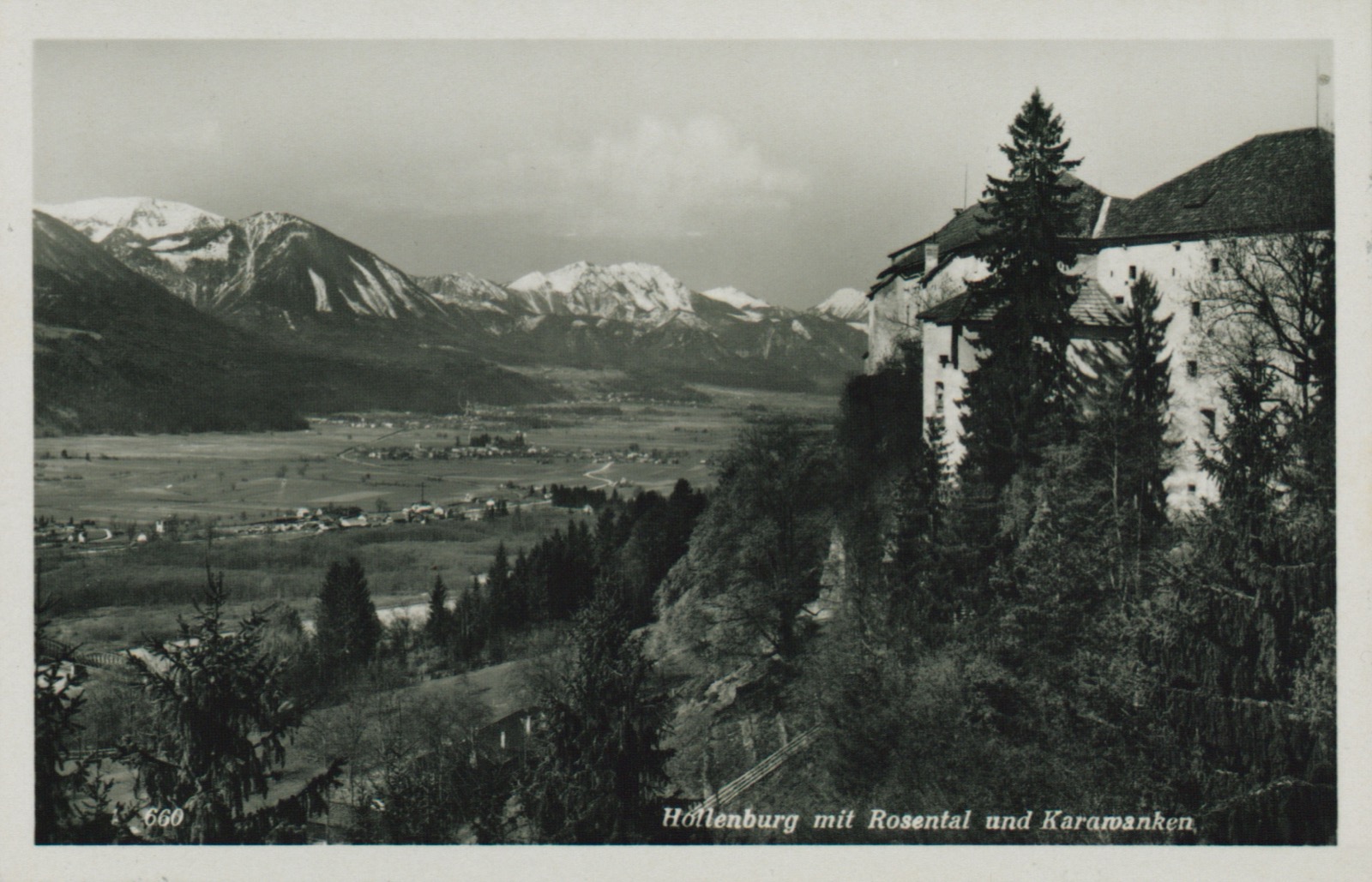
Hollenburg mit Rosental und Karawanken
· Dr Franc Sušnik's Central Library of Carinthia (via Europeana)
Public domain


