
Bosnia and Herzegovina · Partial ruin
Blagaj Fortress
Stari grad Blagaj
Blagaj Fortress (Stari grad Blagaj or Stjepan-grad) is a multi-period town-fortress complex on a high karst hill above the source of the river Buna near Blagaj, Bosnia and Herzegovina. The site contains medieval and Ottoman fortifications arranged as an irregular polygon with high curtain walls, a gatehouse, and the remains of a palace; it was a regional residence in the 14th–15th centuries and is a protected national monument.
Its prime
1423
Today
Partial ruin
As it stood in 1423
What Blagaj Fortress looked like in its prime.
Built on a flat-topped karst hill with vertical cliffs to the south, west and north, the fortress is an irregular polygon of quarry-stone curtain walls rising 12–14 m high and 1.5–2.0 m thick, pierced by a central eastern tower and a higher east gatehouse with an outer forecourt. A steep serpentine bridle path approaches from the east. Within the ramparts is a roughly rectangular palace block and compact inner courtyard; repairs show layers of opus incertum and opus spicatum masonry.
Its story
The story of Blagaj Fortress.
Illyrian Hillfort to Byzantine Frontier, Prehistory–Tenth Century
Archaeological material scattered across the slopes of the karst hill above the Buna's source points to settlement here in the prehistoric and Roman periods. Each of the hill's three summits carries its own remains: on the north-eastern summit a Roman or late-antique watch-post, known as Mala gradina, on the south-eastern summit the contours of a prehistoric hillfort, and on the south-western summit the fort later known as Stjepan grad, built up in the medieval and Ottoman periods. It is possible the site formed a twin settlement of Old Fort and Mala gradina into at least the mid-tenth century. The earliest indirect written notice of the Zahumlje forts, Blagaj among them, is the Byzantine emperor Constantine Porphyrogenitus's Treatise on Peoples, composed between 948 and 952, which names two strongholds in the district, Bona and Hum.
Miroslav's Church and the Bosnian Royal Charters, to 1404
After the tenth century Blagaj played an important role in the development of Hum. A major route linking the Adriatic to the Bosnian hinterland ran along the Neretva valley nearby. Miroslav, prince of Hum, held court at Blagaj and built a church there dedicated to Saints Cosmas and Damian; a Cyrillic-inscribed plaque recording the church's construction, found in 1912 near the ruins of the manor at Bišće, is now held in the National Museum of Bosnia and Herzegovina. By the time of King Tvrtko, Bosnian rulers were issuing charters from Blagaj.
Sandalj Hranić, Stjepan Vukčić Kosača and Ottoman Rule, 1404–1835
In May 1404 Blagaj became one of the residences of Duke Sandalj Hranić, and afterwards of herzeg Stjepan Vukčić Kosača, after whom the town named the fort Stjepan grad. The first written reference to the fortress itself is a peace accord Sandalj concluded with Venice on 1 November 1423, issued "in our town of Blagaj"; it was also named in fifteenth-century charters of Alfonso V, king of Aragon and Naples. The Ottomans took Blagaj in 1465, and a kadi of Blagaj is on record by 1473. They repaired the fort twice, restoring the west tower in 1699 and again in 1827, and kept a garrison there until 1835, by which point the fort's earlier strategic role had passed to Mostar.
Walls, Powder Blast and Protection since 2003
The largely preserved walls, 12 to 14 metres high, trace an irregular polygon above vertical cliffs to the south, west and north, reached by a 900-metre serpentine bridle path and entered through a gatehouse in the thicker eastern wall. That east wall was badly damaged in the 18th or early 19th century when a large quantity of gunpowder exploded in its middle tower; the repairs that followed were carried out crudely and altered the fort's original appearance. Excavations in 1965, directed for the National Museum of Bosnia and Herzegovina, investigated some 1,000 square metres, over a third of the walled area, recovering medieval pottery, ironwork and roughly 700 kilograms of lead from the ruined palace, alongside a scatter of Illyrian pottery and Roman roof-tile fragments. The fortress remains state property, protected since 6 December 2003 as a National Monument of Bosnia and Herzegovina.
Step inside
11 places to explore in 1423.
The record describes 11 distinct spots at Blagaj Fortress, including 2 interiors: inner courtyard and palace (palace xv), palace hall interior. Create your own photoreal reconstruction and explore every one, more scenes means more rooms, more angles, and more of the place to stand in.
Build Your Own Castle
Recreate Blagaj Fortress with AI to explore it.
The artist rebuilds it as it stood in 1423, a photoreal reconstruction that belongs to you alone. Pay with coins, no subscription needed.
Recreate this castle →Defend this castle →Whose castle
Clans who held Blagaj Fortress.
The families that held Blagaj Fortress for a decade or more across its history, follow a name to its clan.
Hranić
Blagaj became one of the residences of Duke (vojvoda) Sandalj Hranić in May 1404.
Kosača
Residence of the herzeg Stjepan Vukčić Kosača, after whom the fort was named Stjepan-grad.
From the archive
Blagaj Fortress on paper: the measured plan and period views.
The survey plan and photographs below are the ground truth this page's reconstructions are checked against, drawn and photographed while the castle was still a working garrison. Every image is public-domain or openly licensed, with its source named.
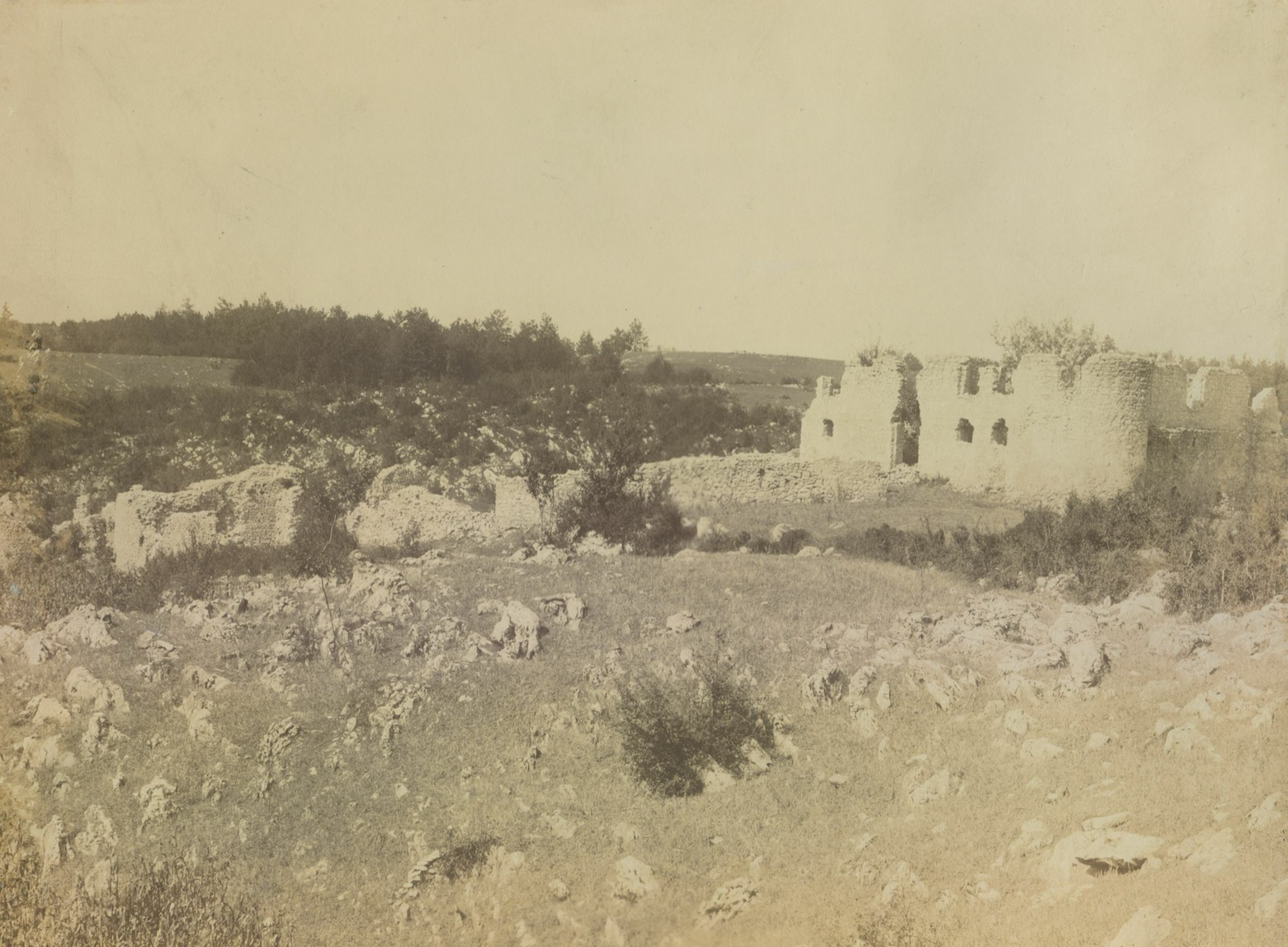
Blagaj - grad nad Koranom s istočne strane; spominje se od 1249. g. i u posjedu je Blagajskih do 1835. g., do
· Ministry of Culture and Media of the Republic of Croatia (via Europeana)
Public domain

Questions about Blagaj Fortress
What is the history of Blagaj Fortress?
What is inside Blagaj Fortress?
Who owns Blagaj Fortress now?
Why was Blagaj Fortress built, and what was it used for?
Which family or clan held Blagaj Fortress?
What did Blagaj Fortress look like in its prime?
Is Blagaj Fortress still standing, or is it a ruin?
Where is Blagaj Fortress?
More castles of Bosnia and Herzegovina


Explore the city
