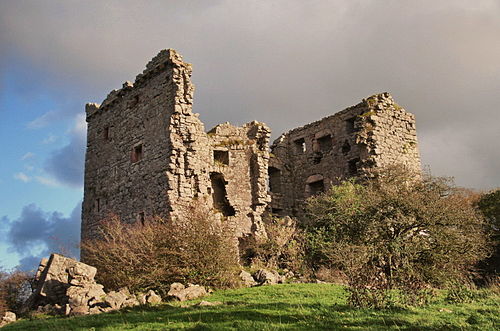
England · Restored
Caverswall Castle
Caverswall Castle is an early-17th-century mansion built within and upon the walls of a 13th-century moated castle in Caverswall, Staffordshire. The present three-storey, five-bay stone house with castellated parapets stands inside retained medieval curtain walls and towers and is a Grade I listed building.
First raised
1275
Its prime
1620
Today
Restored
As it stood in 1620
What Caverswall Castle looked like in its prime.
A rectangular, three-storey stone mansion set within surviving medieval curtain walls and a surrounding moat; the house presents five bays of closely spaced, stone-mullioned-and-transomed windows across a flat main façade, an elevated central entrance porch, tall chimneys and a low castellated parapet. The older defensive fabric remains evident: squared and round angle towers rising from the curtain walls, arched bridge crossing the moat and stone ashlar facing of the bridge piers and towers, with parkland trees beyond.
Its story
The story of Caverswall Castle.
Licence to Crenellate, 1275, and Decay by 1600
The manor of Caverswall was held in ancient times by the family of the same name, and in 1275 the family were granted licence to crenellate their manor house, the work commissioned by William de Caverswall. What went up was a moated medieval castle, roughly rectangular in plan, with four angle towers and a keep inside the curtain walls.
In the fifteenth century the castle, still owned by the Caverswalls, became the seat of the Montgomery family, three of whom served as High Sheriff of Staffordshire. By the end of the sixteenth century it was much decayed and neglected.
Matthew Cradock Rebuilds Within the Walls, from 1615
Matthew Cradock of Stafford, a wool merchant who had been the town's first mayor in 1614 and was to sit as its Member of Parliament in 1621, bought Caverswall in 1615 and rebuilt it. The mansion he raised (three storeys, five bays, a castellated parapet) is said to have been designed by Robert Smythson or by John Smythson, and it was set on the foundations and within the walls of the thirteenth-century castle, whose old walling was kept.
A Parliamentary Garrison, and the End of the Cradocks in 1655
During the English Civil War the castle was garrisoned by parliamentary forces. When the Cradock male line failed the estate was sold in 1655 to William Joliffe, High Sheriff of Staffordshire for 1663, but the eventual heir, William Vane, 2nd Viscount Vane, was forced to sell. Several owners followed.
Benedictines, Wedgwoods and the Bowers Restoration, 1811–1933
In 1811 the castle was occupied as a nunnery by a Benedictine order, which sold it in 1853 to Sir Perceval Radcliffe and relocated to Oulton Abbey. The Wedgwood family rented it in the 1880s. W. E. Bowers bought it in 1891 and carried out extensive renovations that much improved the property; W. A. Bowers sold it in 1933 to the Sisters of the Holy Ghost.
Convents, Enforcement Notices and the Sale of April 2021
The Sisters of the Holy Ghost sold Caverswall in 1965 to another convent, the Daughters of the House of Mary; when they left in 1977 the castle was sold in various lots. It had been listed Grade I on 2 May 1953. From the late 1970s onwards numerous planning applications for commercial uses were submitted, and all were refused.
Property tycoon Robin MacDonald bought the castle in 2006 for £1.7 million and spent £1 million renovating it. In 2013 the owner was prosecuted for allowing some holiday-letting use, fined £17,000 and ordered to pay £100,000 in costs. Enforcement notices prohibited a range of uses, among them "events, activity days, parties, photography & romantic breaks", and the local authority refused on several occasions to remove them. In October 2020 the planning department turned down two further applications, one for use as a small-scale hotel, the other for photography and for visits by groups such as schools and historic-interest societies.
The castle was offered for sale with Sotheby's at £3 million in February 2015 and with Leading Estates at £5 million in 2016, and had been on the market again since September 2019. It sold in April 2021 for an undisclosed sum.
Step inside
8 places to explore in 1620.
The record describes 8 distinct spots at Caverswall Castle, including the full exterior approach. Create your own photoreal reconstruction and explore every one, more scenes means more rooms, more angles, and more of the place to stand in.
Build Your Own Castle
Recreate Caverswall Castle with AI to explore it.
The artist rebuilds it as it stood in 1620, a photoreal reconstruction that belongs to you alone. Pay with coins, no subscription needed.
Recreate this castle →Defend this castle →Whose castle
Clans who held Caverswall Castle.
The families that held Caverswall Castle for a decade or more across its history, follow a name to its clan.
Caverswall
Held the manor of Caverswall in ancient times; granted licence to crenellate their manor house in 1275.
Montgomery
Seat of the Montgomery family in the 15th century; three of them served as High Sheriff of Staffordshire.
Cradock
Held Caverswall until the male line failed and the estate was sold in 1655.
Nearby