Clan Rising
Château de Jumilhac today

France · Restored

Château de Jumilhac

The Château de Jumilhac is a modified castle in Jumilhac-le-Grand, Dordogne, France, built across the 15th to 17th centuries. The composition is a 15th-century central castle with two long wings added in the reign of Louis XIV, linked by arcaded walls to form a near-rectangular court; the site includes a terraced lawn, an orangery and surrounding parkland and is privately owned but open to the public.

Photograph via Wikimedia Commons

Its prime

1700

Today

Restored

As it stood in 1700

What Château de Jumilhac looked like in its prime.

A broad frontal composition: a low stone curtain wall with a central arched entrance gives onto a rectangular court flanked by two long 17th-century wings; beyond rises the older central block with a cluster of round towers and many steep, slate-covered, conical and pyramidal roofs. Walls are warm honey-coloured limestone with corbelled stonework and regular vertical window openings; the rear faces onto a terraced lawn and an orangery within parkland.

Its story

The story of Château de Jumilhac.

The Château de Jumilhac, in the commune of Jumilhac-le-Grand in the Dordogne, was built across the 15th to 17th centuries. A 15th-century central castle forms the core, with two long wings added in the reign of Louis XIV, linked by arcaded walls to enclose a near-rectangular court.

The grounds include a terraced lawn, an orangery and surrounding parkland. The castle and gardens are privately owned but open to the public.

Step inside

9 places to explore in 1700.

The record describes 9 distinct spots at Château de Jumilhac, including 1 interior: covered porch linking wing and arcaded wall. Create your own photoreal reconstruction and explore every one, more scenes means more rooms, more angles, and more of the place to stand in.

Frontal approach across the forecourtCentral arched gate in the curtain wallRectangular court of honourCovered porch linking wing and arcaded wallArcaded walls between the wingsLeft wing exterior façadeCentral block, towers and rooflineTerraced lawn and orangery (rear)View from the surrounding parkland

Build Your Own Castle

Recreate Château de Jumilhac with AI to explore it.

The artist rebuilds it as it stood in 1700, a photoreal reconstruction that belongs to you alone. Pay with coins, no subscription needed.

Recreate this castle →

Castle Siege

Play Castle Siege at Château de Jumilhac.

A strategy game played on Château de Jumilhac’s real ground plan: the same surveyed walls shown in the archive below. Post your finite garrison on the battlements between assaults, then hold out as rams, siege towers, trebuchets and sappers arrive in ever-worse waves.

Sign in free to see the garrison muster. One castle costs 150 Clan Coins and is yours forever.

Sign in to take command →

See every castle’s leaderboard →

From the archive

Château de Jumilhac on paper: the measured plan and period views.

The survey plan and photographs below are the ground truth this page's reconstructions are checked against, drawn and photographed while the castle was still a working garrison. Every image is public-domain or openly licensed, with its source named.
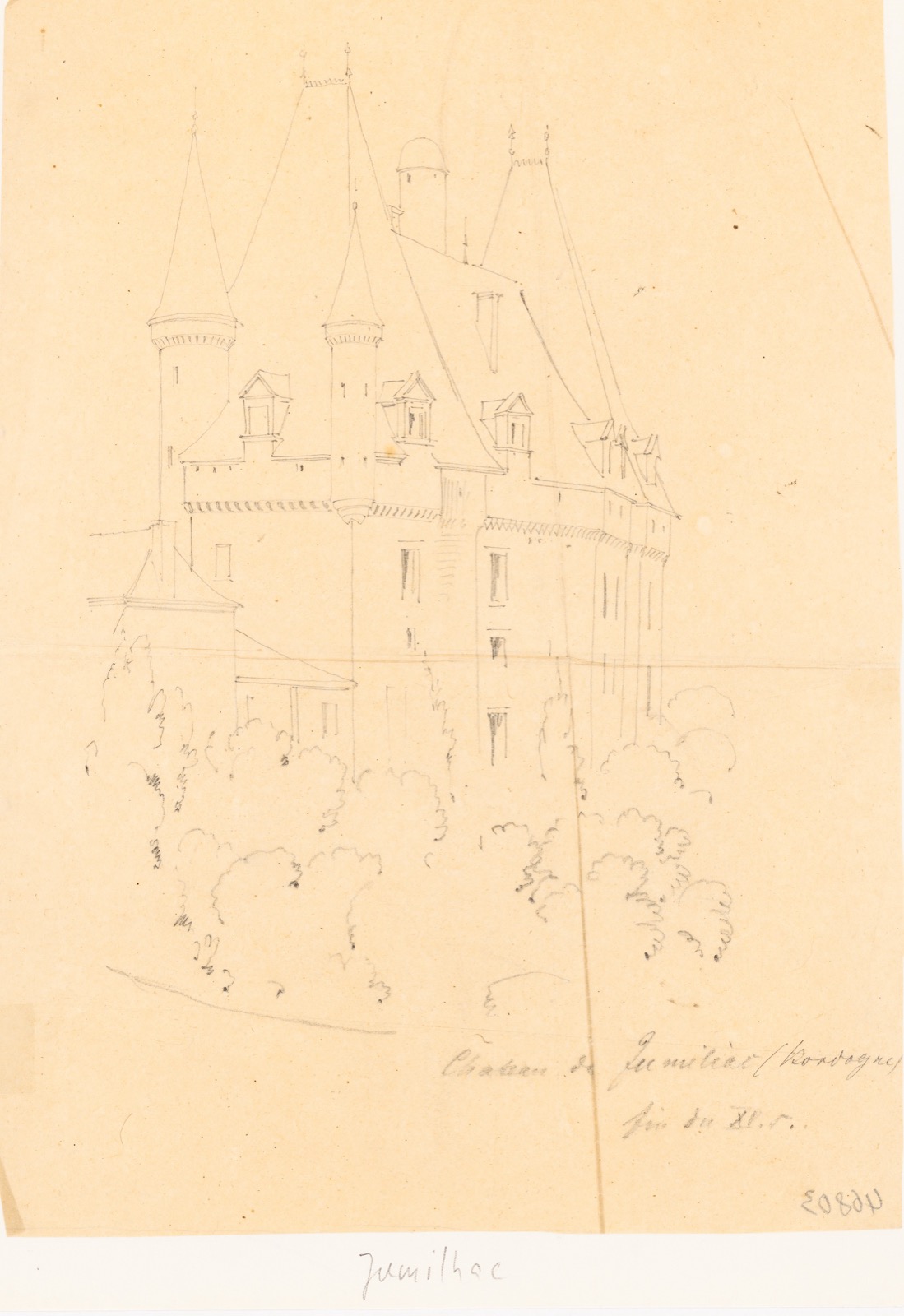
Chateau de Jumilhac, Dordogne (?): Perspektivische Ansicht, Château de Jumilhac

Chateau de Jumilhac, Dordogne (?): Perspektivische Ansicht

· Museum of Architecture at Berlin Institute of Technology (via Europeana)

CC0 (no rights reserved)

Questions about Château de Jumilhac

What is the history of Château de Jumilhac?

Château de Jumilhac was built and altered in phases from the 13th to the 17th centuries. An older fortified castle was known from the 12th century, while the present central castle dates from the 15th century. Two wings were added during the reign of Louis XIV, and the building was later restored by Raymond Odet Chapelle de Jumilhac and his wife after they bought it in 1927.

What is inside Château de Jumilhac?

Inside Château de Jumilhac, the documented covered porch links the ends of the two wings and the arcaded walls. Together, these elements form an almost rectangular court of honour. A balcony on the main façade was installed in the 17th century to serve the restructured first-floor apartments from outside.

Who owns Château de Jumilhac now?

Château de Jumilhac is privately owned by the direct descendants of the Chapelle de Jumilhac family, the La Tour du Pin family. The property has belonged to the Chapelle de Jumilhac family since the 16th century and is now undergoing permanent restoration by its owner.

Where is Château de Jumilhac?

Château de Jumilhac is in Jumilhac-le-Grand, in the Dordogne. It stands in the Dordogne département, in the Périgord vert, near the confluence of the Isle and the Ruchalait stream. The castle is south-west of the village of Jumilhac-le-Grand.

When was Château de Jumilhac built?

Château de Jumilhac was built in several phases between the 13th and 17th centuries. The present central castle is described as 15th-century, while the two long wings were added during the reign of Louis XIV. The site therefore combines a medieval core with major later additions.

What did Château de Jumilhac look like in its prime?

Château de Jumilhac has a broad stone frontage centred on an arched entrance and a rectangular court. Its older central block has round towers, many steep slate-covered conical and pyramidal roofs, and warm honey-coloured limestone walls. Two long 17th-century wings and arcaded walls frame the forecourt, while a terraced lawn and orangery lie behind it.

Is Château de Jumilhac still standing or is it a ruin?

Château de Jumilhac is still standing and has been restored. Its central block, towers, wings, arcaded walls and court survive as a substantial castle rather than a ruin. The property is also described as being in permanent restoration by its owner.

Can you visit Château de Jumilhac?

Château de Jumilhac is open to the public, although it remains privately owned. The castle and gardens have been open for visits since 1964. Its central part, right wing and left wing were classified as historical monuments in 1922, 1923 and 1924 respectively.
All castles of France · Castles of Europe · the best castles in Europe · explore the finished reconstructions.