
France · Restored
Château de la Rochepot
Château de La Rochepot is a historic castle in La Rochepot, Côte-d'Or, France, with medieval origins and major 15th-century rebuilding followed by an extensive late 19th–early 20th-century restoration. The restoration reinstated a multi-towered silhouette and glazed burgundy-tiled roofs. The château sits on a wooded rocky slope above surrounding vineyards and parkland.
Its prime
1919
Today
Restored
As it stood in 1919
What Château de la Rochepot looked like in its prime.
Long pale limestone main range set on a wooded rocky slope, punctuated by a large cylindrical tower with a tall conical slate roof at the east end and a square tower with a pyramidal patterned-tile roof at the west; a steep, multicoloured glazed tile roof in a diamond pattern spans the range, broken by triangular dormer windows, tall rectangular chimneys and several slender conical turrets and pinnacles; the château appears complete and intact, rising above trees and nearby vineyard terraces.
Its story
The story of Château de la Rochepot.
From Alexandre de Bourgogne to the Sovereigns of Piedmont
A castle of the eleventh and twelfth centuries stood on the rock before the present one. Its ruins, burnt or perhaps only abandoned for want of water, still lie in the forest round about. After 1180 Alexandre de Bourgogne, seigneur de Montagu and younger son of Duke Hugues III, rebuilt on the site; the stronghold was called the Château de La Roche Nolay for its closeness to Nolay.
Nolay and the Roche de Nolay seem to have stayed tied feudally to Alexandre's descendants, the Bourgogne-Montagu, who could exercise an eminent lordship over them. The direct lords were two substantial Burgundian houses, the de Thil and the Frôlois. The heiress Agnès de Frôlois, daughter of Jean I de Frôlois and dame of La Roche-Nolay and Vézinnes, married Jean I de Thil: she appears in the first third of the fourteenth century and her father in the second half of the thirteenth. Her first cousin Jean II de Frôlois, marshal of Burgundy, held nearby Molinot and had married Isabelle de Montréal-Arcis.
Agnès's daughter Marie de Thil (died 1360) married Édouard de Beaujeu, marshal of France, in 1333, and in 1350 the couple exchanged La Roche-Nolay for Berzé with that same Jean II de Frôlois. Yet Jacques de Savoie (about 1316 to 1367), who married their daughter Marguerite de Beaujeu (1346-1402) in 1362 and inherited through her, enjoyed both La Roche de Nolay and Berzé. The line then runs to his sons, the sovereigns of Piedmont Amédée (1363-1402) and Louis de Savoie (1364-1418), but Berzé passed directly into the hands of the dukes of Burgundy.
The Pot Family and the Name of La Roche-Pot
In 1403 the castle was bought by Régnier Pot (born about 1362, died 1432), chamberlain to Duke Philippe le Hardi and a knight of the Golden Fleece, one of the ducal house's faithful men and a survivor of the crusade at Nicopolis in 1396. He gave the place his own name, La Roche-Pot. In the same years the ground around it was planted with pinot noir vines, in execution of the duke's ordinance of 1395.
Régnier passed the castle to his son Jacques Pot (1399-1458), who left it in turn to his own son Philippe Pot (about 1428 to 1493). From Philippe it went to his brother Guyot Pot (died 1495), then to Guyot's son Régnier III (died 1503), and on Régnier's death to his sister Anne Pot (about 1472 to 1510), wife of Guillaume de Montmorency (1453-1531). Their children included the constable Anne de Montmorency (1493-1567) and an elder Anne de Montmorency (died 1525), who married Guy XVI, count of Laval.
The Constable, the Cardinal de Retz and the Last Lord
In the sixteenth century the fortress belonged to that constable, Anne de Montmorency, marshal and then constable of France, who held more than 130 castles, and to his elder sister Anne, countess of Laval. The countess was mother of Anne de Laval, baroness of Acquigny and Crèvecœur and dame de La Roche-Pot, who married Louis de Silly, count of La Roche-Guyon and sire of Louvois.
In the seventeenth century the castle came by inheritance to Jean-François Paul de Gondi, the Cardinal de Retz, a great-grandson of Louis de Silly and Anne de Laval through his mother Françoise-Marguerite de Silly. He sold it in 1644 to Pierre Legoux de la Berchère, first president of the Parlement of Burgundy and afterwards of the Parlement of Dauphiné, who was made marquis de Dinteville in 1647. Joseph Blancheton, who bought the castle in 1740, was its last lord; he made new apartments in it and put the chapel back in order.
La Roche Fidèle: Demolition and the Carnot Reconstruction
At the Revolution in 1789 the castle was renamed the château de La Roche Fidèle and declared a national asset. On 7 messidor year VII, 25 June 1799, it was acquired by citizen Bélorgey of Arnay-sur-Arroux, who demolished a great part of it. Stripped of its keep, the domain passed from hand to hand, belonging for instance to a sieur Crochet in about 1839 to 1855.
In 1893 Cécile Carnot, wife of the President of the Republic Sadi Carnot, bought the ruins and in January 1894 gave them to her eldest son, the infantry colonel Lazare-Hippolyte-Sadi Carnot (1865-1948). He made himself the historian of La Roche-Pot and spent twenty-six years on a large and meticulous historical reconstitution in the spirit of the fifteenth century, the whole building raised again under the glazed tile of Burgundy.
The architect was Charles Suisse (1846-1906), chief architect of historic monuments at Dijon, who worked in the spirit of Viollet-le-Duc and at the same time as Bodo Ebhardt at Haut-Koenigsbourg. Decoration of the great tower began in 1897, drawing on tapestries and pavements of the late Middle Ages, and the study for the corps de logis was completed in 1904. Suisse died in 1906 with the structural work almost finished and was replaced by his associates Forey and Prost; building stopped during the war, resumed only in 1921 and ended in 1927. For the castle's original state Suisse took guidance from Châteauneuf-en-Auxois, of a neighbouring period and itself once a Pot property, following its dormers and carved decoration, while Xavier Schanosky (1867-1916) cut sculpture in imitation of the Burgundian artists of the fifteenth century. For Laurent Saracco these schemes are in no way a copy but genuinely original compositions.
Sale, Seizure and the Beaune Auction of 2021
The Carnot family put the castle up for sale in 2012. Parts of it were inscribed on the register of historic monuments in 2013, and in 2014 the castle, its outbuildings, its vineyard and its park were classified. The sale itself went through in 2015, to a group of Ukrainian investors based in Luxembourg.
Financial difficulties appear to have slowed the buyers' project and to have left debts behind it. In October 2018 the Ukrainian businessman among them, Dmytro Malynovskyi, was arrested by the Gendarmerie nationale and the castle was seized by the French state, after an investigation into an alleged corruption and money-laundering scheme in which he was said to have bought the castle and lived in it having faked his own death. Two public auctions followed. The second, on the order of the commercial court, dispersed part of the furniture and works of art that had adorned the house, at Beaune on 10 October 2021, and the commune has feared that a residential scheme would in the end cost it its identity.
Step inside
7 places to explore in 1919.
The record describes 7 distinct spots at Château de la Rochepot, including the full exterior approach. Create your own photoreal reconstruction and explore every one, more scenes means more rooms, more angles, and more of the place to stand in.
Build Your Own Castle
Recreate Château de la Rochepot with AI to explore it.
The artist rebuilds it as it stood in 1919, a photoreal reconstruction that belongs to you alone. Pay with coins, no subscription needed.
Recreate this castle →Defend this castle →Whose castle
Clans who held Château de la Rochepot.
The families that held Château de la Rochepot for a decade or more across its history, follow a name to its clan.
Burgundy
Belonged to Alexander of Burgundy, seigneur de Montagu (1170–1205), son of Duke Hugh III of Burgundy.
Pot
Bought in 1403 by Régnier Pot, Chamberlain to Duke Philip the Bold and Knight of the Golden Fleece.
From the archive
Château de la Rochepot on paper: the measured plan and period views.
The survey plan and photographs below are the ground truth this page's reconstructions are checked against, drawn and photographed while the castle was still a working garrison. Every image is public-domain or openly licensed, with its source named.
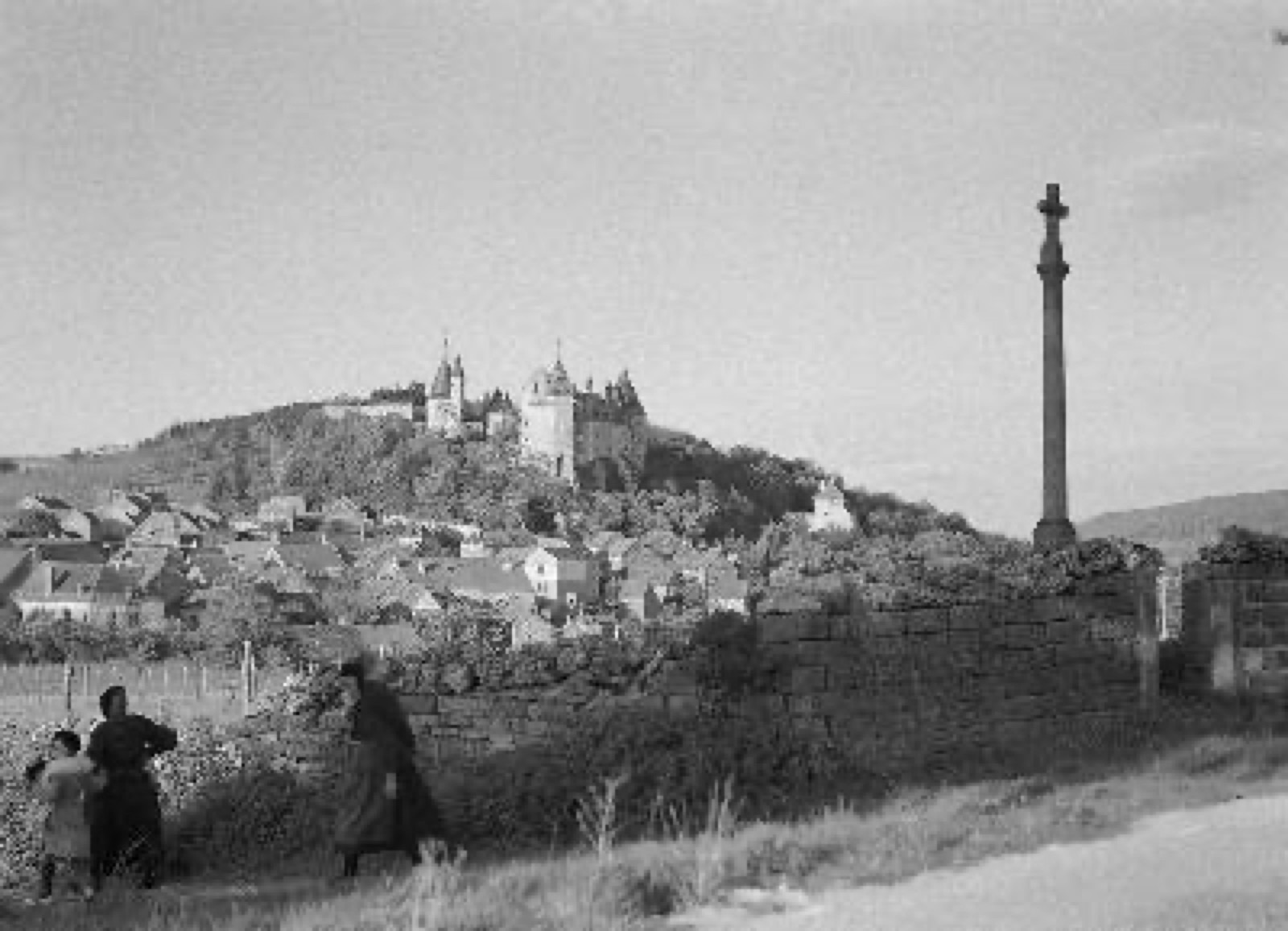
Zicht op La Rochepot, een dorp in de buurt van Beaune met een 13de- eeuws kasteel
1935 · National Archives of the Netherlands (via Europeana)
Public domain


