
Germany · Partial ruin
Thurant Castle
Burg Thurant
Thurant Castle (Burg Thurant) is a spur castle on a slate hill above Alken on the Moselle in Rhineland-Palatinate, Germany. Historically divided into Trier and Cologne halves, it retains two prominent round bergfriede, curtain walls and a cluster of domestic buildings; the site is partly rebuilt, privately owned and open to visitors seasonally.
Its prime
1350
Today
Partial ruin
As it stood in 1350
What Thurant Castle looked like in its prime.
Perched on a wide slate spur above terraced vineyards, the complex reads as a linear ring-walled spur castle with two large cylindrical bergfriede set along the ridge, a continuous stone curtain wall with crenellations, clustered steeply pitched slate roofs and several multi-storey stone domestic ranges including a timber-framed upper floor. A gatehouse with a wooden access bridge spans a neck moat; battlemented walkways and small round tourelles punctuate the profile. Vine terraces slope away below.
Its story
The story of Thurant Castle.
Count Palatine Henry I the Tall of the House of Welf probably built the first fortification on this slate spur above Alken between 1198 and 1206, to secure the claims of his brother, Emperor Otto IV, in the Moselle region. After Henry II the Younger died without male issue in 1214, Emperor Frederick II gave the castle and the village of Alken as an imperial fief to the House of Wittelsbach.
Duke Otto II of Bavaria appointed a knight, Berlewin, named Zurn, as burgrave, who conducted himself as a robber baron and raided the Trier Land from the castle, until Arnold II of Isenburg and Conrad of Hochstaden joined forces and besieged it in 1246, the so-called Great Feud. From the mid-13th century the archbishops of Cologne and Trier were joint owners, and each half of the double castle had its own bergfried, domestic buildings and entrance.
From the early 16th century the castle gradually fell into disrepair, and the War of the Palatine Succession left it a complete ruin. Robert Allmers, co-founder of the Hansa Automobil company, bought the site in 1911 and had part of it rebuilt; since 1973 it has been the joint private residence of the Allmers and Wulf families, open to visitors from March to mid-November.
Step inside
11 places to explore in 1350.
The record describes 11 distinct spots at Thurant Castle, including 3 interiors: castle chapel interior, cologne tower (bergfried) interior and stair, knights' hall in the cologne palace. Create your own photoreal reconstruction and explore every one, more scenes means more rooms, more angles, and more of the place to stand in.
Build Your Own Castle
Recreate Thurant Castle with AI to explore it.
The artist rebuilds it as it stood in 1350, a photoreal reconstruction that belongs to you alone. Pay with coins, no subscription needed.
Recreate this castle →Defend this castle →Whose castle
Clans who held Thurant Castle.
The families that held Thurant Castle for a decade or more across its history, follow a name to its clan.
Welf
Built by Count Palatine Henry I the Tall of the House of Welf, c. 1198–1206; held until Henry II the Younger died without male issue in 1214.
Wittelsbach
Granted to the House of Wittelsbach as an imperial fief by Frederick II in 1214; returned to the Counts Palatine by Rhine in 1225.
From the archive
Thurant Castle on paper: the measured plan and period views.
The survey plan and photographs below are the ground truth this page's reconstructions are checked against, drawn and photographed while the castle was still a working garrison. Every image is public-domain or openly licensed, with its source named.
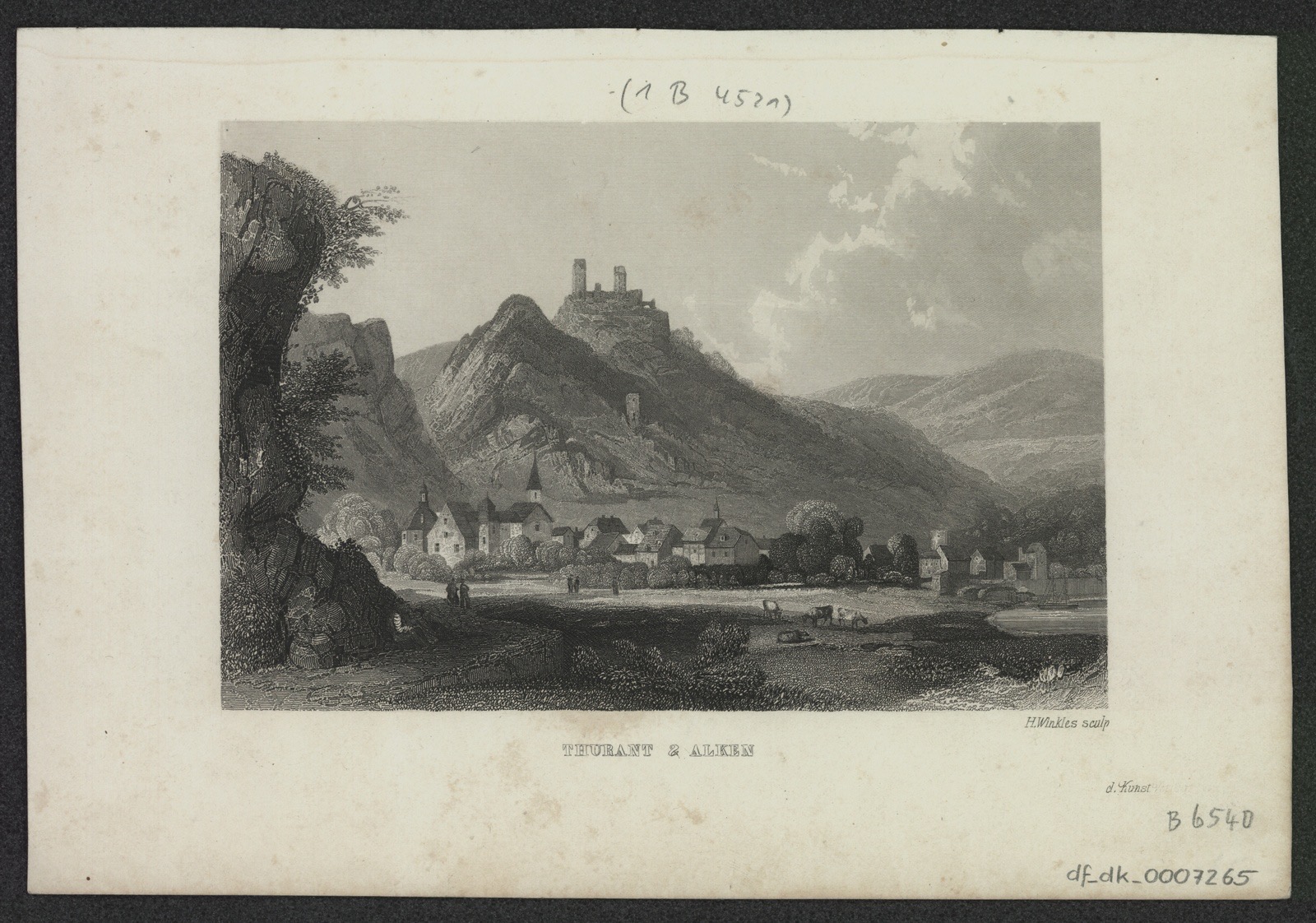
View of Thurant Castle near Alken, Stich, circa 1840
· Deutsche Fotothek (via Europeana)
CC BY-SA
Nearby


