
Italy · Partial ruin
Sigmundskron Castle
Castel Firmiano
Sigmundskron Castle (Castel Firmiano) is an extensive multi-phase fortress on a rocky hill near Bolzano in South Tyrol. First mentioned in 945, it was bought and strengthened for the gun age by Duke Sigismund around 1473; today its partly-ruined enceinte houses the Messner Mountain Museum Firmian. The site combines remnants of an older keep with later low, gun-era curtain walls and towers.
Its prime
1473
Today
Partial ruin
As it stood in 1473
What Sigmundskron Castle looked like in its prime.
Extensive, multi-phase stone fortress crowning a rocky hill above Bolzano, composed of concentric curtain walls pierced by low gun-era embrasures and punctuated by several squat defensive towers; the highest point preserves the oldest masonry of the original Formigar keep. Roofed service buildings sit within the inner ward; at its 1473 prime the curtain walls were continuous and roofed, towers intact, and the courtyard a working heart of the castle. Masonry is weathered local stone, with an irregular roofline of timber and slate.
Its story
The story of Sigmundskron Castle.
Formicaria, the Bishops of Trent and the Firmian Ministeriales, 945–1200s
The castle first enters the record around 945 under the name Formicaria, later Formigar, on its rock above the right bank of the Adige outside Bolzano. In 1027 the Emperor Conrad II handed it to the prince-bishop of Trent, and in the 12th century the bishops entrusted it to ministeriales who from then on bore the lordly name of Firmian. The chapel on the highest point of the site, dedicated to Saint Blaise and to Saint Ulrich, bishop of Augsburg, appears to be older than the fortification that later absorbed it; tradition has the Carolingian-age bishop passing through the Bolzano country in the first half of the 10th century.
Burgraves of the castle are named from 1144 onwards, and several further ministerial families tracing back to the Firmian counts are attested in the 13th century: the Estrich, the Hahn or Gallus, the Häring, the Kastraun, the Ripp and the Zungel. From 1163 the ford across the Adige below the walls is recorded as the seat of the bishops' feudal court for the Bolzano district, which marks how much the site mattered to the bishopric.
Sigismund the Rich Rebuilds for Gunpowder, 1473–1600s
In 1473 the Prince of Tyrol, Duke Sigismund the Rich, took the castle from the Firmian counts (bought outright by some accounts, exchanged for the county of Castello in others), and over the following years enlarged it into a fortress built to withstand firearms. It was renamed in his honour as Sigmundskron, Sigismund's crown, the new form attested in 1474 as "slosz Sigmundskron". Of the older castle of Formigar only a few traces remain, at the highest point of the site, where the chapel stands.
Financial difficulties forced Sigismund to give up the castle soon afterwards; the accounts differ on whether he pledged it or sold it outright, but he kept jurisdiction over the ground through his own Burgfrieden, a judicial district answering to the Landgericht of Gries-Bolzano. From the 17th century the complex fell steadily into ruin under the cost of maintaining it.
Wolkenstein, Sarnthein and Toggenburg, 1790s–1994
At the end of the 18th century the castle belonged to Count Wolkenstein. From 1807 to 1870 it was held by the counts of Sarnthein, and from then until 1994 by the counts of Toggenburg.
Los von Trient: the Renaming of 1922 and the Rally of 1957
Until the annexation of southern Tyrol to Italy in 1919, some farmers of Trentino origin living around the rock called the place Zimiscron or Sibizzicróm, corruptions of Sigmundskron. The geographer Ettore Tolomei judged those forms too barbarous and replaced them: the strictly monolingual Castel Firmiano was reintroduced in his Prontuario dei nomi locali dell'Alto Adige, drawn up for openly political ends in the cause of total Italianisation, and made official in 1922.
The fortress became a political symbol of the South Tyrolean autonomy movement. In 1957 the largest protest rally in the history of South Tyrol was held here under the leadership of Silvius Magnago: more than 30,000 people gathered in the castle against the non-observance of the 1946 Paris Agreement and to demand real provincial autonomy for South Tyrol, free of the regional veto held by Trentino, under the slogan "Los von Trient", away from Trent.
Restaurant, Province and Messner Mountain Museum Firmian, 1976–2007
In 1976 an innkeeper's family partially restored the half-ruined castle and opened a restaurant in it. The castle passed into the possession of the autonomous Province of Bolzano in 1996, and in the spring of 2003, after no little controversy, the South Tyrolean mountaineer Reinhold Messner was granted the licence for the mountain museum he had long planned. During the works, in March 2006, a Neolithic grave came to light containing the skeletal remains of a woman, its age estimated at 6,000 to 7,000 years.
The Messner Mountain Museum Firmian, fourth of Messner's mountain museums, opened in the ruins on 9 June 2006, with a further architectural intervention by Werner Tscholl in 2007; Messner gave his museum the name Firmian, which a new Bolzano quarter not far off also carries. The castle is protected both as a cultural heritage monument of South Tyrol and under Italian national heritage designation.
Step inside
5 places to explore in 1473.
The record describes 5 distinct spots at Sigmundskron Castle, including the full exterior approach. Create your own photoreal reconstruction and explore every one, more scenes means more rooms, more angles, and more of the place to stand in.
Build Your Own Castle
Recreate Sigmundskron Castle with AI to explore it.
The artist rebuilds it as it stood in 1473, a photoreal reconstruction that belongs to you alone. Pay with coins, no subscription needed.
Recreate this castle →Defend this castle →Whose castle
Clans who held Sigmundskron Castle.
The families that held Sigmundskron Castle for a decade or more across its history, follow a name to its clan.
Firmian
Ministeriales granted the castle in the 12th century, who from then on were named the Firmian family.
Wolkenstein
Belonged to Count Wolkenstein at the end of the 18th century.
Sarnthein
Held by the counts of Sarnthein, 1807–1870.
Toggenburg
Held by the counts of Toggenburg from 1870 until 1994.
From the archive
Sigmundskron Castle on paper: the measured plan and period views.
The survey plan and photographs below are the ground truth this page's reconstructions are checked against, drawn and photographed while the castle was still a working garrison. Every image is public-domain or openly licensed, with its source named.
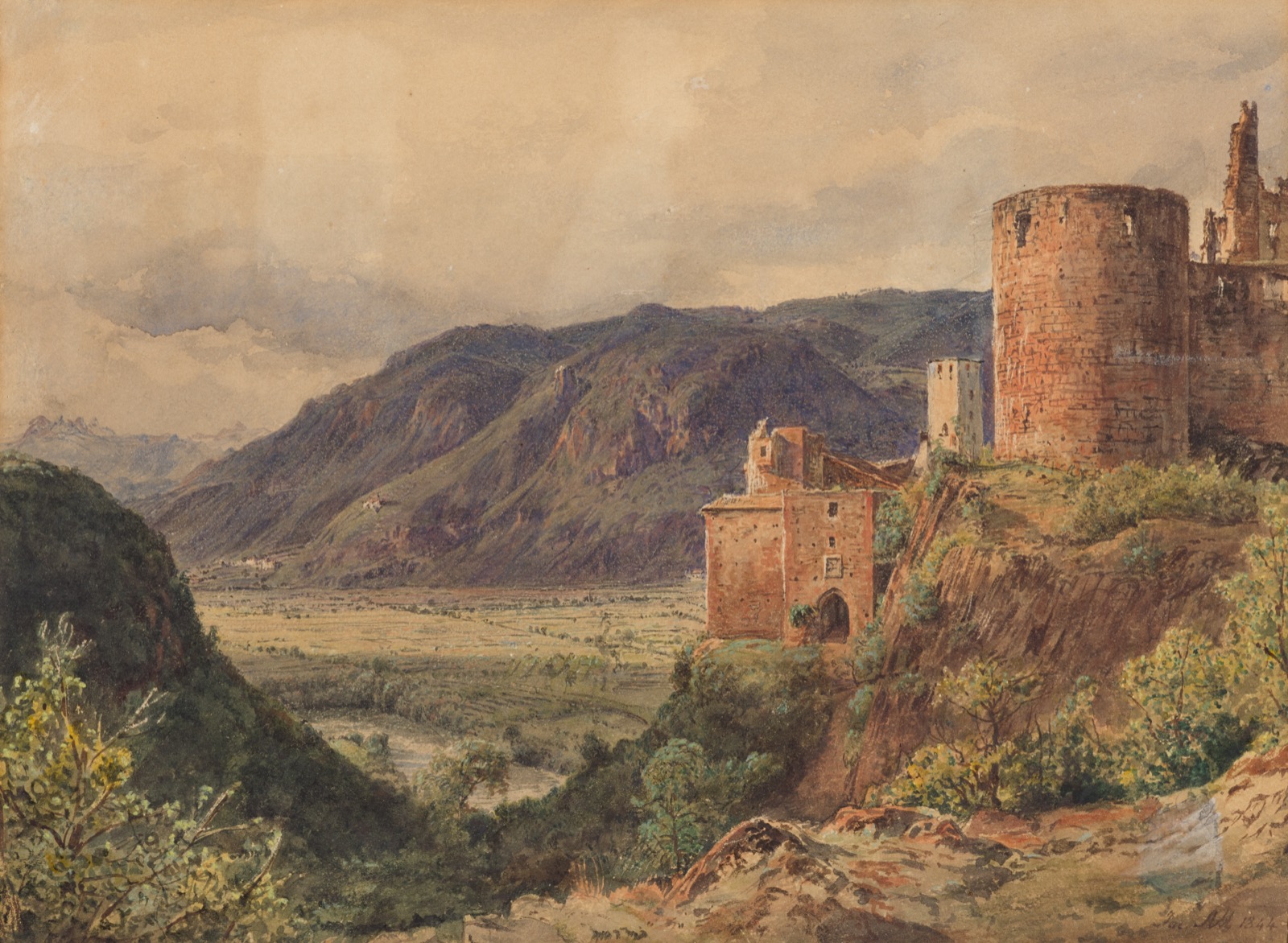
Sigmundskron bei Bozen
1844 · Austrian Gallery Belvedere (via Europeana)
CC BY-SA


