
Scotland · Still standing
Cranshaws Castle
Cranshaws Castle (Cranshaws Tower) is a privately owned 15th‑century rectangular pele tower near the village of Cranshaws in Berwickshire, Scotland. The four‑storey tower has rounded corners and a crenellated parapet and remains in use as a residence; it is protected as a category A listed building.
Its prime
1410
Today
Still standing
As it stood in 1410
What Cranshaws Castle looked like in its prime.
A tall, boxy four‑storey rectangular pele with gently rounded corner towers, its walls finished in a grey‑brown harled render over rubble stone. Small narrow slit and later sash windows punctuate the plain façades; a single modest ground‑level doorway opens to the lawn. A corbelled band supports a crenellated parapet and short square chimney stacks rise above the battlements. The tower stands isolated on a grassy plot amid scattered trees with no remaining barmkin walls.
Its story
The story of Cranshaws Castle.
From the Olifards to the Douglases of Bothwell
The lands of Cranshaws were originally part of the Barony of Bothwell, a barony created for David Olifard, ancestor of the present chief of the Oliphants, by King Malcolm IV in the middle of the 12th century. Occupancy of Cranshaws was then granted to a younger Olifard son, in the form such a grant usually took: a feu, with the superiority left in the hands of the barony. The estate stayed with that junior line for some centuries. In 1329 its senior representative, by then 7th chief of the name, William Oliphant, Lord of Aberdalgie, died, and among the properties he left was Cranshaws, inherited from his Olifard forebears. In 1336/7 the lands of Cranschawes and Hedderwick, held by a William Olyphant, were in the hands of Edward III on account of that William's forfeiture.
The superiority had by then moved out of Oliphant hands altogether. On the extinction of the senior line of Oliphants the Barony of Bothwell passed by marriage to the Morays in 1252, and in 1362 Joanna de Moravia, heiress of Bothwell, married Archibald Douglas, 3rd Earl of Douglas. Their son and heir was Archibald Douglas, 4th Earl of Douglas (1372–1424).
"Our Beloved Cousin": The Swinton Grant and Homildon Hill
In 1401 Archibald Douglas, 4th Earl of Douglas, bestowed Cranshaws upon Sir John Swinton, 14th of that Ilk, whom the earl called "dilectus consanguineus nostra", our beloved cousin. The grant dispossessed the Oliphants. He was killed at the Battle of Homildon Hill the following year, and the lands passed to his son, Sir John Swinton, 15th of that Ilk. It is the younger Swinton who is thought to have built the castle that survives, a rectangular keep of four storeys with rounded corners, which would originally have been ringed by a defensive barmkin, of which no remnant is left. What kind of building the Oliphants had held at Cranshaws is not known.
A Superiority Contested: March, Swinton and Oliphant
The question of who held the superiority over Cranshaws ran on behind the Swinton tenure. In 1403/4 the Earl of Dunbar and March was stripped of his Scottish lands, much of which went to Archibald Douglas, 4th Earl of Douglas. The Earl of Dunbar was restored to his Earldom of March in 1409, and it is probable that the Earl of Douglas had attempted to transfer the superiority of Cranshaws to that earldom at some point before the restoration. Cranshaws was forfeited by the Earl of March in 1435-6, although no record survives connecting the place to the Earldom of Dunbar and March before that date, and around 1460 there was a protracted battle over the superiority, which was being claimed for the earldom.
The effective removal of the Cranshaws estate from the Oliphants, without their consent and without compensation, was the start of a dispute that ran for most of the 15th century. A charter of the lands of Cranshawes in 1412 names Walter Oliphant as Lord of Aberdalgie. In 1442 Sir John Oliphant was retoured heir to his grandfather in the lands of Cranshaws; his sasine was taken on 28 February 1442/3, and was formally broken the next day by Sir John Swinton of that Ilk, who claimed the same lands. An inquest was held over the ownership dispute between Swinton and Lord Oliphant in 1464, and in 1474 Lord Oliphant petitioned the courts for ownership.
In 1476 Lord Oliphant took an indenture with Alexander, Duke of Albany and Earl of March, undertaking to pay thirty years of non-entry running from the death of his father, Sir John Oliphant, for the lands of Cranshaws. The terms barred him from entering any agreement with Sir Johne of Swyntoune, or with any other of that name, without the duke's special permission, and then only on payment of 1,000 merks within forty days; the duke for his part gave him leave to pursue Swinton, his heirs, and anyone else who had taken up mails from the lands of Cranschaws since Sir John Oliphant's death. In the same year Lord Oliphant, claiming his rights, raided Cranshaws and carried off oxen and horses.
Thomas Carlyle's Thirty Horsemen, February 1545
During the war known as the Rough Wooing, an English soldier, Thomas Carlyle, came to Cranshaws in February 1545. He brought thirty horsemen with him, and fought there with men who had come to Cranshaws to meet the Laird of Swinton, warden of the East March of Scotland.
The Mortons, the Restorers and Ravenswood
In the 18th century the castle was re-acquired by another branch of the Douglas family, the Earls of Morton, and George Douglas, 13th Earl of Morton (1662–1738), carried out extensive renovations. The Mortons later sold it on, and the crenellated parapet is thought to have been added in the late 19th century, after that sale. Andrew Smith of Whitchester restored the building in 1896/97, and in 1931 it passed to his nephew, Stenhard Landale FRSE.
Cranshaws is privately owned and still in use as a residence, and has been protected since June 1971 as a category A listed building in the Scottish Borders. It is thought to have been the original of Ravenswood Castle, home of Edgar in Sir Walter Scott's tragedy The Bride of Lammermoor, and it is supposed to be inhabited by a brownie.
Step inside
5 places to explore in 1410.
The record describes 5 distinct spots at Cranshaws Castle, including 1 interior: upper‑storey chamber with window embrasures. Create your own photoreal reconstruction and explore every one, more scenes means more rooms, more angles, and more of the place to stand in.
Build Your Own Castle
Recreate Cranshaws Castle with AI to explore it.
The artist rebuilds it as it stood in 1410, a photoreal reconstruction that belongs to you alone. Pay with coins, no subscription needed.
Recreate this castle →Defend this castle →Whose castle
Clans who held Cranshaws Castle.
The families that held Cranshaws Castle for a decade or more across its history, follow a name to its clan.
Oliphant
The Olifard/Oliphant line held Cranshaws for centuries; William Oliphant, Lord of Aberdalgie, left it at his death in 1329, and the family was dispossessed in 1401.
Swinton
Bestowed on Sir John Swinton, 14th of that Ilk, by the 4th Earl of Douglas in 1401; his son is thought to have built the existing tower.
From the archive
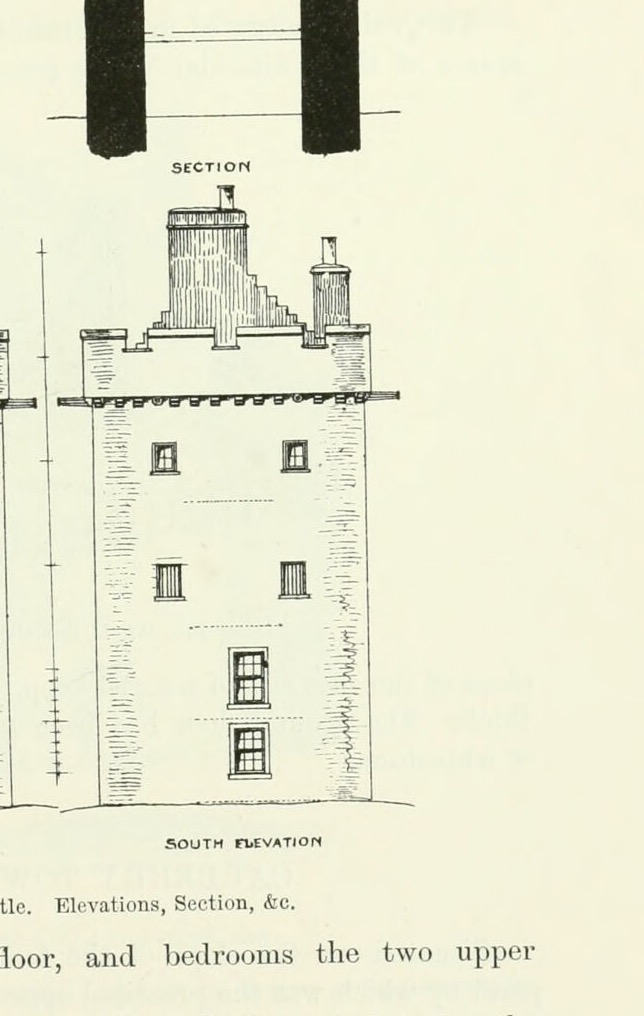
Cranshaws Castle on paper: the measured plan and period views.
The survey plan and photographs below are the ground truth this page's reconstructions are checked against, drawn and photographed while the castle was still a working garrison. Every image is public-domain or openly licensed, with its source named.
SECTION
1889 · MacGibbon & Ross, vol. 3 (1889)
Public domain
WEST ELEVATION
1889 · MacGibbon & Ross, vol. 3 (1889)
Public domain
SOUTH ELEVATION
1889 · MacGibbon & Ross, vol. 3 (1889)
Public domain


