
Serbia · Restored
Golubac
Golubac Fortress is a medieval fortified town on the south bank of the Danube at the entrance to the Iron Gate gorge in north-eastern Serbia. The stone complex is built on a rocky riverbank and consists of multiple compounds, thick curtain walls, and a series of towers and gateworks that controlled river traffic. It has seen repeated modification and occupation from the Middle Ages into the Ottoman period and is a restored tourist site today.
First raised
1335
Its prime
1458
Today
Restored
As it stood in 1458
What Golubac looked like in its prime.
A compact stone fortress clinging to a rocky Danube riverbank, arranged as three compounds linked by thick curtain walls. The silhouette shows a string of roughly ten towers, a mix of square and round plans, some topped by conical wooden roofs and others as tall cylindrical keeps; towers are separated rather than fully joined. The masonry is light-grey limestone and brick-stone mixes, with crenellated battlements, stair lines up the slope, a lower forward wall/river bastion, and a protected gateway facing the river.
Its story
The story of Golubac.
The Stone Watcher of the Iron Gate
Golubac was a medieval fortified town on the south bank of the Danube, four kilometres downstream from the modern town, at the point where the river narrows into the Iron Gate gorge. A Roman and Byzantine settlement stood here first, and in the Middle Ages a heavy chain stretched from the fortress to Babakaj, a rock on the far side of the river, so that traffic along and across the Danube could be regulated and taxed. The first known record is in Hungarian sources from 1335, which describe it as the 'watcher made of stone, guarding the gorge'.
Who built it (Bulgarians, Serbs or Hungarians) remains unclear, though an Orthodox chapel built into one of the towers shows that part, at least, was the work of a local noble, and tentatively points to a Serbian origin. The fortress grew in stages into three compounds with ten towers, walls two to three metres thick, and a moat connected to the Danube.
Jeremija's Price, 1427
Held by Serbia by the time of the Battle of Kosovo in 1389, Golubac fell to Sultan Bayezid I after the battle and changed hands twice in 1391 alone. In 1403 King Sigismund of Hungary ceded it, jointly with Belgrade, as a personal fiefdom to Despot Stefan Lazarević. By the Tata contract of 1426, Golubac, Belgrade and Mačva were to return to Hungary on Stefan's death.
When Stefan died in 1427, Belgrade and Mačva were handed over without trouble, but Golubac's commander, Voivode Jeremija, demanded 12,000 ducats in compensation. Sigismund refused to pay, and Jeremija handed the fortress to the Turks, who made it a pasha's residence. Despot Đurađ Branković travelled to Golubac in person, promising Jeremija forgiveness if he returned it by any means possible; the Voivode refused, and attacked the Despot when he tried to enter the walls.
The Battle of Golubac, 1428
Around April 1428 Sigismund massed 25,000 infantry, 6,000 Wallachian archers under Prince Dan II, 200 Italian artillerymen and a body of Polish cavalry across the Danube, with ships attacking from the river, one of them commanded by Cecília Rozgonyi, wife of the Comes of Timișoara. Sultan Murad II arrived in late May to relieve the besieged garrison, and Sigismund, unwilling to fight the larger army, agreed a treaty by early June.
Once part of the Hungarian army had withdrawn across the river, the Turkish commander Sinan Bey attacked the rear, capturing and killing those who remained, among them the Polish knight Zawisza Czarny. Sigismund himself was nearly taken; Cecília Rozgonyi was solely responsible for his rescue, and he granted her and her brothers a hereditary right to Golubac.
Kinizsi at the Gate, 1481
The Peace of Szeged returned Golubac to the restored Serbian Despotate in 1444, but the Turks took it again after Đurađ Branković's death in 1456; Matthias Corvinus regained it in 1458 and lost it to Mehmed II the same year. In the autumn of 1481 Pál Kinizsi, Comes of Timișoara, turned an army of 32,000 south towards the Danube. At Golubac a thousand Turkish cavalry were killed or captured, 24 ships were sunk, and Mihaloğlu İskender Bey, pasha of Ottoman-held Smederevo, was beheaded at the gate by one of Kinizsi's men.
The raid took no land, and the Turks retook the fortress and quickly improved it for the age of firearms: fortifying the western towers with cannon ports and thick polygonal reinforcements, and adding a final low artillery tower, almost identical to those at Smederevo, to command traffic on the Danube.
From the Sultan to the Knez
Credited with successfully repelling over 120 attacks, Golubac was held by the Habsburg monarchy in 1688–90 and 1718–39, and by Serb rebels during the Kočina Krajina revolt of 1788–91 and the First Serbian Uprising of 1804–13. In 1867 it was turned over, along with Kalemegdan and other towns, to the Serbian Knez Mihailo Obrenović III.
The hydroelectric dam built in the Iron Gate gorge between 1964 and 1972 raised the river and flooded the lowest walls, leaving the cannon tower protruding into the Danube. Declared a Monument of Culture of Exceptional Importance in 1979, the fortress was rebuilt from 2014 with European Union funds, a tunnel taking the through-road out of its two portcullises in 2017, and reopened fully reconstructed in 2019. In the moat stands a restored fountain raised in honour of Zawisza Czarny, the knight who fell there in 1428.
Step inside
11 places to explore in 1458.
The record describes 11 distinct spots at Golubac, including 3 interiors: orthodox chapel inside a tower, brick-and-stone hammam building, interior of the river bastion. Create your own photoreal reconstruction and explore every one, more scenes means more rooms, more angles, and more of the place to stand in.
Build Your Own Castle
Recreate Golubac with AI to explore it.
The artist rebuilds it as it stood in 1458, a photoreal reconstruction that belongs to you alone. Pay with coins, no subscription needed.
Recreate this castle →Defend this castle →From the archive
Golubac on paper: the measured plan and period views.
The survey plan and photographs below are the ground truth this page's reconstructions are checked against, drawn and photographed while the castle was still a working garrison. Every image is public-domain or openly licensed, with its source named.
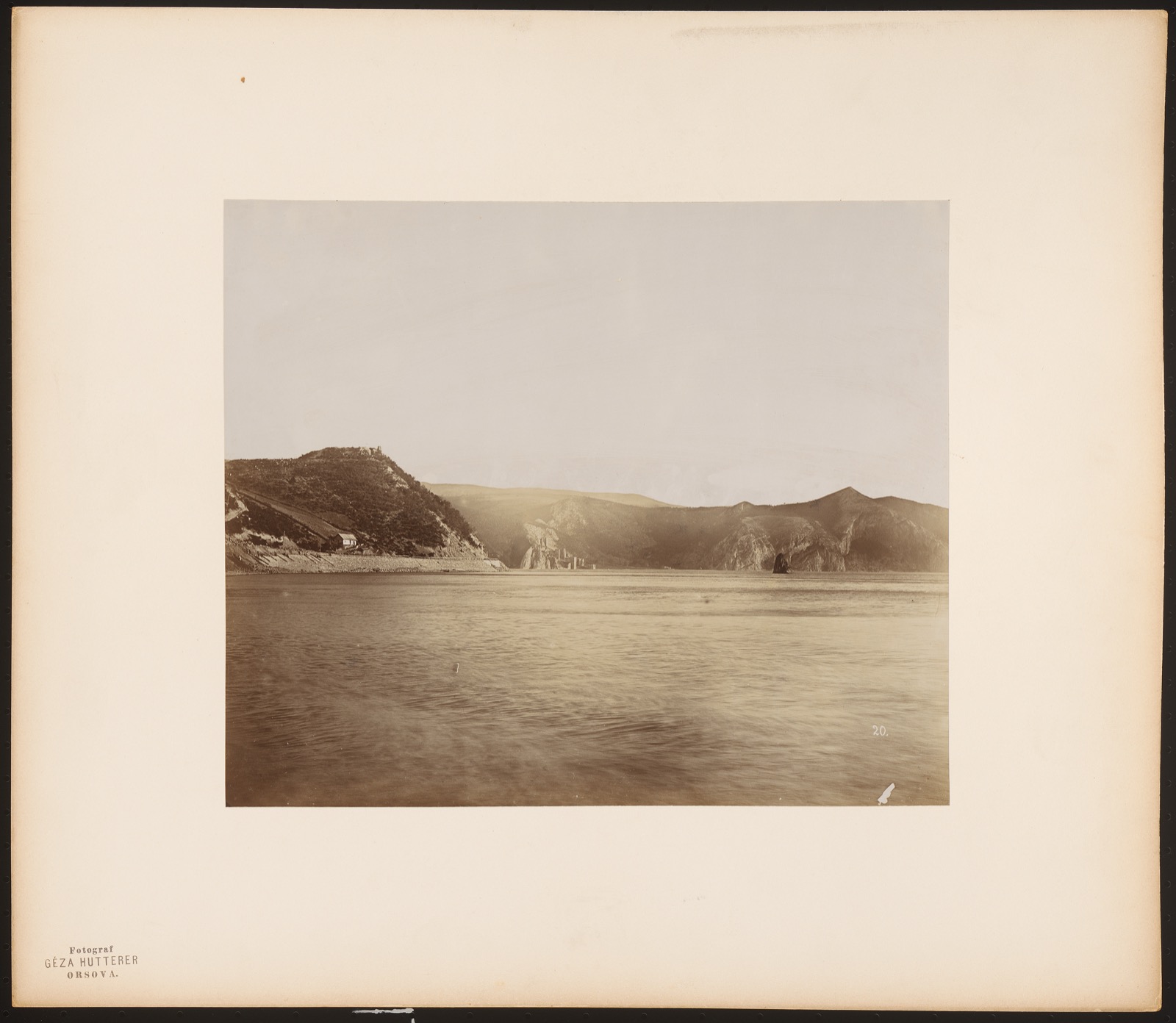
Lászlóvár, Golubac und Babakaj: Flusslandschaft
· Museum of Architecture at Berlin Institute of Technology (via Europeana)
CC0 (no rights reserved)
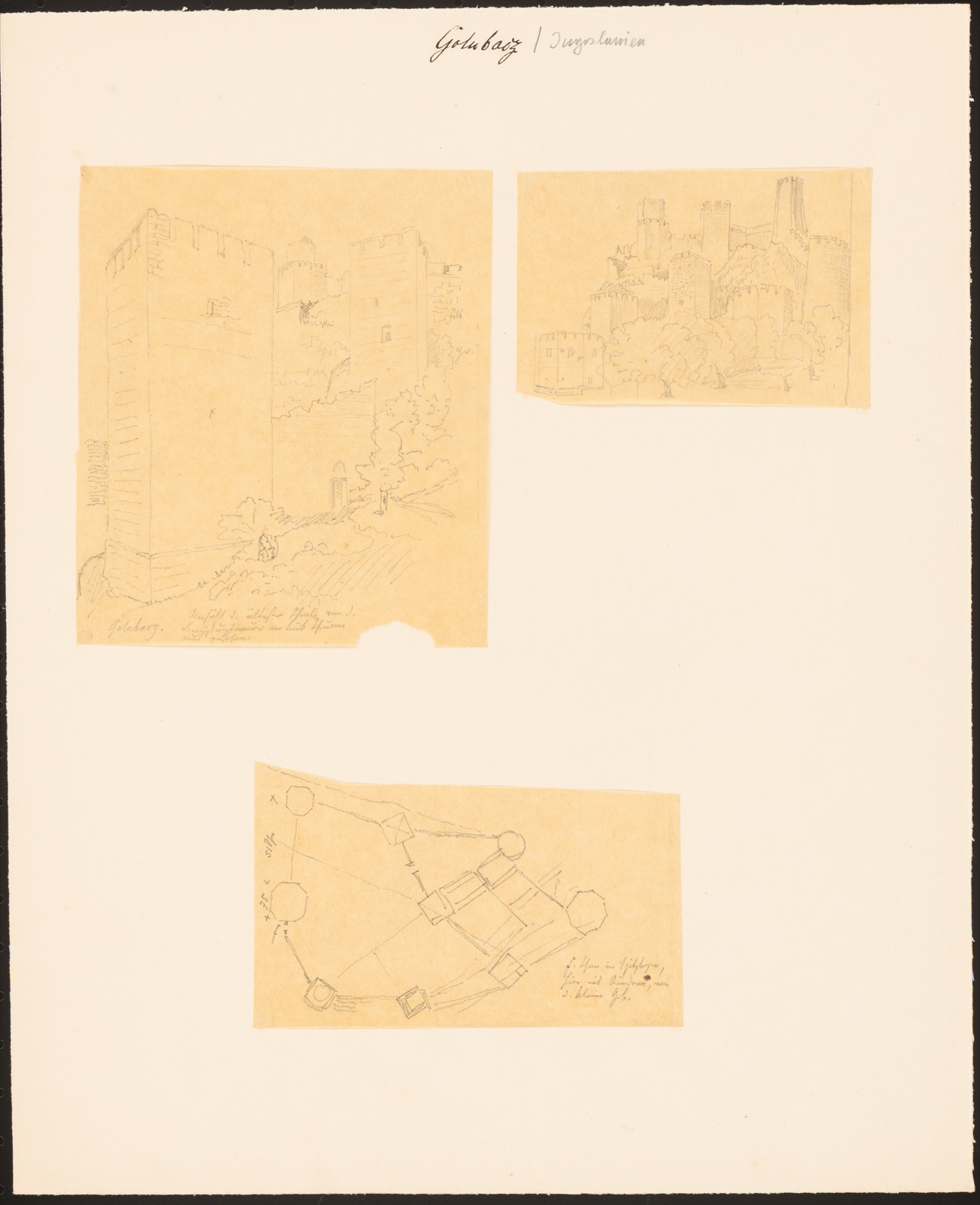
Festung, Golubacz: Zwei perspektivische Ansichten, Grundriss der Burganlage (drei Blätter)
· Museum of Architecture at Berlin Institute of Technology (via Europeana)
CC0 (no rights reserved)


