Wales · Partial ruin
Bronllys Castle
Castell Bronllys
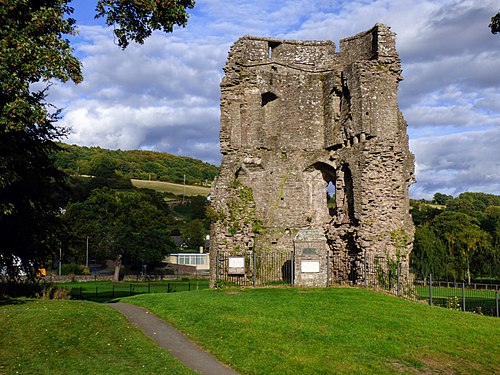
Bronllys Castle is a motte-and-bailey fortress in Powys, Wales centered on a large cylindrical stone tower set on an earthen motte. The castle was originally timber-built in the early 12th century and the surviving round stone keep dates to the later 12th century; the site is now managed by Cadw and is open to the public. The castle fell out of regular military use after the medieval period and survives as a partially ruined motte with its round tower standing.
Its prime
1233
Today
Partial ruin
As it stood in 1233
What Bronllys Castle looked like in its prime.
A single, tall cylindrical stone keep of coursed grey-brown rubble sits atop a steep, grass-covered motte. The round tower rises without visible attached curtain walls in the photograph, pierced by two narrow, arched window/arrow-slit openings and small irregular sockets in the masonry. The motte slopes down to surrounding trees and pasture; the tower’s masonry finish is roughly coursed with horizontal banding from construction layers. At prime the tower would present a complete stone parapet and battlements around its roofline.
Its story
The story of Bronllys Castle.
The first castle at Bronllys, of timber, was founded in or soon after 1100 by Richard Fitz Pons, holder of the nearby Herefordshire barony of Clifford and a supporter of Bernard of Neufmarché. In 1144 Roger Fitzmiles, Earl of Hereford, detached the surrounding land from the Lordship of Brecknock for Richard's son Walter de Clifford, who rebuilt the castle in stone and seems to have raised the round tower on the motte.
In 1165 that tower caught fire, and a stone tumbling from the battlements killed Mahel de Hereford, Earl Roger's last surviving brother, Gerald of Wales claims the dying Mahel repented his persecution of the Bishop of St Davids, which he blamed for his fate. Brecknock passed through Philip de Braose and Eleanor de Braose to her husband Humphrey de Bohun, and Edward III later transferred the castle itself to the Bohun Lords of Brecknock, persuaded that such a place needed a powerful magnate.
Through the disputed Bohun inheritance, contested between the Duke of Gloucester and Henry Bolingbroke, husbands of the two daughters, Bronllys came to Humphrey Stafford, who inherited the Earldom of Buckingham and was raised to Duke. When Edward Stafford, 3rd Duke of Buckingham, was executed for treason under Henry VIII in 1521, Bronllys was forfeited to the crown. The round stone keep still stands on its motte, in the care of Cadw and open to the public.
Step inside
5 places to explore in 1233.
The record describes 5 distinct spots at Bronllys Castle, including the full exterior approach. Create your own photoreal reconstruction and explore every one, more scenes means more rooms, more angles, and more of the place to stand in.
Build Your Own Castle
Recreate Bronllys Castle with AI to explore it.
The artist rebuilds it as it stood in 1233, a photoreal reconstruction that belongs to you alone. Pay with coins, no subscription needed.
Recreate this castle →Defend this castle →Whose castle
Clans who held Bronllys Castle.
The families that held Bronllys Castle for a decade or more across its history, follow a name to its clan.
Clifford
Founded c. 1100 by Richard Fitz Pons of the barony of Clifford; his son Walter de Clifford rebuilt it in stone from 1144.
Braose
Brecknock, with Bronllys, passed through Philip de Braose to Eleanor de Braose, whose marriage carried it to the Bohuns.
Bohun
Came under Humphrey de Bohun through Eleanor de Braose; Edward III later transferred the castle to the Bohun Lords of Brecknock.
Stafford
Inherited by the Staffords, Dukes of Buckingham; forfeited to the crown on the 3rd Duke's execution in 1521.