Guinness
also McGuinness, Magennis, Mag Aonghusa
Earls of Iveagh, brewers and statesmen since 1759.
- Origin
- Leinster, Ireland
- Motto
- Spes mea in Deo
- Famous bearer
- Arthur Guinness (1725-1803), founder of the brewery at St James's Gate
- Register
- Irish family
Ranked of all time
The 10 Most Powerful Irish Clans of All Time
The Guinness arms and country

Coat of armsArms of GuinnessWikimandia · CC BY-SA 4.0 
Coat of armsMcGuinness Coat of armsCookieman1.1.1 · CC BY-SA 4.0


- Coat of arms: Granted to an individual and inherited down that one documented line. These are the arms of particular families of the name, not of everyone who shares the surname.
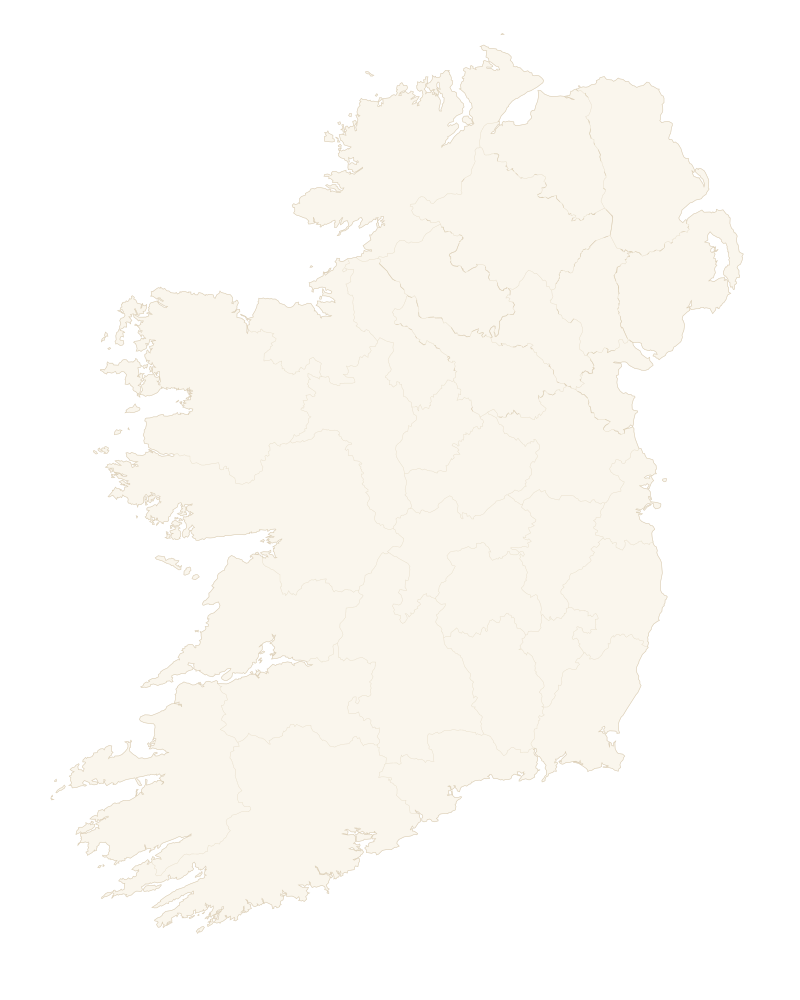
CoreHistoric reach
The seat of Guinness
Seat vacantChief
No one leads the Guinness community yet. When the movement opens, you can stand for its leadership, or help elect whoever does.
Current mission
No shared goal set yet. Once Guinness has leadership, it sets the public focus: a restoration, a gathering, a real-world project that helps its own.
The Guinness clan is being rebuilt. Join the waiting list for the movement today, and you help decide who leads it and what it does.
Help rebuild the Guinness clan →Motto
Spes mea in Deo
“My hope is in God”
What does the Guinness name mean?
From the Gaelic 'Mag Aonghusa', son of Aonghus, anglicised over time as Magennis, McGuinness, and Guinness. The family of brewers and Earls of Iveagh trace their senior line to the Magennis chiefs of Iveagh in County Down, the Gaelic kindred from whom the family's modern peerage takes its name.
The history of Guinness
Mag Aonghusa: how the son of Aonghus became Guinness
In Irish a surname was built from Mac, meaning son, or O, meaning descendant, set before a father's name in the genitive: Mac Siurtain, son of Jordan, or O Donaill, descendant of Donall. Where the name that followed began with a vowel, Mac softened to Mag. Aonghus begins with a vowel, so this kindred was written Mag Aonghusa, and that is the name that reaches modern paper as Magennis, as McGuinness and as Guinness. Ireland fixed surnames early by European standards, in the century of declining Ui Neill dominance that ended with Brian Boru taking the high kingship in 1002.
The anglicising of Gaelic names was never tidy. Prefixes were dropped, or kept and respelled as Mc, M' or Mag, and because Gaelic lenited the first letter after Mac the English result could look nothing like its parent. Mac Aonghais alone has been written as MacAngus, MacInnis, MacInnes, Innis, Innes and Guinness. Magennis on one document and Guinness on the next is one name through two clerks.
Iveagh, and the County Down kindred behind the name
The Magennis kindred ruled Iveagh in what is now County Down from the 12th century into the 17th, their senior chiefs styled Lords of Iveagh into the early 17th century. They belonged, with the Mac Artain or Macartan family, to the Dal nAraide of the old Cruthin, and both surnames became tributaries of the O'Neills. An Irish clan meant the chief, his patrilineal relatives, and a body of unrelated clients who took the leading lineage's name as a show of allegiance.
The stonework survives. At Dundrum, on the rocky hill commanding Dundrum Bay and the Mourne Mountains, the Mac Artain chiefs of Kinelarty held John de Courcy's 13th-century castle in the late 15th century, and at some point after 1333 it was managed by their cousins the Magennises, which is why it is still sometimes called Magennis Castle. In 1601 Phelim Magennis Mac Artain and his son Donal Oge surrendered it to Lord Mountjoy. On the Clanrye River the Magennises built the tower house and bawn at Narrow Water in the 1560s. That world was then dismantled by law: English common law and the county sheriff replaced the chief's country, and surrender and regrant swapped election by tanistry for succession by primogeniture.
The argument over Richard Guinness of Celbridge
The brewing and banking lines both descend from Richard Guinness, born about 1690, of Celbridge in County Kildare, who married Elizabeth Read (1698-1742), a farmer's daughter from Oughterard, and was still living at Leixlip in 1766. Before him the record stops. Lord Moyne put it plainly in The Times in 1959: the origins of the family are hidden in the mists of a not very remote antiquity, and conjecture has led principally towards the Magennises of County Down and the Gennys family of Cornwall.
The traditional answer was Magennis: Sir Bernard Burke corroborated the descent, and Edward Cecil Guinness took Iveagh for his earldom in 1891 in allusion to the Viscounts Iveagh of the 1623 creation. In 2007 Patrick Guinness, in Arthur's Round, largely dismantled that claim using DNA testing carried out at Trinity College Dublin. The family, he concluded, descends from the Macartans, the lesser County Down clan beneath the Magennises, and from their followers and tenants rather than their chiefs; the surname comes from the townland of Guiness, in Irish Gion Ais, recorded in 1640 as the property of Phelim Macartan.
Forty-five pounds a year, for nine thousand years
Arthur Guinness was born at Celbridge on 28 September 1725, eldest son of that Richard Guinness, land steward to Dr Arthur Price, the Church of Ireland Archbishop of Cashel. The father was the brewer at the Archbishop's house, so the son was raised in a brewhouse, and the Archbishop christened him. When Price died in 1752 he left Arthur a legacy of one hundred pounds, and the twenty-seven-year-old used it to take a small brewery at Leixlip and learn the trade on his own account.
In December 1759 he travelled the ten miles down the Liffey to a derelict four-acre yard at St James's Gate, on the western edge of Dublin, and signed a lease of nine thousand years at forty-five pounds a year. He cleared the yard, repaired the malthouse and the millpond, and was selling Dublin ale inside the year. The lease is still kept at the brewery.
The decision to brew the black beer
Through the 1770s Arthur made the second of the brewery's defining choices. Dark, hop-heavy porter shipped from London was taking the Dublin trade by force, and rather than defend Irish ale against it he set out to brew a porter of his own: heavier, blacker, finished with a longer roast. By 1799 he had stopped brewing ale altogether. By the early 19th century Guinness porter had pushed the imported English ales out of most of the Irish market, and by the 1880s St James's Gate was the largest single brewery in the world.
He fought the duty wars with the Irish Revenue through the 1770s with a temper that became family folklore, and defended the Dublin brewers' water rights against the city corporation with a pickaxe in his own hand. He was a founding governor of the Meath Hospital and a public advocate for Catholic relief when most of his Protestant peers in the city were not. He died at St James's Gate on 23 January 1803.
Ashford, Luttrellstown and Hay: castles that passed to Guinnesses
Sir Benjamin Lee Guinness, 1st Baronet (1798-1868), is remembered as the restorer of St Patrick's Cathedral in Dublin. In 1852 he bought the Ashford estate on the shore of Lough Corrib and enlarged it with two Victorian extensions; his son Lord Ardilaun expanded it again in neo-Gothic style. Ashford had begun in 1228 as an Anglo-Norman stronghold of the House of Burke and stayed with the de Burgos until it fell to Sir Richard Bingham in 1589. It is a five-star hotel today.
Luttrellstown, granted to Sir Geoffrey de Luterel about 1210 by King John and built up as a castle from around 1420, passed from the Luttrells to the bookseller Luke White, to the Barons Annaly, then to the Guinness family and on to the Primwest Group. In Wales, Hay Castle, a Norman ringwork rebuilt in stone by the de Braose family around 1200, was sold to the banker Benjamin Guinness in 1937; the Hay Castle Trust reopened it on 26 May 2022 as a centre for arts and literature.
The largest flotation of the century, and the Earls of Iveagh
Edward Cecil Guinness (1847-1927), Arthur's great-grandson, took the brewery onto the London Stock Exchange in 1886 in what was then the largest initial public offering in history. Created 1st Earl of Iveagh in 1891, he was at his death in 1927 the wealthiest man in Britain. The money went back out in quantity: the restoration of St Patrick's Cathedral, the Iveagh Trust housing schemes in Dublin and London, the Lister Institute of Preventive Medicine, and the gift of Kenwood House in Hampstead to the nation.
A second line had grown alongside the brewing one: Arthur's brother Samuel (1727-1795) set up as a goldbeater in Dublin in 1750, Samuel's son Richard (1755-1830) practised as a Dublin barrister, and Richard's son Robert Rundell Guinness founded the bank Guinness Mahon in 1836. Politics ran through Walter Guinness, 1st Baron Moyne (1880-1944), Colonial Secretary in Winston Churchill's wartime cabinet. The senior line carries the current 4th Earl of Iveagh, who put Elveden Hall in Suffolk back into active estate management.
The name away from the label
Not every Guinness brewed or banked. Alec Guinness (1914-2000) was a British actor, as is Matthew Guinness, born 1940. Kenelm Lee Guinness (1887-1937) was a racing driver and spark plug manufacturer. Arthur Guinness (1846-1913) was a New Zealand politician. Desmond Guinness (1931-2020) wrote on Georgian art and architecture.
The brewery merged with United Distillers in 1997 to form Diageo, the largest spirits company in the world, the family retaining a substantial holding. The harp of Brian Boru went onto the label in 1862 and stands today on the coinage of the Irish state. For a name whose earliest firm record is a Kildare man of about 1690 whose own parentage is still argued over, that is a long way from a County Down townland.
Champions of the Guinness name
The bearers whose lives are inseparable from this surname. Each has their own page, biography, achievements, geography, connection to the family.
Historic Places, Rebuilt
Explore the streets and seats the Guinness name knew, rebuilt with AI as they stood in history.
Castles the Guinness held
Strongholds this name held for a decade or more, look one up, or rebuild it to explore.
- Ashford Castle, County Mayo
Bought by Sir Benjamin Guinness in 1852 and expanded by his son, Lord Ardilaun.
- Luttrellstown Castle
Held by the Guinness family before passing to the Primwest Group.
- Hay Castle
Sold to the banker Benjamin Guinness in 1937.
- Dundrum Castle
The Magennis clan managed Dundrum from some point after 1333. The castle is sometimes called "Magennis Castle".
- Narrow Water Castle
The Magennis family built the tower house and bawn at Narrow Water in the 1560s, replacing the earlier Norman keep.
The castles of the homeland
The great strongholds of the homeland, look one up, see what it looked like in its prime, and recreate it to explore.
 Ashford Castle, County MayoRestored · prime 1880
 Manderley CastleRestored · prime 1840
 Dublin CastleRestored · prime 1790
All castles in Ireland → · Strongest castles in Ireland → · Castles of Europe
Play As Your Clan
Hold a real castle against whatever you choose to send at it, take a ship out in her own service years, or stand at the shoulder of someone the record remembers. The chronicler sets the scene; the deeds are yours.
Notable bearers of the Guinness name
- Arthur Guinness (1725-1803), founder of the brewery at St James's Gate
- Sir Benjamin Lee Guinness, 1st Baronet (1798-1868), restorer of St Patrick's Cathedral
- Edward Cecil Guinness, 1st Earl of Iveagh (1847-1927), the wealthiest man in Britain at his death
- Walter Guinness, 1st Baron Moyne (1880-1944), Colonial Secretary
- Edward Guinness, 4th Earl of Iveagh, current head of the senior line