Llewellyn
also Llewelyn, Llywelyn, ap Llywelyn
Son of Llywelyn, the surname of the last Prince of Wales.
- Origin
- Gwynedd, Wales
- Famous bearer
- Richard Llewellyn (1906–1983), novelist, How Green Was My Valley
- Register
- Welsh family
Where the Llewellyn name comes from
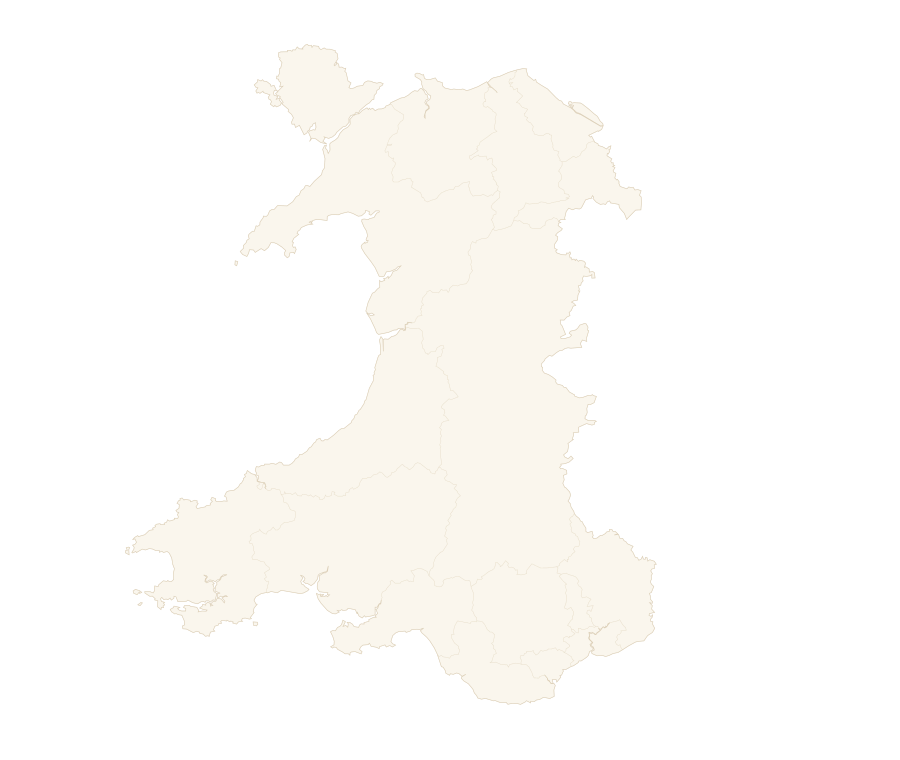
CoreHistoric reach
The seat of Llewellyn
Seat vacantChief
No one leads the Llewellyn community yet. When the movement opens, you can stand for its leadership, or help elect whoever does.
Current mission
No shared goal set yet. Once Llewellyn has leadership, it sets the public focus: a restoration, a gathering, a real-world project that helps its own.
The Llewellyn clan is being rebuilt. Join the waiting list for the movement today, and you help decide who leads it and what it does.
Help rebuild the Llewellyn clan →What does the Llewellyn name mean?
From ap Llywelyn, son of Llywelyn (also rendered Llewelyn or Llewellyn). The personal name Llywelyn was the most prestigious in mediaeval Welsh princely use, borne by Llywelyn the Great (Llywelyn ap Iorwerth, 1173–1240), Prince of Gwynedd and effective ruler of native Wales, and by his grandson Llywelyn ap Gruffydd (1223–1282), 'Llywelyn the Last', the only Welsh prince formally recognised by the English crown as Prince of Wales. The compressed surname Llewellyn carries the princely name forward in the modern surname pool.
The history of Llewellyn
The prince's name, and the law that froze it
Llywelyn was the most prestigious personal name in medieval Welsh princely use. Llywelyn the Great (Llywelyn ap Iorwerth, 1173–1240) ruled Gwynedd and was the effective ruler of native Wales; his grandson Llywelyn ap Gruffydd (1223–1282) was the only Welsh prince the English crown formally recognised as Prince of Wales. He was killed at Cilmeri near Builth Wells on 11 December 1282, ambushed during Edward I's second Welsh war, and the Statute of Rhuddlan of 1284 annexed Gwynedd to the crown. The sovereignty ended with him. The name did not.
What carried it forward was a naming system with no fixed surnames in it. A baptismal name was linked to the father's by ap or ab, son of, so that Evan son of Thomas was Evan ap Thomas. It changed every generation, and could be run backwards through grandfathers as far as the seventh, making a string like Llewelyn ap Dafydd ab Ieuan ap Gruffudd ap Meredydd ordinary: a spoken pedigree of the male line. In 1292, 48 per cent of recorded Welsh names were patronymics.
The system broke in the Tudor century. Under Henry VIII, who ordered that marital births be recorded under the father's surname, hereditary surnames took hold among the Welsh gentry and spread slowly to commoners, and the unification of Wales with England in 1536 pushed English documentary habit into every parish. Some families welded the old particle onto the front of the new name, giving Powell from ap Hywel, Price from ap Rhys, Pugh from ap Hugh. The bearers of ap Llywelyn dropped the ap and left the princely name standing alone.
Morris Llewellyn, an English politician, was active in 1555, the earliest date attached to any recorded bearer of the name. One caution goes with the name from the start: Welsh surnames came from a small pool of baptismal names, so two Llewellyn families, even in one village, cannot be assumed to share an ancestor. The name formed independently wherever a father was called Llywelyn.
A baronetcy out of the Glamorgan coalfield
Industry rearranged the Welsh population. Wales held 587,000 people in 1801 and 2,421,000 by 1911, and most of that growth landed on the coalfield: Glamorganshire alone went from 71,000 in 1801 to 1,122,000 in 1911. Rees Llewellyn (1851–1919) was a Welsh industrialist and public figure, and Sir David Llewellyn, 1st Baronet (1879–1940), a Welsh industrialist and financier, took a hereditary title out of the same country.
The numbering of that baronetcy tracks the name down the century: Sir Rhys Llewellyn, 2nd Baronet (1910–1978), was a mining executive, soldier and author, and Sir David Llewellyn, 4th Baronet (1946–2009), was known as Dai. Roddy Llewellyn (born 1947), landscape gardener, author and baronet, brought the surname into British public life in the 1970s. David Llewellyn (1907–1981) was a Welsh trade unionist and political activist.
The valley that Richard Llewellyn wrote
Richard Llewellyn was born Richard Dafydd Vivian Llewellyn Lloyd on 8 December 1906, into a south Wales family of miners and tin-plate workers from the coal-valley country between Llanelli and Pontypridd. He was schooled in Cardiff and then, on an uncle's scholarship, at a Catholic boarding school in Rome. He served a kitchen apprenticeship at Claridge's, enlisted in the British Army in 1926 and spent five years with the 9th Lancers in India and Hong Kong, then reported for the trade weekly Cinema News. In 1938, at thirty-two, he took a typewriter to a rented cottage on the south coast.
How Green Was My Valley was published in London on 2 October 1939, two weeks after the British declaration of war. Six hundred pages long and narrated in retrospect by the surviving son Huw Morgan, it laid down the template Welsh identity took in twentieth-century popular fiction: the chapel and rugby and coal community before the industrial collapse, the Welsh-speaking family and parish, and the scattering of that community by strike, flood and emigration. It sold fifty thousand copies in its first year and seven million since.
John Ford's adaptation, produced by Darryl Zanuck at Twentieth Century Fox, was released on 28 October 1941 and won Best Picture at the 1942 Academy Awards. Ford took Best Director, Donald Crisp took Best Supporting Actor, and the film took five Oscars in all; it has stayed, for popular audiences, the film image of pre-war south Wales ever since. Llewellyn carried the Morgan family through three further novels, ending with Green, Green My Valley Now (1975), and died in Dublin on 30 November 1983.
A Royal Academy president and a shelf of Llewellyn books
William Llewellyn (1858–1941) was a Welsh painter and President of the Royal Academy. Fewlass Llewellyn (1866–1941) was an English actor, playwright and producer, and Edward Llewellyn (1879–1936) an American trumpeter and composer. The music runs on through Ernest Llewellyn (1915–1982), Australian violinist and conductor, and Grant Llewellyn (born 1960), Welsh conductor.
In writing, Kate Llewellyn (born 1936) is an Australian poet and author whose daughter Caro Llewellyn (born 1965) became a business executive and writer; Sheila Llewellyn (born 1948) is a novelist from Northern Ireland, Sam Llewellyn (born 1948) a British author, and David Llewellyn (born 1978) a Welsh novelist.
Llewellyns in the Welsh game
Welsh rugby has fielded the name for well over a century. Willie Llewellyn (1878–1973) was a Welsh rugby union footballer; Lewis Llewellyn (1881–1931), Tom Llewellyn (1882–1956) and Steve Llewellyn (1924–2002) each played both codes, union and league. The modern game has Phil Llewellyn (born 1947), Glyn Llewellyn (born 1965), Gareth Llewellyn (born 1969) and Max Llewellyn (born 1999), four more bearers of the surname in the modern Welsh union game.
Elsewhere in sport: Carl Llewellyn (born 1965) is a Welsh jockey and racehorse trainer, Harry Llewellyn (1911–1999) was a British equestrian, Trevor Llewellyn (1897–1981) a Welsh boxer, and Chris Llewellyn (born 1979) a Welsh footballer and coach.
The Alabama, the squadrons and the lecture theatres
David Herbert Llewellyn, a doctor, went down with the CSS Alabama in 1864. Evan Henry Llewellyn (1847–1914) was a British army officer and politician; Reginald Llewellyn (1914–2000) became a Royal Air Force flying ace of the Second World War; Stephen Peter Llewellyn (1913–1960) was a New Zealand soldier, historian and writer; and Morgan Llewellyn (1937–2024) served as a British Army officer.
Others built institutions. Llewellyn Jones Llewellyn (1871–1934) was a Welsh physician and writer, and Don Llewellyn (1919–2004), an English chemist, became founding vice-chancellor of the University of Waikato.
Pennsylvania, Patagonia and the sixteen million
Welsh emigration scattered the name. Settlers concentrated in Pennsylvania above all, and in Jackson County, Ohio, sometimes called Little Wales. Others went to Y Wladfa in Patagonia, and to New Brunswick aboard the Albion out of Cardigan in 1819.
Karl Llewellyn (1893–1962) came of one of those transplanted lines, a Pennsylvania-Welsh family, and became the American jurist who drafted the Uniform Commercial Code. The American branches also produced Reese J. Llewellyn (1862–1936), a businessman, and Clem Llewellyn (1895–1969), a baseball player who later practised law and sat as a judge.
The scale is measurable. A study commissioned by the Welsh Government found 718,000 people in Wales, nearly 35 per cent of the population, carrying a family name of Welsh origin, against 5.3 per cent in the rest of the United Kingdom, 4.7 per cent in New Zealand, 4.1 per cent in Australia and 3.8 per cent in the United States: 16.3 million people bearing a Welsh name across the countries studied. Llewellyn is one of them, and unlike Jones or Williams it kept the shape of the man it was made from: a prince.
Champions of the Llewellyn name
The bearers whose lives are inseparable from this surname. Each has their own page, biography, achievements, geography, connection to the family.
Historic Places, Rebuilt
Explore the streets and seats the Llewellyn name knew, rebuilt with AI as they stood in history.
Historic Places, Rebuilt · New
Edward I's walled bastide and mighty castle in North Wales, a generation after the conquest, the banded towers still rising.
Historic Places, Rebuilt · New
Owain Glyndŵr's mountain fortress and court at the high tide of Welsh independence, the English siege lines gathering below.
The castles of the homeland
The great strongholds of the homeland, look one up, see what it looked like in its prime, and recreate it to explore.
 Caernarfon CastleRestored · prime 1330
 Conwy CastleRuin · prime 1287
 Pembroke CastleRestored · prime 1280
All castles in Wales → · Strongest castles in Wales → · Castles of Europe
Play As Your Clan
Hold a real castle against whatever you choose to send at it, take a ship out in her own service years, or stand at the shoulder of someone the record remembers. The chronicler sets the scene; the deeds are yours.
Notable bearers of the Llewellyn name
- Richard Llewellyn (1906–1983), novelist, How Green Was My Valley
- Karl Llewellyn (1893–1962), American jurist, drafter of the Uniform Commercial Code
- Roddy Llewellyn (b. 1947), landscape designer
Frequently asked
What does the surname Llewellyn mean?
Where does the Llewellyn family come from?
Where did the Llewellyn family historically hold territory?
Is Llewellyn Welsh or English?
How old is the Llewellyn surname?
What is the Llewellyn family known for?
Is there a Llewellyn family crest or coat of arms?
Who is the most famous Llewellyn?
Who are some famous Llewellyns?
Is Llewelyn the same family as Llewellyn?
Is Llywelyn the same family as Llewellyn?
Is ap Llywelyn the same family as Llewellyn?
Where is the Llewellyn surname found today?
What does the Clan Rising page for the Llewellyn family cover?
Who is the head of the Llewellyn family today?
Neighbouring clans
- WilliamsSon of William, second only to Jones in Welsh density, and first in the north.
- RobertsStrong in the north, the patronymic of Robert, second to Williams in Caernarfonshire.
- HughesSon of Huw / son of Aodh, Welsh patronymic and Irish Mac Aodha under one spelling.
- OwenThe princely name, Owain in Welsh, the surname of the last revolt and the first Tudor.