Sweeney
also McSweeney, Mac Suibhne
Hebridean gallowglass, household cavalry of Tír Chonaill.
- Origin
- Ulster, Ireland
- Motto
- Buaidh no bas
- Famous bearer
- Eoghan Óg Mac Suibhne na dTuath (fl. c.1600), gallowglass chief at the Battle of Kinsale
- Register
- Irish family
Where the Sweeney name comes from
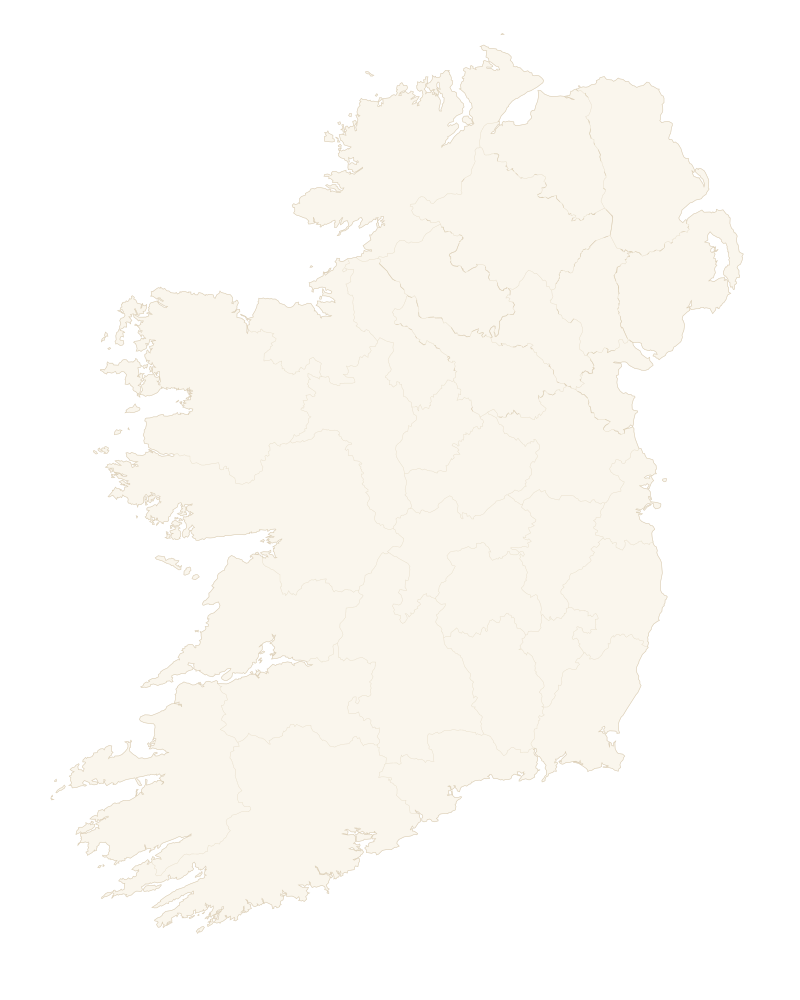
CoreHistoric reach
The seat of Sweeney
Seat vacantChief
No one leads the Sweeney community yet. When the movement opens, you can stand for its leadership, or help elect whoever does.
Current mission
No shared goal set yet. Once Sweeney has leadership, it sets the public focus: a restoration, a gathering, a real-world project that helps its own.
The Sweeney clan is being rebuilt. Join the waiting list for the movement today, and you help decide who leads it and what it does.
Help rebuild the Sweeney clan →Motto
Buaidh no bas
“Victory or death”
What does the Sweeney name mean?
From Mac Suibhne, son of Suibhne ('pleasant'). The Mac Suibhne were a Hebridean Norse-Gael line, descendants of Suibhne, lord of Castle Sween in 13th-century Knapdale (modern Argyll, Scotland), where their stronghold still stands. Driven out of the Hebrides in the late 13th century, the Mac Suibhne re-established themselves in Donegal as gallowglass mercenaries to the O'Donnells of Tír Chonaill from c.1267. Three Donegal branches developed, Mac Suibhne Fanad (north-east Donegal), Mac Suibhne na dTuath ('of the territories', west Donegal), and Mac Suibhne Banagh (south-west Donegal). A separate Mac Suibhne line later settled in Munster as gallowglass to the MacCarthys, giving the Cork-Sweeney pool.
The history of Sweeney
Mac Suibhne, the name Castle Sween carries
Sweeney is the anglicised Mac Suibhne, son of Suibhne, from a Gaelic byname meaning pleasant or well disposed. Suibhne was a lord in 13th-century Knapdale, in what is now Argyll, and the castle that carries his name still stands: Castle Sween, probably the oldest surviving stone-built castle in Scotland. The surname is Scottish in origin and Irish in history, a Hebridean Norse-Gaelic kindred that became one of the great names of Donegal. In the Irish records the qualifiers sit between given name and surname, Mór for the elder and Óg for the younger, which is why the annals fill with an Eoghan Óg and a Niall Mór.
The family's own book, Leabhar Clainne Suibhne, carries the line back to Ánrothán, said to be a prince of the Uí Néill who gave up a kingship, made for Argyll and married a daughter of the king of Scotland. Suibhne was his great-grandson. Whether that descent is real is argued: W. D. H. Sellar has held it may be genuine, while others read it as a pedigree assembled to attach the family to the Milesian kings of Ireland.
The lordship of Knapdale, lost between 1262 and 1310
In the 13th century the MacSweens held lands across central Argyll, as far north as Loch Awe and as far south as Loch Fyne, with seats at Castle Sween in Knapdale, Skipness Castle, and Lochranza Castle on Arran. They kept Knapdale and lands in Kintyre until 1262, when Dugall MacSween granted or surrendered to Walter Stewart, Earl of Menteith, the lands of Skipness, South Knapdale and others in the parish of Kilcalmonell; Alexander III granted Menteith Lochranza in the same year. When Haakon IV of Norway brought an invasion fleet down the western seaboard in 1263, the dispossessed MacSweens under Murchadh MacSween were pressed into his service under guarantee of hostages, and the campaign ended at the Battle of Largs, a Norwegian defeat.
Knapdale was still Menteith's in 1293, and by 1301 it was in the hands of Sir John Menteith. That year John MacSween went to Edward I of England to argue that Menteith had deprived him of his inheritance, and between 1301 and 1310 he served the English to keep the claim alive. In 1310 Edward II granted John and his brothers Toirdelbach and Murdoch their ancestral Knapdale, provided they could take it back from Menteith. The Book of the Dean of Lismore's tryst of a fleet against Castle Sween may record that failed attempt. After it the MacSweens left Scotland for good, and some who stayed formed into the Clan MacQueen.
Gall-óglaigh: two warriors for every quarter of land
The gallowglass, gall-óglaigh or foreign warriors, were the heavy infantry that changed Irish warfare from the 13th century onward, replacing the lighter-armed native kerns with Hebridean professionals in chain mail carrying the great two-handed sparth axe. The Mac Suibhne became the foremost gallowglass line of north-west Ireland, contracted to the Ua Domnaill dynasty of Tír Chonaill from about 1267. The earliest record of a Mac Suibhne connected with the clan belongs to that year: Murchadh Mac Suibne, son of Máel Muire an Sparáin of Castle Sween, taken by Domnall Ó Conchobair and handed to the Earl of Ulster, in whose prison he is said to have died.
What made the arrangement unusual was that it was hereditary and written into the land. Toirdhealbhach Caoch of Fanad pledged to Ó Domhnaill that he and his successors after him would furnish two gallowglass soldiers for every quarter of land in his territory whenever the Ó Domhnaills went to war. Each of the three Donegal branches held a defined territory and owed defined numbers of fighting men along with rents in produce. The obligation held until the Plantation of Ulster after 1607.
In Scotland the chiefs were inaugurated at Iona and buried there; in Ireland they were inaugurated at Kilmacrenan, and the remains of the Sweeneys who crossed lie outside the walls of Castle Doe. James Logan, in The Scottish Gaël, singled the Mac Swineys out for hospitality: at their seat of Clodach Castle a stone by the highway carried an open invitation to any traveller to turn in for refreshment. Logan also recorded their war cry, Battalia-abu, the noble staff victorious, from the battle-axe they bore in their arms.
Murchad Mear at Lough Swilly and the making of Fanad
Fánad is the peninsula between Lough Swilly and Mulroy Bay, and it was the first territory the family made its own. The record does not agree on when: one account holds the Mac Suibhne did not settle permanently in Ireland before the beginning of the 14th century, while the branch history makes Eoin, grandson of Máel Muire, the first in Tír Conaill, expelling the ruling Ó Breisléins after 1263 and marrying his daughter to the Ó Domnaill, king of Tír Conaill. Eoin's line failed quickly: his son Suibne and his brother Toirdelbach both died without heirs.
Following the Battle of Bannockburn in 1314, Murchad Mear, great-grandson of Máel Muire an Sparáin and grandson of the Murchadh taken by the Earl of Ulster, arrived at Lough Swilly with his followers. He and his son Murchad Óc, who held the lands east of Bearnas Mór after him, conquered large tracts of Tír Conaill. The branches came out of the next generation: one of Murchad Óc's sons, Máel Muire, became lord of Fanad, while another, Donnchad Mór, became lord of the Trí Tuatha in the north-west, taken from the Ó Báegills.
Máel Muire defeated Niall Ó Domhnaill at the battle of Achadh Móna and later came round to his side, after Niall killed his own brother Conchobhar Ó Domhnaill, king of Tír Chonaill, in 1342. For that aid Máel Muire was granted the lands of Moross in the north of Fanad. His son was the Toirdhealbhach Caoch of the two-gallowglass pledge. Rathmullan was the seat of Mac Suibhne Fánad for four hundred years, and from it the branch's influence reached out of Donegal into Connacht and Munster.
Rathmullan, a wrestling match and the Carmelite priory
Toirdhealbhach Ruadh succeeded in 1399, but only after seeing off two uncles who tried to take the lordship, with help from Toirdhealbhach an Fhíona Ó Domhnaill. He rode with Niall Ó Domhnaill and Domhnall Ó Néill when they defeated the English Lord Deputy at Meath in 1423, though other sources put Mac Suibhne of Connacht at that battle instead. In 1434 Niall Ó Domhnaill was taken by English forces in a skirmish and Toirdhealbhach Ruadh got him out. He died in about 1438, having ruled thirty-nine years.
His son Ruaidhrí inherited a claim disputed by his uncle Donnchadh Garbh, and the two settled it by wrestling for it, a contest Ruaidhrí won. He ruled thirteen years and was followed by his brother Domhnall. In 1456 Énrí Ó Néill, king of Tír Eoghain, invaded Inishowen, and Maol Mhuire Mac Suibhne, son of Toirdhealbhach Ruadh, fought for Ó Domhnaill and was taken prisoner. Released in 1460, he and Aodh Ruadh Ó Domhnaill won a victory near Mulroy Bay the next year, and on the strength of it Aodh Ruadh made him lord of Fanad. He held it eleven years and was killed on Easter Tuesday, 1472, fighting alongside Aodh Ruadh against Énrí Ó Néill; his body was carried to Derry for burial covered in the flag of Mac Domhnaill of Antrim, a gallowglass captain taken in the same battle.
His son Ruaidhrí built Rathmullan castle. Ruaidhrí's wife Máire, a daughter of Ó Máille, was known for her piety, and together they founded the Carmelite priory at Rathmullan, completed in 1516. When he died in 1518 the succession was contested: his cousin Domhnall Óg was proclaimed lord at Kilmacrenan by the chiefs of Cenél Conaill, while Ruaidhrí's son Toirdhealbhach refused him and, after Domhnall Óg's death in 1529, had himself inaugurated there in turn, which angered Aodh Dubh Ó Domhnaill, who held that inaugurating a sub-chief was his alone to do. Leabhar Clainne Suibhne was written in this era.
Doe and Banagh, the two western lordships
Na Trí Tuatha lay west of Fanad in what are now the parishes of Gweedore and Tory Island, and was held by the Ó Báegill until just after 1360, when Clann tSuibhne took it. Donnchadh Mór, son of Murchad Óc, was the first Mac Suibhne na dTuath. His son Eoghan Connachtach, held captive in 1359 by the son of Ó Conchobhair Shligigh, afterwards helped Séan Ó Domhnaill to a victory at Sliabh Malair, and the Book of Ballymote names Eoghan's son Toirdealbhach Óg as lord of Na Tuatha; then the branch goes quiet in the record until the mid-16th century.
Eoghan Óg of Doe was killed fighting at Ceann Salach in Cloghaneely in 1554, and his son Murchadh Mall helped Sir Aodh Ó Domhnaill defeat Séan an Díomuis Ó Néill near Letterkenny in 1567. Murchadh Mall fell in 1570 at Dún na Long near Strabane. His brother Eoghan Óg steered the branch through the crisis years: in 1588 the English were alarmed that he was aiding Spaniards stranded from the Armada, in 1590 he sheltered Brian Ó Ruairc of Breifne after his defeat by the English, and in 1592 he attended the inauguration of Aodh Ruadh Ó Domhnaill as lord of Tír Conaill. He died in 1596.
The third branch took Tír Boghaine, the modern barony of Banagh in south-west Donegal. Leabhar Clainne Suibhne makes them descend from Dubhghall Mac Suibhne, who had the lands from his grandfather Murchadh Mear, dead in about 1320. The sources part company after that: the Book of Ballymote places six of Dubhghall's grandsons among the Mac Suibhne of Connacht instead, and names the eldest, Toirdhealbhach, as High Constable of Connacht, killed with two brothers in 1397. By the 16th century the branch was seated at Rahan Castle near Dunkineely, where Niall Mór mac Eoghain, remembered as a constable of hardest hand, died in 1524. Banagh also held Killybegs, Na Cealla Beaga, the small churches.
In 1513 Eoghan Ó Máille and the crews of three ships plundered Killybegs and took prisoners, then found the weather too rough to carry them home to Connacht. The fighting men of Banagh were away in Ó Domhnaill's army, so a youth called Brian Mac Suibhne gathered up shepherds and farmers, rescued the prisoners and killed Ó Máille. Another landing was driven off at Rathlin O'Beirne in 1547. For a kindred that made its living supplying soldiers to other men's wars, these are the occasions the record shows defending their own coast.
Kinsale, Rathmullan, and a good bawne of lime and stone
Domhnall of Fanad, the last chief inaugurated lord there, lived into the 17th century and saw the Gaelic order in Tír Conaill end. He raided into Thomond in 1599. In March 1601 an English garrison was put into Rathmullan and Domhnall submitted; in September he rose against the English; by January 1602 he had submitted again. Maol Mhuire of Doe, the last lord of Na Tuatha, took the English side against Aodh Ruadh Ó Domhnaill in early 1598 and was banished from his lands, was knighted in May 1600 for that support, changed back to Ó Domhnaill later the same year, and was captured and held aboard a ship on the Foyle near Derry until he got himself off it.
The sources disagree about which chief of the western branch stood at Kinsale. The clan chronicle has Eoghan Óg Mac Suibhne na dTuath dying in 1596 and Maol Mhuire succeeding him; the family record holds that Eoghan Óg served Hugh O'Donnell at the Battle of Kinsale in 1601 and lost the family lands in the settlement that followed. Both accounts are in circulation and neither has been reconciled with the other.
In 1607 the earls sailed from Rathmullan, the Fanad seat; when some of the crew came ashore for water, Domhnall's son attacked them and was driven off. In 1608 Domhnall sat on the jury that indicted the earls of Tyrconnell and Tyrone for treason, and so did Donnchadh, lord of Banagh; both were granted land in the Plantation of Ulster. By 1619 Domhnall held 2,000 acres called Roindoberg and Caroocomony, on which he built a good bawne, and a house, all of lime and stone, in which with his family, he dwelleth. Donnchadh was allotted 2,000 acres in the barony of Kilmacrenan.
The families held that ground into the next generation. Domhnall's son Domhnall Gorm married a daughter of Eoghan Óg Mac Suibhne na dTuath, had ten children and died in 1637; his sons Domhnall Óg and Aodh Buidhe held lands at Clondavaddog in north Fanad, and Colonel Maol Mhuire Mac Suibhne, grandson of the last lord of Doe, held Dunlewy in Gweedore. Those holdings were forfeit after the rising of 1641, which closed the account of the Mac Suibhne as landholding lords, though the name stayed rooted where the branches had put it.
Sweeney and McSweeney after the lordships
The spelling settled as the lordships were dismantled: Mac Suibhne yielded both Sweeney and McSweeney. Donegal is not the only pool: a separate Mac Suibhne line settled in Munster as gallowglass to the MacCarthys, and that is where the Cork Sweeneys come from.
The chiefly lines thinned. Historians reckon the line of Fanad had gone before 1800, and folk tradition in south Donegal holds that the last two male descendants of the Banagh line died at Teelin near the end of the 19th century. Doe, thought to descend from Fanad, is the line still argued over: in 1999 Thomas A. Sweeney petitioned the Office of the Chief Herald of Ireland to be recognised as Chief of the Name of the Mac Sweeneys of Doe, claiming senior male descent from Maol Mhuire, Sir Myles Mac Sweeney, Chief of Doe, 1596–1630. In July 2003 the Genealogical Office stopped recognising chiefs, and the petition was left pending.
The Donegal Sweeneys stayed densely planted in the territory their ancestors were contracted to defend, and the emigrant weight of the name fell on the north-east of America, Pennsylvania and Boston above all. John J. Sweeney (1934–2021) led American organised labour as president of the AFL-CIO from 1995 to 2009, the first Catholic of openly Irish descent to head the federation. The name runs through Irish arts and public life too: the poet Matthew Sweeney (1951–2018), the composer Eric Sweeney (1948–2020), and the postmistress Maureen Flavin Sweeney (1923–2023).
The bearer who has carried the name furthest into public view is the journalist John Sweeney, born at Tonbridge in west Kent, eldest of five children of an Irish-immigrant railway clerk and an English bookkeeper. He spent thirteen years at The Observer from 1986, covering the siege of Sarajevo, then twenty-one years as lead investigative reporter on BBC Panorama from 2001, and moved to Kyiv six weeks after the February 2022 invasion. A gallowglass patronymic out of Argyll and Donegal, carried into a war zone again.
Champions of the Sweeney name
The bearers whose lives are inseparable from this surname. Each has their own page, biography, achievements, geography, connection to the family.
Historic Places, Rebuilt
Explore the streets and seats the Sweeney name knew, rebuilt with AI as they stood in history.
The castles of the homeland
The great strongholds of the homeland, look one up, see what it looked like in its prime, and recreate it to explore.
 Ashford Castle, County MayoRestored · prime 1880
 Manderley CastleRestored · prime 1840
 Dublin CastleRestored · prime 1790
All castles in Ireland → · Strongest castles in Ireland → · Castles of Europe
Play As Your Clan
Hold a real castle against whatever you choose to send at it, take a ship out in her own service years, or stand at the shoulder of someone the record remembers. The chronicler sets the scene; the deeds are yours.
Notable bearers of the Sweeney name
- Eoghan Óg Mac Suibhne na dTuath (fl. c.1600), gallowglass chief at the Battle of Kinsale
- John J. Sweeney (1934–2021), president of the AFL-CIO 1995–2009
- John Sweeney (b. 1957), BBC investigative journalist (Panorama, Newsnight)